Produk (44.000+)

STM32G081RBT6 - 128KB Flash ARM Cortex-M0+ MCU | STMicroelectronics
STM32G081RBT6

STM32G081RBT6 - 128KB Flash ARM Cortex-M0+ MCU | STMicroelectronics

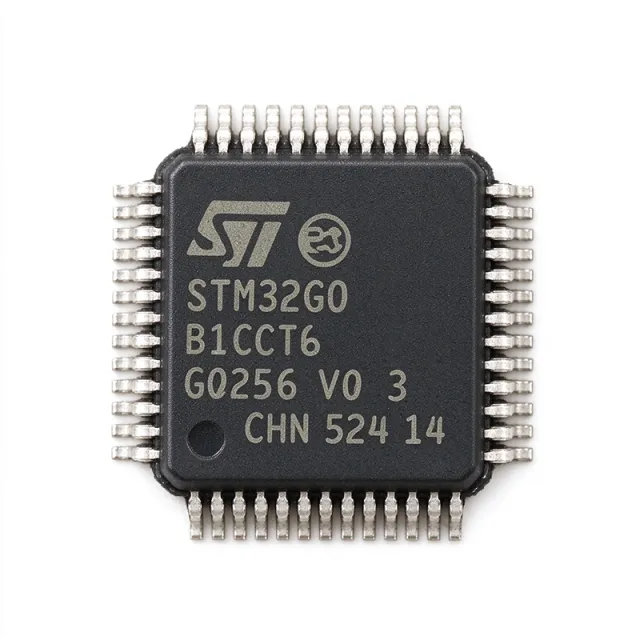
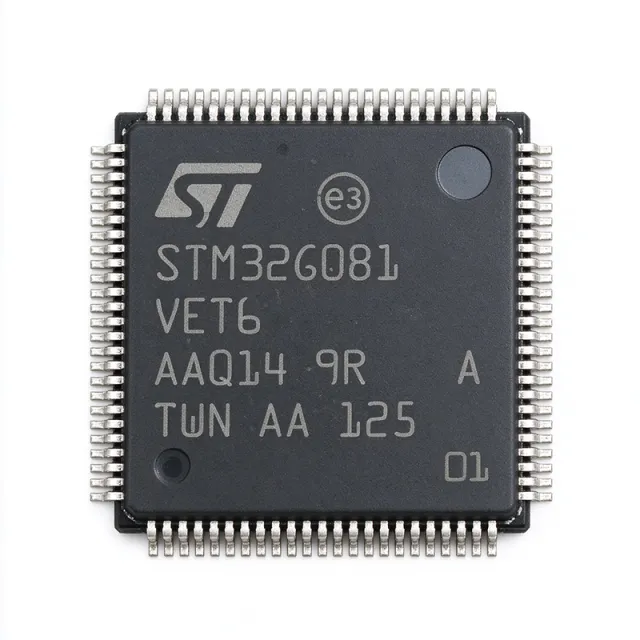
The STM32G081RBT6 is a 32-bit ARM Cortex-M0+ microcontroller from STMicroelectronics, featuring 128KB of Flash memory and 36KB of SRAM in a 64-pin LQFP package. It operates at a maximum frequency of 64 MHz and supports a supply voltage range of 1.7V to 3.6V, making it suitable for a wide range of embedded applications. What is a microcontroller? A microcontroller (MCU) is a compact integrated circuit designed to govern a specific operation in an embedded system. It contains a processor core, memory (Flash and SRAM), and programmable input/output peripherals on a single chip. Microcontrollers are the brains of countless electronic devices, from automotive engine control units to IoT sensors and consumer electronics. They are a subset of embedded processors, which fall under the broader category of semiconductor integrated circuits. Key features of the STM32G081RBT6 include a 12-bit ADC with up to 19 channels, two 12-bit DACs, multiple timers including advanced 16-bit and 32-bit timers, and a variety of communication interfaces such as I2C, SPI, USART, and USB 2.0 Full-Speed device. It also integrates a CRC calculation unit, a true random number generator (RNG), and a unique device ID for security applications. The device is designed for low-power operation with multiple low-power modes including Sleep, Stop, and Standby. The STM32G081RBT6 is built on ST's advanced 90nm process technology, offering a balance of performance and power efficiency. The Cortex-M0+ core is optimized for low-power applications while providing sufficient computational power for real-time control tasks. The device includes a nested vectored interrupt controller (NVIC) for efficient interrupt handling and a memory protection unit (MPU) for enhanced system reliability. Typical applications include industrial control systems, motor control, consumer electronics, IoT devices, and battery-powered equipment. Its rich peripheral set and low-power capabilities make it ideal for smart sensors, portable medical devices, and home automation nodes. The USB interface enables direct connectivity to PCs and mobile devices for data logging and firmware updates. When designing with this MCU, pay attention to the power supply decoupling: place a 100nF capacitor close to each VDD pin and a 4.7uF bulk capacitor on the main supply. For low-power applications, utilize the Stop mode with RTC wakeup to minimize current consumption. The STM32G081RBT6 is available in a 64-pin LQFP package, which is suitable for PCB designs requiring moderate pin count and easy soldering.

Permintaan RFG Kontak
STM32G0B0RET6 - 64MHz Cortex-M0+ MCU | STMicroelectronics
STM32G0B0RET6

STM32G0B0RET6 - 64MHz Cortex-M0+ MCU | STMicroelectronics

The STMicroelectronics STM32G0B0RET6 is a 32-bit Arm Cortex-M0+ microcontroller operating at up to 64 MHz, with 512 KB of flash memory and a 64-pin LQFP package measuring 10 mm by 10 mm. The device is designed for cost-sensitive embedded applications requiring mainstream performance, substantial program storage, and a broad selection of peripheral interfaces. A microcontroller is a programmable semiconductor that integrates a processor core, memory, and peripherals into one compact device. The STM32G0 belongs to the STM32G0 mainstream value-line family, positioning it between simple 8-bit controllers and more specialized high-performance embedded processors. Its Arm Cortex-M0+ architecture supports efficient control workloads while retaining broad ecosystem support for development tools, firmware libraries, and embedded communication peripherals. Key characteristics include a maximum operating frequency of 64 MHz, 512 KB of flash, and up to 144 KB of RAM. The controller is identified with the 64-LQFP surface-mount package, giving the design 64 externally accessible pins compared with smaller leaded or compact packages. Its 10 mm by 10 mm body size balances routing flexibility and thermal performance with the higher assembly cost and footprint of a large leaded package. The STM32G0B0RET6 combines a general-purpose RISC core with embedded-control peripherals suited to sensor acquisition, digital interfaces, timing, communications, and system supervision. Its 512 KB flash capacity provides room for application code, configuration data, and firmware updates, while the available RAM supports more demanding buffering than entry-level microcontrollers. Exact peripheral assignments, voltage limits, and electrical characteristics should be confirmed against the manufacturer pinout and datasheet for the selected board revision. Typical uses include industrial control modules, building automation equipment, appliance controllers, compact motor-control systems, communications hubs, and low-cost IoT gateways. The larger 64-pin package is especially useful when a design requires more exposed GPIO than smaller STM32G0 variants provide. It also offers sufficient peripheral connectivity for designs combining digital control with external sensors, displays, communication transceivers, or power-conversion stages. PCB planning should begin with the exact 64-pin pad geometry and alternate-function assignments. Confirm every power, ground, reset, clock, programming, and communication connection before layout because peripheral mapping is pin-specific. Provide stable decoupling near the supply pins, route sensitive clock and communication paths away from fast-switching nodes, and confirm the recommended external-component configuration in the manufacturer documentation. This page combines the core manufacturer and distributor characteristics with pinout, application, selection, and engineering guidance. It is intended to help designers confirm package fit, memory capacity, processing headroom, and interface suitability before committing the STM32G0B0RET6 to a new embedded-control design.

Permintaan RFG Kontak
STM32G0B1CCU6 - 64MHz 256KB Cortex-M0+ MCU | STMicroelectronics
STM32G0B1CCU6

STM32G0B1CCU6 - 64MHz 256KB Cortex-M0+ MCU | STMicroelectronics

STMicroelectronics STM32G0B1CCU6 is an Arm Cortex-M0+ 32-bit microcontroller operating up to 64 MHz, with 256 KB of Flash memory and a 48-pin UFQFPN package measuring 7 x 7 mm. The device belongs to the STM32G0 mainstream microcontroller family and targets compact embedded, industrial-control, IoT, metering, and low-power board designs. According to the verified distributor data, it combines a 32-bit Arm Cortex-M0+ core with 256 KB of Flash memory in a 48-UFQFPN package. A microcontroller is a semiconductor device that integrates a processor core, memory, and peripherals into one compact component. The STM32G0 MCU hierarchy places this device within the STM32G0 mainstream series, where Cortex-M0+ processing is intended for embedded control rather than a host workstation. Its compact package helps reduce board area while supporting integration of digital control, communication, timing, analog-adjacent, and general-purpose I/O functions. The verified product information identifies the Cortex-M0+ core as operating at up to 64 MHz and provides 256 KB of programmable Flash memory. The family description also identifies the STM32G0B1xB/xC/xE parts as mainstream microcontrollers built around a high-performance Arm Cortex-M0+ 32-bit RISC core. The Mouser listing additionally identifies the family as supporting up to 512 KB Flash and 144 KB RAM, but those family-level values should not be substituted for the target device's verified 256 KB Flash specification. The STM32G0B1CCU6 is suitable for low-power embedded control, connected equipment, industrial devices, and board-level monitoring. Its 64 MHz operating capability provides a clear performance point for control-loop and peripheral-oriented designs. The exact operating voltage, GPIO count, peripheral configuration, memory protection details, and temperature grade require confirmation from the official STM32G0B1CC product documentation because they were not supplied in the verified snippets. Design work should preserve the UFQFPN footprint, exposed-pad thermal requirements, and manufacturer-recommended decoupling network. Firmware replacement should also validate peripheral mappings, clock configuration, memory initialization, and application-specific interrupt assignments. A similarly named STM32G0B1 device is not automatically interchangeable without checking its exact package, pinout, temperature grade, memory configuration, and peripheral population. This page consolidates the verified manufacturer and distributor findings, cross-reference candidates, and engineering selection guidance for engineers evaluating STM32G0B1CCU6 in embedded designs. For current pricing and availability, confirm the quantity-specific distributor offer as of 2026-10-22 rather than relying on an unverified historical price.

Permintaan RFG Kontak
STM32G0B1CEU6 - 64MHz Cortex-M0+ MCU, 512KB Flash | ST
STM32G0B1CEU6

STM32G0B1CEU6 - 64MHz Cortex-M0+ MCU, 512KB Flash | ST

STMicroelectronics STM32G0B1CEU6 is a 32-bit Arm Cortex-M0+ microcontroller with a 64 MHz maximum operating frequency, 512 KB of flash memory, and up to 144 KB of RAM in a 48-pin UFQFPN package measuring 7 mm by 7 mm. It also supports a 1.8 V, 2.5 V, or 3.3 V supply and provides six USART peripherals for connected embedded systems. A microcontroller is a programmable system-on-chip that integrates a processor core, nonvolatile program memory, volatile data memory, and peripherals such as serial interfaces, timers, and analog conversion blocks. The STM32G0B1CE is part of STMicroelectronics' mainstream STM32G0 family, positioned between simple microcontroller designs and more feature-dense embedded platforms. Its Arm Cortex-M0+ architecture supports efficient event-driven control while retaining a broad ecosystem of development tools and software libraries. The principal specifications include an Arm Cortex-M0+ 32-bit RISC core operating at up to 64 MHz, 512 KB of flash with protection and a securable area, two flash banks, and read-while-write support. Up to 144 KB of RAM supports working data and protocol buffers. Six USART interfaces enable simultaneous serial connectivity, while the 1.8 V to 3.3 V operating range supports low-voltage industrial, consumer, and communication equipment. The STM32G0B1xB, STM32G0B1xC, and STM32G0B1xE devices share the same mainstream Arm Cortex-M0+ platform. This makes the STM32G0B1CEU6 appropriate for applications requiring more memory and serial channels than entry-level devices without moving to a larger MCU architecture. The secure flash organization and dual-bank capability can support controlled firmware updates and protected code areas, subject to the detailed configuration procedures in the manufacturer documentation. Typical uses include industrial control panels, connected building equipment, data loggers, serial gateways, access-control terminals, and compact consumer appliances. Six USART channels can bridge multiple sensors, radio modules, display controllers, or service interfaces, while the 512 KB flash capacity accommodates networking stacks, protocol handlers, and application firmware. The industrial temperature option extends the operating range to -40°C to 85°C according to the LCSC listing. PCB design should preserve access to the exposed pad and provide low-impedance supply and ground connections. Decoupling capacitors should be placed directly beside the relevant power pins, while serial interfaces require deliberate signal-routing and grounding practices. Firmware should also be validated against the exact STM32G0B1CE device revision because peripheral behavior, errata, and low-power settings are controlled by the manufacturer documentation. This product page combines verified distributor pricing, availability, package information, interface counts, and manufacturer series information with practical application and design guidance. It distinguishes confirmed STM32G0B1CEU6 facts from parameters that still require verification from the complete device datasheet.

Permintaan RFG Kontak
STM32G0B1KCT6 - 64MHz Cortex-M0+ MCU | STMicroelectronics
STM32G0B1KCT6

STM32G0B1KCT6 - 64MHz Cortex-M0+ MCU | STMicroelectronics

The STMicroelectronics STM32G0B1KCT6 is a 32-bit Arm Cortex-M0+ microcontroller operating at up to 64 MHz, with 256 KB of Flash memory, 144 KB of RAM, and a 32-LQFP 7 x 7 mm package. It operates from 1.7 V to 3.6 V and integrates six USART peripherals, timers, ADC, DAC, and communication interfaces. A microcontroller is a programmable semiconductor that combines a CPU core, memory, and peripherals in one device. The STM32G0 belongs to the STM32G0 mainstream microcontroller family, where the Arm Cortex-M0+ RISC core provides compact, energy-efficient control for embedded products. Its combination of serial interfaces, analog converters, and general-purpose timers supports industrial controllers, communication equipment, access controls, and compact consumer devices. The 256 KB Flash configuration provides room for application firmware, while 144 KB of RAM supports protocol buffers, data acquisition, and real-time control state. The six-USART configuration is especially useful for multi-port gateways, serial concentrators, programmable controllers, and equipment that must connect several external devices. The integrated ADC and DAC enable measurement and signal-generation functions without requiring separate analog devices. The STM32G0 architecture targets efficient embedded control with a maximum core frequency of 64 MHz and a 1.7 V to 3.6 V supply range. The operating-temperature families associated with the STM32G0B1 xB, xC, and xE devices span options identified by STMicroelectronics as extending from -40 °C to 85 °C, 105 °C, or 125 °C. The exact temperature grade for this orderable part must be confirmed from its ordering information before deployment. Typical uses include serial-to-Ethernet gateways, motor and valve controllers, access-control readers, programmable logic controllers, building automation controllers, and low-cost sensor-hub designs. Engineers can use the USARTs for downstream and upstream links, the ADC for analog monitoring, the DAC for controlled outputs, and timers for periodic or capture-based operations. PCB design should preserve a short return path for every supply pin and place decoupling capacitors close to the device. Confirm pin assignments, alternate functions, and debug connections against the STM32G0B1KC product documentation before routing a new board. This page combines the verified product characteristics, sourcing guidance, interface use cases, and design checks needed for initial component selection.

Permintaan RFG Kontak
STM32G0B1KET6 - 64MHz Cortex-M0+ 512KB MCU | STMicroelectronics
STM32G0B1KET6

STM32G0B1KET6 - 64MHz Cortex-M0+ 512KB MCU | STMicroelectronics

STMicroelectronics STM32G0B1KET6 is a 32-bit Arm Cortex-M0+ microcontroller operating at up to 64 MHz, with 512 KB of Flash memory, 144 KB of RAM, and six USART peripherals in a 32-LQFP 7 x 7 mm package. The STM32G0B1 series is designed for compact, cost-sensitive embedded systems that require broad communication options, efficient processing, and a conventional microcontroller feature set. An Arm Cortex-M0+ microcontroller is a compact 32-bit RISC processor used in embedded control products. The STM32G0 family combines the Cortex-M0+ core with timers, serial interfaces, analog peripherals, GPIO, memory, and security features on one integrated circuit. This places the STM32G0B1KET6 within the hierarchy of microcontroller, embedded processor, RISC processor, and semiconductor, allowing one device to manage sensing, communications, actuation, and system control. The most prominent specifications are a 64 MHz maximum operating frequency, 512 KB of embedded Flash, and 144 KB of SRAM. According to the manufacturer product-page information, the STM32G0B1xB family uses a high-performance Cortex-M0+ 32-bit RISC core. Flash protection, a securable area, two memory banks, and read-while-write support are identified for this memory configuration. Six USART peripherals support serial links to sensors, human-interface equipment, module radios, and external controllers. The STM32G0B1KET6 supports a 1.8 V, 2.5 V, or 3.3 V supply as identified for the exact ordering code. Its operating-temperature options extend down to -40°C and can reach 85°C, 105°C, or 125°C across the STM32G0B1xB/xC/xE family. The 32-LQFP package provides 32 accessible leads and a 7 x 7 mm body, making it suitable for automated assembly and medium-density embedded control boards. Typical applications include compact industrial controllers, building and access modules, motor-control auxiliaries, connected sensors, communication equipment, and consumer peripherals. Six USARTs are particularly useful when a design needs multiple isolated serial links without adding a separate interface expander. A 512 KB Flash capacity also allows firmware, boot logic, communication tables, and application data to coexist within one MCU. When designing the PCB, place decoupling capacitors beside the supply and ground pins and route sensitive analog and communication lines away from fast-switching nodes. Confirm the exact peripheral mapping, pin multiplexing, clock-tree settings, and boot configuration against the manufacturer datasheet before releasing a board. Software compatibility should also be checked because alternative Cortex-M0+ devices may use different peripheral registers or interrupt arrangements. This product page consolidates the exact ordering-code characteristics, family-level engineering details, package information, and purchasing workflow. It also distinguishes genuine package-compatible alternatives from devices that merely share the STM32G0 name, helping engineers make a defensible sourcing decision without assuming that every similarly described MCU is a drop-in replacement.

Permintaan RFG Kontak
STM32G0B1KEU6 - 64MHz Cortex-M0+ 512KB Flash MCU | STMicroelectronics
STM32G0B1KEU6

STM32G0B1KEU6 - 64MHz Cortex-M0+ 512KB Flash MCU | STMicroelectronics

The STMicroelectronics STM32G0B1KEU6 is a 32-bit Arm Cortex-M0+ microcontroller with a maximum operating frequency of 64 MHz, 512 KB of embedded flash memory, and a 32-pin UFQFPN package measuring 5 mm by 5 mm. It belongs to the STM32G0 mainstream microcontroller family for compact control systems requiring efficient processing, integrated memory, and a small surface-mount footprint. A microcontroller is a programmable semiconductor device that combines a processor core, memory, and peripherals into one integrated circuit. The STM32G0 family hierarchy runs from the Cortex-M0+ core to 32-bit RISC microcontrollers, embedded controllers, and semiconductor devices for embedded systems. This device is intended for designs that need more general-purpose control capability than a basic fixed-function logic component while retaining a compact package. The STM32G0B1KEU6 provides 512 KB of flash for firmware and 144 KB of RAM according to the product listing. Its Arm Cortex-M0+ core operates up to 64 MHz. The device is identified in the 32-pin UFQFPN package, and the U6 ordering code denotes tray packaging. The operating voltage range shown for this ordered device is 1.8 V, 2.5 V, and 3.3 V, supporting common embedded supply rails. Its architecture combines a 32-bit RISC processor with multiple embedded peripherals for communication, timing, control, and data acquisition. A 64 MHz operating point provides useful responsiveness for protocol handling, digital control, and human-interface tasks without requiring a higher-complexity processor. Dual-bank flash with protection and a securable area, together with read-while-write support, is identified for this MCU family and can support controlled firmware-update and data-retention workflows. Typical uses include compact industrial controllers, sensor-hub and IoT equipment, building-access terminals, appliance control boards, and USB-connected embedded accessories. The small 5 mm by 5 mm UFQFPN package is particularly useful when board area is constrained, although its fine-pitch footprint requires careful PCB design, thermal planning, and assembly-process control. When laying out a board, follow the exact pin table and exposed-pad requirements in the manufacturer datasheet. Place input, output, decoupling, and programming-access components in accordance with the reference layout, and reserve the exposed thermal pad for the required copper and solder pattern. Confirm startup, clock, reset, and communication settings in firmware rather than assuming behavior from another STM32 family. This product page combines the exact orderable-part information, manufacturer documentation, package details, practical design guidance, and an explicit drop-in-replacement assessment for engineers comparing STM32G0B1KEU6 sourcing and redesign options.

Permintaan RFG Kontak
STM32G0B1RET6 - 64MHz Cortex-M0+ 512KB MCU | STMicroelectronics
STM32G0B1RET6

STM32G0B1RET6 - 64MHz Cortex-M0+ 512KB MCU | STMicroelectronics

STMicroelectronics STM32G0B1RET6 is an Arm Cortex-M0+ 32-bit RISC microcontroller operating at up to 64 MHz, with 512 KB of Flash memory, 144 KB of RAM, and a 64-pin LQFP 10 x 10 mm package. The device belongs to the STM32G0 mainstream microcontroller family and combines a compact general-purpose MCU with six USART interfaces and embedded security features. A microcontroller is a programmable system-on-chip that integrates a CPU, memory, peripherals, and communication interfaces on one integrated circuit. Within the semiconductor hierarchy, an MCU is a semiconductor, embedded controller, and general-purpose processing device. The STM32G0 family targets cost-sensitive embedded applications while retaining an Arm ecosystem, efficient real-time execution, and extensive peripheral integration. The STM32G0B1RET6 provides up to 512 KB of Flash memory with protection, securable areas, two banks, and read-while-write support. It also includes 144 KB of RAM and six USART peripherals. Its Arm Cortex-M0+ core operates at up to 64 MHz, providing useful processing capacity for control loops, human-interface systems, communications, and connected industrial equipment. The 64-pin LQFP package also exposes substantially more I/O than smaller MCU packages. The two-bank Flash organization supports controlled programming and protection workflows, while the securable area provides a hardware-defined region for isolating sensitive code or data. These capabilities are relevant to firmware security, access-control products, metering equipment, and systems requiring more disciplined code isolation. Exact details such as supply voltage, peripheral current, ADC performance, and package thermal limits are not included in the supplied records and must be confirmed in the manufacturer datasheet. Typical uses include industrial automation modules, building and access-control terminals, serial gateways, sensor-hub controllers, battery-powered instruments, and human-machine interfaces. The combination of 64 MHz processing, 512 KB Flash, 144 KB RAM, and six USART channels is particularly useful when a design must manage multiple serial endpoints while retaining enough memory for protocol stacks, local data buffering, and application firmware. Engineers should treat software migration, peripheral mapping, clock configuration, and bootloader compatibility as part of replacement planning. A component having the same package does not by itself prove that firmware is interchangeable. Before substitution, verify the exact pin assignment, power domains, peripheral configuration, pin multiplexing, boot behavior, and errata applicable to the production revision. This page consolidates the supplied manufacturer and distributor records, verified memory and interface specifications, package information, and a structured comparison of same-family alternatives. It also adds engineering guidance for memory planning, mixed-signal design, and production sourcing while clearly identifying details that still require datasheet confirmation.

USD $6,23 Diketersediaan
STM32G0B1VET6 - 64MHz Cortex-M0+ 512KB MCU | STMicroelectronics
STM32G0B1VET6

STM32G0B1VET6 - 64MHz Cortex-M0+ 512KB MCU | STMicroelectronics

The STMicroelectronics STM32G0B1VET6 is a 32-bit Arm Cortex-M0+ microcontroller operating up to 64 MHz, with 512 KB of Flash memory, 144 KB of SRAM, and a 100-pin LQFP package measuring 14 mm by 14 mm. The device supports 1.8 V, 2.5 V, and 3.3 V operating configurations, making it suitable for low-power embedded control systems that require broad peripheral integration in a conventional leaded package. A microcontroller is a programmable semiconductor that integrates a processor core, nonvolatile program memory, volatile data memory, and peripherals such as timers, serial interfaces, and analog inputs on one die. The Arm Cortex-M0+ architecture is a compact 32-bit RISC design commonly used in cost-sensitive embedded products. The STM32G0B1 family therefore sits within the hierarchy of embedded MCU, RISC processor, microcontroller, and semiconductor, where firmware controls sensors, communications, actuators, and user-interface functions. The STM32G0B1VET6 combines a 64 MHz processing core with 512 KB of protected, securable Flash organized in two banks. Read-while-write support allows program-memory access to continue during supported write operations, which can improve firmware-update flexibility. Its 144 KB of SRAM provides working memory for protocol stacks, control loops, diagnostics, and user application code without requiring an external memory device in many designs. The 100-pin LQFP package gives the device a large complement of external connections compared with smaller MCU packages. The available 1.8 V, 2.5 V, and 3.3 V supply configurations support designs operating across common embedded voltage rails. The manufacturer product page identifies the STM32G0B1xB, xC, and xE devices as mainstream Cortex-M0+ microcontrollers, while the distributor listing identifies this exact orderable part as the 512 KB Flash, 100-pin LQFP configuration. Typical applications include industrial control modules, building automation equipment, sensor-hub controllers, compact communication equipment, appliance-control boards, and general-purpose embedded products. The large package is particularly useful when a design requires numerous I/O functions and a straightforward leaded assembly process rather than a very small leadless package. PCB design should begin with the manufacturer pinout, alternate-function assignments, decoupling requirements, clock options, and programming interface. Place the required bypass capacitors close to their associated supply pins, route sensitive analog and communication signals away from fast-switching nodes, and reserve a reliable connection for programming and debug access. Confirm the complete pin configuration before schematic capture or footprint placement. This page organizes the exact MCU configuration, sourcing information, application guidance, design considerations, and verified same-package alternatives. It also distinguishes confirmed drop-in replacements from related family members whose package or pin count differs, helping engineers avoid a mechanically incorrect substitution.

USD $4,92 Kontak
STM32G0C1RET6 - 64MHz Cortex-M0+ 512KB MCU | STMicroelectronics
STM32G0C1RET6

STM32G0C1RET6 - 64MHz Cortex-M0+ 512KB MCU | STMicroelectronics

STMicroelectronics STM32G0C1RET6 is a 32-bit Arm Cortex-M0+ microcontroller in the STM32G0C1xC/xE mainstream family. The device operates up to 64 MHz and integrates 512 KB of Flash memory with 144 KB of RAM, making it suitable for compact embedded products that require substantial code and data storage. It is packaged in a 64-LQFP 10 x 10 mm surface-mount package. The STM32G0C1RET6 belongs to the STM32G0 mainstream microcontroller family. An STM32 microcontroller combines an Arm Cortex-M0+ processor, embedded Flash and SRAM, and a broad set of peripherals within one integrated circuit. This device type is used to control sensors, power stages, communications links, human-interface equipment, and industrial automation nodes while reducing the component count and software complexity of embedded systems. The STM32G0C1RET6 is identified as a mainstream Arm Cortex-M0+ MCU with up to 512 KB of Flash and 144 KB of RAM. The manufacturer describes the STM32G0C1xC/xE family as operating at up to 64 MHz with memory protection, securable areas, two Flash banks, and read-while-write support. These capabilities support firmware isolation, controlled code updates, and responsive real-time control routines. Typical uses for this microcontroller include industrial control modules, motor and actuator controllers, building automation equipment, connected sensors, low-cost USB peripherals, and compact consumer appliances. Its 64-LQFP outline provides a practical routing option for designs that need more general-purpose I/O than smaller packages while retaining a conventional leaded package for assembly and inspection. The STM32G0C1RET6 should be selected only after confirming the exact peripheral mix, pin multiplexing, clock configuration, memory map, and electrical limits required by the product. Firmware migration decisions should also consider differences among STM32G0C1 and STM32G0B1 devices, even when their package and headline memory characteristics are similar. This product page consolidates the verified manufacturer and distributor information, package details, pricing evidence, search-focused technical FAQs, and drop-in alternatives for faster engineering and sourcing review. The Request a Quote form on this page supports current commercial evaluation, including availability, lead time, and responsible sourcing questions.

Permintaan RFG Kontak
STM32G431C6T6 - 170MHz Cortex-M4 MCU | STMicroelectronics
STM32G431C6T6

STM32G431C6T6 - 170MHz Cortex-M4 MCU | STMicroelectronics

STMicroelectronics STM32G431C6T6 is a 32-bit Arm Cortex-M4F microcontroller with a 170 MHz maximum clock, 32 KB of Flash memory, 32 KB of SRAM, and a math accelerator, packaged in a 48-pin LQFP measuring 7 x 7 mm. It combines mainstream embedded processing with rich analog resources for compact industrial, instrumentation, motor-control, and embedded-control designs. A microcontroller is a programmable system-on-chip that integrates a processor core, memory, peripherals, and interfaces into one component. The STM32G4 family belongs to the hierarchy of Cortex-M MCUs, embedded processors, and general-purpose semiconductors. Its Cortex-M4F core adds floating-point instruction support, while the math accelerator accelerates suitable mathematical operations so the main CPU can handle control and communications tasks more efficiently. Key device characteristics include 170 MHz processing performance, 213 DMIPS as stated by STMicroelectronics, 32 KB of Flash program memory, 32 KB of SRAM, and a dedicated math accelerator. The device is identified in the 48-LQFP 7 x 7 mm package. Operating-voltage descriptions for this ordered part include 1.8 V, 2.5 V, and 3.3 V operation, allowing integration with common embedded power rails. The STM32G431x6 platform is based on the high-performance 32-bit Arm Cortex-M4 RISC architecture with floating-point capability. Its memory configuration is tailored for control firmware, boot logic, parameter storage, communications handling, and signal-processing routines. The combination of 170 MHz clocking, 32 KB SRAM, and the math accelerator supports responsive mixed-signal and real-time control workloads without moving routine calculations to an external processor. Typical applications include digital power conversion, motor-control systems, industrial automation, measurement and test equipment, sensor conditioning, and compact embedded platforms. Its rich analog feature set is particularly useful when a control system must operate analog inputs, perform signal acquisition, and execute deterministic control algorithms within one microcontroller package. Designers should verify the exact peripheral pin assignments, electrical limits, clock configuration, and startup sequence in the manufacturer datasheet before layout is released. Firmware should also be checked for the complete STM32CubeG4 peripheral set, interrupt requirements, analog-reference handling, and board-level decoupling rather than assuming that every STM32G4 member has identical behavior. This product page organizes the key technical facts, practical application guidance, design cautions, and order-code alternatives for STM32G431C6T6. It also distinguishes physical pin compatibility from memory and temperature-grade differences so engineers can assess a replacement against both PCB and firmware requirements.

Permintaan RFG Kontak
STM32G431C8T6 - 170MHz Cortex-M4F 64KB MCU | STMicroelectronics
STM32G431C8T6

STM32G431C8T6 - 170MHz Cortex-M4F 64KB MCU | STMicroelectronics

The STMicroelectronics STM32G431C8T6 is a 32-bit Arm Cortex-M4F microcontroller operating up to 170 MHz, with 64 KB of Flash memory and a 48-pin LQFP package. The device combines a 213 DMIPS processing capability with a math accelerator and rich analog resources, making it suitable for compact real-time control, motor-control, sensing, and power-conversion systems. A microcontroller is a programmable semiconductor that integrates a processor core, memory, and peripherals on one package. The STM32G4 family sits within the hierarchy microcontroller, embedded processor, semiconductor, and programmable control device. STM32 devices combine a Cortex-M4 processor with timers, analog-to-digital converters, digital-to-digital converters, communication interfaces, and GPIO in a single system-on-chip design. The STM32G431C8T6 provides 64 KB of Flash for firmware and 32 KB of SRAM for working data. Its Cortex-M4F core supports floating-point instructions, while the dedicated math accelerator accelerates suitable digital signal-processing operations. These resources allow real-time algorithms to execute without relying entirely on an external processor. The verified product information identifies rich analog capabilities and supports 1.8 V, 2.5 V, and 3.3 V supply configurations. The family is positioned for motor-control applications, power-supply control, industrial automation, communications, and consumer equipment where a combination of timing precision, analog conversion, and compact packaging is valuable. The 48-LQFP package provides 48 externally accessible pins and is suitable for conventional PCB assembly using standard surface-mount technology. Because the MCU integrates analog and digital functions, board design must separate sensitive analog inputs appropriately, provide stable supply bypassing, and route high-current outputs and switching nodes away from precision measurement circuitry. A practical selection must also account for firmware size, peripheral coverage, pin assignment, regulator requirements, and qualification expectations. The STM32G431C8T6 is most appropriate when a 170 MHz Cortex-M4F MCU with 64 KB Flash and 32 KB SRAM is sufficient and its integrated analog and math-acceleration resources match the control task. This page consolidates verified manufacturer and distributor information, pricing context, a same-package family alternative, and practical design guidance to support component selection, PCB planning, sourcing, and firmware bring-up.

Permintaan RFG Kontak
STM32G431C8T6TR - 170MHz Cortex-M4F 64KB MCU | STMicroelectronics (Tape & Reel)
STM32G431C8T6TR

STM32G431C8T6TR - 170MHz Cortex-M4F 64KB MCU | STMicroelectronics (Tape & Reel)

The STMicroelectronics STM32G431C8T6TR is a 32-bit Arm Cortex-M4F microcontroller operating up to 170 MHz, with 64 KB of Flash memory and a 48-pin LQFP package. The device combines a 213 DMIPS processing capability with a math accelerator and rich analog resources, making it suitable for compact real-time control, motor-control, sensing, and power-conversion systems. A microcontroller is a programmable semiconductor that integrates a processor core, memory, and peripherals on one package. The STM32G4 family sits within the hierarchy microcontroller, embedded processor, semiconductor, and programmable control device. STM32 devices combine a Cortex-M4 processor with timers, analog-to-digital converters, digital-to-digital converters, communication interfaces, and GPIO in a single system-on-chip design. The STM32G431C8T6TR provides 64 KB of Flash for firmware and 32 KB of SRAM for working data. Its Cortex-M4F core supports floating-point instructions, while the dedicated math accelerator accelerates suitable digital signal-processing operations. These resources allow real-time algorithms to execute without relying entirely on an external processor. The verified product information identifies rich analog capabilities and supports 1.8 V, 2.5 V, and 3.3 V supply configurations. The family is positioned for motor-control applications, power-supply control, industrial automation, communications, and consumer equipment where a combination of timing precision, analog conversion, and compact packaging is valuable. The 48-LQFP package provides 48 externally accessible pins and is suitable for conventional PCB assembly using standard surface-mount technology. Because the MCU integrates analog and digital functions, board design must separate sensitive analog inputs appropriately, provide stable supply bypassing, and route high-current outputs and switching nodes away from precision measurement circuitry. A practical selection must also account for firmware size, peripheral coverage, pin assignment, regulator requirements, and qualification expectations. The STM32G431C8T6TR is most appropriate when a 170 MHz Cortex-M4F MCU with 64 KB Flash and 32 KB SRAM is sufficient and its integrated analog and math-acceleration resources match the control task. This page consolidates verified manufacturer and distributor information, pricing context, a same-package family alternative, and practical design guidance to support component selection, PCB planning, sourcing, and firmware bring-up.

Permintaan RFG Kontak
STM32G431C8U3 - 170MHz 64KB Cortex-M4 MCU | STMicroelectronics
STM32G431C8U3

STM32G431C8U3 - 170MHz 64KB Cortex-M4 MCU | STMicroelectronics

The STMicroelectronics STM32G431C8U3 is a 32-bit Arm Cortex-M4 microcontroller with a 170 MHz operating frequency, 64 KB of Flash memory, and a 48-UFQFPN 7 x 7 mm package. The part belongs to the STM32G4 family and combines a high-performance RISC core with mixed-signal peripherals for compact industrial, instrumentation, and control designs. A microcontroller is a semiconductor that integrates a processor core, memory, and peripherals into one device. In the product hierarchy, the STM32G431C8U3 is an Arm Cortex-M4 MCU, an embedded microcontroller within the broader category of microcontrollers, microprocessors, and semiconductor devices. Its 32-bit architecture supports efficient real-time control while keeping the implementation compact enough for space-constrained equipment. The principal features visible for this ordering code include a 170 MHz Cortex-M4 core, 64 KB of Flash program memory, and a 48-pin ultra-small quad flat package with a 7 x 7 mm body size. The manufacturer describes the STM32G431x6, x8, and xB devices as members of the same STM32G4 performance family. Exact SRAM size, analog performance, temperature limits, and peripheral configuration should be confirmed against the ordering-information table in the manufacturer datasheet before release to production. The STM32G4 architecture is intended for applications that need more than basic digital control, particularly where signal acquisition, timing-sensitive control, and general-purpose processing must coexist in one device. Its Cortex-M4 instruction set provides a 32-bit processing platform while retaining a compact embedded-control design. Peripheral details, memory variants, and package options are distinguished through the STM32G431 ordering codes rather than by changing the basic application concept. Typical uses include sensor instrumentation, industrial motor and power-system control, laboratory measurement equipment, digital power conversion, and compact embedded data-acquisition platforms. In these systems, the MCU can coordinate peripheral activity and execute control software while its analog and mixed-signal resources support signal-chain requirements. Board design should follow the exact pin assignment, decoupling, exposed-pad, and recommended-land-pattern guidance in the STM32G431C8U3 documentation. Confirm the package drawing and pin table before footprint creation because the 48-UFQFPN format has a small body and a dense lead pitch. Also validate the selected memory, temperature, and order-code variants before creating a production BOM. This product record combines the manufacturer’s family information with distributor package details and practical engineering guidance. It also provides a constrained, evidence-based drop-in comparison so engineers can distinguish genuine footprint-compatible options from broader STM32 alternatives that require different packages, peripherals, firmware support, or qualification review.

Permintaan RFG Kontak
STM32G431C8U6 - 170MHz Cortex-M4 MCU | STMicroelectronics
STM32G431C8U6

STM32G431C8U6 - 170MHz Cortex-M4 MCU | STMicroelectronics

STMicroelectronics STM32G431C8U6 is a 32-bit Arm Cortex-M4 microcontroller with FPU, math accelerator, 170 MHz maximum CPU frequency, 213 DMIPS performance, 64 KB of Flash memory, and 32 KB of SRAM in a 48-pin UFQFPN package measuring 7 x 7 mm. It combines high-performance embedded control with a rich analog and mixed-signal feature set for compact industrial, motor-control, power-conversion, and sensor-driven products. A microcontroller is a programmable embedded-control semiconductor that integrates a processor core, memory, peripherals, and interface circuitry on one die. The STM32G4 MCU family combines the Arm Cortex-M4 core with analog peripherals and a dedicated math accelerator. This makes the STM32G431C8U6 part of the broader 32-bit MCU, embedded processor, and embedded-control hierarchy rather than a general-purpose application processor. Principal device features include 170 MHz operation, 213 DMIPS performance, a hardware floating-point unit, 64 KB of Flash, 32 KB of SRAM, and a math accelerator. The high-performance core supports responsive digital control loops, while the G4-series mixed-signal resources support applications in which computation and analog measurement share the same package. The 48-pin UFQFPN footprint also exposes substantial I/O while keeping the device compact enough for high-density control boards. The STM32G431C8U6 is based on the high-performance Arm Cortex-M4 32-bit RISC core. Its floating-point unit accelerates common control and signal-processing operations, while the math accelerator adds dedicated arithmetic capability for demanding embedded algorithms. The combination is useful for digital power conversion, motor control, industrial automation, and precision sensor systems where a general Cortex-M4 implementation may leave more processing work to the CPU. Typical applications include switched-mode power supplies, motor-control boards, industrial sensor nodes, digital power modules, condition-monitoring equipment, and compact automation controllers. Its 64 KB of Flash accommodates embedded firmware, while its analog-rich MCU architecture reduces the number of separate signal-chain components required around a control loop. Designers should reserve all power, ground, decoupling, and programming pins according to the manufacturer package drawing and datasheet. Firmware migration among STM32G431C8 density variants is generally simplest when the memory organization and peripheral configuration match, but application code must still be checked against the selected device's memory size and pin availability. This product page combines manufacturer specifications, package information, application guidance, replacement analysis, and practical engineering notes. It is intended to help engineers identify the correct STM32G431 variant, plan a pin-compatible redesign, and evaluate whether memory capacity, analog resources, lifecycle needs, and procurement constraints fit the target system.

Permintaan RFG Kontak
STM32G431CBT3 - 170MHz Cortex-M4 MCU | STMicroelectronics
STM32G431CBT3

STM32G431CBT3 - 170MHz Cortex-M4 MCU | STMicroelectronics

STMicroelectronics STM32G431CBT3 is a 32-bit Arm Cortex-M4 microcontroller with FPU, a maximum clock frequency of 170 MHz, and up to 128 KB of Flash memory in a 48-pin LQFP package measuring 7 x 7 mm. It combines a single-core Cortex-M4 processor with 32 KB of SRAM, making it suitable for embedded control, signal-processing, and connected industrial designs. A microcontroller is a programmable semiconductor that integrates a processor core, memory, and peripherals on one package. STM32G4 devices occupy the middle of the STMicroelectronics product hierarchy: they combine general-purpose embedded control with higher processing performance than basic microcontroller families. The Cortex-M4 architecture supports efficient execution of control code and floating-point operations while retaining the low-power and deterministic characteristics expected from embedded processors. The STM32G431CBT3 reaches 170 MHz and is specified at up to 213 DMIPS. Its memory configuration provides 128 KB of Flash for firmware and 32 KB of SRAM for working data. The 48-LQFP package exposes a conventional leaded surface-mount footprint and can support compact PCB layouts without requiring the fine-pitch assembly associated with smaller leadless packages. The STM32G431CBT3 belongs to the STM32G4 family and uses an Arm Cortex-M4 core with FPU. Its single-core architecture provides a straightforward execution model for embedded control tasks, while the 170 MHz operating point supports more demanding control loops and computational workloads. The 128 KB Flash and 32 KB SRAM balance firmware capacity against RAM requirements without moving to a larger memory configuration. Typical applications include digital power controllers, industrial motor-control equipment, sensor-processing systems, industrial automation controllers, and compact embedded instruments. In these systems, the MCU can combine control-loop execution with communications and peripheral handling in a single device, reducing component count and simplifying firmware coordination. PCB implementation should follow the manufacturer pin-description table and package drawing. Place decoupling capacitors close to the supply pins, preserve the exposed land-pattern requirements of the 48-LQFP footprint, and route high-speed or sensitive signals away from switching nodes. Firmware selection, peripheral configuration, clock setup, and pin multiplexing must be checked against the exact device revision and datasheet. This product page consolidates the identified STM32G431CBT3 specifications, package information, sourcing workflow, and engineering guidance. It also distinguishes exact drop-in replacements from alternatives that require firmware, peripheral, or package validation, helping engineers make a defensible design decision before committing a new PCB revision.

Permintaan RFG Kontak
STM32G431CBT6 - 170MHz Arm Cortex-M4F MCU | STMicroelectronics
STM32G431CBT6

STM32G431CBT6 - 170MHz Arm Cortex-M4F MCU | STMicroelectronics

The STMicroelectronics STM32G431CBT6 is a high-performance 32-bit microcontroller based on the Arm Cortex-M4 core with floating-point unit (FPU), operating at up to 170 MHz. It features 128 KB of Flash memory and 32 KB of SRAM, making it suitable for a wide range of real-time control and signal processing applications. The device is housed in a 48-pin LQFP package (LQFP-48) and operates over a supply voltage range of 1.71V to 3.6V. What is a microcontroller? A microcontroller (MCU) is a compact integrated circuit designed to govern a specific operation in an embedded system. It contains a processor core, memory (Flash and SRAM), and programmable input/output peripherals on a single chip. The STM32G431CBT6 belongs to the STM32G4 series, which is optimized for mixed-signal control applications, combining digital signal processing (DSP) capabilities with advanced analog peripherals. This MCU sits within the broader hierarchy of embedded processors, from general-purpose microcontrollers to application-specific system-on-chips (SoCs). Key features of the STM32G431CBT6 include a 170 MHz Arm Cortex-M4F core with DSP instructions and FPU, 128 KB Flash, 32 KB SRAM, and a rich set of peripherals. It integrates a 12-bit ADC with hardware oversampling (up to 16-bit resolution), two 12-bit DACs, operational amplifiers, comparators, and advanced timers. The device also supports multiple communication interfaces including SPI, I2C, USART, and CAN FD, making it versatile for industrial and automotive applications. From a technical architecture perspective, the STM32G431CBT6 leverages the STM32G4 series' advanced analog and control peripherals, such as the high-resolution timer (HRTIM) for precise PWM generation, and the CORDIC hardware accelerator for trigonometric functions. The FPU and DSP instructions enable efficient execution of complex algorithms like motor control and digital power conversion. The device also includes a memory protection unit (MPU) and a cyclic redundancy check (CRC) unit for enhanced reliability. Typical applications include motor control (e.g., field-oriented control of brushless DC motors), digital power supplies (e.g., LLC resonant converters), industrial automation, and consumer electronics. The STM32G431CBT6's combination of high clock speed, analog integration, and communication interfaces makes it ideal for these use cases. When designing with this MCU, ensure proper decoupling of the VDD pins with 100nF capacitors and a bulk capacitor. The VDDA pin must be connected to a clean analog supply to maintain ADC accuracy. Also, consider the thermal performance of the LQFP-48 package; the maximum junction temperature is 125°C, so adequate PCB copper area is recommended for high-power applications. This page synthesizes distributor pricing, drop-in alternatives, and practical design notes not found in the ST datasheet, providing a comprehensive resource for engineers evaluating the STM32G431CBT6.

USD $3,98 Kontak
STM32G431CBU3 - 170MHz Cortex-M4F MCU | STMicroelectronics
STM32G431CBU3

STM32G431CBU3 - 170MHz Cortex-M4F MCU | STMicroelectronics

The STMicroelectronics STM32G431CBU3 is a 32-bit ARM Cortex-M4F microcontroller with FPU operating up to 170 MHz, 128 KB of Flash memory, 32 KB of SRAM, and up to 213 DMIPS, housed in a 48-UFQFPN package measuring 7 x 7 mm. It combines a high-performance embedded processing core with compact packaging for control-oriented industrial and embedded systems. A microcontroller is a semiconductor that integrates a CPU core, program memory, data memory, and peripherals such as timers, communication interfaces, and analog-to-digital converters into one device. The STM32G431 belongs to the STM32G4 product family, where the Cortex-M4F core, memory resources, and peripheral mix support real-time embedded control. The FPU adds hardware-assisted floating-point calculation, while the 170 MHz operating rate provides processing headroom for control algorithms and supervisory logic. Verified specifications include a 32-bit ARM Cortex-M4F core, operation up to 170 MHz, 128 KB organized as 128K x 8 of Flash, 32 KB of SRAM, and up to 213 DMIPS. The device is supplied in a 48-pin UFQFPN package with an exposed thermal pad, making it suitable for compact control boards where package area and heat dissipation both matter. The STM32G4 architecture combines real-time processing with a broad selection of embedded peripherals. Its 213 DMIPS figure provides a useful performance indicator for comparing the core with slower Cortex-M devices. Because the MCU includes 128 KB of Flash, firmware must be sized with attention to boot code, application logic, and update data, while the 32 KB SRAM constrains simultaneous buffer allocation. Typical use cases include industrial automation modules, compact motor and actuator controllers, digital power-conversion control, sensor acquisition systems, and connected equipment. The 7 x 7 mm UFQFPN package supports dense boards, but the exposed pad requires careful thermal design and PCB layout to dissipate heat effectively. Designers should use the manufacturer pin definition and datasheet before assigning every package terminal, because the supplied search data does not provide a complete terminal-by-terminal map. Input and output capacitors, grounding, and exposed-pad thermal-via placement should follow the manufacturer reference layout and application guidance. This page consolidates verified distributor specifications, family-level drop-in candidates, pricing availability, pin-data limitations, and practical selection guidance. It distinguishes confirmed parameters from unverified details so engineers can build an accurate design plan before committing to a PCB layout or production order.

Permintaan RFG Kontak
STM32G431CBU6 - 170MHz Cortex-M4 MCU 128KB Flash | STMicroelectronics
STM32G431CBU6

STM32G431CBU6 - 170MHz Cortex-M4 MCU 128KB Flash | STMicroelectronics

The STMicroelectronics STM32G431CBU6 is a mainstream 170 MHz Arm Cortex-M4F microcontroller with FPU and DSP instructions, 128 KB of Flash and 32 KB of SRAM, housed in a 48-pin UFQFPN (7x7 mm) package. It integrates a math accelerator (CORDIC + FMAC), three fast 12-bit ADCs (up to 5 Msps), four 12-bit DACs, four op-amps and four comparators, making it a rich-analog part designed for digital power conversion and motor control. Mainstream microcontrollers (MCUs) such as the STM32G4 family sit in the 32-bit Cortex-M tier between low-power Cortex-M0/M0+ devices and high-performance Cortex-M7 parts. The G4 sub-family is optimized for mixed-signal real-time control: where M0+ targets simple battery-driven sensing, and M7 targets graphics-rich gateways, the G4 adds high-resolution timers, fast comparators and a math accelerator to drive power-conversion loops with deterministic latency. This positions the G4 in the system hierarchy as: Cortex-M4 MCU -> mainstream MCU -> microcontroller -> embedded IC -> semiconductor. Key features include a 170 MHz core delivering 213 DMIPS, an Adaptive Real-Time (ART) accelerator for zero-wait-state Flash execution, 213 DMIPS performance, 128 KB Flash with ECC, 32 KB SRAM, and 4 KB CCM-SRAM for time-critical routines. Peripherals include USB Type-C Power Delivery 3.0, CAN 2.0B, three I2C, four USART/UART, three SPI, and an FDCAN interface. The integrated CORDIC and FMAC accelerators offload trigonometric and digital-filter math, reducing CPU load in field-oriented motor control loops. The operating voltage range is 1.71 V to 3.6 V and the part is qualified to -40 C to +85 C (grade 6 suffix) or -40 C to +105 C depending on order code. Typical applications include field-oriented control (FOC) of PMSM and BLDC motors, digital switched-mode power supplies (digital SMPS), LED lighting drivers, photovoltaic micro-inverters, wireless chargers, and industrial PLC modules. The combination of fast ADCs, comparators and op-amps enables single-chip current/voltage sensing with hardware over-current protection, eliminating external analog front-ends in many power topologies. When designing with this part, route the analog supply (VDDA) and reference (VREF+) pins through ferrite beads and decouple them with 100 nF plus 1 uF ceramic capacitors placed within 5 mm of the pins. The math accelerator reduces the FOC loop time from ~3 us to ~1 us compared with software-only implementations, freeing CPU bandwidth for housekeeping and communications.

Permintaan RFG Kontak
STM32G431CBY3TR - 170MHz Cortex-M4 MCU | STMicroelectronics
STM32G431CBY3TR

STM32G431CBY3TR - 170MHz Cortex-M4 MCU | STMicroelectronics

The STMicroelectronics STM32G431CBY3TR is a 32-bit Arm Cortex-M4 microcontroller with FPU, a maximum operating frequency of 170 MHz, and 128 KB of Flash memory in a 49-ball WLCSP package measuring 3.15 mm by 3.13 mm. The device combines a 213 DMIPS processing capability with 32 KB SRAM and an adaptive real-time accelerator for efficient execution from Flash memory. A microcontroller is a programmable semiconductor that integrates a CPU, memory, peripherals, and interface circuitry on one package. The STM32G4 family occupies the performance-oriented segment of STMicroelectronics' STM32 portfolio, combining real-time control, fast analog conversion, and advanced timer resources. The Cortex-M4 processor provides a 32-bit instruction set, hardware floating-point operation, memory protection, and digital signal processing instructions for control-oriented embedded systems. The STM32G431CBY3TR provides 128 KB of Flash memory and 32 KB SRAM, with an operating frequency of up to 170 MHz. Its adaptive real-time accelerator allows zero-wait-state execution from Flash memory, improving responsiveness in interrupt-driven and signal-processing workloads. The family also includes an FPU, MPU, DSP instructions, high-resolution timer resources, and analog peripherals, making it suitable for compact embedded-control platforms. At 170 MHz, the Cortex-M4 core delivers up to 213 DMIPS. This processing headroom supports control loops, communications protocols, and mixed-signal processing without relying on a separate digital signal processor. The 128 KB Flash capacity provides room for application firmware, while 32 KB SRAM supports working state, buffers, stacks, and peripheral data. The 49-ball WLCSP land pattern enables a very compact board footprint. Typical uses include digital power conversion, motor and motion control, industrial automation, sensor acquisition, and embedded communications. In a compact motor-control design, the controller can execute control algorithms while operating timers, ADCs, and communication peripherals concurrently. In a power-conversion application, its combination of processing performance, analog resources, and fast timers supports responsive feedback control. PCB planning should prioritize short analog and digital return paths, adequate bypass capacitance at supply pins, and clean separation between sensitive analog inputs and high-current switching nodes. Because the WLCSP package has a fine ball pitch, assembly process capability, board design rules, and pad geometry should be reviewed before layout release. This page consolidates the core MCU specifications, sourcing information, package characteristics, and engineering-oriented design guidance. It also distinguishes confirmed direct replacements from broader functional alternatives, helping engineers assess interchangeability without mistaking a different package or incompatible peripheral configuration for a true drop-in substitute.

Permintaan RFG Kontak
STM32G431CBY6TR - 170MHz Cortex-M4 128KB MCU | STMicroelectronics
STM32G431CBY6TR

STM32G431CBY6TR - 170MHz Cortex-M4 128KB MCU | STMicroelectronics

The STMicroelectronics STM32G431CBY6TR is a 170 MHz Arm Cortex-M4 microcontroller with FPU, math accelerator, 128 KB of Flash memory, and 32 KB of SRAM in a 49-WLCSP package measuring 3.15 mm by 3.13 mm. It combines 213 DMIPS processing performance with a compact package intended for space-constrained embedded systems. A microcontroller is a programmable semiconductor that integrates a CPU, memory, peripherals, and communication interfaces on one device. The STM32G4 family belongs to the broader embedded-controller hierarchy: Arm Cortex-M4 core, 32-bit microcontroller, embedded processing IC, and semiconductor. This product combines general-purpose control with enhanced analog and math capabilities in an area-efficient surface-mount package. The STM32G431CBY6TR operates at up to 170 MHz and provides 128 KB of Flash plus 32 KB of SRAM. Its Arm Cortex-M4 core includes a floating-point unit, while the on-chip math accelerator supports computational workloads that benefit from hardware acceleration. The 49-WLCSP format reduces PCB footprint compared with larger leaded microcontroller packages, making the device suitable for compact control boards. The STM32G431 family provides rich analog peripherals according to the manufacturer datasheet. These resources can support industrial control, sensor acquisition, motor-control, power-conversion, and communications-oriented designs. The Cortex-M4 instruction set and FPU also provide a conventional embedded development path for control loops and signal-processing functions that do not require a higher-power application processor. Typical uses include industrial sensor hubs, compact motor controllers, digital power modules, condition-monitoring equipment, and connected measurement instruments. In each case, the 170 MHz core provides processing margin, the 128 KB Flash supports firmware and configuration data, and the small WLCSP footprint supports dense board layouts. PCB design requires careful attention to the WLCSP ball pitch, exposed-pad requirements, power routing, and decoupling. Confirm the exact ball map and recommended land pattern in the STMicroelectronics datasheet before routing, and reserve adequate copper and thermal management around the device. Firmware validation should also cover clock startup, peripheral pin multiplexing, and analog calibration. This product page combines core specifications, practical application guidance, package considerations, and same-package replacement candidates for engineers evaluating the STM32G431CBY6TR. It is designed to accelerate schematic assignment, PCB footprint review, firmware preparation, and sourcing decisions without replacing the manufacturer’s complete technical documentation.

Permintaan RFG Kontak
STM32G431K6U3 - 170MHz Cortex-M4F MCU, 32KB | STMicroelectronics
STM32G431K6U3

STM32G431K6U3 - 170MHz Cortex-M4F MCU, 32KB | STMicroelectronics

The STMicroelectronics STM32G431K6U3 is a 32-bit Arm Cortex-M4F microcontroller with a 170 MHz operating frequency, 32 KB of embedded Flash memory, and a 32-pin 5 mm × 5 mm UFQFPN package. It combines a high-performance real-time control core with 26 I/O pins and integrated analog, communications, timing, and security peripherals in a compact surface-mount package. A general-purpose microcontroller is a programmable semiconductor that executes firmware, controls peripherals, and exchanges data with sensors, actuators, and communications equipment. The STM32G4 family belongs to the hierarchy of embedded microcontroller, 32-bit RISC processor, Arm Cortex-M4F core, and embedded-control semiconductor. STM32G431K6U3 is particularly suited to systems requiring deterministic control, fast analog conversion, and communication functions in a space-constrained design. Key features include a 170 MHz Arm Cortex-M4F processor with floating-point capability, 32 KB of Flash program memory, 26 I/O pins, and an integrated math accelerator. Its connected peripherals include CANbus, I2C, SPI, UART/USART, and other serial interfaces, while its analog resources include medium-resolution ADCs, operational amplifiers, comparators, and DAC functions. These resources allow a compact controller to supervise power conversion, acquire sensor data, and communicate with external equipment without requiring several separate devices. The Cortex-M4F architecture uses a 32-bit RISC instruction set and includes single-precision floating-point instructions for control calculations. The STM32G431K6U3 also supports programmable timer resources for motor control, digital power conversion, and periodic signal generation. Brown-out detection and reset, DMA, programmable power and timing behavior, and direct-memory-access peripherals help separate data-transfer tasks from the CPU core. Typical applications include digital power supplies and motor controllers, where PWM generation, fast analog feedback, and communication interfaces are valuable. The device can also serve in industrial sensor hubs, data-acquisition modules, compact industrial control panels, and communication equipment requiring CANbus, SPI, or UART connectivity. Its 32-pin package reduces board area while preserving a broad selection of general-purpose interfaces. PCB design should preserve access to every UFQFPN lead, provide a stable local supply and ground distribution, and route analog inputs away from fast switching and high-current paths. Check the manufacturer pin-description and land-pattern tables before assigning signals, and use the recommended decoupling arrangement for reliable operation. This page combines device specifications, application guidance, package information, and same-package alternatives to support faster engineering evaluation. Because flash capacity and package dimensions can change the most appropriate replacement, verify firmware size, peripheral requirements, and pin assignments before approving any substitution.

Permintaan RFG Kontak
STM32G431K6U6 - 170MHz Cortex-M4 MCU | STMicroelectronics
STM32G431K6U6

STM32G431K6U6 - 170MHz Cortex-M4 MCU | STMicroelectronics

STMicroelectronics STM32G431K6U6 is a 32-bit Arm Cortex-M4 microcontroller with a 170 MHz operating frequency, 32 KB of Flash memory, 32 KB of SRAM, and a 32-pin UFQFPN package measuring 5 x 5 mm. It combines a 32-bit RISC core with floating-point capability and a math accelerator for efficient control-oriented processing. A microcontroller is a programmable semiconductor that integrates a CPU, memory, peripherals, and communication interfaces on one integrated circuit. Within the embedded-device hierarchy, the STM32G431K6U6 is an Arm Cortex-M4 MCU in the STM32G4 family of 32-bit RISC microcontrollers. This category serves industrial control, motor-control, automation, sensing, and connected embedded systems where deterministic real-time performance and a compact package are important. The device operates at 170 MHz and is identified as an Arm Cortex-M4 MCU with math-accelerator capability. Its 32 KB Flash configuration provides 32K x 8 program storage, while 32 KB of SRAM supports working memory, data buffers, and control software. Available connectivity includes CANbus, I2C, SPI, and UART, allowing the MCU to interface with sensors, actuators, transceivers, memories, and human-interface equipment. The STM32G4 architecture combines performance-oriented Cortex-M4 processing with analog and mixed-signal capabilities suited to precision control systems. Math acceleration improves execution of control and signal-processing algorithms, while the 5 x 5 mm UFQFPN package supports compact PCB layouts. Operation from 1.8 V, 2.5 V, and 3.3 V supply levels also permits integration with common industrial and consumer system rails. Typical applications include industrial motor controllers, digital power converters, sensor-hub equipment, building automation controllers, communication modules, and compact embedded instruments. The combination of 170 MHz processing, dedicated digital interfaces, and a small footprint is especially useful when a design must combine real-time control with several low-speed peripheral connections. PCB design should account for the exposed pad and all VDD, VSS, VDDA, and VREF connections specified in the manufacturer pin-description table. Place decoupling capacitors close to their associated supply pins and preserve clean return paths beneath the exposed pad. Review the device's recommended oscillator, reset, and debug connections before releasing the PCB layout. This page combines device specifications, application guidance, comparison parameters, and practical design considerations to help engineers evaluate the STM32G431K6U6 for compact embedded-control designs.

Permintaan RFG Kontak
STM32G431K8T6 - 170MHz Arm Cortex-M4F MCU | STMicroelectronics
STM32G431K8T6

STM32G431K8T6 - 170MHz Arm Cortex-M4F MCU | STMicroelectronics

The STM32G431K8T6 is a high-performance 32-bit microcontroller from STMicroelectronics, featuring an Arm Cortex-M4F core with FPU and DSP instructions running at up to 170 MHz. It is part of the STM32G4 series, designed for advanced motor control, digital power conversion, and industrial applications. The device integrates a rich set of analog peripherals, including a 12-bit ADC with hardware oversampling, a 12-bit DAC, and high-resolution timers, making it ideal for real-time control loops. A microcontroller (MCU) is a compact integrated circuit designed to govern a specific operation in an embedded system. It contains a processor core, memory (Flash and RAM), and programmable input/output peripherals. The STM32G431K8T6 belongs to the STM32G4 family, which is optimized for mixed-signal control applications. In the hierarchy of embedded systems, it sits above simple 8-bit MCUs but below application processors, offering a balance of performance, power efficiency, and peripheral integration. Key features include a 128 KB Flash memory and 32 KB SRAM, a 170 MHz Cortex-M4F core with FPU, and a comprehensive set of communication interfaces (SPI, I2C, USART, FDCAN). The device also features a 12-bit ADC with up to 5 MSPS, a 12-bit DAC, and advanced timers with dead-time generation for motor control. Its operating voltage range is 1.71V to 3.6V, and it is available in a 32-pin LQFP package (LQFP32). The STM32G431K8T6 is built on a high-performance Arm Cortex-M4F core with a single-precision FPU, enabling efficient execution of complex control algorithms. It includes a memory protection unit (MPU) and a nested vectored interrupt controller (NVIC) for deterministic interrupt handling. The device also supports a wide range of clock sources, including an internal 16 MHz RC oscillator and an external crystal, with a PLL for frequency multiplication. Typical applications include field-oriented control (FOC) of brushless DC motors, digital power supplies (buck, boost, and flyback converters), and industrial automation. Its high-resolution timers and fast ADC make it suitable for power conversion topologies requiring precise PWM generation and current sensing. The device also supports functional safety features, making it suitable for safety-critical applications. When designing with this MCU, ensure proper decoupling of the VDD pins with 100 nF capacitors and a bulk capacitor. The VDDA pin must be connected to a clean analog supply to maintain ADC accuracy. For motor control applications, use the high-resolution timer (HRTIM) for PWM generation and the ADC injected channels for synchronized current sampling.

Permintaan RFG Kontak