IC Antarmuka
Subkategori
Produk (3.100+)

KSZ8001S - 10/100 Ethernet PHY | Microchip | SSOP-48
The Microchip Technology KSZ8001S is a single-chip 10BASE-T, 100BASE-TX, and 100BASE-FX Ethernet physical-layer transceiver with MII, RMII, and SMII host interfaces, a 1.8 V core supply, and 3.3 V analog I/O in a 48-SSOP package. It combines three copper/fiber physical layers with LinkMD cable diagnostics and supports cable lengths up to 130 m on standard Ethernet cabling. An Ethernet physical-layer transceiver, or Ethernet PHY, is the circuit that converts digital Ethernet data into signals suitable for twisted-pair or fiber links and converts received signals back into digital data. In the networking hierarchy, the KSZ8001S sits between a Media Access Controller or Ethernet MAC and its physical medium. Its MII, Reduced MII, and Serial MII interfaces provide host-connection choices for embedded systems, industrial controllers, and networking equipment. Key verified features include 10BASE-T, 100BASE-TX, and 100BASE-FX support, operation from a 1.8 V core, compatibility with 3.3 V signaling, and the three listed host interfaces. The manufacturer literature describes approximately 250 mW power consumption, LinkMD cable-length determination to 200 m with stated accuracy of ±2 m, and robust operation over standard cables longer than 130 m. These characteristics make the device suitable where copper and fiber PHY support share one package. Technically, the transceiver integrates transmit and receive DSP functions needed for Manchester-coded 10 Mb/s Ethernet and MLT-3 100 Mb/s links. Full MII exposes parallel timing and data signals, RMII reduces pin count for higher-throughput controllers, and SMII provides a serial controller option. The serial management interface enables configuration, while LinkMD assists commissioning by estimating cable length and identifying wiring faults rather than requiring every fault to be diagnosed by a higher-level host. Typical uses include industrial Ethernet controllers, embedded gateways, test equipment, print servers, network switches, and optical-to-copper interface equipment. A copper-only design can select 10BASE-T or 100BASE-TX links, while 100BASE-FX support can extend the PHY into fiber-oriented designs. Fiber magnetics, optical signaling requirements, and system timing still need validation against the complete interface design. A key design consideration is that the KSZ8001S needs both its 1.8 V core rail and appropriate 3.3 V analog or digital supplies. Place required bypass capacitors at their pins, route high-speed and analog signals according to the reference layout, and isolate noisy switching nodes from PHY inputs. Check the complete pinout and operating limits in the official KSZ8001L/S datasheet before layout release. This page consolidates verified distributor information, manufacturer technical capabilities, sourcing context, and engineering guidance. It also distinguishes confirmed KSZ8001S facts from values that still require datasheet validation, avoiding unsupported package, pricing, temperature, or replacement claims.
KSZ8001S-TR - 10/100 Ethernet PHY | Microchip | SSOP-48 (Tape & Reel)
The Microchip Technology KSZ8001S-TR is a single-chip 10BASE-T, 100BASE-TX, and 100BASE-FX Ethernet physical-layer transceiver with MII, RMII, and SMII host interfaces, a 1.8 V core supply, and 3.3 V analog I/O in a 48-SSOP package. It combines three copper/fiber physical layers with LinkMD cable diagnostics and supports cable lengths up to 130 m on standard Ethernet cabling. An Ethernet physical-layer transceiver, or Ethernet PHY, is the circuit that converts digital Ethernet data into signals suitable for twisted-pair or fiber links and converts received signals back into digital data. In the networking hierarchy, the KSZ8001S-TR sits between a Media Access Controller or Ethernet MAC and its physical medium. Its MII, Reduced MII, and Serial MII interfaces provide host-connection choices for embedded systems, industrial controllers, and networking equipment. Key verified features include 10BASE-T, 100BASE-TX, and 100BASE-FX support, operation from a 1.8 V core, compatibility with 3.3 V signaling, and the three listed host interfaces. The manufacturer literature describes approximately 250 mW power consumption, LinkMD cable-length determination to 200 m with stated accuracy of ±2 m, and robust operation over standard cables longer than 130 m. These characteristics make the device suitable where copper and fiber PHY support share one package. Technically, the transceiver integrates transmit and receive DSP functions needed for Manchester-coded 10 Mb/s Ethernet and MLT-3 100 Mb/s links. Full MII exposes parallel timing and data signals, RMII reduces pin count for higher-throughput controllers, and SMII provides a serial controller option. The serial management interface enables configuration, while LinkMD assists commissioning by estimating cable length and identifying wiring faults rather than requiring every fault to be diagnosed by a higher-level host. Typical uses include industrial Ethernet controllers, embedded gateways, test equipment, print servers, network switches, and optical-to-copper interface equipment. A copper-only design can select 10BASE-T or 100BASE-TX links, while 100BASE-FX support can extend the PHY into fiber-oriented designs. Fiber magnetics, optical signaling requirements, and system timing still need validation against the complete interface design. A key design consideration is that the KSZ8001S-TR needs both its 1.8 V core rail and appropriate 3.3 V analog or digital supplies. Place required bypass capacitors at their pins, route high-speed and analog signals according to the reference layout, and isolate noisy switching nodes from PHY inputs. Check the complete pinout and operating limits in the official KSZ8001L/S datasheet before layout release. This page consolidates verified distributor information, manufacturer technical capabilities, sourcing context, and engineering guidance. It also distinguishes confirmed KSZ8001S-TR facts from values that still require datasheet validation, avoiding unsupported package, pricing, temperature, or replacement claims.
KSZ8001SA3 - 10/100 Ethernet Transceiver | Microchip | 48-SSOP
The Microchip Technology KSZ8001SA3 is a single-port 10/100 Ethernet transceiver supporting MII, RMII, and SMII interfaces, supplied in a 48-SSOP surface-mount package. Its verified operating range is 0°C to +70°C, and its digital supply accepts either 1.8 V or 3.3 V. The device is intended for embedded systems that require a physical-layer connection to an Ethernet controller or processor MAC. An Ethernet transceiver is an interface integrated circuit that converts logical data into signals suitable for a twisted-pair network and receives those signals in the opposite direction. Within the network hierarchy, the KSZ8001SA3 is an Ethernet interface IC and a physical-layer device. It connects a digital MAC through MII, RMII, or SMII to a 10/100 Ethernet network, while a magnetics-based network interface and appropriate PCB routing complete the physical link. The principal verified features are support for full MII, RMII, and SMII operation, compatibility with 10/100-Mbit Ethernet links, operation from a 1.8 V or 3.3 V supply, and a commercial temperature range of 0°C to +70°C. The 48-SSOP package provides a relatively high pin count for separate data, control, clock, and analog connectivity. That pin count can simplify compatibility with an established 48-pin Ethernet interface layout while still requiring careful signal-integrity and power planning. The KSZ8001SA3 is designed to operate as the physical-layer interface between a network media access controller and the external Ethernet magnetics. MII provides separate transmit and receive data paths, RMII reduces the required interface signals, and SMII provides a serial management-oriented option. Selection among these modes depends on the host controller, clocking scheme, firmware, and PCB layout; the interface mode cannot be changed merely by substituting another package without checking the complete pin-level design. Typical applications include industrial Ethernet control equipment, embedded routers and switches, industrial automation controllers, network-connected test instruments, and embedded systems requiring 10/100-Mbit connectivity. In these systems, the KSZ8001SA3 handles the Ethernet physical layer, while the host processor or dedicated controller handles higher-layer traffic. The device should be paired with a compatible Ethernet controller, network transformer or integrated magnetics, suitable decoupling, and a layout that separates sensitive analog and clock paths from noisy digital circuitry. The primary design consideration is to validate the complete interface rather than relying only on the package name. Confirm the 48-SSOP footprint dimensions, exposed or non-exposed pad arrangement, pin assignments, strap options, clock requirements, and register behavior against the manufacturer documentation before layout release. Maintain short supply paths, place decoupling close to the relevant pins, and use a controlled-impedance layout for the network differential pairs. This page consolidates the verified protocol, package, supply-voltage, and temperature information with practical application guidance and sourcing context. It also identifies the principal verification gaps: current price, detailed electrical limits, lifecycle classification, compliance declarations, and a complete manufacturer-confirmed pin map were not present in the supplied source data and are therefore not guessed.

KSZ8001SI - 10/100 Ethernet PHY, 48-SSOP | Microchip
The Microchip Technology KSZ8001SI is a single-chip 10BASE-T, 100BASE-TX, and 100BASE-FX Ethernet physical-layer transceiver with MII, RMII, and SMII host interfaces, supplied in a 48-BSSOP package. It supports 1.8 V CMOS operation, 3.3 V interface operation, 10 Mbit/s and 100 Mbit/s links, and cable diagnostics through LinkMD. An Ethernet PHY is an interface IC that translates between a digital Ethernet Media Independent Interface and analog signaling over twisted-pair or fiber media. In the network hierarchy, the KSZ8001SI sits between a network controller or embedded processor and an Ethernet transformer or optical interface. Its MII support permits a parallel host connection, RMII reduces the host-side pin and signal burden, and SMII provides a serial alternative. The verified device information identifies a 1.8 V CMOS design, 250 mW power consumption, operation over standard cables longer than 130 m, and support for MII, RMII, and SMII. LinkMD determines cable length and diagnoses faulty cables up to 200 m with stated accuracy of ±2 m. These capabilities make the device suitable for embedded Ethernet equipment, industrial controllers, network adapters, and test equipment. The KSZ8001SI supports copper and fiber link modes, including 10BASE-T, 100BASE-TX, and 100BASE-FX. Its 48-BSSOP package is intended for surface-mount PCB assembly, while the supplied search results identify tube packaging for one ordering configuration. The MII, RMII, and SMII interfaces give system designers flexibility in host bus selection and board partitioning. For copper links, the PHY requires appropriate external magnetics, termination, line-side filtering, and a compliant Ethernet transformer or coupling network. For 100BASE-FX, the external fiber interface must be designed for the selected optical device and link budget. The selected interface mode, clocking method, and host voltage must follow the manufacturer datasheet. A critical design consideration is that advertised protocol support does not eliminate the need for PCB-level Ethernet compliance testing. Differential routing, grounding, magnetics placement, isolation boundaries, and power filtering can determine whether a nominal PHY implementation achieves reliable 10BASE-T and 100BASE-TX operation. This page consolidates verified product facts, sourcing data, interface options, and engineering guidance for design evaluation.
KSZ8001SL - 10/100 Ethernet PHY, 48-SSOP | Microchip Technology
Microchip Technology KSZ8001SL is a single-chip 10BASE-T, 100BASE-TX, and 100BASE-FX physical-layer transceiver with MII, RMII, and SMII host interfaces, supplied in a 48-lead SSOP package. The verified data identifies 1.8 V and 3.3 V supply operation, a 250 mW power-consumption figure, and support for cables longer than 130 m. It also includes LinkMD cable diagnostics. An Ethernet physical-layer transceiver, or Ethernet PHY, is the interface between a digital host controller and physical copper or fiber media. It belongs to the hierarchy of Ethernet interface ICs, network interface controllers, communication semiconductors, and integrated circuits. By translating host-interface signals into physical-layer signaling, a PHY allows an embedded controller, communications processor, or FPGA to connect to 10 Mb/s or 100 Mb/s Ethernet networks. The KSZ8001SL supports MII, Reduced Media Independent Interface, and Serial Media Independent Interface host connections. This selection of interfaces gives designers options for parallel, reduced-pin, and serial host integration. Its 1.8 V CMOS-oriented implementation and stated 250 mW power consumption are relevant to compact embedded networking equipment where supply efficiency and interface count influence system architecture. The physical-layer capability covers 10BASE-T copper Ethernet, 100BASE-TX twisted-pair Ethernet, and 100BASE-FX fiber Ethernet. Verified manufacturer information identifies LinkMD cable diagnostics, a feature intended to help system software characterize the physical cable connection. Operation over standard cables of more than 130 m is also identified for the device family. Typical uses include industrial Ethernet controllers, embedded network appliances, communications modules, industrial automation equipment, and custom Ethernet designs based on an FPGA or application-specific processor. The MII, RMII, and SMII choices allow the same PHY family to support different host-controller architectures, provided the selected interface is wired and clocked correctly. Designers should preserve the package footprint, supply sequencing, interface timing, and media-side termination requirements of the selected device configuration. Because the verified material does not provide complete pin-level details, current limits, link-time specifications, temperature limits, or validated replacement data, those values should be confirmed in the manufacturer datasheet before schematic release or production qualification. This page consolidates the verified distributor and manufacturer information for KSZ8001SL, distinguishes documented drop-in candidates from unsupported assumptions, and provides application and selection guidance that supplements the basic catalog description without inventing missing electrical or lifecycle details.

KSZ8021RNL - 10/100 Ethernet PHY RMII | Microchip
The Microchip Technology KSZ8021RNL is a single-supply 10Base-T/100Base-TX Ethernet physical-layer transceiver with Reduced Media Independent Interface support, a 50 MHz RMII reference-clock input, and a 24-QFN exposed-pad package measuring 4 mm by 4 mm. It provides the physical-layer functions required to connect an RMII-compatible Ethernet MAC or processor to standard Category 5 unshielded twisted-pair cabling. An Ethernet PHY is a semiconductor that converts logical data transmitted by a Media Access Controller into electrical signals suitable for copper cabling, while recovering incoming signals and forwarding recovered data to the MAC. In the product hierarchy, the KSZ8021RNL is an Ethernet transceiver, an interface IC, a physical-layer device, and a network-connectivity semiconductor. Its RMII interface reduces the number of parallel data connections required between the PHY and the host processor compared with older parallel Ethernet interfaces. The manufacturer datasheet identifies the KSZ8021RNL as the variant that accepts a 50 MHz RMII reference clock. It also describes support for status and control registers and an interrupt pin that eliminates the need for the processor to poll PHY output continuously. The 24-QFN exposed-pad construction supports compact Ethernet designs by providing a solderable thermal and electrical connection beneath the package while allowing the board to remove heat through its copper area. The KSZ8021RNL supports both 10Base-T and 100Base-TX operation, allowing a system to use a common physical-layer device for 10 Mbps legacy Ethernet and 100 Mbps Fast Ethernet links. Compatibility with standard CAT-5 unshielded twisted pair makes it applicable to embedded controllers, industrial equipment, access equipment, printers, set-top boxes, and embedded Ethernet systems that use an RMII-capable host processor. Typical implementations place the PHY close to the RJ45 connector and route the differential twisted-pair pairs with controlled geometry. The MAC supplies transmit data and timing signals over RMII, while the PHY translates those signals for the cable. Received data, carrier status, collision information, and interrupt indications are returned to the host through the interface. System firmware then handles link negotiation, autonegotiation, and network-stack configuration. A critical layout consideration is maintaining a continuous ground reference beneath the differential pairs and avoiding splits in the ground plane. The exposed pad should be connected to ground and thermal copper using the manufacturer’s land-pattern guidance. Input and interface traces also require careful return-path planning because the RMII clock and data signals operate at a relatively high digital rate relative to the 10/100 Ethernet data payload. This page combines the manufacturer datasheet, verified distributor identification, package information, and the manufacturer’s hardware-migration guidance. It also distinguishes a genuine same-family drop-in option from newer PHY families whose pin assignments differ, helping engineers avoid replacements that require board changes or interface redesign.
KSZ8031RNL - 10/100 Ethernet PHY | Microchip Technology
The Microchip Technology KSZ8031RNL is a single-supply 10Base-T/100Base-TX Ethernet physical layer transceiver with a 3.3 V supply, full-duplex operation, and an RMII interface to an Ethernet MAC. It is packaged in a surface-mount 24-QFN (4 x 4 mm) package for compact networking equipment. The device handles transmission and reception over standard CAT-5 unshielded twisted-pair cable. An Ethernet physical layer transceiver is the circuit that converts digital frame data from an Ethernet media access controller into signals suitable for twisted-pair cabling, then converts received cable signals back into digital data. This PHY belongs to the hierarchy Ethernet transceiver > physical layer device > network interface IC > semiconductor. RMII provides a standardized parallel connection between the PHY and a compatible Ethernet processor or switch. The KSZ8031RNL supports both 10Base-T and 100Base-TX operation, allowing one physical-layer design to serve legacy 10 Mb/s and Fast Ethernet 100 Mb/s links. Its full-duplex RMII interface supports simultaneous transmit and receive activity, while single-supply operation simplifies system power design. The 24-QFN package also supports space-constrained embedded networking designs. Compared with the related KSZ8021RNL, the KSZ8031RNL uses the RMII reference-clock arrangement suited to systems requiring a 25 MHz reference. The RMII interface exposes the PHY connections required for data, control, carrier sense, and clock signaling between the transceiver and Ethernet MAC. The manufacturer documentation also identifies the device as a direct-interface physical layer rather than a complete Ethernet controller. Typical uses include industrial Ethernet equipment, embedded control systems, IP cameras, network switches, serial-to-Ethernet products, and compact data-acquisition devices. The device is particularly appropriate when a host processor already includes an RMII-compatible Ethernet MAC and the PCB area is limited. Design the PCB with the 24-QFN footprint, power and decoupling capacitors, a 50 MHz differential clock arrangement, and an RMII interface routed according to the manufacturer datasheet. Confirm PHY address, strap configuration, magnetics, termination, and cable-side layout before releasing the design. This product page combines the manufacturer electrical description, package information, application guidance, replacement cross-checks, and PCB-focused design considerations to support faster component selection and implementation.

KSZ8041FTL - 10/100 Ethernet PHY with 100BASE-FX | Microchip
The Microchip Technology KSZ8041FTL is a single-supply 10Base-T, 100Base-TX, and 100Base-FX Ethernet physical-layer transceiver with MII, RMII, and SMII interfaces, supplied in a 48-pin 7 x 7 mm TQFP package. Its 3.135 V to 3.465 V supply range, one transmitter and one receiver, and automatic MDI/MDI-X handling support copper and fiber Ethernet connectivity. An Ethernet physical-layer transceiver, commonly called an Ethernet PHY, converts digital data from a network controller into electrical or optical-signaling-compatible signals for the physical medium. The KSZ8041 belongs to the Ethernet interface IC hierarchy, combining a 10/100 Ethernet MAC interface with mixed-signal circuitry for 10Base-T, 100Base-TX, and 100Base-FX physical channels. The KSZ8041FTL adds 100Base-FX support to the feature set of the KSZ8041TL. This makes the FTL suitable for fiber links, media converters, and equipment that needs one Ethernet PHY to address copper and fiber interfaces. Automatic crossover handling through HP Auto MDI/MDI-X removes the need to distinguish straight-through and crossover cables in conventional copper installations. Its mixed-signal design is intended to extend signaling distance while reducing power consumption. The device supports full MII, reduced MII, and serial MII connectivity, allowing integration with network controllers operating at different interface rates and pin requirements. The 48-pin lead-free TQFP package provides a conventional surface-mount footprint for industrial and embedded Ethernet equipment. Typical uses include 10/100 industrial Ethernet controllers, fiber-to-copper media converters, embedded gateways, network switches, test equipment, and communication equipment requiring a single PHY with both copper and fiber support. Evaluation is supported by the Microchip KSZ8041FTL-EVAL platform, while the KSZ8041TL-FTL evaluation board covers the related TL and FTL devices. A critical design consideration is validating the selected media mode, PHY address straps, and interface configuration at power-up. The manufacturer hardware design checklist specifically identifies reset-time strap behavior and warns that receive inputs can affect strap latching, so external hardware and software sequencing must follow the manufacturer guidance. This page combines manufacturer-supported interface and package information with distributor availability references, practical application guidance, and engineering-focused comparison data. It also distinguishes exact verified facts from parameters that require confirmation from the current manufacturer datasheet before a new PCB or production release is approved.

KSZ8041NLI-TR - 10/100 Ethernet PHY | Microchip
Microchip Technology KSZ8041NLI-TR is a single-supply 10Base-T/100Base-TX Ethernet physical-layer transceiver with MII and RMII interfaces, operating from a single 3.3 V supply and packaged in a 32-QFN 5x5 mm package. It supports one Ethernet channel at 10 Mbps or 100 Mbps and includes the mixed-signal circuitry required to connect a network medium interface to a digital Ethernet controller. An Ethernet PHY, or physical-layer transceiver, converts digital frame data into electrical signaling for a 10/100 Ethernet link and converts received link signals back into data for the host controller. The KSZ8041 sits between an Ethernet MAC or microcontroller with MII/RMII support and the transformer-coupled network interface, providing the physical signaling layer required by IEEE 802.3 Ethernet designs. Key verified features include 10/100Base-TX operation, full MII and RMII interface support, single-supply operation, and a 32-QFN package measuring 5x5 mm. The manufacturer describes a mixed-signal design intended to extend signaling distance while reducing power consumption. The part is identified by the -TR ordering suffix and is listed in tape-and-reel commercial distribution channels. The interface architecture makes the KSZ8041 suitable for embedded Ethernet designs, including industrial controllers, embedded processors, set-top boxes, access equipment, and other systems that require a 10/100 Ethernet physical layer. MII support suits designs requiring separate transmit and receive data paths, while RMII can reduce the number of digital interface signals when supported by the host controller. When placing the device, follow the manufacturer package and land-pattern requirements, provide the specified decoupling and Ethernet magnetics interface components, and route high-speed or high-current network-side connections according to the applicable reference design. The exact pin names, pin functions, electrical limits, and recommended external-component values require confirmation from the official manufacturer datasheet before layout release. This page consolidates verified manufacturer and distributor information for KSZ8041NLI-TR and distinguishes confirmed product facts from parameters that were not included in the supplied search data. It is intended to support component identification, sourcing, and preliminary engineering review rather than replace the complete Microchip datasheet.
KSZ8041RNL - 10/100BASE-TX RMII PHY | Microchip Technology
The Microchip Technology KSZ8041RNL is a single-supply 10BASE-T/100BASE-TX physical-layer transceiver with a full RMII interface, operating from 3.135 V to 3.465 V in a 32-VFQFN exposed-pad package measuring 5 mm by 5 mm. It accepts a 25 MHz crystal as its input reference clock and supplies a 50 MHz RMII reference clock to the media access controller, eliminating the need for a separate 50 MHz system clock. The device supports one transmit driver and one receive receiver and uses a mixed-signal design intended to extend Ethernet signaling distance while reducing power consumption. An Ethernet PHY is the physical-layer interface between a media access controller and a copper Ethernet network. Within the hierarchy of Ethernet controllers, PHYs, interface transceivers, and semiconductors, the KSZ8041RNL converts digital MAC data into differential 10BASE-T or 100BASE-TX signals and converts received Ethernet signals back into RMII digital data. The RMII interface reduces the number of parallel data signals required between the PHY and MAC while supporting 100 Mb/s operation. The key features include support for both 10BASE-T and 100BASE-TX networks, an RMII-only configuration, a 25 MHz input reference, and a generated 50 MHz RMII reference output. According to the Microchip datasheet 00002245B, the RNL version is an enhanced RMII implementation that does not require a 50 MHz system clock. Microchip also identifies automatic MDI/MDI-X capability in the KSZ8041 product family, reducing the need for manual crossover handling. The mixed-signal architecture separates the digital control and clock paths from the analog line-driver and receive functions. This is important in compact embedded systems because the Ethernet magnetics, crystal, decoupling network, and high-speed digital RMII traces all influence signal integrity. Power-supply noise and imperfect clock routing can therefore affect otherwise correct firmware and media-access-controller configurations. Typical uses include embedded Linux systems, industrial controllers, set-top boxes, access equipment, printers, and embedded network bridges that connect a conventional RMII MAC to a 10/100 Ethernet network. The part can also support a design needing the MAC to receive a stable 50 MHz reference generated by the PHY. The manufacturer product page lists related KSZ8041 variants for MII, SMII, RMII, and fiber support, so interface requirements should be checked before substitution. Designers should provide the specified crystal, clock-support components, Ethernet transformer, decoupling capacitors, and a layout that keeps sensitive analog and differential Ethernet traces isolated from noisy digital circuitry. The power-up strapping pins configure speed, duplex, auto-negotiation, power-down behavior, and PHY address, and their values are latched during reset. The hardware design checklist should be followed because incorrect strap resistors or reset timing can produce an unintended operating mode even when the clock and power rails are correct. This page combines the verified Microchip datasheet details, distributor availability, package information, interface distinctions, and practical migration considerations in a format that helps engineers evaluate the KSZ8041RNL before PCB layout or a second-source decision.
KSZ8041TL 10/100 Ethernet PHY | Microchip | TQFP-48
The Microchip Technology KSZ8041TL is a single-supply 10BASE-T/100BASE-TX Ethernet physical-layer transceiver with MII, RMII, and SMII interfaces, supplied in a 48-TQFP package. It supports 10 Mb/s and 100 Mb/s copper Ethernet and combines transmit, receive, clock, and management functions for embedded network equipment. The verified manufacturer material identifies a mixed-signal design intended to extend signaling distance while reducing power consumption, plus HP Auto MDI/MDIX capability. An Ethernet physical-layer transceiver, or PHY, converts digital MAC data into signals suitable for twisted-pair cabling and converts received cable signals back into digital data. The KSZ8041 belongs to the Ethernet interface IC hierarchy, connecting a network media-access controller to a 10BASE-T or 100BASE-TX copper link. Its MII, RMII, and SMII support lets designers select an interface appropriate to the host controller and board constraints. The KSZ8041TL provides separate 10BASE-T and 100BASE-TX operation, automatic cable-related handling, and support for HP Auto MDI/MDIX according to the Microchip product page. These features simplify connection to standard Ethernet magnetics and network transformers without requiring a fixed transmit/receive crossover configuration. The verified sources also describe the KSZ8041TL as a low-power physical-layer solution enabled by a mixed-signal architecture. The manufacturer datasheet describes INTRP on pin 32 as an optional interrupt signal for informing an external controller that the PHY register has received a status update. This makes the device suitable for designs requiring PHY-status monitoring alongside packet transmission and reception. The digital host interface can be used with controllers that support MII, RMII, or SMII, subject to the voltage, timing, and pin requirements in the device documentation. Typical uses include industrial Ethernet controllers, embedded gateways, printers, set-top equipment, network interface cards, media-conversion equipment, and industrial control systems. The TL variant is intended for copper-based 10BASE-T/100BASE-TX links; the related KSZ8041FTL adds 100BASE-FX support, so it is not a drop-in functional substitute unless the PCB and magnetics are specifically designed for fiber. For a new layout, follow the manufacturer pinout and reference-circuit recommendations exactly, especially the supply bypass capacitors, crystal or clock network, Ethernet differential pairs, and isolation or magnetics interface. Keep the digital MII/RMII/SMII traces away from the analog magnetics-side circuitry, maintain the specified impedance environment, and provide clean power referenced to the device ground. Confirm the exact package variant, temperature range, and ordering suffix before releasing a PCB.
KSZ8041TL-S - 10/100 Ethernet PHY | Microchip Technology
The Microchip Technology KSZ8041TL-S is a single-supply 10BASE-T/100BASE-TX Ethernet physical-layer transceiver with one transmitter and one receiver, MII, RMII, and SMII host interfaces, and a 48-lead TQFP package measuring 7 mm by 7 mm. Its 3.135 V to 3.465 V operating-supply range supports 3.3 V network equipment designs. An Ethernet physical-layer transceiver, commonly called an Ethernet PHY, converts digital frames exchanged with a network controller into electrical signals suitable for twisted-pair cabling. It belongs to the interface-IC hierarchy: Ethernet PHY, network interface, interface IC, and semiconductor. The KSZ8041 family supports both 10BASE-T and 100BASE-TX copper links and provides configurable host-facing interfaces for integration with Ethernet MAC controllers. The KSZ8041TL-S uses a mixed-signal design intended to extend Ethernet signaling distance while reducing power consumption. Its one-driver, one-receiver arrangement supports bidirectional copper communication through an external magnetics-based network interface. The part provides MII, RMII, and SMII connectivity, allowing system designers to select an interface appropriate to MAC timing and board constraints rather than introducing a separate PHY for each parallel-interface mode. The principal operating constraints center on the single 3.3 V supply, supported Ethernet data rates, copper media support, package footprint, and configuration straps. The device supports 10BASE-T and 100BASE-TX operation but does not include the 100BASE-FX capability described for the KSZ8041FTL family member. The target therefore fits copper Ethernet designs requiring MII, RMII, or SMII connectivity rather than fiber-media converter designs. Typical uses include industrial Ethernet controllers, embedded network equipment, print servers, network interface adapters, and communication equipment that connects a host MAC to a 10/100 copper Ethernet network. Its SMII interface can also suit designs requiring a wider parallel data bus, while RMII reduces the number of host-side signals when board area is more constrained than throughput demands. When designing a board around the KSZ8041TL-S, follow the manufacturer hardware design checklist for power sequencing, reset behavior, PHY strapping, magnetic-component selection, and magnetics-side layout. Ensure the host interface voltage levels match the selected MII, RMII, or SMII mode, and avoid driving strap pins with external circuitry that could interfere with startup sampling. This page consolidates the KSZ8041TL-S electrical identity, package details, host-interface options, sourcing guidance, drop-in candidates, and practical PCB considerations into one engineering reference. It also distinguishes the target from copper-only, industrial-temperature, and fiber-capable members of the KSZ8041 family.
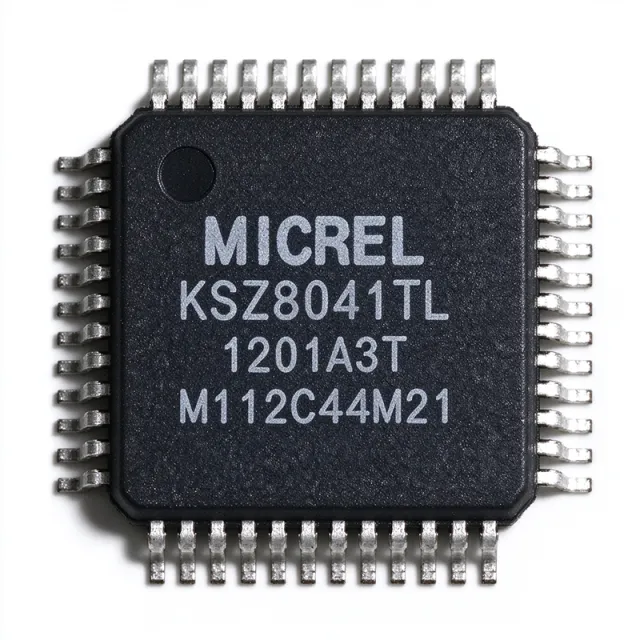
KSZ8041TLI - 10/100 Ethernet PHY | Microchip Technology
The Microchip Technology KSZ8041TLI is a single-channel 10Base-T/100Base-TX Ethernet physical-layer transceiver with full MII, RMII, and SMII interfaces, supplied in a 48-pin TQFP package. The device operates from a single 3.3 V supply and supports IEEE 802.3 and IEEE 802.3u Ethernet operation at 10 Mbps and 100 Mbps. Its integrated mixed-signal design is intended to extend signaling distance while reducing power consumption in compact embedded networking equipment. An Ethernet PHY is the physical-layer component that converts digital data from a MAC or Ethernet controller into analog signaling for a copper network, while receiving and converting incoming signals back into digital data. In the broader hierarchy, the KSZ8041TLI is an Ethernet interface transceiver, a network interface IC, and a semiconductor for Ethernet connectivity. It is appropriate for industrial control, embedded systems, communications equipment, and other designs requiring a dedicated 10/100 Ethernet front end. The verified device information identifies support for auto-negotiation through hardware pin strapping on pin 42 or software using register 0h bit 12. Auto-negotiation follows Clause 28 of the IEEE 802.3u specification and allows link partners to select the highest common operating mode. The same 48-pin TQFP package also supports MII, RMII, and SMII host interfaces, allowing designers to match the PHY to different MAC architectures. The KSZ8041TLI is designed for surface-mount implementation and uses a 3.3 V single-supply architecture. Its mixed-signal approach supports the 10Base-T and 100Base-TX physical layers while controlling power use compared with discrete implementations. The product page also identifies HP Auto MDI/MDIX support, which simplifies connection to both straight-through and crossover cable arrangements in many network designs. Typical uses include embedded Ethernet controllers, industrial automation modules, serial-to-Ethernet equipment, printer controllers, set-top boxes, and communication appliances. When designing around this PHY, verify the exact MAC interface mode, pin strapping requirements, magnetics selection, and termination network against the manufacturer datasheet. The verified data confirms the functional family and package but does not provide a complete pin list, recommended magnetics part numbers, or detailed timing values. This product record combines verified distributor and manufacturer information with practical interface-selection guidance, same-package alternatives, pricing context, and design cautions. The comparison and notes help distinguish temperature, packaging, and interface-option differences without treating functionally similar parts as automatically drop-in replacements.

KSZ8051MLL - 100Mbps MII Ethernet PHY | Microchip Technology
Microchip Technology KSZ8051MLL is a single-supply 10Base-T/100Base-TX Ethernet physical-layer transceiver with full MII support, 100 Mbps data rate, and a 48-LQFP 7 x 7 mm package. It operates from a 3.3 V supply with a specified 3.135 V to 3.465 V range and is designed for transmission and reception over standard Category 5 unshielded twisted-pair cable. An Ethernet physical-layer transceiver, or PHY, converts logical data transmitted by a MAC or controller into signals suitable for copper Ethernet wiring and converts received cable signals back into digital data. The KSZ8051MLL belongs to the 10/100 Ethernet PHY category, within interface ICs and the broader Ethernet communications hierarchy. Its full MII interface provides parallel control, data, and status connections to a network controller. The principal operating characteristics are a 100 Mbps maximum data rate, one transmitter and one receiver, and a 3.3 V supply. Manufacturer information identifies support for 1.8 V, 2.5 V, and 3.3 V interface operating levels, depending on the configuration and connected controller. The commercial-temperature version operates from 0°C to +70°C and is supplied in a surface-mount 48-LQFP package. The integrated PHY reduces the amount of external circuitry required for a 10/100 Ethernet endpoint. It handles physical signaling to the network medium while the associated controller manages packet processing and the higher-level protocol stack. Full MII support makes it appropriate for designs that require a conventional parallel Ethernet interface rather than a serial reduced-media interface. Typical applications include industrial Ethernet equipment, embedded network controllers, print servers, IP cameras, building-control gateways, and compact communication modules. The 100 Mbps rate supports Fast Ethernet networks, while MII connectivity allows direct integration with controllers such as LAN9353T/PT and related Ethernet interface devices. PCB implementation requires careful separation between the digital MII signals and the analog magnetics interface. Place network-side filtering and magnetics close to the connector, observe the recommended copper and layout practices in the manufacturer datasheet, and keep high-current and high-speed return paths controlled to reduce radiated emissions and susceptibility to external noise. This page combines the manufacturer product information, interface characteristics, package details, drop-in candidates, and practical Ethernet design guidance. It is intended to help engineers verify mechanical compatibility, MII requirements, supply conditions, and thermal constraints before integrating the KSZ8051MLL into a Fast Ethernet design.
KSZ8051MNL - 10/100 Ethernet MII PHY | Microchip Technology
The Microchip Technology KSZ8051MNL is a single-supply 10BASE-T/100BASE-TX automotive Ethernet physical-layer transceiver with a full Media Independent Interface (MII), supplied in a 32-pin QFN package measuring 5 mm by 5 mm. It is designed to connect an Ethernet MAC or equivalent controller to standard CAT-5 unshielded twisted-pair cabling while supporting 10 Mbps and 100 Mbps operation. An Ethernet physical-layer transceiver is the network-interface circuit that converts digital data from a media-access controller into differential signaling suitable for twisted-pair cabling, then converts received signals back into digital data. Within the broader hierarchy of Ethernet interface components, the KSZ8051MNL belongs to the PHY class, sits below the network interface controller, and ultimately forms part of a complete Ethernet communication system. The KSZ8051 family is AEC-Q100 standard qualified for automotive applications. The manufacturer describes the KSZ8051 as a highly integrated PHY solution that reduces board cost and simplifies layout through on-chip termination resistors for the differential pairs. It also integrates a low-noise regulator that supplies the 1.2 V core. These features place more of the analog network interface inside the package while reducing the number of external support components needed on the PCB. The KSZ8051MNL provides the full MII interface, distinguishing it from the KSZ8051RNL version, which uses the Reduced Media Independent Interface. This distinction is important during product selection because RMII and MII are not interchangeable bus arrangements. The MII version is appropriate when the connected controller exposes the required parallel MII signals, clocks, and control lines. Typical uses include automotive Ethernet gateways, vehicle domain controllers, infotainment platforms, industrial Ethernet equipment, and other 10/100BASE-TX endpoints. In an automotive design, the device can support a wired network connection while the AEC-Q100 qualification provides an automotive-oriented component option. Its integrated 1.2 V regulator and on-chip termination simplify the analog implementation, although the power supply, magnetic-component interface, decoupling, and signal-integrity layout still require careful implementation. For layout, follow the manufacturer datasheet when assigning the 32 QFN connections and routing the MII and differential Ethernet signals. Keep the 1.2 V bypass capacitor close to its supply pin, route the differential pairs as a controlled-impedance pair, and provide the magnetic-interface network recommended by the datasheet. These practices reduce board-area requirements and help preserve the performance of the integrated PHY. This product page combines the manufacturer’s device description, package and interface information, documented automotive qualification, source links, and practical implementation guidance. It also distinguishes the MII KSZ8051MNL from RMII and migration-related devices so engineers can identify the appropriate family member without relying on a superficial package-size match.
KSZ8081MNXIA-TR - 10/100 Ethernet PHY | Microchip
The Microchip Technology KSZ8081MNXIA-TR is a single-supply 10Base-T/100Base-TX Ethernet physical-layer transceiver in a 32-QFN 5 x 5 mm package. The verified distributor listing identifies it as a one-transceiver Full MII Ethernet device for transmitting and receiving data over standard CAT-5 unshielded twisted-pair cable. Its integrated PHY reduces board space by combining the physical-layer functions required for a 10/100 Ethernet copper interface. What is an Ethernet PHY? An Ethernet physical-layer transceiver converts digital data from a network controller into electrical signaling for twisted-pair cabling and converts received cable signals back into digital data. A 10Base-T/100Base-TX PHY supports 10 Mbps and 100 Mbps Ethernet operation over CAT-5 UTP, while the host interface connects the PHY to a network controller or embedded processor. In the hierarchy of semiconductor components, the KSZ8081 is an Ethernet interface IC, then a network physical-layer transceiver, then a communication semiconductor. The verified product information specifies a 32-QFN 5 x 5 mm package and single-supply operation. The KSZ8081 family is designed for compact Ethernet equipment, embedded systems, industrial controllers, communications equipment, and network interface designs. Its 10/100 capability provides compatibility with legacy 10 Mbps networks as well as Fast Ethernet links. The Full MII designation in the verified DigiKey listing identifies the host-side interface category; detailed pin functions, voltage ranges, temperature limits, and timing parameters must be taken from the manufacturer datasheet. The KSZ8081MNXIA-TR is intended for designs using Ethernet magnetics and an RJ45 connector. The verified manufacturer product page describes support for transmission and reception over standard CAT-5 UTP. Hardware design must preserve the differential TX and RX pairs, provide the required decoupling, and follow the KSZ8081 hardware design guidance. Microchip's published KSZ8081 hardware design checklist notes that pin 2 of the RJ45 is RX- and should route through the magnetics to RXM pin 4 of the KSZ8081MNX when using the specified arrangement. A key design consideration is that Ethernet PHY operation depends on a clean 3.3 V supply, correct magnetics, controlled impedance, and compliant physical-layer layout. Use the manufacturer datasheet and hardware design checklist for the authoritative pinout, exposed-pad connection, capacitor values, supported media, and interface timing. Do not infer undocumented electrical values from distributor descriptions. This page combines verified distributor identity and package information with manufacturer-level application context and practical Ethernet layout guidance for engineers evaluating the KSZ8081MNXIA-TR.
KSZ8081RNACA-TR - 10/100 Ethernet PHY, RMII, 24-QFN | Microchip
The Microchip KSZ8081RNACA-TR is a single-supply 10BASE-T/100BASE-TX Ethernet physical-layer transceiver (PHY) with RMII v1.2 MAC interface, packaged in a 24-pin QFN (4x4 mm). It delivers 100 Mbps full-duplex operation over standard CAT-5 UTP cable and operates from a single 3.3 V supply (3.135 V to 3.465 V), with on-chip LDO regulators providing the required 1.2 V core rails. An Ethernet PHY (Physical Layer Transceiver) is a category of mixed-signal IC that sits between a MAC controller and the magnetics/RJ-45 jack. It performs MLT-3 line coding, baseline wander compensation, adaptive equalization, and link pulse detection per IEEE 802.3, while exposing a digital bus to the MAC. Within the system hierarchy, a PHY is a sub-class of Ethernet Interface IC, which itself is a sub-class of Interface IC, which falls under Integrated Circuits. The RMII (Reduced Media Independent Interface) variant of the KSZ8081 uses a 50 MHz reference clock to reduce pin count from MII's 16 signals to 8, easing PCB routing and shrinking MAC-PHY interconnect area. Key features include IEEE 802.3u compliance, programmable interrupt output, MDC/MDIO SMI for PHY register access, RMII back-to-back mode for 100 Mbps copper repeaters, and on-chip termination resistors that reduce external BOM by 6 to 8 components. The device supports both 25 MHz crystal input and 50 MHz RMII reference clock input, and offers HP Auto-MDIX for automatic transmit/receive pair crossover. Architecturally, the KSZ8081 integrates the analog front-end (AFE), DSP-based echo/next-cable canceller, line driver, baseline wander correction, and a 100BASE-TX 4B/5B scrambler/descrambler in a single 0.18 um CMOS die. The mixed-signal design tolerates up to 140 m of CAT-5 cable with sub-1e-10 BER. Typical applications include industrial Ethernet nodes (PROFINET, EtherNet/IP, Modbus TCP), IoT gateways, IP cameras, smart-home hubs, automotive Ethernet gateways, factory-automation controllers, and any MCU/MPU-based design that needs to add 10/100 Ethernet connectivity through an RMII MAC interface. When designing with this part, pay attention to the strap-in pins (PHYAD, config) which are latched at reset de-assertion; add 4.7 kohm pull-ups or 1.0 kohm pull-downs if MAC signals may drive those lines during reset. Place the 25 MHz crystal within 5 mm of the XI/XO pins and provide a solid ground pour under the analog supply pins. This page synthesizes distributor pricing, drop-in alternatives sourced from web data, and practical design notes drawn from the manufacturer datasheet and Microchip's reference designs - engineering content not found on a single distributor page.
KSZ8081RNBIA-TR - 10/100 Ethernet PHY | Microchip | 32-QFN
Microchip Technology KSZ8081RNBIA-TR is a single-supply 10Base-T/100Base-TX Ethernet physical-layer transceiver with full RMII support, supplied in a 32-QFN 5 x 5 mm package. It interfaces a digital Ethernet MAC through RMII while transmitting and receiving data over standard CAT-5 unshielded twisted-pair cable. The verified distributor record identifies the device as a one-transceiver Ethernet interface in the KSZ8081 family. An Ethernet physical-layer transceiver, or Ethernet PHY, converts digital data supplied by a media-access controller into electrical signaling suitable for twisted-pair cabling, while receiving and decoding signals returning from the network. The PHY belongs to the Ethernet interface hierarchy: network interface controller, Ethernet transceiver, physical layer, interface IC, and semiconductor. Integrating this function beside a microcontroller, processor, or dedicated MAC reduces board space and the amount of external interface circuitry required. The KSZ8081 supports 10Base-T and 100Base-TX operation, allowing a single Ethernet connection to negotiate with either 10 Mbps or 100 Mbps network equipment. Its full RMII interface connects the PHY to the digital MAC side of the design. Because RMII timing, voltage levels, clocking, and reset sequencing are design-critical, the host controller and PHY must use compatible timing and a correctly implemented reference circuit. Typical uses include embedded Ethernet control, industrial networking, communications equipment, USB-to-Ethernet products, set-top boxes, printers, and embedded systems requiring a compact 10/100 network port. CAT-5 UTP is the specified cable medium in the verified manufacturer description; newer cable categories may also support the physical installation, but link capability must be verified in the complete system. A key design consideration is the relationship between digital RMII signals, the single PHY supply, and the network magnetics or integrated magnetics. The PHY footprint, exposed-pad layout, decoupling, clock source, and Ethernet line-side implementation must follow the manufacturer datasheet exactly. Input voltage limits, absolute maximum ratings, timing values, temperature range, and recommended operating conditions are not present in the supplied verification text and are marked as data needed rather than estimated. This page combines the verified manufacturer product description with distributor availability, packaging, price references, and application guidance. It also separates confirmed facts from engineering questions that still require review of the manufacturer datasheet, including detailed pin names, electrical limits, and qualification status.

KSZ8342Q Voice/Fax ATA SoC, 128-QFP | Microchip
The Microchip Technology KSZ8342Q is an integrated Voice/Fax ATA system-on-chip that converts analog telephone or fax signals for transmission over IP networks. It combines an advanced digital signal processor with the logic required for analog-to-digital telephone processing in a RoHS-compliant 128-lead QFP package. The verified distributor listing describes the device as a VoIP ATA ASSP with voice-codec functionality, while the manufacturer datasheet identifies its broader role as a complete voice/fax-to-IP conversion solution. An ATA, or Asynchronous Telephone Adapter, is a semiconductor that bridges traditional analog telephone equipment and packet-based IP communications. It belongs to the broader hierarchy of application-specific integrated circuits, communication controllers, network interface processors, and VoIP interface ICs. In this role, the KSZ8342Q supports a complete voice or fax signal path rather than serving as a general-purpose microprocessor or standalone network PHY. The principal verified feature is high integration in a 128-lead QFP package. The manufacturer datasheet states that the device supplies the logic needed to convert traditional telephone and fax-machine signals into a form suitable for transmission over IP. This integration can reduce the component count required in a voice-access design while providing a dedicated path for telephony signaling, voice processing, and packet-network connectivity. The exact operating voltages, clock requirements, memory interfaces, codec performance, and protocol details are not available in the supplied verified excerpts and must be confirmed from the manufacturer datasheet before design release. The KSZ8342Q is intended for VoIP ATA equipment, voice/fax gateways, telephone line interface systems, and other embedded communications products. Its dedicated architecture is appropriate when a product needs to interface analog telephone equipment with an IP network. Designers should validate line-interface levels, ringing requirements, codec performance, thermal conditions, and network protocol requirements during schematic and layout review because those parameters are not stated in the verified distributor snippets. A key design consideration is that this is a complex application-specific communications IC rather than a simple regulator or interface transceiver. PCB layout, power sequencing, grounding, clocking, and high-speed signal integrity should follow the manufacturer reference design and datasheet recommendations. The 128-lead QFP footprint also requires adequate escape routing and thermal copper, while production sourcing should confirm lifecycle status and lead time with authorized distributors. This page consolidates the verified manufacturer datasheet link, distributor identification, package information, pricing evidence, and engineering caveats. Because the supplied search results do not provide a complete pinout, verified drop-in substitutions, or full electrical tables, those fields are intentionally marked as data-needed rather than inferred.
KSZ8382Q - VoIP IP Phone ASSP 128-QFP | Microchip
The Microchip KSZ8382Q is a Voice-over-IP (VoIP) IP phone Application-Specific Standard Product (ASSP) integrating an Ethernet MAC/PHY, a voice codec, and a network processor core in a single 128-pin QFP package. Designed as the central SoC for entry-level and mid-range IP desk phones, it combines a 10/100 Ethernet physical layer, an HD voice codec, and on-chip processing for SIP/H.323 signaling stacks. The integration eliminates the multi-chip bill of materials used in legacy designs that paired separate Ethernet PHYs with discrete audio codecs. Background knowledge: An ASSP (Application-Specific Standard Product) is a commercially available IC tailored to a specific application category rather than a single customer. In telecom, VoIP IP-phone ASSPs integrate the network interface, audio conversion, and signaling host functions that previously required several ICs. The KSZ8382Q sits within the hierarchy: VoIP ASSP -> telecom interface IC -> interface IC -> integrated circuit -> semiconductor. Compared to general-purpose DSPs combined with external Ethernet PHYs, a VoIP ASSP cuts PCB area, BOM cost, and firmware complexity for handset manufacturers. Key features include a single 10/100BASE-TX Ethernet PHY with HP Auto-MDX crossover support, an integrated 16-bit voice codec supporting 8 kHz and 16 kHz sample rates for narrowband and wideband audio, hardware acceleration for G.711/G.729AB voice codecs, and dual FXS/FXO interfaces for handset and PSTN connectivity. The device operates from a single 3.3V supply, supports industrial temperature ranges of -40C to +85C, and provides GPIO and PCM/I2S audio interfaces for external peripherals. Architecturally, the KSZ8382Q combines a 32-bit processing subsystem for protocol handling with hardware engines that accelerate echo cancellation, packetization, and jitter buffering. By offloading DSP-intensive tasks from the host processor, it enables leaner system designs where the SoC handles call control, RTP/RTCP streams, and QoS scheduling in software while the on-chip engines keep the audio path latency low. Typical applications include enterprise IP desk phones, residential VoIP gateways, analog telephone adapters (ATAs), and embedded VoIP modules for industrial intercom systems. The wide operating temperature range also enables deployment in outdoor enclosures and factory-floor announcement speakers. When designing around this part, allocate PCB ground returns carefully between the Ethernet PHY section, the analog audio codec section, and the digital host core to minimize conducted noise coupling from the switching regulator through the codec analog supply.

KSZ8441HLI - IEEE 1588v2 Ethernet Controller | Microchip
Microchip Technology KSZ8441HLI is an IEEE 1588v2-enabled 10/100 Ethernet controller with an integrated media access control and physical layer, supplied in a 64-LQFP package measuring 10 mm by 10 mm. The device supports 10 Mbps and 100 Mbps Ethernet communication and adds precision-clock synchronization for industrial networking systems that require accurate time distribution. An Ethernet controller is an interface integrated circuit that connects a host processor or embedded system to an Ethernet physical network. The KSZ8441 combines a MAC, a PHY, and IEEE 1588v2 synchronization in one device. This integration reduces the number of external network components while supporting industrial Ethernet endpoints where protocol timing and network availability are more important than maximum data throughput. The verified product information identifies the KSZ8441 as a 10/100 Ethernet controller with IEEE 1588v2 support and an internal MAC and PHY. Its 64-LQFP package provides a substantial number of connections for power, ground, Ethernet media, clocking, host-interface, and control signals. The specific protocol, electrical, timing, and host-interface details not present in the supplied search records are marked as DATA_NEEDED rather than inferred from other Ethernet devices. Typical uses include industrial Ethernet endpoint controllers, synchronized test and measurement equipment, factory automation nodes, embedded control systems, and communication equipment that must exchange data while maintaining time alignment across a network. IEEE 1588v2 support is particularly relevant when distributed devices need deterministic event timing, synchronized acquisition, or coordinated machine operation. Designers should verify the complete pin assignment, host-interface mode, clock requirements, supply voltages, magnetic-interface components, and timing margins in the manufacturer datasheet before layout release. The 64-pin land pattern must be treated as a function-specific footprint rather than a generic LQFP because unused pins, reserved pins, and power distribution must be implemented exactly as specified by Microchip Technology. This page combines verified manufacturer and distributor information, technical application guidance, comparison placeholders, and acquisition details. It also distinguishes exact drop-in alternatives from functionally similar Ethernet PHYs that use different packages and therefore cannot replace the KSZ8441HLI without PCB redesign.
KSZ8462HLI - 3-Port 10/100 Ethernet Switch | Microchip
The Microchip Technology KSZ8462HLI is an IEEE 1588v2-enabled, three-port 10/100 Ethernet switch with an integrated 8- or 16-bit general host interface, supplied in a 64-LQFP 10 x 10 mm package. It combines two 10BASE-T/100BASE-TX physical-layer transceivers, associated MAC units, a Layer 2 switch, and the bus interface unit needed for host-managed industrial networking. An Ethernet switch is a semiconductor that forwards Ethernet frames between connected network nodes while supporting dedicated media access control, physical signaling, and port management. The KSZ8462 belongs to the Microchip EtherSynch family, adding IEEE 1588 precision time protocol capabilities to a conventional Layer 2 switch. This makes it a specialized Ethernet interface IC rather than a general-purpose processor or standalone transceiver. The verified product information identifies three 10/100 Ethernet ports, an IEEE 1588v2-capable EtherSynch architecture, and a flexible 8- or 16-bit host interface. The product page states that the family provides integrated communications and synchronization for industrial Ethernet applications. Its combination of switching, two integrated 10BASE-T/100BASE-TX PHYs, MAC units, and precision-time features reduces the component count required for synchronized network equipment. The KSZ8462HLI is packaged as a 64-lead LQFP measuring 10 x 10 mm. This surface-mount package provides a substantial pin count for separate port signals, host-bus connectivity, synchronization functions, power, ground, and configuration. The HLI ordering code is listed by DigiKey, Mouser, and other distributors as active, while detailed electrical limits, clock requirements, transceiver characteristics, and absolute maximum ratings require verification against the manufacturer datasheet. Typical uses include industrial Ethernet gateways, precision-time-aware network bridges, synchronized test equipment, factory automation controllers, embedded communication modules, and Ethernet interfaces for host processors. In these systems, the switch can combine upstream and downstream 10/100 links while the host interface supports device configuration, status access, and network integration. IEEE 1588v2 support is especially relevant where equipment requires more precise network timing than ordinary best-effort Ethernet delivery provides. Design work should verify the host-bus width, interface voltage levels, clock configuration, magnetic-interface components, bypass-capacitor placement, and pin termination directly against the manufacturer datasheet before layout release. The LQFP footprint also requires adequate copper area, thermal consideration, and assembly-process compatibility. This page synthesizes the verified distributor and manufacturer information with practical engineering guidance and clearly separates confirmed specifications from parameters still requiring datasheet verification.
KSZ8463FMLI - 3-Port 10/100 Managed Ethernet Switch | Microchip
The Microchip Technology KSZ8463FMLI is a three-port 10/100 managed Ethernet switch with MII and RMII host interfaces, IEEE 1588v2 synchronization support, and fibre-support capability, housed in a 64-LQFP package measuring 10 mm by 10 mm. It belongs to the EtherSynch family of industrial Ethernet switching products. A managed Ethernet switch is a network semiconductor that connects multiple physical-network ports while implementing configurable traffic handling, status monitoring, and management functions. The KSZ8463 family combines Ethernet switching with precision-time features, placing it within the hierarchy of Ethernet controller, network interface controller, industrial Ethernet IC, and broader communication semiconductor. The KSZ8463FMLI provides three 10/100 Ethernet ports and supports either MII or RMII connectivity to a host processor. These interfaces let the device operate as the Ethernet-facing switching element in embedded industrial equipment, where deterministic communication and synchronization are important. The KSZ8463 family is specifically identified as IEEE 1588v2 enabled for distributed communications and timing applications. Fibre support adds an important deployment option for industrial networks whose copper links have distance, interference, or topology limitations. Although the external transceiver and optical implementation details are not established by the product-page summary, the fibre-support designation identifies the KSZ8463 as a suitable switching component for optical industrial Ethernet links when paired with appropriate external hardware. Typical uses include industrial Ethernet bridges, embedded control equipment, synchronized test systems, factory-network infrastructure, and communication interfaces that require managed three-port Ethernet connectivity. In these systems, the MII or RMII interface connects the switch to a local controller, while its Ethernet ports extend connectivity to sensors, programmable logic controllers, industrial computers, and other network nodes. Designers should review the manufacturer pin-description table and interface reference section before assigning PCB signals, supplying clocking, and configuring the host interface. The 64-LQFP footprint also requires deliberate escape routing for the high-speed MII or RMII signals, differential Ethernet pairs, clock inputs, power rails, and management connections. This page organizes the available manufacturer and distributor information into an engineering-focused view of interfaces, synchronization, packaging, application fit, and design considerations. It also highlights the distinction between verified product attributes and parameters that require confirmation from the complete manufacturer datasheet before a new PCB is released.
KSZ8463FRLI - 3-Port 10/100 Ethernet Switch | Microchip
Microchip Technology KSZ8463FRLI is a three-port 10/100 managed Ethernet switch with IEEE 1588v2 synchronization, a generic host interface supporting MII and RMII, and fiber-support options in a 64-LQFP package measuring 10 x 10 mm. The device is intended for industrial Ethernet systems that combine local switching, precise time synchronization, and host connectivity. An Ethernet switch is a network semiconductor that receives frames on one port and forwards them to another port using MAC-address information. The KSZ8463 family belongs to the EtherSynch product line, where EtherSynch combines Ethernet switching with IEEE 1588 precision time protocol functions. This makes the device useful in industrial automation, test systems, and synchronized control networks where data transfer and time correlation must occur within one platform. The KSZ8463FRLI provides three 10/100 Ethernet ports and a generic host interface with MII or RMII options. Its IEEE 1588v2 capability supports distributed clock and synchronization functions for industrial Ethernet applications. The 64-LQFP package provides 64 externally accessible connections and is suitable for multilayer PCB designs requiring several copper interfaces, control signals, power rails, and management functions. Microchip describes the device as a precision-time-protocol-enabled managed switch. Managed-switch operation supports configurable network behavior rather than acting as a simple frame-forwarding bridge. The combination of three 10/100 ports, synchronization support, and a selectable host interface consolidates several network functions into one device, reducing component count in systems requiring more than a basic two-port Ethernet interface. Typical applications include industrial PLC and factory-automation controllers, networked measurement equipment, synchronized data-acquisition systems, embedded control platforms, and optical-network interfaces. For copper-based networks, the integrated 10/100 ports support Fast Ethernet links. Where electrical copper links are unsuitable or fiber connectivity is required, the KSZ8463 family's fiber-support capability can be used as part of a larger network design. PCB implementation requires careful separation of Ethernet signal groups, clock domains, power supplies, and digital control signals. Place all required decoupling capacitors close to their associated supply pins, preserve the manufacturer-recommended Ethernet magnetics and impedance-controlled routing geometry, and use a solid ground plane. Management firmware and host-interface configuration must also match the selected MII or RMII implementation. This product page combines the manufacturer family description with distributor package and interface data, then adds application-focused design guidance, comparison structure, and sourcing instructions. It is intended to help engineers identify whether the three-port managed switching, IEEE 1588v2 synchronization, and 64-LQFP integration fit an industrial Ethernet design before requesting a quote.