メモリIC
サブカテゴリ
製品 (875)

NT5CC256M16CP-DI - 4Gb DDR3L SDRAM 256Mx16 | Nanya
The Nanya NT5CC256M16CP-DI is a 4Gb DDR3L SDRAM organized as 256M x 16 bits, operating at 1.35V with a VFBGA-96 package. It supports DDR3-1600 speed grade with CL11 timing, and is backward compatible with 1.5V DDR3. This memory device is designed for commercial, industrial, and automotive temperature ranges, making it suitable for a wide range of applications. DDR3L SDRAM (Double Data Rate 3 Low Voltage) is a type of synchronous dynamic random-access memory that operates at 1.35V, reducing power consumption by about 20% compared to standard 1.5V DDR3. It is part of the DDR3 family, which uses prefetch buffers and on-die termination to achieve high data rates. DDR3L is commonly used in computing, networking, and embedded systems where power efficiency is critical. Key features include 8 internal memory banks, differential clock inputs (CK, CK#), programmable CAS latency (CL) of 5-11, and write latency (CWL) of 5-9. The device supports on-die termination (ODT) and DLL-off mode for low-power operation. It also features programmable additive latency (posted CAS) and a 0.075V reference voltage tolerance. The NT5CC256M16CP-DI uses a 70nm process technology, offering a balance of performance and power efficiency. The VFBGA-96 package provides a compact footprint with excellent thermal and electrical characteristics. The device supports burst lengths of 8 and 4, and includes auto-refresh and self-refresh modes for power management. Typical applications include DDR3L memory modules for laptops, servers, networking equipment, and industrial computing. It is also used in automotive infotainment and ADAS systems where reliability and temperature range are critical. The 1.35V operation makes it ideal for battery-powered devices. When designing with this device, ensure proper decoupling capacitors near the power pins and follow the PCB layout guidelines in the datasheet to minimize signal integrity issues. The device requires a stable 1.35V supply and a 0.75V reference voltage for correct operation.

NT5CC256M16CP-DIA - 4Gb DDR3L SDRAM 256Mx16 | Nanya
The Nanya NT5CC256M16CP-DIA is a 4Gb DDR3L SDRAM organized as 256M x 16, operating at 1.35V with a data rate of 1600Mbps (800MHz clock). It is housed in a 96-ball TFBGA package with 0.8mm pitch, measuring 9x13mm. This device supports commercial, industrial, and automotive temperature grades, making it suitable for a wide range of applications. DDR3L SDRAM is a type of double data rate synchronous dynamic random-access memory that operates at a lower voltage (1.35V) compared to standard DDR3 (1.5V), reducing power consumption by about 20%. It is part of the memory hierarchy in computing systems, serving as the main working memory for processors, and is widely used in servers, networking equipment, and embedded systems. Key features include 8 internal memory banks, differential clock inputs (CK, CK#), programmable CAS latency (CL) and write latency (CWL), on-die termination (ODT) for signal integrity, and a burst length of 8. The device supports DLL-off mode for low-frequency operation and includes auto-refresh and self-refresh modes for power saving. It is halogen-free and RoHS compliant. Technically, the NT5CC256M16CP-DIA uses a CMOS process and features a 0.225ns clock-to-output access time. The high-speed bin is backward compatible with lower speed bins, allowing flexible system design. The 96-ball TFBGA package provides excellent thermal and electrical performance, with a thermal resistance of [DATA_NEEDED: theta_JA] and operating temperature range of -40°C to +95°C (industrial) or -40°C to +105°C (automotive). Typical applications include DDR3L memory modules for laptops, embedded computing, networking routers, and industrial automation. Its low voltage and wide temperature range make it ideal for power-sensitive and harsh-environment designs. When designing with this device, ensure proper termination and decoupling on the VDD and VDDQ rails. The ODT feature should be configured via mode registers to match the system's impedance requirements for optimal signal integrity.
NT5CC256M16CP-DIB - 4Gb DDR3L SDRAM 256Mx16 | Nanya Technology
The Nanya Technology NT5CC256M16CP-DIB is a 4Gb DDR3L SDRAM organized as 256M x 16 bits, operating at 1.35V with a 96-ball TFBGA package. It is designed for industrial temperature grade applications, offering high-speed data transfer with a data rate of up to 1600 Mbps (DDR3L-1600). The device features 8 internal memory banks, differential clock inputs, and programmable CAS latency (CL) and write latency (CWL) for flexible system timing. DDR3L (Double Data Rate 3 Low Voltage) SDRAM is a type of synchronous dynamic random-access memory that operates at a reduced voltage of 1.35V compared to standard DDR3's 1.5V, enabling lower power consumption in mobile and embedded systems. It is part of the DDR3 memory family, which uses double data rate signaling to transfer data on both edges of the clock, and is widely used in computing, networking, and industrial applications. Key features include a 4Gb density, 16-bit I/O width, 96-ball TFBGA package (9x13mm, 0.8mm pitch), industrial temperature range (-40°C to +95°C), and RoHS compliance. The device supports programmable CAS latency of 5, 6, 7, 8, and 9, and write latency of 5, 6, 7, 8, and 9, with a refresh cycle count of 8192. It also features on-die termination (ODT) and dynamic ODT for improved signal integrity. Technically, the NT5CC256M16CP-DIB uses a CMOS process and incorporates a differential clock input (CK, CK#) for precise timing. The device supports auto-refresh and self-refresh modes, with a reduced standby current for power saving. The 1.35V operation is backward compatible with 1.5V DDR3 parts, allowing flexible system design. Typical applications include industrial embedded systems, networking equipment, and automotive infotainment, where high-density, low-power memory is required. The industrial temperature grade ensures reliable operation in harsh environments. When designing with this device, ensure proper decoupling capacitors near the power pins and follow the layout guidelines in the datasheet to minimize signal integrity issues. The device requires a stable 1.35V supply and a reference voltage (VREF) for the I/O.
NT5CC256M16CP-DIB1 - 4Gb DDR3L SDRAM 256Mx16 | Nanya
The Nanya NT5CC256M16CP-DIB1 is a 4Gb DDR3L SDRAM organized as 256M x 16, operating at 1.35V with a data rate of 1600Mbps (DDR3L-1600). It is housed in a 96-ball TFBGA package with 0.8mm pitch, halogen-free and RoHS compliant. This device is designed for commercial, industrial, and automotive applications, offering JEDEC DDR3 compliance with 8n prefetch architecture, differential clock (CK/CK#), and data strobe (DQS/DQS#). DDR3L SDRAM is a type of dynamic random-access memory that operates at a lower voltage (1.35V) compared to standard DDR3 (1.5V), reducing power consumption while maintaining high bandwidth. It is part of the memory hierarchy in computing systems, serving as the main system memory for processors, and is widely used in embedded systems, networking equipment, and automotive infotainment. Key features include a 4Gb density, 16-bit I/O width, 8 internal banks, programmable CAS latency (CL) and write latency (CWL), on-die termination (ODT), and a configurable output drive strength. The device supports a burst length of 8 and a burst chop of 4, with a self-refresh mode for low-power standby. The -DIB1 speed grade indicates DDR3L-1600 with timing parameters of CL=11, CWL=8, and tRCD/tRP=11. The architecture uses a 70nm process technology, providing a balance of performance and power efficiency. The differential clock inputs and data strobes ensure signal integrity for high-speed operation. The device includes programmable mode registers for flexible configuration, and it supports DLL-off mode for reduced power consumption in low-frequency applications. Typical applications include solid-state drives (SSDs), network routers, industrial automation controllers, automotive infotainment systems, and embedded computing platforms. The low 1.35V operation makes it ideal for power-sensitive designs, while the industrial and automotive temperature grades ensure reliability in harsh environments. When designing with this device, ensure proper decoupling capacitors near the power pins and follow the PCB layout guidelines for DDR3 routing to maintain signal integrity. The device requires a 1.35V supply and a separate VDDQ, with careful attention to the reference voltage (VREF) for the address and control signals.
NT5CC256M16CP-DIH - 4Gb DDR3L SDRAM 256Mx16 | Nanya
The Nanya NT5CC256M16CP-DIH is a 4Gb DDR3L SDRAM organized as 256M x 16 bits, operating at 1.35V with a data rate of 1600 Mbps (DDR3L-1600). It is housed in a 96-ball TFBGA package with a 9x13 mm body and 0.8 mm ball pitch, designed for commercial, industrial, and automotive temperature grades. This memory device supports programmable CAS latency (CL), write latency (CWL), and additive latency, along with on-die termination (ODT) and DLL-off mode for power savings. DDR3L SDRAM is a type of double data rate synchronous dynamic random-access memory that operates at a lower voltage (1.35V) compared to standard DDR3 (1.5V), reducing power consumption by about 15% while maintaining compatibility with DDR3 slots. It is part of the memory hierarchy in computing systems, serving as main memory in laptops, servers, and embedded systems, and is essential for high-bandwidth data processing. Key features include 8 internal memory banks (BA0-BA2), differential clock inputs (CK, CK#), programmable write latency (CWL) of 5, 6, 7, 8, and 9, and a burst length of 8 with on-the-fly burst chop. The device supports a self-refresh mode and partial array self-refresh for low-power standby, making it suitable for battery-powered applications. It is RoHS compliant and halogen-free, meeting environmental standards. Technically, the NT5CC256M16CP-DIH uses a 70nm process technology, enabling high density and low power. The device features a 16n prefetch architecture, achieving high data rates with low power consumption. It includes programmable impedance (ZQ calibration) for signal integrity and supports a temperature-compensated self-refresh (TCSR) to maintain data integrity across temperature ranges. Typical applications include DDR3L memory modules for laptops and ultrabooks, embedded systems in industrial automation, networking equipment, and automotive infotainment systems. Its low voltage and wide temperature range make it ideal for power-sensitive and harsh environments. When designing with this device, ensure proper decoupling capacitors near the power pins and follow the layout guidelines for DDR3 routing to maintain signal integrity. The device requires a 1.35V supply and a separate VDDQ, with careful attention to the ZQ pin for calibration.
NT5CC256M16CP-DII - 4Gb DDR3L SDRAM 256Mx16 | Nanya
The Nanya NT5CC256M16CP-DII is a 4Gb DDR3L SDRAM organized as 256M x 16, operating at 1.35V with a clock frequency of 800MHz (DDR3-1600). It comes in a 96-ball TFBGA package (9x13mm, 0.8mm pitch) and is halogen-free and RoHS compliant. This industrial-grade memory device is designed for reliable operation in extended temperature ranges, making it suitable for networking, industrial automation, and embedded computing applications. DDR3L (Double Data Rate 3 Low Voltage) SDRAM is a type of synchronous dynamic random-access memory that operates at a lower voltage (1.35V) compared to standard DDR3 (1.5V), reducing power consumption by up to 20% while maintaining similar performance. It is part of the DDR3 memory family, which uses double data rate signaling to transfer data on both edges of the clock, and is widely used in computing and embedded systems. Key features include a 256Mx16 organization, 800MHz clock frequency (1600Mbps data rate), 1.35V nominal voltage, and industrial temperature grade. The device supports 8192 refresh cycles and features on-die termination (ODT) for improved signal integrity. The TFBGA-96 package with 0.8mm pitch enables compact PCB designs, and the halogen-free, RoHS-compliant construction meets modern environmental standards. The NT5CC256M16CP-DII utilizes Nanya's 70nm DDR3 A-die process technology, offering a balance of performance and power efficiency. The 1.35V DDR3L parts are backward compatible with 1.5V DDR3 systems, providing design flexibility. The industrial temperature grade ensures reliable operation from -40°C to +95°C, making it suitable for harsh environments. Typical applications include networking equipment (routers, switches), industrial automation controllers, embedded computing modules, and automotive infotainment systems. The high density and low power consumption make it ideal for memory-intensive applications where space and thermal budgets are constrained. When designing with this device, ensure proper decoupling capacitors near the power pins and follow the PCB layout guidelines in the datasheet to maintain signal integrity at DDR3-1600 speeds. The ODT feature should be configured via mode registers to match the system's memory topology.
NT5CC256M16CP-DINA - 4Gb DDR3L SDRAM 256Mx16 | Nanya
The Nanya NT5CC256M16CP-DINA is a 4Gb DDR3L SDRAM organized as 256M x 16 bits, designed for commercial, industrial, and automotive applications. It operates at 1.35V (DDR3L) and is backward compatible with 1.5V DDR3, offering flexibility in system design. The device is housed in a 96-ball TFBGA package with 0.8mm pitch, measuring 9 x 13 mm, and is halogen-free and RoHS compliant. DDR3L SDRAM is a type of double data rate synchronous dynamic random-access memory that operates at a lower voltage (1.35V) compared to standard DDR3 (1.5V), reducing power consumption by up to 20% while maintaining similar performance. It is part of the memory hierarchy in computing systems, serving as the main system memory for processors, and is widely used in laptops, embedded systems, and networking equipment. Key features include a data rate of 1600 Mbps (DDR3-1600), a CAS latency of 11, and a burst length of 8. The device supports on-die termination (ODT), programmable CAS latency, and auto self-refresh for low-power standby. It also features a temperature-compensated self-refresh (TCSR) mode for industrial temperature ranges. The NT5CC256M16CP-DINA uses a 70nm process technology, enabling high density and low power. It includes a precision DLL for timing alignment and supports write leveling for improved signal integrity. The device is designed for reliable operation in harsh environments, with an operating temperature range of -40°C to +95°C (industrial) and -40°C to +105°C (automotive). Typical applications include embedded computing, industrial automation, automotive infotainment, and networking equipment. Its low voltage and high density make it ideal for power-sensitive designs, while its wide temperature range suits automotive and industrial environments. When designing with this memory, ensure proper decoupling capacitors near the power pins and follow the layout guidelines in the datasheet to minimize signal integrity issues. The device requires a stable 1.35V supply and a reference voltage (VREF) for the address and control signals.
NT5CC256M16CP-EK - 4Gb DDR3L SDRAM 256Mx16 | Nanya Technology
The Nanya Technology NT5CC256M16CP-EK is a 4Gb DDR3L SDRAM organized as 256M x 16, designed for high-speed memory applications requiring reliable data throughput and low power consumption. It utilizes an 8n-prefetch architecture and supports data transfer rates up to 2133 Mb/s per pin. With integrated features for signal integrity, power management, and timing calibration, it is well suited for a wide range of computing and embedded systems. DDR3L (Double Data Rate 3 Low Voltage) SDRAM is a type of synchronous dynamic random-access memory that operates at a lower voltage (1.35V) compared to standard DDR3 (1.5V), reducing power consumption by up to 20% while maintaining similar performance. It is part of the DRAM memory hierarchy, which includes SRAM, DRAM, and flash memory, and is widely used in main memory, graphics, and embedded applications. Key features include a 4Gb density, 256M x 16 organization, 96-ball TFBGA package, and support for both DDR3 and DDR3L operation. The device operates over a temperature range of 0°C to +95°C (TC) and includes features such as auto self-refresh, auto precharge, asynchronous reset, data mask, write leveling, dynamic on-chip termination, and ZQ calibration. These features enhance signal integrity and system reliability. The NT5CC256M16CP-EK uses an 8n-prefetch architecture with 8 internal memory banks, differential clock inputs (CK, CK#), and programmable CAS latency (CL), write latency (CWL), and additive latency. It supports burst lengths of 8 and 4 with burst chop, and includes on-die termination (ODT) for improved signal quality. The device is RoHS compliant and lead-free. Typical applications include servers, networking equipment, industrial computing, automotive infotainment, and consumer electronics such as set-top boxes and smart TVs. Its low-voltage operation makes it ideal for power-sensitive designs, while its high-speed interface supports demanding data-intensive workloads. When designing with this device, ensure proper decoupling capacitors near the power pins and follow the layout guidelines in the datasheet to minimize signal integrity issues. The ZQ calibration pin requires a 240-ohm resistor to ground for proper impedance calibration.
NT5CC256M16DN-FLNA - 4Gb DDR3L SDRAM | Nanya Technology
The NT5CC256M16DN-FLNA is a 4Gb DDR3L SDRAM organized as 256M x 16, manufactured by Nanya Technology Corporation. It operates at a supply voltage of 1.35V (VDD and VDDQ) with a range of 1.283V to 1.45V, and is backward compatible to 1.5V ±0.075V for DDR3 operation. This device is designed for commercial, industrial, and automotive temperature grades, making it suitable for a wide range of applications. DDR3L (Double Data Rate 3 Low Voltage) SDRAM is a type of synchronous dynamic random-access memory that operates at a lower voltage (1.35V) compared to standard DDR3 (1.5V), reducing power consumption by about 20-30% while maintaining similar performance. It is part of the memory hierarchy in computing systems, serving as the main system memory for processors, and is widely used in laptops, embedded systems, and networking equipment. Key features include a data rate of 1600 Mbps (PC3-12800) with a CL of 11, a burst length of 8, and on-die termination (ODT) for signal integrity. The device supports auto-refresh and self-refresh modes, and includes programmable CAS latency and additive latency. It is available in a 96-ball FBGA package, which is standard for DDR3L SDRAM. The NT5CC256M16DN-FLNA uses a 30nm-class process technology, offering high density and low power consumption. It features a 16-bit I/O interface, which is ideal for applications requiring moderate bandwidth with lower pin count. The device includes a temperature sensor for thermal management and supports DLL (Delay-Locked Loop) for precise timing. Typical applications include embedded computing, industrial automation, automotive infotainment, networking equipment, and consumer electronics such as set-top boxes and routers. Its low voltage and wide temperature range make it suitable for battery-powered and harsh environments. When designing with this device, ensure proper decoupling capacitors near the power pins and follow the layout guidelines in the datasheet to minimize signal integrity issues. The device requires a stable power supply and proper termination for the address/control lines.
NT5CC256M16DP-DI - 4Gb DDR3L SDRAM 256Mx16 | Nanya
The Nanya NT5CC256M16DP-DI is a 4Gb DDR3L SDRAM organized as 256M x 16 bits, operating at 1.35V with a data rate of 800MHz (DDR3L-1600). It comes in a 96-ball VFBGA package and is designed for commercial, industrial, and automotive temperature grades. This memory device supports high-speed data transfer rates up to 2133 Mb/s/pin, making it suitable for a wide range of computing and embedded applications. DDR3L (Double Data Rate 3 Low Voltage) SDRAM is a type of synchronous dynamic random-access memory that operates at a lower voltage (1.35V) compared to standard DDR3 (1.5V), reducing power consumption while maintaining high bandwidth. It is part of the DDR3 memory family, which uses double data rate signaling to transfer data on both edges of the clock, and is widely used in servers, laptops, and industrial systems. Key features include a 4Gb density, 16-bit data bus, 800MHz clock frequency (1600 Mbps/pin), and a low operating voltage of 1.35V. The device supports programmable CAS latency, burst lengths of 8 and 4 (with burst chop), and on-die termination (ODT) for improved signal integrity. It also includes auto-refresh and self-refresh modes for power saving. Technically, the NT5CC256M16DP-DI uses a CMOS process and is designed to comply with all key DDR3(L) DRAM features. It has a differential clock input (CK and CK#) and all control and address inputs are synchronized to the clock. The device supports DLL (Delay-Locked Loop) for precise timing and includes a mode register for configuration. The VFBGA-96 package provides a compact footprint with excellent thermal and electrical performance. Typical applications include main memory in embedded systems, networking equipment, industrial PCs, and automotive infotainment. Its low voltage and high speed make it ideal for power-sensitive designs. The industrial temperature grade (-40°C to +95°C) ensures reliable operation in harsh environments. When designing with this device, ensure proper decoupling capacitors near the power pins and follow the layout guidelines in the datasheet to minimize signal integrity issues. The device requires a 1.35V supply and a separate VDDQ for the I/O, which should be regulated accurately.
NT5CC256M16DP-DIH - 4Gb DDR3L SDRAM 256Mx16 1.35V | Nanya
The Nanya NT5CC256M16DP-DIH is a 4Gb DDR3L SDRAM organized as 256Mx16, operating at 1.35V with a 96-ball VFBGA package. It is designed for commercial, industrial, and automotive applications, offering high-speed data transfer with a data rate of 1600 Mbps (DDR3-1600). The device supports auto self-refresh, auto precharge, asynchronous reset, data mask, write leveling, dynamic on-chip termination, and ZQ calibration functions, ensuring robust performance in demanding environments. DDR3L SDRAM is a type of dynamic random-access memory that operates at a lower voltage (1.35V) compared to standard DDR3 (1.5V), reducing power consumption while maintaining high bandwidth. It is part of the DDR3 memory family, which uses double data rate architecture to transfer data on both edges of the clock signal. DDR3L is widely used in computing, networking, and embedded systems where power efficiency is critical. Key features include a 4Gb density, 16-bit I/O width, 1.35V core voltage, and support for industrial temperature range (0°C to +95°C). The device offers programmable CAS latency, burst lengths of 8 and 4, and on-die termination for improved signal integrity. The 96-ball VFBGA package provides a compact footprint suitable for space-constrained designs. The NT5CC256M16DP-DIH utilizes advanced CMOS process technology, achieving high-speed operation with low power dissipation. It incorporates a temperature-compensated self-refresh mechanism to maintain data integrity across temperature variations. The device also features a programmable output driver impedance and supports DLL (Delay-Locked Loop) for precise timing control. Typical applications include DDR3L memory modules for laptops, servers, networking equipment, industrial PCs, and automotive infotainment systems. Its low voltage and high density make it ideal for power-sensitive applications requiring large memory capacity. When designing with this device, ensure proper decoupling capacitors near the power pins and follow the layout guidelines in the datasheet to minimize signal integrity issues. The ZQ calibration pin requires a 240-ohm resistor to ground for correct impedance calibration.
NT5CC256M16DP-FLNA - 4Gb DDR3L SDRAM | Nanya Technology
The Nanya Technology NT5CC256M16DP-FLNA is a 4Gb DDR3L SDRAM organized as 256M x 16, operating at 1.35V with a data rate of 1600 Mbps (PC3L-12800). It is housed in a 96-ball BGA package (13x9 mm) and supports commercial, industrial, and automotive temperature ranges. This device is designed for high-bandwidth memory applications requiring low power consumption and reliable performance. DDR3L SDRAM is a type of dynamic random-access memory that operates at a lower voltage (1.35V) compared to standard DDR3 (1.5V), reducing power consumption by up to 20% while maintaining similar performance. It is part of the DDR3 memory family, which uses double data rate architecture to transfer data on both edges of the clock signal, achieving high data rates. DDR3L is commonly used in mobile devices, embedded systems, and industrial applications where power efficiency is critical. Key features include a 16-bit data bus, 8 internal banks, programmable CAS latency (CL 11, 12, 13), burst lengths of 8 and 4 (with burst chop), on-die termination (ODT) for signal integrity, and ZQ calibration for improved timing. The device supports auto self-refresh, auto precharge, and write leveling, ensuring robust operation in various system conditions. It also includes a data mask function and asynchronous reset for enhanced control. The NT5CC256M16DP-FLNA utilizes advanced CMOS technology, achieving low power consumption and high reliability. The 96-ball BGA package provides excellent thermal and electrical performance, with a thermal resistance of [DATA_NEEDED: theta_JA] and operating temperature range of -40°C to +95°C (industrial) and -40°C to +105°C (automotive). The device is RoHS compliant and lead-free. Typical applications include networking equipment (routers, switches), industrial automation, automotive infotainment and ADAS, and embedded computing systems. Its low voltage and high density make it ideal for memory-intensive tasks in space-constrained designs. When designing with this device, ensure proper decoupling capacitors near the power pins and follow the layout guidelines in the datasheet to minimize signal integrity issues. The ZQ pin requires a 240-ohm resistor to ground for calibration.
NT5CC256M16ER-EK - 4Gb DDR3L SDRAM 256Mx16 | Nanya
The Nanya NT5CC256M16ER-EK is a 4Gb DDR3L SDRAM organized as 256M x 16, operating at 1.35V with a data rate of 933MHz (DDR3L-1866). It comes in a 96-ball TFBGA package and is designed for commercial and industrial temperature ranges (0°C to +95°C). This memory IC supports auto self-refresh, auto precharge, asynchronous reset, data mask, write leveling, dynamic on-chip termination, and ZQ calibration functions, making it suitable for high-performance computing and embedded systems. DDR3L (Double Data Rate 3 Low Voltage) SDRAM is a type of synchronous dynamic random-access memory that operates at a lower voltage (1.35V) compared to standard DDR3 (1.5V), reducing power consumption while maintaining high bandwidth. It is part of the DDR3 family, which uses double data rate signaling to transfer data on both edges of the clock, and is widely used in laptops, servers, and industrial applications where energy efficiency is critical. Key features include a 4Gb density, 16-bit I/O width, 933MHz clock speed, and support for 1.35V operation. The device also features programmable CAS latency, burst lengths of 8 and 4 (with burst chop), and on-die termination (ODT) for improved signal integrity. The TFBGA-96 package offers a compact footprint suitable for space-constrained designs. Technically, the NT5CC256M16ER-EK uses an 8n-prefetch architecture, achieving high data rates with low power. It includes a mode register for configuration, and supports DLL (Delay-Locked Loop) for precise timing. The device is RoHS compliant and lead-free, meeting environmental standards. Typical applications include DDR3L memory modules for laptops, embedded systems, networking equipment, and industrial PCs. Its low voltage and high density make it ideal for power-sensitive applications. When designing with this component, ensure proper decoupling capacitors near the power pins and follow the layout guidelines in the datasheet to maintain signal integrity at high speeds.
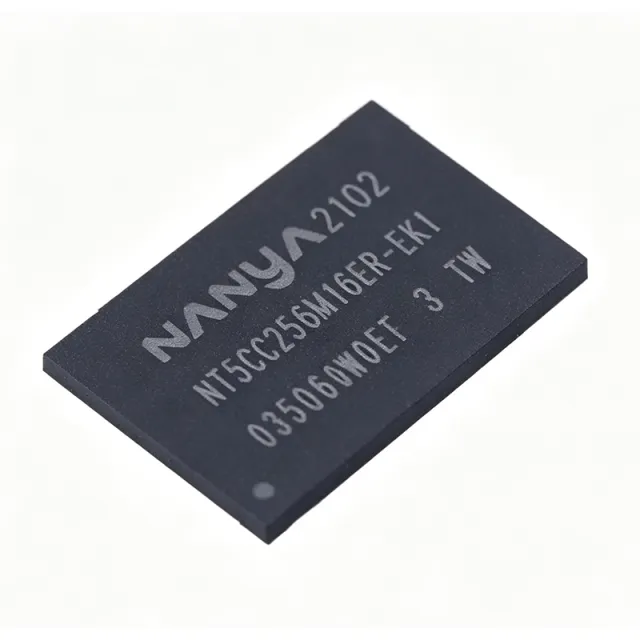
NT5CC256M16ER-EKI - 4Gb DDR3L SDRAM 256Mx16 | Nanya
The Nanya Technology NT5CC256M16ER-EKI is a 4Gb DDR3L SDRAM organized as 256M x 16, operating at 1.35V (also compatible with 1.5V) in a 96-ball TFBGA package. It is designed for commercial and industrial applications with a temperature range of -40°C to +95°C. This memory component supports data rates up to 933MHz (DDR3L-1866) and includes features such as auto self-refresh, auto precharge, asynchronous reset, write leveling, dynamic on-chip termination, and ZQ calibration. DDR3L SDRAM is a type of double data rate synchronous dynamic random-access memory that operates at a lower voltage (1.35V) compared to standard DDR3 (1.5V), reducing power consumption while maintaining high bandwidth. It is part of the memory hierarchy in computing systems, serving as the main system memory for processors, and is widely used in embedded systems, networking equipment, and industrial PCs. Key features include a 4Gb density, 16-bit data bus, 1.35V core voltage, and support for industrial temperature range. The device uses an 8n-prefetch architecture and supports burst lengths of 8 and 4 (with burst chop). It also features on-die termination (ODT) for improved signal integrity and a programmable CAS latency. The TFBGA-96 package provides a compact footprint suitable for space-constrained designs. Technically, the NT5CC256M16ER-EKI is fabricated using Nanya's advanced DRAM process technology, offering high reliability and low power consumption. The device includes a mode register set (MRS) for configuration, and supports DLL (delay-locked loop) for precise timing. It is compliant with JEDEC DDR3L standards, ensuring interoperability with a wide range of controllers. Typical applications include industrial computing, networking routers and switches, embedded systems, and automotive infotainment. Its industrial temperature rating makes it suitable for harsh environments. The low voltage operation is ideal for battery-powered and energy-efficient designs. When designing with this component, ensure proper decoupling capacitors near the power pins and follow the PCB layout guidelines in the datasheet to minimize signal integrity issues. Also, verify the memory controller supports 1.35V operation for optimal performance.
NT5CC256M16ER-EKT - 4Gb DDR3L SDRAM 256Mx16 | Nanya
The Nanya NT5CC256M16ER-EKT is a 4Gb (256Mx16) DDR3L SDRAM component operating at a nominal 1.35V, with backward compatibility to 1.5V DDR3 systems. It is housed in a 96-ball TFBGA package and supports DDR3L-1866 (1866 Mbps) with 13-13-13 timing (CL13). This device is designed for commercial and industrial temperature ranges (0°C to +95°C) and includes features such as auto self-refresh, auto precharge, asynchronous reset, data mask, write leveling, dynamic on-chip termination, and ZQ calibration. DDR3L (Double Data Rate 3 Low Voltage) SDRAM is a type of synchronous dynamic random-access memory that operates at a lower voltage (1.35V) compared to standard DDR3 (1.5V), reducing power consumption by up to 20% while maintaining similar performance. It is part of the DDR3 memory family, which uses double data rate signaling to transfer data on both edges of the clock, and is widely used in computing, networking, and embedded systems. Key features include a 4Gb density organized as 256Mx16, a 96-ball TFBGA package, and support for DDR3L-1866 speed grade. The device operates from a 1.35V supply (with 1.5V compatibility) and features programmable CAS latency, burst lengths of 8 and 4 (with burst chop), and on-die termination (ODT) for improved signal integrity. The industrial temperature range option (EKI suffix) is available for harsh environments. Technically, the NT5CC256M16ER-EKT uses an 8n-prefetch architecture with a 16-bit I/O interface, achieving data rates up to 1866 Mbps. It includes a mode register set (MRS) for configuration, DLL for timing alignment, and ZQ calibration for output driver and ODT impedance tuning. The device supports various power-saving modes including power-down and self-refresh, making it suitable for battery-powered applications. Typical applications include DDR3L memory modules for laptops and embedded systems, networking equipment such as routers and switches, industrial automation controllers, and automotive infotainment systems. Its low voltage and high density make it ideal for space-constrained designs requiring high memory bandwidth. When designing with this device, ensure proper decoupling capacitors near the VDD and VDDQ pins, and follow the PCB layout guidelines for DDR3 routing to maintain signal integrity. The ZQ pin requires a 240-ohm resistor to ground for calibration.
NT5CC256M16ER-FLNA - 4Gb DDR3L SDRAM 256Mx16 | Nanya
The Nanya NT5CC256M16ER-FLNA is a 4Gb DDR3L SDRAM organized as 256M x 16 bits, operating at 1.35V with a 96-ball TFBGA package. It is designed for commercial and industrial temperature ranges, supporting data rates up to 1866 Mbps. This memory device features auto self-refresh, auto precharge, asynchronous reset, data mask, write leveling, dynamic on-chip termination, and ZQ calibration, making it suitable for a wide range of computing and embedded applications. DDR3L (Double Data Rate 3 Low Voltage) is a type of synchronous dynamic random-access memory (SDRAM) that operates at a lower voltage (1.35V) compared to standard DDR3 (1.5V), reducing power consumption by about 20% while maintaining similar performance. It is part of the DDR3 family, which uses double data rate signaling to transfer data on both edges of the clock, and is widely used in laptops, servers, and industrial systems where energy efficiency is critical. Key features include a 4Gb density, 16-bit data bus, 1.35V core power supply, and support for 1.5V I/O for compatibility. The device offers programmable CAS latency, burst lengths of 8 and 4 (with burst chop), and on-die termination (ODT) for improved signal integrity. It also includes a temperature sensor for thermal management and supports auto refresh and self refresh modes to maintain data integrity. Architecturally, the NT5CC256M16ER-FLNA uses an 8-bank design with a 16n prefetch architecture, enabling high-speed data transfer. The TFBGA package provides excellent thermal and electrical performance, with a ball pitch of 0.8mm and dimensions of 13mm x 8mm. The device is RoHS compliant and lead-free, meeting environmental standards. Typical applications include DDR3L memory modules for laptops, embedded systems, networking equipment, and industrial PCs. Its low voltage and high density make it ideal for power-sensitive designs, while the industrial temperature grade (-40°C to +95°C) ensures reliable operation in harsh environments. When designing with this device, ensure proper decoupling capacitors near the power pins and follow the layout guidelines in the datasheet to minimize signal integrity issues. The ZQ calibration pin requires a 240-ohm resistor to ground for proper operation.

NT6AN512M32AV-1G - 16Gb LPDDR4 512Mx32 1.1V | Nanya
The Nanya NT6AN512M32AV-1G is a high-performance mobile LPDDR4 SDRAM organized as 512M x 32 bits, providing 16Gb (2GB) of memory density. It operates at a supply voltage of 1.1V and supports data rates up to 4267 Mbps (LPDDR4-4267), making it suitable for bandwidth-intensive applications in smartphones, tablets, AI edge devices, and embedded systems. The device is housed in a 200-ball BGA package, enabling compact PCB designs. LPDDR4 (Low Power Double Data Rate 4) is a type of synchronous DRAM designed for mobile and low-power applications. It achieves high bandwidth while operating at lower voltages (1.1V) compared to standard DDR4 (1.2V), reducing power consumption in battery-powered devices. LPDDR4 is part of the JEDEC LPDDR memory standard family, which includes LPDDR2, LPDDR3, LPDDR4, and LPDDR5, each offering increased speed and efficiency. As a mobile DRAM, it is optimized for low-power operation and high-density packaging, making it essential for modern portable electronics. Key features include a 16Gb density with a 512M x 32 organization, 1.1V core power supply, and support for data rates up to 4267 Mbps. The device includes a built-in temperature sensor for Temperature Compensated Self Refresh (TCSR), which adjusts refresh rates based on temperature to save power. It also supports ZQ calibration for DS/ODT impedance accuracy via an external ZQ pad (240Ω ± 1%) and Data Bus Inversion (DBI) to reduce power consumption and improve signal integrity. The 200-ball BGA package is designed for space-constrained applications. Technically, the NT6AN512M32AV-1G utilizes advanced DRAM process technology to achieve high density and low power. The device supports dual-channel operation in multi-die packages (DDP/QDP) for higher capacity. It includes features like DQ calibration for signal synchronization, training for signal synchronization, and a temperature sensor for TCSR. These features ensure reliable operation across a wide temperature range, making it suitable for industrial and automotive applications. Typical applications include mobile devices (smartphones, tablets), AI computers, video conferencing systems, and industrial control systems. The high bandwidth and low power consumption make it ideal for AI edge inference, where large data sets are processed locally. In video conferencing, the high data rate supports multiple high-resolution video streams simultaneously. When designing with this device, ensure proper power decoupling with 0.1uF and 1uF capacitors near the power pins. Follow the JEDEC LPDDR4 layout guidelines for signal integrity, especially for high-speed data lines. The ZQ pin requires a 240Ω ± 1% resistor to ground for impedance calibration.
NT6AN8T0SA - 2Gb LPDDR2 SDRAM | Nanya Technology
The NT6AN8T0SA is a high-performance, low-power mobile LPDDR2 SDRAM manufactured by Nanya Technology Corporation. It is designed for space-constrained, battery-powered applications requiring high memory density and low power consumption. The device operates at a low supply voltage of 1.2V, making it ideal for portable electronics where power efficiency is critical. The NT6AN8T0SA is available in a compact FBGA package, enabling high-density board layouts in smartphones, tablets, and other mobile devices. LPDDR2 (Low Power Double Data Rate 2) SDRAM is a type of synchronous dynamic random-access memory optimized for low power consumption in mobile and embedded systems. It is part of the DDR memory family, which includes DDR2, DDR3, and DDR4, but is specifically designed to operate at lower voltages (1.2V) and provide power-saving features such as deep power-down and partial-array self-refresh. LPDDR2 is widely used in smartphones, tablets, and portable consumer electronics, where battery life is a primary concern. Key features of the NT6AN8T0SA include a 2Gb density, a 32-bit I/O width, and support for data rates up to 1066 Mbps (533 MHz). The device operates from a 1.2V power supply, with an I/O voltage of 1.2V, and supports a temperature range of -30°C to +85°C. It includes features such as programmable latency, burst length of 4 or 8, and on-die termination (ODT) for improved signal integrity. The device is RoHS compliant and lead-free, meeting environmental standards. Technically, the NT6AN8T0SA utilizes a 4-bank architecture with a 2Gb density, organized as 64M x 32. It supports auto-refresh and self-refresh modes, with a refresh period of 64ms at 85°C. The device features a programmable output driver impedance and supports DLL (Delay-Locked Loop) for precise timing. The low-voltage operation and advanced power management features make it suitable for always-on applications, such as IoT devices and wearables. Typical applications include smartphones, tablets, portable media players, and embedded systems requiring high memory bandwidth with minimal power consumption. The NT6AN8T0SA is also used in automotive infotainment systems and industrial handheld devices where reliability and low power are essential. When designing with the NT6AN8T0SA, ensure proper decoupling capacitors are placed near the power pins to minimize noise. The device requires a stable 1.2V supply and careful PCB layout to maintain signal integrity at high data rates. Refer to the manufacturer's datasheet for detailed timing and layout guidelines.
NT6AN8T6WBJ1B1 - 8Gb DDR4 SDRAM | Nanya Technology
The NT6AN8T6WBJ1B1 is a high-performance 8Gb DDR4 SDRAM manufactured by Nanya Technology, organized as 512M x 16 bits. It operates at a data rate of 3200 MT/s (PC4-25600) with a supply voltage of 1.2V, compliant with JEDEC DDR4 standards. The device is housed in a 96-ball FBGA package, enabling high-density memory solutions for computing, networking, and industrial applications. DDR4 SDRAM (Double Data Rate 4 Synchronous Dynamic Random-Access Memory) is a type of volatile memory that transfers data on both edges of the clock signal, doubling the data rate compared to DDR3. It operates at lower voltages (1.2V) and higher speeds, offering improved power efficiency and bandwidth. DDR4 is the industry standard for main memory in servers, desktops, and laptops, and is also used in embedded systems requiring high-speed data processing. Key features include a burst length of 8 (BL8) with burst chop (BC4), on-die termination (ODT) for signal integrity, and programmable CAS latency (CL) of 22 cycles. The device supports auto-refresh and self-refresh modes for power saving, and includes a temperature sensor for thermal management. The 1.2V supply reduces power consumption by up to 20% compared to DDR3L, making it suitable for energy-efficient designs. Architecturally, the NT6AN8T6WBJ1B1 uses an 8n-prefetch architecture with a 16-bit I/O interface, achieving a peak bandwidth of 25.6 GB/s per module. It incorporates bank groups (4 groups of 4 banks) to improve concurrency and reduce latency. The device supports write leveling and read leveling for robust signal integrity in high-speed systems, and includes a built-in self-test (BIST) feature for manufacturing and system diagnostics. Typical applications include DDR4 memory modules (UDIMM, SODIMM, RDIMM), embedded computing, networking equipment (routers, switches), and industrial automation. Its high density and speed make it ideal for servers and data centers requiring large memory capacity and fast data throughput. When designing with this device, ensure proper decoupling capacitors (0.1uF and 10uF) are placed near the VDD and VDDQ pins, and follow the JEDEC DDR4 layout guidelines for trace impedance (40-50 ohms) and length matching. The device requires a stable 1.2V supply and a separate 1.2V VDDQ for the I/O, with a reference voltage (VREF) of 0.6V.
P64706-B21 - 32GB DDR5-5600 2Rx8 ECC RDIMM | HPE SmartMemory
The HPE P64706-B21 is a 32GB DDR5-5600 Registered ECC Smart Memory module (288-pin RDIMM) designed for HPE Gen11 ProLiant servers, featuring dual-rank x8 architecture, CAS-46-45-45 timings, EC8 grade components, and 1.10V operating voltage. It operates at a peak transfer rate of 5600 MT/s (PC5-44800) and supports on-module ECC for enterprise-class data integrity. DDR5 RDIMM (Registered DIMM) is a server-class memory module that places a register buffer between the DRAM chips and the memory controller, reducing electrical loading and enabling higher capacity and speed than unbuffered modules. Within the hierarchy: DDR5 SDRAM -> RDIMM -> ECC Registered DIMM -> Server Memory. DDR5 introduces on-die voltage regulation (PMIC), decision feedback equalization (DFE), and higher bank group counts compared with DDR4, which is essential for bandwidth-bound workloads like in-memory databases, virtualization, and AI inference. Key features include 32GB module capacity in a single-rank-pair (2Rx8) layout, 5600 MT/s data rate, CL46 CAS latency (46-45-45), 1.10V low-voltage operation (versus 1.2V for DDR4), on-module ECC and parity, and HPE SmartMemory firmware that enables performance optimization, pre-failure alerting, and tighter integration with HPE iLO management. The 288-pin RDIMM form factor is standard for Gen11 platforms. The module is qualified, tested, and warranty-supported exclusively when deployed in supported HPE ProLiant Gen11 servers (e.g., DL380 Gen11, ML110 Gen11, DL110 Gen11). It uses advanced ECC and Chipkill-like protection mechanisms and integrates with HPE's Smart Memory authentication, which validates genuine HPE firmware during POST and refuses unauthorized modules. Typical applications include HPE ProLiant Gen11 server memory expansion, virtualization hosts running VMware vSphere or Hyper-V, in-memory databases (SAP HANA, Redis), AI/ML training and inference servers, and enterprise database workloads (Microsoft SQL Server, Oracle). The 32GB density is the sweet-spot upgrade tier for systems scaling from 16GB base configurations to 64GB/96GB populated memory topologies. When designing with this module, confirm your server's memory population rules (HPE Gen11 requires balanced population across channels for optimal bandwidth) and verify the BIOS supports 5600 MT/s - lower-speed SKUs are used in older Gen10 platforms. Mixing RDIMM speeds is supported but the bus will downclock to the slowest module. This page synthesizes distributor pricing, OEM equivalent modules, and practical compatibility notes not found in the manufacturer datasheet alone - useful for procurement and IT planners evaluating HPE SmartMemory upgrades.

PC28F256P33TFE - 256Mb Parallel NOR Flash, 95ns, 64-LBGA | Micron
The Micron PC28F256P33TFE is a 256-Mbit (16M x 16) parallel NOR Flash memory organized as CFI-compliant FLASH NOR (MLC), supplied in a 64-ball LBGA (11x13 mm, EasyBGA) surface-mount package. It operates from a single 2.3 V to 3.6 V supply, delivers 95 ns initial access time, and supports a 52 MHz synchronous burst clock frequency for high-throughput x16 code execution and data storage. A NOR Flash (Not-OR gate Flash) is a non-volatile memory technology that provides random read access at byte/word granularity and executes-in-place (XIP) directly from the array, distinguishing it from NAND Flash which requires block-level access and external ECC management. NOR Flash belongs to the hierarchy: NOR Flash -> non-volatile memory -> semiconductor memory -> integrated circuit. It is commonly used as boot ROM, firmware storage, and parameter backup where reliability and deterministic read latency outweigh cost-per-bit. Key features of the PC28F256P33TFE include top-boot block architecture, asynchronous and synchronous burst read modes, hardware write protection, and a deep power-down mode for battery-powered designs. The device provides 100K endurance cycles per sector and a 20-year data retention rating. Operating temperature spans -40C to +85C, qualifying it for industrial-grade embedded systems. The 64-ball EasyBGA package offers a small 11x13 mm footprint compatible with high-density PCB layouts. The PC28F256 family uses a 16-bit data bus and a multiplexed address/data interface. The top-boot configuration places the parameter and boot sectors at the lowest addresses, simplifying bootloader mapping in many embedded architectures. Synchronous burst reads deliver up to 52 MHz, enabling fast shadowing and execute-in-place performance comparable to older pSRAM. Typical applications include networking routers and switches, industrial PLCs and HMI controllers, automotive infotainment, medical instrumentation, set-top box firmware storage, and aerospace embedded controllers. In these systems the PC28F256P33TFE stores the operating system, configuration tables, and device firmware that must survive power cycles without reloading from external media. When designing with this part, derate the junction temperature using a 1 oz copper pour under the BGA, observe the 100 ms maximum erase and 4 s program timings for sector updates, and follow the JEDEC JESD22-A114 moisture sensitivity level handling. The original Micron part has been transferred to Alliance Memory, which now produces it as a long-term supply drop-in. This page synthesizes distributor pricing, parametric cross-references, and practical design notes for engineers evaluating the PC28F256P33TFE for both new designs and legacy board refresh cycles.
PC28F640P30BF65B - 64Mb Parallel NOR Flash, 52MHz, 64-EasyBGA | Micron
The Micron PC28F640P30BF65B is a 64-Mbit parallel NOR Flash memory IC organized as 4M x 16 with a 65 ns access time and 52 MHz synchronous burst read clock, housed in a 64-ball EasyBGA (10x13 mm) package. It operates from a single 1.7V to 2.0V VCC supply (with VCCQ tolerant up to 3.6V per the P30 family specification), making it a drop-in compatible member of the legacy Micron/Numonyx P30 parallel NOR family. A parallel NOR Flash (often called CFI NOR) is a non-volatile memory that maps random memory accesses onto a parallel address/data bus, giving true execute-in-place (XIP) capability. Unlike NAND, every byte is addressable and read latency is deterministic in tens of nanoseconds, so boot code, BIOS, and firmware can run directly from the array without shadowing into DRAM. Parallel NOR sits above asynchronous SRAM and below NAND in the memory hierarchy: lower density than NAND, far faster random access, and far more durable (typically 100K program/erase cycles per sector). Key features include a bottom-boot sector architecture (parameter and small boot blocks at low addresses, bulk array above), 65 ns initial access / 52 MHz burst read for fast sequential code execution, x16 data width with multiplexed address bus, hardware data protection via WP#/LOCK#, deep power-down to microamp-level standby, and a -40C to +85C industrial operating range. The P30 family is also known for an automotive grade option (-B suffix) and a self-encrypting drive variant in the 128 Mb member of the family. The architecture is a true 16-bit-wide NOR cell array with on-chip write state machine supporting chip/sector erase and single-word programming, freeing the host from toggling legacy Intel-command sequences. Programmable erase and program timing let the host trade throughput for in-system endurance. The 64-ball EasyBGA package (10x13 mm) provides a compact footprint with exposed die attach paddle for thermal dissipation during sustained writes or erases. Typical applications include automotive infotainment boot ROM, networking line cards running u-boot or VxWorks directly from flash, industrial PLC firmware storage, point-of-sale terminals, and any embedded design requiring deterministic read latency and high endurance. The bottom-boot layout favors systems that need a small, frequently-updated calibration block plus a large read-mostly code region. Designers should respect the 1.7-2.0V VCC window, place VCC/VCCQ decoupling within 5 mm of the balls, and observe tAVQV (address-to-output) timing. Because this part is supplied today primarily by Alliance Memory's Axcell franchise (Micron exit-NOR was completed earlier), confirm current lead time and lifecycle status at order entry. This page synthesizes distributor pricing, drop-in pin-compatible alternatives, and practical design notes not found on a single manufacturer datasheet page.
PC28F640P30BF65B-TR - 64Mb Parallel NOR Flash, 52MHz | Micron
The Micron PC28F640P30BF65B-TR is a 64-Mbit (4M x 16) parallel NOR Flash memory device built on the P30-65nm Axcell process technology, supporting a 52 MHz synchronous burst read interface and packaged in a 64-ball EasyBGA (10x13 mm). It operates from a 1.7 V to 2.0 V VCC core supply with a separate 1.7 V to 3.6 V VCCQ I/O supply, and offers an asynchronous access time of 65 ns (also reported as 75 ns in some datasheet revisions). A NOR Flash (Not-OR, technically "Not AND" wired-OR array) is a non-volatile memory class that supports random read access at byte or word granularity and executes code directly from the array (execute-in-place, XIP). This positions NOR above serial NOR for high-bandwidth or random-latency-sensitive workloads such as boot ROM, FPGA configuration shadowing, and embedded firmware storage. NOR sits within the broader hierarchy: NOR Flash -> parallel NOR -> non-volatile memory -> memory ICs -> semiconductors. Key features include 64 Mb density, a bottom-boot 128-KB uniform plus 4-KB parameter block architecture, 52 MHz synchronous burst reads, and individual block locking with a one-time programmable (OTP) security region. The device supports a hardware RESET# pin plus a RST# configuration input, WP#/ACC high-voltage protection/unprotect, and configurable read-array, read-ID, read-status, erase, and program command sets. The P30 architecture implements a multiplexed Address/Status/Command interface on DQ[15:0] with separate chip-enable (CE#), output-enable (OE#), and write-enable (WE#) controls, plus a synchronous burst pin group (AVD#, ADV#, CLK, WAIT). Block erase and word program operations typically complete in 0.4 s and 100 us respectively, with a 100K endurance rating per block. Typical applications include networking line-card boot, industrial controller firmware storage, automotive infotainment boot ROM, point-of-sale terminals, printer firmware, and any embedded system requiring execute-in-place with deterministic read latency. The 64-ball EasyBGA footprint also suits small-form-factor PCB designs. When designing with this device, place VCC and VCCQ decoupling (0.1 uF and 1 uF ceramic) within 5 mm of the package balls, keep CE# transitions clean during burst reads, and avoid long parallel bus stubs above 50 mm to preserve the 52 MHz timing margin. This page synthesizes distributor stock, pricing tiers, drop-in alternatives, and design notes to complement the manufacturer datasheet.
PDRQL8KCBF12-00 - 16Gb DDR5-7200 DRAM | Samsung
The Samsung PDRQL8KCBF12-00 is a 16Gb (2Gx8) DDR5 SDRAM device operating at DDR5-7200 data rates, designed for high-performance computing, server, and AI applications. It is a synchronous dynamic random-access memory that provides high bandwidth and low latency, essential for modern processors and accelerators. The device is housed in a standard FBGA package, compatible with JEDEC DDR5 specifications, and operates from a 1.1V core supply. DDR5 SDRAM is the fifth generation of double data rate synchronous dynamic random-access memory, succeeding DDR4. It doubles the burst length to 16 and introduces on-die ECC, improving reliability and performance. DDR5 operates at higher speeds and lower voltages than DDR4, making it suitable for bandwidth-intensive workloads such as data center servers, AI training, and high-end computing. The PDRQL8KCBF12-00 is a key component in memory modules and systems requiring high capacity and speed. Key features include a 16Gb density organized as 2Gx8, a data rate of 7200 MT/s, and a 1.1V supply voltage. It supports on-die ECC, which corrects single-bit errors internally, enhancing data integrity. The device also features a programmable refresh rate, write and read latencies, and a temperature-compensated refresh, ensuring reliable operation across a wide temperature range. The FBGA package provides excellent thermal and electrical performance. Technically, the PDRQL8KCBF12-00 uses a 10nm-class process technology, enabling high density and low power consumption. It incorporates a decision feedback equalizer (DFE) for improved signal integrity at high speeds, and a pseudo-differential DQ interface. The device supports a burst length of 16 and a burst chop of 8, and includes a mode register for configuration. The on-die ECC reduces system-level ECC overhead, improving overall system efficiency. Typical applications include DDR5 memory modules for servers, high-performance computing, AI accelerators, and networking equipment. The high bandwidth and capacity make it ideal for data-intensive tasks such as large-scale data analytics, machine learning inference, and real-time processing. The device is also used in advanced workstations and gaming systems that demand high memory performance. When designing with this device, ensure proper signal integrity by following JEDEC DDR5 layout guidelines, including controlled impedance traces and proper termination. The 1.1V supply should be well-regulated and decoupled with high-frequency capacitors. Thermal management is critical at high data rates; ensure adequate airflow or heatsinking to maintain junction temperature within specified limits. This page synthesizes distributor pricing, drop-in alternatives, and practical design notes not found in the manufacturer datasheet, providing engineers with a comprehensive resource for sourcing and implementing the PDRQL8KCBF12-00.