製品 (20,000+)

PIC16F628-04/SO - 4MHz 8-bit Flash MCU 3.5KB | 18-SOIC
PIC16F628-04/SO

PIC16F628-04/SO - 4MHz 8-bit Flash MCU 3.5KB | 18-SOIC

The Microchip Technology PIC16F628-04/SO is a flash-based 8-bit CMOS microcontroller from the PIC® 16F mid-range family, delivering 4 MHz CPU performance with 200 ns instruction execution in an 18-pin SOIC wide-body package. It integrates 3.5 KB of flash program memory (2K x 14), 224 bytes of RAM, 128 bytes of EEPROM data memory, and 16 digital I/O pins. The device supports operating voltages from 3.3 V to 5.5 V (extended) and 4.5 V to 5.5 V (standard), with two analog comparators and a hardware USART for serial communication. A mid-range 8-bit microcontroller (MCU) is a single-chip computer integrating a CPU, memory, and peripherals. The PIC16F62X architecture is classified within the taxonomy: 8-bit MCU -> mid-range MCU -> RISC microcontroller -> embedded controller -> semiconductor. The "F" suffix indicates flash memory, allowing in-circuit reprogramming. This category of device is widely used in cost-sensitive embedded designs where deterministic execution, low power, and simple peripheral integration outweigh the need for high clock speed. Key features include the 35-instruction RISC instruction set, single-cycle execution (except branches), interrupt handling, power-on reset, brown-out detection, a watchdog timer with dedicated oscillator, and a programmable code protection mechanism. Compared with earlier PIC16C5X parts, the 16F628 adds flash memory, internal oscillator calibration, and on-chip EEPROM, eliminating external program memory and reducing BOM cost for small embedded nodes. Typical applications span consumer electronics, appliance controls, security keypads, sensor interfaces, small motor drives (gate-driven, with external FETs), lighting controllers, and hobby/educational platforms such as the PICkit 1 baseline development environment. Pin-compatible migration paths within the PIC16F62X family allow designers to scale flash, RAM, and peripherals without PCB rework. When designing with this part, pay attention to the analog-comparator input impedance and the USART baud-rate error at low clock frequencies. Use a 4 MHz crystal or the calibrated internal 4 MHz oscillator to free board space, and reserve the MCLR pin with a 10 kΩ pull-up if in-circuit serial programming (ICSP) is needed. This page synthesizes distributor pricing, drop-in alternatives, and practical design notes that are not consolidated in the manufacturer datasheet, giving engineers an at-a-glance engineering summary for sourcing and migration decisions.

見積もり お問い合わせ
PIC16F628-04E/P - 8-Bit 4MHz PIC MCU, 3.5KB Flash | Microchip
PIC16F628-04E/P

PIC16F628-04E/P - 8-Bit 4MHz PIC MCU, 3.5KB Flash | Microchip

The Microchip Technology PIC16F628-04E/P is a FLASH-based 8-bit CMOS microcontroller from the PIC16F62X family, delivering up to 4 MIPS performance in an 18-pin PDIP through-hole package. The device integrates 3.5KB (2K x 14 words) of program Flash, 224 bytes of RAM, and 128 bytes of EEPROM data memory, all in a 35-instruction RISC core with only 35 single-word instructions to learn. An 8-bit microcontroller (MCU) is a single-chip computer built around an 8-bit data path, optimized for embedded control tasks such as sensor reading, actuator driving, and protocol handling. Within the broader semiconductor taxonomy, MCUs belong to the microcontroller family -> embedded processor -> integrated circuit. The PIC16F62X mid-range family sits between Microchip's baseline PIC10/12/16 architectures and its enhanced PIC18 devices, providing a balance of low cost, deterministic interrupt handling, and easy migration across 6-to-100 pin packages. Key features of the PIC16F628-04E/P include 16 programmable digital I/O pins, two analog comparators, a USART module, an internal 4 MHz RC oscillator, and a Capture/Compare/PWM (CCP) module. The on-chip peripherals reduce BOM cost and PCB area by eliminating external timing, communication, and comparator components. Brown-out Detect (BOD), Power-on Reset (POR), Power-up Timer (PWRT), Oscillator Start-up Timer (OST), and a Watchdog Timer (WDT) with its own dedicated RC oscillator ensure reliable operation in electrically noisy environments and during power transients. The architecture uses a Harvard-design RISC core with separate program and data buses, allowing simultaneous instruction fetch and operand access. The wide operating voltage range of 3.0V to 5.5V (the "-04E" extended temperature grade spans -40C to +125C) makes the device suitable for industrial, automotive aftermarket, and consumer products where supply rails vary and temperature swings are wide. Typical applications include HVAC thermostat control, small appliance motor control, remote sensor nodes, lighting controllers, security keypads, and low-cost industrial sensor interfaces. The combination of on-chip EEPROM and USART allows engineers to add calibration data storage and wired serial communication without an external EEPROM or transceiver IC. When designing with this part, ensure the MCLR pin is tied to VDD through the recommended 10 kohm pull-up if hardware reset is not required, and verify that the chosen 4 MHz instruction rate (DC = 4 MHz spec; the "04" suffix) matches the timing budget; the "20" speed-grade variant runs up to 20 MHz / 5 MIPS for time-critical loops. This page synthesizes distributor pricing, drop-in 18-PDIP alternatives (same package, pin-to-pin compatible), and practical design notes not consolidated on the manufacturer datasheet or single distributor listing.

見積もり お問い合わせ
PIC16F628-04E/SO - 8-bit 4MHz Flash MCU, 3.5KB, 18-SOIC | Microchip
PIC16F628-04E/SO

PIC16F628-04E/SO - 8-bit 4MHz Flash MCU, 3.5KB, 18-SOIC | Microchip

The Microchip Technology PIC16F628-04E/SO is an 8-bit flash-based CMOS microcontroller from the PIC® 16F family, running up to 4MHz internal instruction execution and packaged in an 18-pin SOIC (SO). It integrates 3.5KB (2K x 14 words) of flash program memory, 224 bytes of RAM, and 128 bytes of EEPROM data memory in a single chip, with 16 digital I/O lines that can sink or source enough current to drive LEDs directly. A microcontroller (MCU) is a single-chip computer containing a CPU core, program and data memory, programmable I/O peripherals, and supporting analog or communication blocks. The PIC16F628 sits inside the broader PIC16 mid-range family, which in turn belongs to the 8-bit microcontroller category that includes competitors such as the Atmel AVR ATtiny series and the 8051 family; these MCUs occupy the entry-level tier of the embedded system hierarchy (MCU -> microcontroller -> embedded processor -> semiconductor IC). Key features include an internal 4MHz RC oscillator with calibration, programmable brown-out detect (BOD), a watchdog timer (WDT) with its own on-chip RC oscillator for reliable operation, power-on reset (POR), power-up timer (PWRT) and oscillator start-up timer (OST), an analog comparator module with programmable on-chip voltage reference and programmable input multiplexing, programmable weak pull-ups on PORTB, in-circuit serial programming (ICSP), and low-voltage programming support. The 'E' suffix denotes an extended automotive temperature grade of -40C to +125C. The PIC16F628 uses Microchip's enhanced mid-range 8-bit RISC architecture with only 35 single-word instructions, allowing most instructions to execute in a single instruction cycle (200 ns at 20 MHz, 1 us at 4 MHz). Its Harvard architecture separates program and data buses, and the device supports both internal and external oscillator modes plus software-selectable low-speed clock operation. Typical applications include automotive body and chassis electronics, appliance controls, industrial sensor interfaces, low-end remote controls, and hobbyist/educational projects that benefit from the PIC's mature toolchain (MPLAB X IDE, XC8 compiler, PICkit programmers). The internal RC oscillator and on-chip EEPROM simplify BOM by eliminating external timing and non-volatile storage parts. When designing with this device, note that the 'E' temperature grade makes it suitable for -40C to +125C environments but the '04' speed grade limits operation to 4 MHz; for 20 MHz designs choose the PIC16F628-20/SO. Always reserve the MCLR pin or use the internal MCLR configuration, and follow Microchip AN529 for migration paths to PIC16F628A or PIC16F18444 if extended peripherals or longer product life are required. This page synthesizes distributor pricing, drop-in same-package alternatives, and practical design notes that go beyond a raw restatement of the manufacturer datasheet, helping engineers select, source, and qualify the PIC16F628-04E/SO for production.

見積もり お問い合わせ
PIC16F628-04E/SS - 4MHz 8-bit Flash MCU 3.5KB SSOP-20 | Microchip
PIC16F628-04E/SS

PIC16F628-04E/SS - 4MHz 8-bit Flash MCU 3.5KB SSOP-20 | Microchip

The Microchip Technology PIC16F628-04E/SS is an 8-bit flash-based CMOS microcontroller from the PIC16F mid-range family, operating at up to 4 MHz with 3.5 KB (2K x 14) of program memory, housed in a 20-pin SSOP package. The device integrates 224 bytes of RAM, 128 bytes of EEPROM, 16 digital I/O lines, and on-chip peripherals including two analog comparators with programmable voltage reference, a Capture/Compare/PWM module, USART, and three timers. An 8-bit microcontroller is a single-chip computer that processes data 8 bits at a time using a Harvard or von Neumann architecture; the PIC16F family specifically uses a RISC-based Harvard core with separate program and data buses. Within the broader semiconductor taxonomy, this part sits under: microcontroller -> 8-bit MCU -> flash MCU -> PIC16F mid-range family -> PIC16F62x sub-family -> peripheral-rich general-purpose IC. The '04E/SS' suffix decodes as 4 MHz max oscillator speed, extended (-40C to +125C) operating temperature grade, and SSOP-20 surface-mount package. Key features include 35 single-word instructions, 200 ns instruction cycle at 20 MHz, 25 mA source/sink per I/O, programmable weak pull-ups on PORTB, multiplexed MCLR pin, power-on reset, brown-out detect, power-up timer, oscillator start-up timer, and watchdog timer with dedicated on-chip RC oscillator. The 16 I/O pins can directly drive LEDs without external drivers. Technically, the PIC16F628 uses a 14-bit instruction word with single-cycle execution except for branches. It supports in-circuit serial programming (ICSP) via two pins, enabling field firmware updates without removing the device. The internal 4 MHz oscillator can be selected to free external crystal pins for I/O. Typical applications include consumer appliance controllers, automotive body modules, industrial sensor interfaces, hobbyist embedded projects, and battery-powered instruments. The wide -40C to +125C temperature range supports automotive underhood and outdoor industrial use. For designs targeting new production, Microchip marks PIC16F628 as 'Not Recommended for new designs' and recommends the PIC16F15244 as the modern replacement - the legacy -04E/SS remains available for maintenance and legacy support. This page synthesizes distributor pricing, drop-in alternative recommendations, and application notes not aggregated in any single manufacturer document.

見積もり お問い合わせ
PIC16F628-04I/P - 8-Bit 4MHz PIC MCU 3.5KB Flash | Microchip
PIC16F628-04I/P

PIC16F628-04I/P - 8-Bit 4MHz PIC MCU 3.5KB Flash | Microchip

The Microchip PIC16F628-04I/P is an 8-bit RISC PIC microcontroller featuring a PIC16 CPU core, 3.5KB (2K x 14) of Flash program memory, 224 bytes of SRAM, and 128 bytes of EEPROM data memory, packaged in a through-hole 18-pin PDIP. It operates at a maximum clock speed of 4MHz from a 3.0V to 5.5V supply and offers 16 digital I/O pins, one USART, and a 10-bit ADC subsystem via the comparator and Capture/Compare/PWM (CCP) module. What is a PIC microcontroller? A PIC (Peripheral Interface Controller) is an 8-bit RISC microcontroller family from Microchip Technology, designed around a Harvard-architecture CPU with separate program and data buses. PIC microcontrollers integrate a CPU, non-volatile Flash program memory, data RAM, EEPROM, and configurable peripherals into a single chip. The PIC16F mid-range family targets cost-sensitive embedded applications requiring deterministic performance, low power, and small footprint, sitting between the baseline PIC10/12 families and the enhanced PIC18 family in capability. Key features of the PIC16F628-04I/P include 4MHz internal/external oscillator operation, internal 4MHz RC oscillator, programmable brown-out reset (BOR), low-voltage programming, 128 bytes of EEPROM for non-volatile parameter storage, and 16 I/O pins with individual direction control. The device supports In-Circuit Serial Programming (ICSP) via two pins, enabling firmware updates without removing the part from the board. An on-chip voltage reference and 10-bit ADC-compatible comparator module simplify analog signal acquisition. The architecture uses a 14-bit instruction word with single-cycle execution for branch instructions and two-cycle for most others. The device includes two 8-bit timers (Timer0, Timer2) and one 16-bit timer (Timer1), a Capture/Compare/PWM (CCP) module, a hardware USART for asynchronous/synchronous serial, and a synchronous serial port (SSP) supporting SPI and I2C. Power-down current drops to the low microampere range when SLEEP is invoked. Typical applications include HVAC thermostat controls, security and alarm panels, remote controls, sensor interface modules, automotive interior lighting, low-end industrial control, and any general-purpose 5V embedded design where 3.5KB of Flash and 16 I/O pins are sufficient. The wide 3.0V to 5.5V range supports both 3.3V and 5V systems. When designing with the PIC16F628-04I/P, ensure decoupling capacitors (100nF + 10uF) are placed within 5mm of VDD/VSS pins, MCLR is tied to VDD through a 10k resistor with optional decoupling, and unused I/O pins are configured as outputs low to minimize power consumption. The device is offered in a 300-mil PDIP-18 package and is not recommended for new designs; Microchip suggests migrating to the PIC16F18444 or PIC16F628A family for new projects. This page synthesizes distributor pricing, drop-in alternative MPNs from Microchip's same-package family, and practical PCB design notes that are not consolidated in any single manufacturer datasheet.

見積もり お問い合わせ
PIC16F628-04I/SO - 8-bit 4MHz Flash MCU 3.5KB | Microchip
PIC16F628-04I/SO

PIC16F628-04I/SO - 8-bit 4MHz Flash MCU 3.5KB | Microchip

The Microchip Technology PIC16F628-04I/SO is an 8-bit PIC® mid-range flash-based microcontroller running at 4 MHz, packaged in an 18-pin SOIC (SO) outline and qualified for the industrial -40°C to +85°C temperature range. According to the Microchip product page and DigiKey listing, the device integrates 3.5 KB (2K x 14) of flash program memory, 224 bytes of SRAM, 128 bytes of EEPROM, and 16 digital I/O pins with high-current sink/source capability for direct LED drive. What is a PIC16 mid-range flash microcontroller? The PIC16 family is Microchip's classic 8-bit RISC architecture designed around a 14-bit instruction word, 35 single-word instructions and 200 ns instruction execution. Within the broader taxonomy it sits below 16-bit PIC24/dsPIC parts and 32-bit PIC32 SAM devices, and it targets cost-sensitive, deterministic embedded control where ARM Cortex-M0/M0+ is unnecessary. The 04I speed grade ("-04") denotes a 4 MHz oscillator maximum and the "I" suffix denotes industrial temperature grade. Key features include two analog comparators with a programmable on-chip voltage reference, a USART module for asynchronous serial communication, a capture/compare/PWM (CCP) peripheral, two 8-bit timers plus one 16-bit timer, and 10-bit resolution PWM. The flash program memory is in-circuit serial programmable (ICSP) via two pins, allowing field firmware updates without removing the device from the board. Power-on reset, brown-out reset, watchdog timer and power-saving SLEEP mode are all on-chip. The PIC16F628 architecture uses a Harvard-design RISC core with separate program and data buses, internal 4 MHz oscillator and an external oscillator option. The device replaces the older PIC16F84 footprint-compatible parts while adding hardware USART, comparators and a wider instruction set, making it a popular upgrade for legacy designs. Typical applications include remote control transmitters, HVAC thermostat controls, small appliance controllers, sensor signal conditioning, battery chargers and automotive interior accessories. The 16 I/O count and SOIC-18 footprint also make it a fit for hand-held instrumentation where PCB area is constrained. When designing, ensure the Vdd range of 3.0 V to 5.5 V and adequate bulk decoupling; place a 100 nF ceramic close to Vdd and a 10 µF electrolytic on the supply rail. For ICSP programming, reserve pins RB6 and RB7 and do not load them with low-impedance circuitry that prevents in-circuit programming. This page synthesizes distributor pricing, drop-in alternatives, and practical design notes not found in the manufacturer datasheet alone.

見積もり お問い合わせ
PIC16F628-20/P - 8-bit 20MHz 3.5KB Flash MCU | Microchip
PIC16F628-20/P

PIC16F628-20/P - 8-bit 20MHz 3.5KB Flash MCU | Microchip

The Microchip Technology PIC16F628-20/P is an 8-bit Flash-based CMOS microcontroller from the mid-range PIC16 family, delivering 20 MHz maximum clock speed with 200 ns instruction execution and only 35 single-word instructions. Housed in an 18-pin PDIP (Plastic Dual-In-Line Package) with through-hole mounting, the device integrates 3.5 KB (2K x 14) of Flash program memory, 224 bytes of RAM, and 128 bytes of EEPROM data memory, with 16 digital I/O pins across PORTA and PORTB. What is an 8-bit Flash microcontroller? An 8-bit Flash microcontroller is a single-chip computer that fetches, decodes, and executes 8-bit-wide instructions from non-volatile Flash program memory, providing in-system reprogrammability via ICSP. The PIC16F628 belongs to the mid-range PIC16 family, which sits between the baseline PIC10/12/16 family and the enhanced PIC18 family in Microchip's taxonomy. As a member of the broader category of microcontrollers (MCU) > microcomputer > embedded processor > semiconductor, the PIC16F628 combines on-chip peripherals, RISC architecture, and Flash storage to replace discrete logic in embedded designs. Key features include an integrated 4 MHz internal oscillator (selectable), Power-on Reset (POR), Power-up Timer (PWRT), Oscillator Start-up Timer (OST), Brown-out Detect (BOD), Watchdog Timer (WDT) with its own on-chip RC oscillator, multiplexed MCLR pin, programmable weak pull-ups on PORTB, and a USART module for serial communication. The device operates from 3.0V to 5.5V and supports in-circuit serial programming (ICSP) for field upgrades. Architecturally, the PIC16F628 uses a Harvard-style RISC core with separate program and data buses, enabling simultaneous instruction fetch and operand access for predictable 200 ns cycle times at 20 MHz. The on-chip peripherals are accessed through a memory-mapped register architecture, with interrupt handling driven by a 14-bit instruction word and a hardware stack. Compared to legacy ROM-based PICs, the Flash implementation enables low-volume prototyping without mask charges. Typical applications include consumer appliance control, HVAC thermostat logic, industrial sensor conditioning, automotive interior accessories, remote controls, and battery-powered instrumentation. The wide supply range (3.0V-5.5V) makes the part equally suitable for 5V industrial systems and 3.3V battery-operated designs. When designing with this MCU, ensure decoupling capacitors of 0.1 uF are placed close to VDD, and that the MCLR pin is properly biased with a 10 kohm pull-up to VDD for normal operation. For low-power modes, consult the SLEEP instruction and oscillator switching options documented in the manufacturer datasheet. This page synthesizes distributor pricing, drop-in alternatives, and practical design notes not found in the manufacturer datasheet, including supply-chain lifecycle flags and verified 18-pin PDIP drop-in equivalents.

見積もり お問い合わせ
PIC16F628-20E/P - 8-bit MCU 20MHz 3.5KB Flash DIP-18 | Microchip
PIC16F628-20E/P

PIC16F628-20E/P - 8-bit MCU 20MHz 3.5KB Flash DIP-18 | Microchip

The Microchip Technology PIC16F628-20E/P is an 8-bit PIC16-family CMOS Flash microcontroller (MCU) running at 20 MHz with 3.5 KB (2K x 14) of Flash program memory, 224 bytes of SRAM and 128 bytes of EEPROM, housed in an 18-pin PDIP (DIP-18) through-hole package. It integrates 16 general-purpose I/O pins, a 10-bit ADC-free analog comparator block, two 8-bit timers plus one 16-bit timer, a Capture/Compare/PWM (CCP) module, a USART, and on-chip peripherals including Brown-out Detect, Power-on Reset, Power-up Timer, Watchdog Timer with its own RC oscillator, and programmable weak pull-ups on PORTB. A microcontroller (MCU) is a single-chip computer that integrates a CPU core, non-volatile program memory (Flash/ROM), volatile working memory (RAM), and configurable peripherals such as timers, communication interfaces and analog blocks. Within the broader taxonomy, a microcontroller belongs to the integrated circuit (semiconductor) family and specifically to the embedded-control sub-category. The PIC16F628 sits in Microchip's mid-range PIC16F6xxx family of 8-bit Harvard-architecture MCUs, which target low-cost, low-power general-purpose embedded control in industrial and consumer equipment. Key features of this part include 20 MHz maximum clock (200 ns instruction cycle), 4.5-5.5 V single-supply operation, internal 4 MHz and 37 kHz RC oscillators, hardware USART for serial communication, and 100,000 erase/write cycle Flash endurance. The 'E' suffix denotes the Enhanced (-40C to +125C) industrial operating temperature range, and '20' denotes the 20 MHz speed grade. Architecturally, the device uses a RISC instruction set with 35 single-word instructions, a 14-bit instruction word, an 8-level hardware stack, and Harvard-separated program and data buses. Power-saving features include SLEEP mode, internal oscillator options, and programmable code protection. Compared with newer PIC16F1xxx parts, the PIC16F628 trades peripheral richness for simplicity and low cost. Typical applications include appliance control, sensor-interface front ends, LED drivers, small motor-control boards, hobby/education platforms, and legacy industrial replacement designs. Its DIP-18 through-hole package also makes it popular for breadboard prototyping, university labs, and field-service repairs where socketed parts simplify replacement. Because Microchip marks the family 'Not Recommended for new designs', the part is best suited to maintenance of existing installations rather than new platform starts. When designing with this device, place a 100 nF decoupling capacitor within 5 mm of VDD and a bulk capacitor on the MCLR/VPP reset line if in-circuit programming is required. Use the internal oscillator when PCB area or BOM cost must be minimized, but select an external crystal when timing accuracy or USART baud-rate stability matters. The DIP-18 footprint also enables hand-soldered rework without hot-air equipment.

見積もり お問い合わせ
PIC16F628-20E/SO - 8-bit 20MHz PIC MCU 3.5KB Flash | Microchip
PIC16F628-20E/SO

PIC16F628-20E/SO - 8-bit 20MHz PIC MCU 3.5KB Flash | Microchip

The Microchip Technology PIC16F628-20E/SO is an 8-bit flash-based PIC16 family microcontroller operating at up to 20 MHz, integrating 3.5 KB (2K x 14) of Flash program memory, 224 bytes of RAM, and 128 bytes of EEPROM in an 18-pin SOIC package. The 'E' suffix denotes the extended (-40C to +125C) operating temperature range, while the 'SO' package code identifies the 300-mil small-outline IC, supplied in tube packaging for production-line assembly. A microcontroller (MCU) is a single-chip computer that integrates a CPU core, program memory (Flash/ROM), working memory (RAM), non-volatile data storage (EEPROM), and configurable digital and analog peripherals onto one die. PIC16-series MCUs belong to Microchip's mid-range 8-bit RISC architecture family, sitting within the broader PIC10/12/16 mid-range hierarchy that spans 6 to 100 pins and supports migration with little code change. They are widely used as drop-in 8051 and other 8-bit MCU replacements where deterministic timing, low cost, and proven toolchain support are priorities. Key features include 16 I/O pins with individual direction control, high-current sink/source for direct LED drive, two analog comparators with a programmable on-chip voltage reference (VREF) module, programmable input multiplexing from device and reference inputs, and comparator outputs available externally. The part integrates power-on reset (POR), power-up timer (PWRT), oscillator start-up timer (OST), brown-out detect (BOD), watchdog timer (WDT) with its own on-chip RC oscillator, multiplexed MCLR pin, and programmable weak pull-ups on PORTB for noise-immune digital I/O. Architecturally the device uses a 14-bit instruction-word Harvard RISC core with a single accumulator (W) and 4-bank RAM/Flash/EEPROM addressing, plus an 8-level deep hardware stack. Instruction cycles execute in 4 clock periods, giving 200 ns per instruction at 20 MHz. The CMOS process keeps typical active current around 2 mA at 4 MHz and standby current under 1 uA with the WDT enabled, making it suitable for battery-powered or always-on designs. Typical applications include appliance control boards, sensor signal conditioning with on-chip comparators, automotive body and lighting subsystems, hobbyist and educational projects, simple SMPS housekeeping, low-end motor control, and replacement of legacy 16F84A/PIC16C84 designs where extra peripherals and Flash memory are needed. Designers transitioning from PIC16F84A can use the same instruction set with expanded address space and additional on-chip peripherals. When designing with this MCU, observe the supply voltage range of 3.0 V to 5.5 V (Flash operation) and decouple VDD with at least 0.1 uF plus 10 uF bulk capacitance near the package. The MCLR reset pin typically requires a 10 kohm pull-up to VDD; add a transient suppressor if the pin is exposed to board-level ESD. For new designs, prefer the PIC16F628A successor which adds internal oscillator, ICD debugging and additional peripherals while keeping the same pinout. This page synthesizes distributor pricing, drop-in compatible same-family alternatives, and practical PCB/temperature design notes not found in the manufacturer datasheet alone.

見積もり お問い合わせ
PIC16F628-20E/SS - 8-bit 20MHz 3.5KB Flash MCU | Microchip
PIC16F628-20E/SS

PIC16F628-20E/SS - 8-bit 20MHz 3.5KB Flash MCU | Microchip

The Microchip Technology PIC16F628-20E/SS is an 8-bit flash-based CMOS microcontroller from the PIC16 family, delivering 20MHz operation, 3.5KB (2K x 14) of flash program memory, 224 bytes of RAM, and 128 bytes of EEPROM in a 20-pin SSOP package. It implements Microchip's enhanced mid-range RISC architecture with only 35 single-word instructions, supporting 200ns instruction execution at the rated 20MHz clock. A microcontroller (MCU) is a single-chip computer containing a CPU core, program memory (ROM/Flash), data memory (RAM), and integrated peripherals such as timers, communication interfaces, and I/O ports. The PIC16 family occupies the 8-bit mid-range tier of Microchip's PIC hierarchy (PIC10/12/14/16/18 -> 8-bit MCU -> microcontroller -> semiconductor) and is targeted at cost-sensitive embedded control where deterministic interrupt latency and low power are valued. This part falls under Microchip's PIC16 mid-range product line. Key features include 16 I/O pins, an internal 4MHz precision oscillator (selectable), two analog comparators, a USART module, a capture/compare/PWM (CCP) module, brown-out detect (BOD), power-on reset (POR), power-up timer (PWRT), oscillator start-up timer (OST), watchdog timer (WDT) with its own RC oscillator, and in-circuit serial programming (ICSP). The 'E' suffix denotes the extended industrial temperature grade of -40C to +125C. Programmable weak pull-ups on PORTB and code protection round out the feature set. The device operates from 3.0V to 5.5V (the '04' variant) or 4.5V to 5.5V at the full 20MHz speed grade. CMOS technology with nanoWatt power management enables very low standby current (typical < 1uA). The Harvard bus architecture separates program and data memory to allow simultaneous fetch and read/write in a single instruction cycle. Typical applications include industrial control, automotive body electronics, smart sensors, consumer appliances, remote controls, low-cost data loggers, and battery-powered instrumentation. The extended temperature range makes the PIC16F628-20E/SS well suited to harsh environments where commercial-grade parts would fail. When designing with this MCU, note that the 'E' temperature grade requires verification of the analog comparator and internal oscillator behavior at extreme temperatures. Designers migrating from the older PIC16F84 will find similar peripheral mapping but with substantially more memory and a richer peripheral set.

見積もり お問い合わせ
PIC16F628-20I/P - 8-Bit 20MHz 3.5KB Flash MCU | Microchip
PIC16F628-20I/P

PIC16F628-20I/P - 8-Bit 20MHz 3.5KB Flash MCU | Microchip

The Microchip Technology PIC16F628-20I/P is an 8-bit flash-based CMOS microcontroller from the PIC® mid-range family, operating at up to 20 MHz with 3.5KB (2K x 14 words) of on-chip flash program memory and 224 bytes of RAM, housed in a 18-pin PDIP (P) through-hole package. It integrates 16 digital I/O pins, an internal 4 MHz oscillator, a USART, a capture/compare/PWM module, two analog comparators, and 128 bytes of EEPROM data memory on a single die, eliminating many external components commonly needed on legacy PIC designs. What is a PIC16 mid-range microcontroller? A PIC16F-series microcontroller is an 8-bit RISC CMOS MCU built on Microchip's Harvard architecture. Within the semiconductor hierarchy it sits under: microcontroller -> 8-bit MCU -> mid-range PIC16 family -> flash-programmable MCU. It executes a single instruction per clock cycle (200 ns at 20 MHz), has a 14-bit instruction word, and is programmed using the PIC16 instruction set. Key features include: 20 MHz maximum clock with 200 ns instruction cycle; 3.5KB flash program memory; 224 bytes SRAM; 128 bytes EEPROM; 16 I/O pins with individually configurable direction; an internal 4 MHz RC oscillator; a hardware USART for serial communication; two on-chip analog comparators with programmable reference; one Capture/Compare/PWM (CCP) module; and an ICD (In-Circuit Debugger) interface. The architecture is based on a 14-bit instruction word with 35 single-word instructions, a hardware multiplier is absent, and the device uses a von-Neumann-style data path with Harvard program/data memory separation. The integrated analog comparators and PWM make the part suitable for closed-loop control without external ICs. Typical applications include HVAC fan and damper control, small appliance controllers, automotive interior lighting and body electronics, security and alarm panels, low-cost remote sensor transmitters, and hobby/education platforms where the classic 18-pin PIC footprint is expected. The 18-pin PDIP package remains the most familiar form factor for breadboard-based prototyping. When designing, note that the "I" suffix indicates the industrial temperature grade (-40C to +85C). The 20 MHz speed grade requires VDD of 4.5V-5.5V; below 4.5V the oscillator cannot reliably hit 20 MHz. Place a 100 nF decoupling capacitor within 5 mm of VDD and a 10 uF bulk capacitor near the package. This page synthesizes distributor pricing, drop-in alternatives, and practical design notes not found in the manufacturer datasheet.

見積もり お問い合わせ
PIC16F628-20I/SO - 8-Bit 20MHz PIC MCU 3.5KB Flash | Microchip
PIC16F628-20I/SO

PIC16F628-20I/SO - 8-Bit 20MHz PIC MCU 3.5KB Flash | Microchip

The Microchip Technology PIC16F628-20I/SO is a mid-range PIC16 family 8-bit CMOS flash microcontroller featuring a 20 MHz maximum clock speed, 3.5 KB (2K x 14) of Flash program memory, and 224 bytes of RAM, all housed in an 18-pin SOIC package. Built on the well-known PIC RISC architecture, the PIC16F628 executes instructions in 200 ns and supports only 35 single-word instructions, making it powerful yet easy to program. The device operates from 3.0 V to 5.5 V and provides 16 digital I/O pins across two ports, plus integrated peripherals such as the USART, capture/compare/PWM modules, comparators, and an internal oscillator. An 8-bit microcontroller (MCU) is a single-chip computer that integrates a CPU, program memory (ROM/Flash), data memory (RAM), and peripheral interfaces into one IC. MCUs sit at the bottom of the embedded-computing stack: they execute firmware, drive GPIO pins, and service interrupts from analog and digital peripherals. Within that stack, PIC microcontrollers belong to the 8-bit RISC MCU family, an architecture category that prioritizes deterministic instruction timing and low-power operation over raw computational throughput. The PIC16F628 is the iconic mid-range member of this family, widely adopted in industrial control, automotive subsystems, and hobbyist projects. Key features of the PIC16F628-20I/SO include the Flash-based program memory that enables in-circuit serial programming (ICSP), an internal 4 MHz oscillator with software-selectable calibration, dual analog comparators, a 10-bit PWM module with capture/compare, a hardware USART for asynchronous serial communication, and a programmable brown-out reset. Per the manufacturer datasheet, the device supports 100,000 erase/write cycles on its Flash memory and retains data for more than 40 years. The PIC16F628-20I/SO leverages an enhanced Harvard architecture with separate program and data buses, allowing simultaneous instruction fetch and data access. The 35-instruction RISC set is fully orthogonally addressable, so any register can act as an accumulator, which simplifies compiler design and minimizes code density. The device integrates multiple low-power modes (SLEEP, RC_RUN) that drop quiescent current below 1 microampere for battery-friendly designs. Typical applications include industrial control boards, appliance controls, automotive body modules, low-end consumer electronics, and remote sensor platforms that need moderate compute at minimum power. For new designs, Microchip recommends the PIC16F15244, since this PIC16F628 is flagged as Not Recommended for New Designs (NRND) on the official product page. When designing with the PIC16F628-20I/SO, plan around the 18-pin SOIC package: the device multiplexes analog inputs onto digital I/O, so care is needed when routing traces that share comparator and ADC pins. Always include decoupling capacitors on VDD and use the ICSP header for firmware updates. This page synthesizes distributor pricing, drop-in alternatives, and practical design notes not found in any single manufacturer datasheet.

見積もり お問い合わせ
PIC16F628A-I/P - 8-Bit 20MHz Flash MCU | Microchip 18-PDIP
PIC16F628A-I/P

PIC16F628A-I/P - 8-Bit 20MHz Flash MCU | Microchip 18-PDIP

The Microchip PIC16F628A-I/P is an 8-bit Flash-based CMOS mid-range microcontroller with a 20 MHz maximum clock speed, 3.5 KB (2K x 14) of Flash program memory, 224 bytes of RAM and 128 bytes of EEPROM, packaged in a 18-pin PDIP (DIP-18, 0.300 inch) through-hole form factor. It executes instructions in a 200 ns instruction cycle and is supported by only 35 single-word instructions, making it one of the easiest 8-bit microcontrollers to program. A microcontroller (MCU) is a single-chip computer that integrates a CPU core, program and data memory, plus configurable peripherals such as timers, communications interfaces, comparators and I/O ports. The PIC16F628A belongs to the broader taxonomy 8-bit MCU -> RISC MCU -> PIC16 mid-range family -> embedded controller -> semiconductor. Its nanoWatt Technology variants add multiple power-managed modes that reduce quiescent current to the microamp range, which is critical for battery-backed designs. Key features of the PIC16F628A-I/P include a hardware USART for serial communication, one Capture/Compare/PWM (CCP) module, two analog comparators with a programmable voltage reference, a 4 MHz internal RC oscillator, an 8-level hardware stack and 11 digital I/O pins. It also supports In-Circuit Serial Programming (ICSP) and a low-voltage programming mode, enabling firmware updates in the field without removing the device. Architecturally the PIC16F628A uses a Harvard-style RISC core with separate program and data buses. Code runs from Flash, scratch variables live in the 224-byte SRAM and persistent settings are stored in the 128-byte EEPROM - the same partitioning introduced on the original PIC16F628 and kept for upward compatibility. Its 18-pin pinout is shared with the PIC16F627, PIC16F627A, PIC16F628, PIC16C62XA, PIC16C5X and PIC12CXXX families, which simplifies migration paths when memory size must grow. Typical applications include automotive body and convenience modules, white-goods and appliance control boards, HVAC thermostat and sensor interfaces, industrial remote-keyed annunciators, low-cost data-acquisition front ends, hobby robotics and consumer remote controls. The internal oscillator and onboard USART make the part especially attractive where BOM cost and PCB area must be minimized. Designers should note the -I temperature grade runs from -40C to +85C and the supply voltage range is 2.0 V to 5.5 V (Flash write requires 4.5 V minimum). Decouple VDD with a 100 nF ceramic capacitor placed within 5 mm of the pin and tie MCLR through a 10 kohm pull-up if in-system programming is desired. To reduce EMI, the internal 4 MHz oscillator can be selected over an external crystal when timing tolerance of about 1% is acceptable. This page synthesizes DigiKey and Mouser distributor pricing, Microchip's recommended same-family drop-in alternatives, and application notes that are not present in the bare datasheet, giving engineers a faster path from selection to prototype.

見積もり お問い合わせ
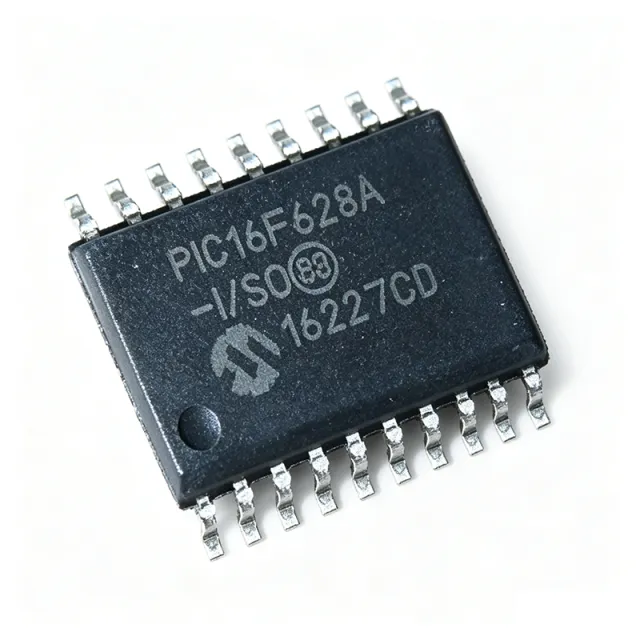
PIC16F628A-I/SO - 8-bit 20MHz 3.5KB Flash MCU | Microchip
PIC16F628A-I/SO

PIC16F628A-I/SO - 8-bit 20MHz 3.5KB Flash MCU | Microchip

The Microchip Technology PIC16F628A-I/SO is an 8-bit CMOS Flash-based microcontroller built on the PIC16 enhanced mid-range core, delivering 20 MHz (200 ns instruction cycle) performance in an 18-pin SOIC package. The device integrates 3.5 KB (2K x 14) of Flash program memory, 224 bytes of RAM, 128 bytes of EEPROM data memory, and a 4 MHz internal oscillator that eliminates the external crystal in many designs. It exposes 16 digital I/O pins, a USART, a capture/compare/PWM module, two analog comparators with a programmable voltage reference, and a brown-out reset circuit on-chip. An 8-bit microcontroller is a single-chip computer that fetches 8-bit-wide data over an 8-bit internal data path while typically using a wider instruction word. The PIC16F628A uses a 14-bit-wide Harvard instruction word, meaning instructions and data travel on separate buses so the CPU can prefetch the next instruction while completing the current one. Within the broader taxonomy, this part sits at: PIC16F628A -> PIC16F62x family -> PIC16 enhanced mid-range MCU -> 8-bit microcontroller -> Microcontroller (MCU) -> Integrated Circuit. The 'F' suffix indicates Flash program memory, allowing in-circuit serial programming via ICSP for prototyping and field updates. Key differentiating features include nanoWatt power management with multiple idle/sleep modes that drop supply current to the low-microamp range, an internal 4 MHz oscillator accurate enough for UART baud generation without external timing components, two comparators with programmable references that implement op-amp-like analog signal conditioning without external ICs, and a USART for asynchronous serial communication. The 'I' suffix indicates the industrial operating-temperature grade of -40 °C to +85 °C, while the 'SO' suffix denotes the 18-pin 7.5 mm SOIC plastic package. Architecturally, the part implements a RISC-style instruction set of 35 single-word instructions, an eight-level deep hardware stack, and direct/indirect addressing modes with a single-cycle multiplication assist. The integrated peripherals are mapped through a linear I/O register map that simplifies C and assembly firmware development in MPLAB X with the XC8 compiler. Typical applications include automotive body and convenience modules, white-goods and appliance control boards, security and access-control panels, low-end consumer electronics, hobby projects, and any battery-powered sensor node that benefits from the nanoWatt sleep modes. The wide 4.5 V to 5.5 V supply range and integrated analog comparators make it equally at home in industrial sensor-interface designs. When designing with this MCU, reserve the ICSPDAT/ICSPCLK pins (RB6/RB7) for the in-circuit serial programming header so the device can be re-flashed on the assembled PCB. Place a 0.1 µF decoupling capacitor within 5 mm of VDD, keep analog comparator inputs short, and avoid toggling the MCLR pin while programming. For the 4 MHz internal oscillator, verify UART baud-rate error against the chosen BAUD value before relying on asynchronous serial links. This page synthesizes verified distributor pricing, pin-compatible drop-in alternatives sourced from Microchip's own cross-reference and FindMyChip, and practical design notes that complement the manufacturer datasheet.

USD $2.32 お問い合わせ
PIC16F628A-I/SS - 8-Bit 20MHz 3.5KB Flash MCU 20-SSOP | Microchip
PIC16F628A-I/SS

PIC16F628A-I/SS - 8-Bit 20MHz 3.5KB Flash MCU 20-SSOP | Microchip

The Microchip Technology PIC16F628A-I/SS is an 8-bit Flash-based CMOS microcontroller in a 20-pin SSOP package, featuring a 20MHz maximum clock speed, 3.5KB (2K x 14) of Flash program memory, 224 bytes of RAM, and 128 bytes of EEPROM data memory. According to the Microchip product page, the device integrates a 4MHz internal oscillator, a hardware USART, a capture/compare/PWM module, two analog comparators, and a programmable voltage reference, all in a small-outline surface-mount form factor. A PIC (Peripheral Interface Controller) microcontroller is a class of 8-bit RISC microcontrollers originally developed by General Instrument's Microelectronics Division and popularized by Microchip Technology. PIC microcontrollers occupy a middle position in the embedded taxonomy: simpler than 32-bit ARM Cortex-M parts but more capable than 4-bit devices, they are widely used in cost-sensitive, deterministic, low-power embedded designs spanning automotive, industrial, appliance, and consumer markets. Within Microchip's portfolio, the PIC16F family sits between the baseline PIC10/12 families and the higher-performance PIC18 and dsPIC families. The PIC16F628A is engineered as the modernized successor to the iconic PIC16F84A, retaining the same 14-bit instruction word and Harvard architecture but adding a USART, internal oscillator, two comparators, PWM module, and significantly more program and data memory. The "I" suffix denotes the industrial temperature range of -40C to +85C, and the "/SS" suffix specifies the 20-pin SSOP package. The integrated 4MHz internal oscillator eliminates the need for an external crystal in many designs, reducing BOM cost and PCB area. The 128 bytes of onboard EEPROM provide non-volatile data storage for user-configurable parameters. The Harvard architecture separates program and data memory, with a 14-bit-wide instruction bus and an 8-bit-wide data bus, allowing instruction fetch and data access to occur in the same clock cycle. The device supports up to 16 I/O pins, three timers, and multiple interrupt sources, with eight hardware stack levels enabling nested subroutine calls. nanoWatt Technology provides multiple power-managed operating modes including run, idle, and sleep, with typical sleep current in the microamp range for battery-powered applications. Typical applications include automotive body electronics and sensor interfaces, industrial control and remote sensing, white goods and home appliances, consumer electronics, lighting control, and metering. The combination of integrated peripherals and small package makes it well-suited for space-constrained designs where an external crystal is undesirable. When designing with this part, ensure the supply voltage stays within 3.0V to 5.5V for the F-version; some legacy variants specify a narrower 4.5V-5.5V range, so verify against the specific device marking. In-circuit serial programming (ICSP) requires two pins (RB6/RB7) which must be accessible on the PCB for production programming. This page consolidates distributor pricing, drop-in same-package alternatives, and design notes sourced from the manufacturer datasheet, giving procurement and design engineers a single reference that typical catalog pages do not provide.

見積もり お問い合わせ
PIC16F628AT-E/SO - 8-bit 20MHz 3.5KB Flash MCU | Microchip
PIC16F628AT-E/SO

PIC16F628AT-E/SO - 8-bit 20MHz 3.5KB Flash MCU | Microchip

The Microchip Technology PIC16F628AT-E/SO is an 8-bit flash-based CMOS microcontroller built on the PIC16 enhanced mid-range RISC core, packaged in a tape-and-reel 18-pin SOIC. It delivers 20MHz maximum clock speed, 3.5KB (2K x 14 words) of flash program memory, 224 bytes of RAM, and 128 bytes of EEPROM data memory. The 'T' suffix indicates tape-and-reel packaging, while the 'E' denotes the extended industrial temperature grade of -40C to +125C, and the /SO package code marks the 18-pin Small Outline IC. An 8-bit microcontroller (MCU) is a single-chip computer that integrates a CPU, program memory (flash/ROM), data memory (RAM), non-volatile data storage (EEPROM), and a set of peripherals (timers, ADC, comparators, communication interfaces) into one package. Within the broader taxonomy, the PIC16F628A belongs to the 8-bit MCU family -> microcontroller -> embedded processor -> semiconductor. Its RISC architecture, 35 single-word instruction set, and 200ns instruction cycle make it a workhorse for cost-sensitive embedded designs, sitting in the same category as 8051 and AVR MCUs but with Microchip's distinctive peripheral integration. Key differentiating features include nanoWatt power management for low-power sleep modes, an internal 4MHz oscillator with calibration, two analog comparators, a capture/compare/PWM (CCP) module, a USART for asynchronous serial communication, and 16 I/O pins with individually programmable pull-ups and interrupt-on-change. The wide 3.0V-5.5V supply range allows direct operation from a 5V rail or from a single Li-Ion cell. The device is code- and feature-compatible with the PIC16F628 and PIC16C62XA families for migration paths. Typical applications span automotive interior modules (with the E temperature grade), industrial sensor interfaces, low-cost remote controls, appliance control boards, and battery-powered instruments. Engineers value the PIC16F628AT-E/SO for its compact 18-pin footprint, robust peripheral set, and the mature MPLAB X toolchain ecosystem. A key design consideration is selecting between the internal 4MHz oscillator and an external crystal: the internal RC saves two pins but introduces a 1% accuracy limit; for USART baud-rate stability, an external crystal is typically required. The /SO package dissipates roughly 800mW at full 20MHz activity, so thermal relief on a moderate copper pour is recommended for extended industrial operation. This page synthesizes distributor pricing, drop-in alternatives from the same PIC16F628A family, and practical design notes that go beyond the manufacturer datasheet.

見積もり お問い合わせ
PIC16F628AT-E/SS - 8-bit MCU 3.5KB Flash 20MHz SSOP-20
PIC16F628AT-E/SS

PIC16F628AT-E/SS - 8-bit MCU 3.5KB Flash 20MHz SSOP-20

The Microchip Technology PIC16F628AT-E/SS is a flash-based, 8-bit CMOS microcontroller from the PIC® 16F family, integrating 3.5 KB (2K x 14) of flash program memory, 224 bytes of SRAM, and 128 bytes of EEPROM data memory in a 20-pin SSOP package. The 'T' suffix denotes tape-and-reel packaging and the 'E' denotes the extended operating temperature range (-40 °C to +125 °C); it executes instructions at a 20 MHz clock rate with a 200 ns instruction cycle for deterministic real-time control. An 8-bit microcontroller (MCU) is a single-chip computer that integrates a CPU, non-volatile program memory, volatile data memory, and peripherals on one die. Within the broader taxonomy, the PIC16F628A sits under PIC16 mid-range family -> 8-bit PIC MCU -> microcontroller -> embedded processor -> semiconductor. The mid-range core uses a 14-bit instruction word with only 35 single-word instructions, making assembly and C programming accessible; its nanoWatt technology delivers dynamic and sleep power management modes that suit battery-powered nodes. Key features include an internal 4 MHz precision oscillator (selectable between 4 MHz and 48 kHz), two analog comparators with a programmable voltage reference, a USART for serial communication, a Capture/Compare/PWM (CCP) module, and a 16-bit timer/counter (TMR1) plus an 8-bit timer (TMR0/TMR2). The device also supports in-circuit serial programming (ICSP) for field upgrades and on-chip debug for in-system bring-up. Architecturally, the PIC16F628A uses a Harvard-style bus with separate program and data paths, allowing instruction fetch and data access in the same cycle. The CMOS process combined with nanoWatt sleep modes brings active current down to a few hundred microamperes at 4 MHz and sleep current below 1 µA, enabling years of operation from coin cells in duty-cycled sensing roles. Typical applications include consumer remote controls, appliance control panels, low-end sensor signal conditioning, hobby robotics, automotive body-electronics nodes (non-safety), and battery-operated IoT endpoints. The 11 usable I/O pins, on-chip comparator, and PWM capability also support simple closed-loop control such as fan-speed regulation, LED dimming, and brushed-DC motor drive. A key design consideration is supply voltage: this part operates from 4.5 V to 5.5 V. Engineers designing 3.3 V-only systems should migrate to the PIC16F182x or PIC16F188xx families rather than use level shifters. Always place a 0.1 µF decoupling capacitor within 5 mm of VDD, and reserve the MCLR pin for a proper reset network. This page synthesizes distributor pricing, cross-manufacturer drop-in alternatives, and engineering design notes that go beyond the manufacturer datasheet, giving procurement and design teams a single source of truth for sourcing PIC16F628AT-E/SS.

見積もり お問い合わせ
PIC16F628AT-I/SO - 8-Bit 20MHz 3.5KB Flash MCU | Microchip
PIC16F628AT-I/SO

PIC16F628AT-I/SO - 8-Bit 20MHz 3.5KB Flash MCU | Microchip

The Microchip PIC16F628AT-I/SO is an 8-bit PIC RISC flash microcontroller delivering 20MHz CPU performance with 3.5KB (2K x 14) on-chip flash program memory in an 18-pin SOIC package. It operates from a 3.0V to 5.5V supply, integrates 224 bytes of RAM and 128 bytes of EEPROM data memory, and offers 16 digital I/O pins plus a nanoWatt power-managed peripheral set. An 8-bit PIC microcontroller (MCU) is a single-chip computer built around Microchip's RISC (Reduced Instruction Set Computer) Harvard architecture. It belongs to the microcontroller category, itself a sub-family of microprocessors, and sits within the embedded IC hierarchy as one of the most widely deployed low-cost control cores for consumer, industrial, and automotive subsystems. The 8-bit designation means the ALU and data bus are 8 bits wide; the 35 single-word instruction set keeps code density high and learning curves short. Key features include an internal 4MHz oscillator (with software-selectable 37kHz LF oscillator), two analog comparators, a capture/compare/PWM (CCP) module, USART for asynchronous serial, 10-bit timer resources, nanoWatt sleep modes that drop quiescent current below 1µA in real designs, and a hardware USART supporting RS-232/485 links. The 18-SOIC wide-body package measures approximately 11.7mm x 7.5mm with 1.27mm pitch. The architecture pairs a 14-bit instruction word with separate program and data buses, allowing simultaneous fetch and access. Flash in-circuit serial programming (ICSP) enables firmware updates in the field, while the wide operating range makes it tolerant of unregulated supplies. Code protection, brown-out reset, and a watchdog timer reinforce reliability in unattended applications. Typical applications include hobby and educational boards, low-volume automation controllers, LED drivers, automotive accessories (with appropriate Q-grade variants), sensor signal conditioning, IR remote receivers, small appliance control, and battery-powered metering. The 16 I/O easily drive character LCDs or multiple relays. When designing, derate maximum load per pin to 20mA source/sink and 200mA per VDD/VSS to stay within absolute limits, and use the internal oscillator to minimize BOM. Compare pin count and ADC requirements against the larger PIC16F88A or PIC18F family for upgrade paths. This page synthesizes distributor pricing, drop-in alternatives, and practical design notes not found in the manufacturer datasheet.

見積もり お問い合わせ
PIC16F628T-04/SO - 4MHz 8-Bit Flash MCU 3.5KB SOIC-18
PIC16F628T-04/SO

PIC16F628T-04/SO - 4MHz 8-Bit Flash MCU 3.5KB SOIC-18

The Microchip Technology PIC16F628T-04/SO is an 8-bit PIC16 family flash-based CMOS microcontroller built on Microchip's enhanced mid-range architecture and packaged in a 18-pin SOIC (SO) wide-body tape-and-reel format. It runs at 4 MHz with a 200 ns instruction cycle, integrates 3.5 KB (2K x 14) of self-programmable flash program memory, 224 bytes of RAM, and 128 bytes of EEPROM data memory, and exposes 16 digital I/O lines across PORTA and PORTB. The supply voltage range covers 3.0 V to 5.5 V for F-version parts, supporting both 3.3 V and 5 V system designs. A microcontroller (MCU) is a single-chip computer that integrates a CPU, memory and programmable I/O peripherals; the PIC16F628 family belongs to Microchip's 8-bit PIC® RISC architecture family, which traces its lineage from the PIC1650 and remains one of the longest-deployed 8-bit MCU cores in industrial, automotive and consumer electronics. The PIC16F628 series was the first mid-range PIC family to migrate from EPROM/ROM to flash, enabling in-circuit reprogramming via ICSP. The hierarchy: 8-bit MCU -> PIC® RISC MCU -> PIC16F mid-range family -> PIC16F628 sub-family. Key features include an internal 4 MHz RC oscillator with calibration, power-on reset (POR), power-up timer (PWRT), oscillator start-up timer (OST), brown-out detect (BOD), watchdog timer (WDT) with its own on-chip RC oscillator, and programmable weak pull-ups on PORTB. Two analog comparators with programmable on-chip voltage reference and a capture/compare/PWM (CCP) peripheral extend its analog/mixed-signal capability beyond pure digital I/O. The -04 speed grade (4 MHz) distinguishes it from the -20 (20 MHz) sibling in the same silicon. The enhanced mid-range core adds hardware interrupt context saving, a deeper hardware stack (8 levels), and an extended instruction set with 35 single-word instructions, enabling compact C and assembly firmware. ICSP (in-circuit serial programming) and ICD (in-circuit debugging) via RB6/RB7 free the I/O pins for end-application use rather than burning them as programming interfaces. Internal EEPROM permits 1 M erase/write cycles, supporting data logging and user-configurable parameter storage without external memory. Typical applications include automotive and industrial sensor interfaces, low-power remote control transmitters, appliance controllers, small-form-factor motor control loops, simple protocol bridges (UART/I2C firmware conversion), and battery-powered instrumentation where the wide 3.0-5.5 V supply range and internal oscillator simplify BOM. The part remains a benchmark for hobbyist, education and legacy drop-in designs that migrate from PIC16C84/16F84 to a higher-memory, more feature-rich flash MCU. When designing with this MCU, note that the -04 grade limits operation to 4 MHz (DC-20 ns); design firmware timing budgets around the 200 ns instruction execution, and account for the SOIC-18 thermal envelope when used in sealed enclosures. Microchip's MPLAB X IDE and the PICkit 5 in-circuit debugger support this device for development and production programming.

見積もり お問い合わせ
PIC16F628T-04/SS - 8-Bit 4MHz PIC MCU 3.5KB Flash SSOP-20 | Microchip
PIC16F628T-04/SS

PIC16F628T-04/SS - 8-Bit 4MHz PIC MCU 3.5KB Flash SSOP-20 | Microchip

The Microchip Technology PIC16F628T-04/SS is an 8-bit flash-based CMOS microcontroller (MCU) from the PIC16F family, featuring a 4 MHz internal oscillator equivalent, 3.5 KB of Flash program memory (2K x 14 words), 224 bytes of RAM, and 128 bytes of EEPROM, all housed in a 20-pin SSOP package supplied on tape-and-reel. The part is rated for 16 I/O lines with high current sink/source capability for direct LED drive, an analog comparator module with programmable on-chip voltage reference, two 8-bit timers plus one 16-bit timer, a 10-bit PWM module, a USART with on-chip baud-rate generator, and a programmable brown-out detector (BOD) with power-on reset and power-up timer for robust startup behavior. A microcontroller (MCU) is a single-chip computer that integrates a CPU core, program memory, working RAM, peripherals, and interrupt logic into one IC, enabling compact embedded control. The PIC16F628 belongs to the enhanced mid-range PIC16 architecture, sits inside the PIC microcontroller product line, and ultimately within the broader category of microcontrollers and embedded processors. It is widely used as a small-footprint, deterministic 8-bit controller for cost-sensitive designs. Key features include nanoWatt technology for low-power operation, an internal 4 MHz RC oscillator with software calibration, a Watchdog Timer with its own on-chip RC oscillator, multiplexed MCLR pin, programmable weak pull-ups on PORTB, and an in-circuit serial programming (ICSP) interface that allows firmware updates after PCB assembly. The device operates across 3.0 V to 5.5 V, supports DC to 20 MHz external clock operation, and is fully static. The PIC16F628T-04/SS uses a Harvard RISC architecture with a single accumulator and a 14-bit instruction word, providing deterministic interrupt response and instruction timing. Its CMOS process technology gives low quiescent current and high code-density, while the SSOP-20 package offers a small footprint for compact PCB designs. Compared with the PIC16F84, it adds a USART, two comparators with a programmable VREF, PWM hardware, and EEPROM data memory. Typical applications include appliance controls, hobby and educational projects, sensor signal conditioning, low-end motor and lighting controllers, and battery-powered instrumentation. The combination of internal oscillator, brown-out reset, and analog comparators allows designers to reduce external components and shrink BOM cost. The part is also a strong fit for migrating legacy PIC16F84A designs where additional peripherals are required. When designing with this device, note that the "-04" suffix denotes the 4 MHz rated version; designers requiring higher throughput should consider the PIC16F628-20 variant (20 MHz) or the pin-compatible PIC16F628A family with enhanced peripherals. Ensure decoupling (100 nF plus bulk) is placed close to VDD/SS, and respect the in-circuit programming pinout so that no production components block ICSP access. This page synthesizes verified distributor pricing, drop-in alternatives drawn from the same PIC16F family, and practical design notes not consolidated in the manufacturer datasheet, delivering the cross-reference and trade-off analysis engineers actually need before placing an order.

見積もり お問い合わせ
PIC16F628T-04E/SS - 4MHz 8-Bit FLASH MCU, 3.5KB | Microchip
PIC16F628T-04E/SS

PIC16F628T-04E/SS - 4MHz 8-Bit FLASH MCU, 3.5KB | Microchip

The Microchip Technology PIC16F628T-04E/SS is an 8-bit flash-based CMOS microcontroller belonging to the PIC16F family, featuring a RISC architecture with 35 single-word instructions and a 4 MHz internal oscillator frequency rating. The device integrates 3.5 KB (2K x 14) of flash program memory, 224 bytes of SRAM data memory, and 128 bytes of EEPROM, packaged in a 20-pin SSOP with a body width of 5.30 mm. It supports 16 I/O pins with individual direction control, each capable of high current sink/source for direct LED drive. A microcontroller (MCU) is a single-chip computer that contains a processor core, memory, and programmable input/output peripherals. PIC microcontrollers from Microchip are widely used in embedded applications because of their compact instruction set, low power consumption, and broad peripheral integration. The PIC16F628 family sits in the mid-range PIC lineup, balancing cost, code density, and on-chip resources for industrial and consumer designs. Key features include two analog comparators with a programmable on-chip voltage reference, a Capture/Compare/PWM (CCP) module, a USART for asynchronous serial communication, and a Watchdog Timer with its own on-chip RC oscillator. Brown-out Detect (BOD), Power-on Reset (POR), Power-up Timer (PWRT), and Oscillator Start-up Timer (OST) are integrated for robust operation. The supply voltage range is 2.0 V to 5.5 V (extended) depending on the frequency variant. Architecturally, the PIC16F628 uses a Harvard bus with separate program and data paths, a 14-bit instruction word, and a two-stage pipeline. Internal peripherals are accessed via a memory-mapped register file. The 'T' suffix indicates tape-and-reel packaging for high-volume assembly, and the 'E' code designates the extended temperature grade of -40 °C to +125 °C. 'SS' refers to the SSOP-20 package. Typical applications include HVAC control, appliance interfaces, automotive interior subsystems, security and alarm panels, low-end motor control, and battery-powered sensor nodes. The combination of internal oscillator, comparators, USART, and EEPROM in a 20-pin SSOP makes the device a strong fit for compact, cost-sensitive designs that require a reliable 8-bit core. When designing with this part, ensure that the MCLR pin is properly handled for in-circuit serial programming. Decoupling capacitors of 0.1 µF should be placed as close as possible to VDD, and the oscillator configuration bits must be set correctly for the chosen clock mode. This page synthesizes distributor pricing, drop-in alternatives, and practical design notes not found in the manufacturer datasheet alone.

見積もり お問い合わせ
PIC16F628T-04I/SO - 4MHz 3.5KB Flash 8-bit MCU | Microchip
PIC16F628T-04I/SO

PIC16F628T-04I/SO - 4MHz 3.5KB Flash 8-bit MCU | Microchip

The Microchip Technology PIC16F628T-04I/SO is a flash-based 8-bit CMOS microcontroller built on the PIC16 mid-range architecture, packaged in an 18-pin SOIC (SO) wide-body tape-and-reel format. It integrates 3.5KB (2K x 14) of flash program memory, 224 bytes of RAM, and 128 bytes of EEPROM, with a maximum CPU clock rate of 4 MHz (the "-04" speed grade) or up to 20 MHz for the -20 variant. The -04I suffix denotes the industrial temperature grade (-40C to +85C). According to the verified distributor listings, the part delivers 16 I/O pins with individual direction control, high-current sink/source drivers capable of direct LED drive, two on-chip analog comparators with programmable voltage reference, and a multiplexed MCLR reset pin. A PIC (Peripheral Interface Controller) microcontroller is a Harvard-architecture RISC MCU whose program and data buses are separate, allowing a single instruction cycle per fetch. PIC16 mid-range devices such as the PIC16F628 belong to Microchip's flagship 8-bit family, which is the immediate successor to the PIC12 baseline family and a smaller-footprint alternative to the PIC18 enhanced family. Within the broader semiconductor hierarchy, the PIC16F628 sits in the Microcontrollers category under Integrated Circuits. Key features include Power-on Reset (POR), Power-up Timer (PWRT), Oscillator Start-up Timer (OST), Brown-out Detect (BOD), Watchdog Timer (WDT) with its own on-chip RC oscillator, and programmable weak pull-ups on PORTB. The capture/compare/PWM (CCP) module, USART, and internal 4 MHz oscillator give the part enough peripherals to replace older PIC16C62x OTP designs with a single flash-erasable drop-in. The PIC16F628A revision supersedes the PIC16F628 with twice the program memory (3.5KB vs 1.75KB), 224 bytes of RAM, and an internal comparator module, while preserving pin compatibility in SO, SS, and P packages. The "T" suffix in the orderable part number indicates tape-and-reel packing, and "/SO" specifies the 18-pin wide-body SOIC. Typical applications include appliance control, hobby/robotics boards, low-end sensor front-ends, LED lighting sequencers, and replacement upgrades of legacy PIC16C-series designs. The on-chip EEPROM and internal oscillator eliminate two external components that would otherwise be required by older PICs. When designing with this part, ensure the input voltage stays within 3.0V to 5.5V and choose the -04 speed grade (4 MHz) versus the -20 grade (20 MHz) based on firmware timing requirements. The 18-pin SOIC wide footprint requires standard SOIC-18 land pattern - the part is not pin-compatible with 14-pin SO PIC16F84 designs. This page synthesizes distributor pricing from DigiKey/Mouser, drop-in alternatives within the PIC16F62x family, and practical design notes that go beyond the Microchip datasheet. All pricing is listed as of 2026-09-21.

見積もり お問い合わせ
PIC16F628T-04I/SS - 8-Bit Flash MCU, 4MHz, 3.5KB | Microchip
PIC16F628T-04I/SS

PIC16F628T-04I/SS - 8-Bit Flash MCU, 4MHz, 3.5KB | Microchip

The Microchip PIC16F628T-04I/SS is a flash-based 8-bit CMOS microcontroller from the PIC16F62X family, packaged in a 20-pin SSOP (5.30 mm body width) and qualified to the industrial -40C to +85C temperature range. It integrates 3.5 KB of flash program memory (2K x 14), 224 bytes of RAM, and 128 bytes of EEPROM, runs at up to 4 MHz instruction rate from a 3.0 V to 5.5 V supply, and offers 16 bidirectional I/O pins with high current sink/source capability for direct LED drive. Two on-chip analog comparators with a programmable voltage reference and internal USART, CCP, and 8/16-bit timer peripherals round out a feature set designed for legacy through mid-range embedded designs. A microcontroller (MCU) is a single-chip computer that integrates a CPU core, program and data memory, I/O peripherals, and interrupt logic on one die. The PIC16F62X family uses Microchip's enhanced mid-range 8-bit RISC core with a 14-bit instruction word, sitting in the product hierarchy of microcontroller -> 8-bit MCU -> PIC16 family -> PIC16F6XX flash series -> PIC16F62X. This category serves cost-sensitive and deterministic real-time control tasks such as appliance control, sensor interfacing, and battery-powered logic replacement. Key features include an internal 4 MHz oscillator with calibration, dual analog comparators with programmable VREF, a hardware USART for asynchronous serial communication, Capture/Compare/PWM (CCP) modules, power-on reset (POR), brown-out detect (BOD), a watchdog timer with its own RC oscillator, programmable weak pull-ups on PORTB, and in-circuit serial programming (ICSP) via the multiplexed MCLR pin. These features minimize external component count for small-form-factor designs. The architecture combines a Harvard bus, 35 single-cycle instructions, and direct/indirect addressing modes with peripheral-rich silicon. Compared to the older 16C/16F baseline, the PIC16F628A generation adds internal oscillator calibration and improved flash endurance, making it suitable for low-volume and field-upgradable designs. Typical applications include appliance and white-goods control boards, sensor signal conditioning front-ends, LED lighting controllers, low-end motor drivers (via CCP/PWM), hobby and educational hardware (Arduino predecessor designs), battery chargers, and small industrial monitoring nodes where deterministic 8-bit performance is sufficient. When designing with this device, budget the oscillator start-up time and BOD reset behavior in power-sequenced systems, and ensure decoupling on VDD/VSS is placed within 5 mm of the IC pins. For new designs, evaluate the pin-compatible PIC16F628A-I/SS or PIC16F88 upgrades for enhanced peripherals, otherwise the PIC16F628T-04I/SS remains a cost-optimized choice. This page synthesizes distributor pricing, cross-reference candidates, and practical design notes not found in the manufacturer datasheet alone.

見積もり お問い合わせ
PIC16F628T-20/SO - 20MHz 8-Bit Flash MCU 3.5KB | Microchip
PIC16F628T-20/SO

PIC16F628T-20/SO - 20MHz 8-Bit Flash MCU 3.5KB | Microchip

The Microchip Technology PIC16F628T-20/SO is an 8-bit RISC flash-based microcontroller with 3.5KB (2K x 14) of program memory, 224 bytes of RAM, and 128 bytes of EEPROM, housed in an 18-pin SOIC (W) package supplied on Tape and Reel. It operates up to 20 MHz instruction cycle, supports 16 I/O pins with individual direction control, and integrates two analog comparators with a programmable on-chip voltage reference (VREF). The "T" suffix denotes Tape & Reel packaging, while "/SO" specifies the 18-lead Small Outline IC package. A PIC microcontroller (peripheral interface controller) is a family of 8-bit, 16-bit, and 32-bit RISC microcontrollers built around a Harvard architecture with separate program and data buses. The PIC16F628 belongs to the mid-range PIC16 family, which uses a 14-bit instruction word optimized for deterministic, single-cycle execution. PIC MCUs sit within the broader taxonomy of embedded microcontrollers, sitting beneath ARM Cortex-M and AVR families but offering lower cost, simpler toolchains, and wide availability for cost-sensitive embedded designs. Key differentiating specifications include 3.3V/5V dual-voltage operation, hardware USART for serial communication, 16 I/O pins with 25 mA sink/source capability for direct LED drive, capture/compare/PWM (CCP) module, and nanoWatt power management for low-power sleep modes. The integrated VREF module eliminates external reference components in comparator-based designs. The 18-pin SOIC package provides drop-in compatibility with the broader PIC16F62X and PIC16F628A family while enabling surface-mount manufacturing. Typical applications include consumer appliance control, automotive body electronics, lighting controllers, sensor signal conditioning, and battery-powered remote controls. Industrial uses span small motor control loops, security alarm panels, and HVAC damper actuators. The combination of low-cost, on-chip EEPROM, USART, and analog comparators makes it well suited to designs that previously required multiple discrete ICs. When designing with this part, place a 100 nF decoupling capacitor within 5 mm of VDD and tie the MCLR pin to VDD through a 10 kohm resistor to ensure clean reset behavior. Verify the oscillator configuration bits match your crystal or resonator choice; using the internal 4 MHz oscillator eliminates two external pins.

見積もり お問い合わせ