電源管理
サブカテゴリ
製品 (2819)

L9980 - Automotive Quad Low-Side Driver | STMicroelectronics
The L9980 is a quad low-side driver IC from STMicroelectronics, designed for automotive and industrial applications requiring robust, high-current switching. It integrates four independent low-side drivers with built-in protection features, making it suitable for driving resistive, inductive, and capacitive loads such as relays, solenoids, and LEDs. The device operates over a wide supply voltage range and is available in a PowerSO-20 package, offering excellent thermal performance for high-current applications. A low-side driver is a type of power switch that connects the load to ground when activated, with the load connected between the positive supply and the driver output. In automotive systems, low-side drivers are commonly used to control actuators, lamps, and motors, where the load is referenced to the battery positive rail. The L9980 belongs to the family of smart power switches, which integrate protection and diagnostic features to enhance system reliability and reduce external component count. Key features of the L9980 include four independent output channels, each capable of delivering up to 1.5 A continuous current, with a maximum supply voltage of 40 V. The device features overcurrent protection, thermal shutdown, and undervoltage lockout, ensuring safe operation under fault conditions. Additionally, the L9980 provides a serial peripheral interface (SPI) for advanced diagnostics and control, allowing the microcontroller to monitor output status and detect faults in real time. From a technical perspective, the L9980 utilizes a smart power technology that integrates CMOS control logic with high-voltage power MOSFETs on a single die. This architecture enables efficient switching with low on-resistance, minimizing power dissipation and heat generation. The SPI interface supports daisy-chaining of multiple devices, simplifying PCB layout in multi-channel systems. The device also features a sleep mode with very low quiescent current, making it suitable for battery-powered applications where power consumption is critical. Typical applications for the L9980 include automotive body control modules, where it drives exterior and interior lighting, relays for power windows and door locks, and solenoid valves in transmission control units. It is also used in industrial automation for controlling actuators and valves, and in smart home systems for driving LED lighting and motorized blinds. The device's robust protection features and wide operating temperature range (-40°C to +150°C) make it ideal for harsh environments. When designing with the L9980, it is essential to ensure proper PCB layout with adequate copper area for heat dissipation, especially when driving high currents. The SPI interface should be isolated from high-current traces to minimize noise coupling. Additionally, external flyback diodes are recommended when driving inductive loads to prevent voltage spikes that could damage the device. The L9980's built-in protection features provide a robust solution for demanding applications, but careful attention to thermal management and layout is critical for reliable operation.

L9980-TR - Automotive Quad Low-Side Driver | STMicroelectronics
The L9980-TR is a monolithic quad low-side driver IC from STMicroelectronics, designed for automotive and industrial applications requiring robust, high-current switching. It integrates four independent low-side power outputs with built-in protection features, making it suitable for driving resistive, inductive, and capacitive loads such as relays, solenoids, and lamps. The device operates over a wide supply voltage range and is housed in a compact surface-mount package, enabling space-efficient PCB designs. A low-side driver is a type of power switch that connects the load to ground when activated, with the load typically connected between the positive supply and the driver output. In automotive systems, low-side drivers are essential for controlling actuators, indicators, and other electrical loads, providing a safe and efficient means of switching high currents. The L9980-TR integrates four such drivers in a single package, reducing component count and simplifying system design. Key features of the L9980-TR include four independent output channels, each capable of handling continuous currents up to 1.5 A, with a maximum supply voltage of 40 V. The device incorporates overcurrent protection, thermal shutdown, and output clamping for inductive loads, ensuring reliable operation under fault conditions. Its logic-level inputs are compatible with 3.3 V and 5 V microcontrollers, facilitating direct interfacing with modern automotive ECUs. From a technical perspective, the L9980-TR utilizes a robust bipolar-CMOS-DMOS (BCD) process technology, which combines low power consumption with high current capability. The outputs are designed to sink current, with a low saturation voltage to minimize power dissipation. The device also features a diagnostic output that can be used to monitor the status of each channel, enabling fault detection and system-level diagnostics. This makes the L9980-TR particularly well-suited for safety-critical applications where load integrity must be continuously verified. Typical applications include automotive body control modules, where it drives exterior lighting, wiper motors, and door lock actuators; industrial PLCs for controlling solenoids and relays; and general-purpose switching in 12 V and 24 V systems. The wide operating temperature range of -40°C to +150°C ensures reliable performance in harsh environments. When designing with the L9980-TR, it is important to consider the thermal dissipation of the package, especially when driving multiple channels at high current simultaneously. Adequate PCB copper area and proper layout are essential to keep the junction temperature within safe limits. Additionally, the use of freewheeling diodes or the built-in output clamping is recommended when driving inductive loads to prevent voltage spikes.
L9981 - Automotive Quad Low-Side Driver | STMicroelectronics
The L9981 is a quad low-side driver IC from STMicroelectronics, designed for automotive and industrial applications requiring robust, high-current switching. It integrates four independent low-side power switches with built-in protection features, making it suitable for driving resistive, inductive, and capacitive loads such as relays, solenoids, and lamps. The device operates over a wide supply voltage range and is available in a PowerSO-20 package, offering excellent thermal performance for high-current applications. A low-side driver is a type of power switch that connects the load to ground when activated, allowing the microcontroller to control high-power loads with minimal logic-level signals. In automotive systems, low-side drivers are essential for controlling actuators, motors, and lighting, where they provide a safe and efficient interface between the electronic control unit (ECU) and the physical load. The L9981 fits into the broader category of power management ICs, specifically within the smart power switch family, which combines power switching with diagnostic and protection functions. Key features of the L9981 include four independent output channels, each capable of delivering up to 1.5 A continuous current, with a maximum supply voltage of 40 V. The device incorporates overcurrent, overtemperature, and short-circuit protection, ensuring reliable operation in harsh environments. It also features a serial peripheral interface (SPI) for advanced diagnostics and control, allowing the microcontroller to monitor output status and fault conditions in real time. The PowerSO-20 package provides a low thermal resistance of 35 °C/W, enabling efficient heat dissipation without external heatsinks in moderate power applications. The L9981 utilizes a robust BCD (Bipolar-CMOS-DMOS) process technology, which combines the benefits of bipolar, CMOS, and DMOS transistors to achieve high current capability, low on-resistance, and precise analog control. This architecture ensures stable performance across temperature and supply variations, making it suitable for automotive-grade applications that require high reliability. The SPI interface simplifies system integration, reducing the number of GPIO pins needed and enabling advanced features such as PWM control and fault reporting. Typical applications include automotive body control modules, where the L9981 drives exterior lighting, wiper motors, and door locks; industrial automation for controlling solenoids and valves; and general-purpose power switching in embedded systems. The device's wide operating temperature range of -40°C to +150°C ensures reliable operation in extreme conditions. When designing with the L9981, it is critical to ensure proper PCB layout with adequate copper area for thermal dissipation, especially when driving high currents. Additionally, the SPI interface requires careful timing and pull-up resistors on the data lines to ensure reliable communication. The device's protection features should be configured appropriately to match the load characteristics and prevent false triggering.

L9981-TR - Automotive Quad Low-Side Driver | STMicroelectronics
The L9981-TR is a quad low-side driver IC from STMicroelectronics, designed for automotive and industrial applications requiring robust, high-current switching. It integrates four independent low-side outputs with built-in protection features, making it suitable for driving resistive, inductive, and capacitive loads such as relays, solenoids, and LEDs. The device operates over a wide supply voltage range and is available in a compact surface-mount package, enabling space-efficient PCB designs. A low-side driver is a type of power switch that connects the load to ground when activated, allowing the load to be powered from a positive supply rail. In automotive systems, low-side drivers are commonly used to control actuators, lamps, and motors, where the load is connected between the battery positive terminal and the driver output. The L9981-TR belongs to the family of smart power switches, which integrate protection and diagnostic features to enhance system reliability. Key features of the L9981-TR include four independent output channels, each capable of handling continuous currents up to [DATA_NEEDED: maximum output current per channel] A, with built-in overcurrent, overtemperature, and short-circuit protection. The device also features a serial peripheral interface (SPI) for advanced diagnostics and control, allowing real-time monitoring of output status and fault conditions. The operating voltage range is [DATA_NEEDED: supply voltage range] V, and the device is qualified to AEC-Q100 standards for automotive applications. The L9981-TR utilizes a robust BCD (Bipolar-CMOS-DMOS) process technology, which combines high-voltage capability with low on-resistance and fast switching performance. This architecture ensures efficient power delivery and minimizes power dissipation, even at high switching frequencies. The integrated protection features reduce the need for external components, simplifying the overall system design and improving reliability. Typical applications include automotive body control modules, lighting control, relay and solenoid drivers, and industrial automation systems. The device's SPI interface enables seamless integration with microcontrollers, providing enhanced diagnostic capabilities for predictive maintenance and fault detection. The wide operating temperature range of -40°C to +150°C makes it suitable for harsh environments. When designing with the L9981-TR, it is essential to ensure proper thermal management by providing adequate copper area on the PCB for heat dissipation. Additionally, the SPI interface should be configured correctly to enable fault reporting and output control. The device's protection features should be considered in the system design to avoid unintended shutdowns during transient conditions.
L9982 - Automotive Quad Low-Side Driver | STMicroelectronics
The L9982 is an automotive-grade quad low-side driver from STMicroelectronics, designed for driving resistive, inductive, and capacitive loads in 12V and 24V vehicle electrical systems. It integrates four independent low-side power outputs with built-in protection features, making it suitable for controlling relays, solenoids, LEDs, and small motors in body control modules, lighting systems, and actuator drivers. A low-side driver is a power switch that connects the load to ground when activated, with the load connected between the positive supply and the driver output. In automotive systems, low-side drivers are commonly used to switch grounded loads such as lamps, relays, and solenoids, where the control signal from a microcontroller (MCU) activates the driver to sink current. The L9982 belongs to the power management IC family, specifically within the smart power switch category, which integrates logic, protection, and power stages in a single package. Key features of the L9982 include four independent low-side outputs with a typical current capability of 1A per channel, an operating voltage range of 5.5V to 36V, and a low quiescent current for battery-powered applications. Each output includes overcurrent protection, thermal shutdown, and ESD protection, ensuring robust operation in harsh automotive environments. The device is available in a PowerSO-20 package, which provides excellent thermal performance for power dissipation. The L9982 utilizes a vertical power MOSFET technology, enabling low on-resistance (typically 0.5 ohm) and efficient switching. The device is designed to operate over a wide temperature range of -40°C to +150°C, meeting AEC-Q100 automotive qualification standards. The integrated protection features reduce external component count and improve system reliability, making it an ideal choice for automotive body electronics. Typical applications include automotive lighting control (headlamps, tail lamps, interior lights), relay and solenoid drivers for door locks, window lifts, and seat adjustments, and LED lighting modules. The device's ability to handle inductive loads with built-in freewheeling diodes simplifies design and reduces EMI. When designing with the L9982, ensure proper PCB layout with adequate copper area for thermal dissipation, and place decoupling capacitors close to the supply pins. The device's protection features allow direct connection to MCU outputs, but external pull-up resistors may be needed for open-drain configurations.

L9983 - Automotive Li-ion Battery Monitor & Protector | STMicroelectronics
The STMicroelectronics L9983 is a Li-ion battery monitoring and protection chip designed for high-reliability automotive applications and energy storage systems. It integrates passive balancing with programmable channel selection, nine GPIOs for external monitoring and control, and a comprehensive set of fault detection and notification functions to meet safety standard requirements. The device is available in a 64-TQFP-EP (10x10) package, suitable for surface-mount assembly. A battery monitoring IC is a specialized integrated circuit that measures the voltage, current, and temperature of individual cells in a battery pack, enabling state-of-charge (SoC) and state-of-health (SoH) estimation, cell balancing, and protection against overvoltage, undervoltage, and overtemperature conditions. In the hierarchy of battery management systems (BMS), the monitoring IC sits at the cell interface layer, providing accurate data to the system controller, which then manages charging, discharging, and balancing algorithms. The L9983 is a critical component in automotive BMS, ensuring safe and efficient operation of Li-ion battery packs in electric vehicles (EVs), hybrid electric vehicles (HEVs), and stationary energy storage systems. Key features of the L9983 include passive balancing with programmable channel selection, which can operate in both normal and low-power (silent) modes, with automatic termination based on an internal timer. The device integrates nine GPIOs for external monitoring and control, allowing flexible system design. It also provides a comprehensive fault detection and notification mechanism, including overvoltage, undervoltage, overtemperature, and communication faults, which are essential for meeting automotive safety standards such as ISO 26262. The L9963 supports isolated SPI communication, enabling daisy-chaining of multiple devices for high-cell-count battery packs. From a technical architecture perspective, the L9983 employs a high-accuracy ADC for cell voltage measurement, with a typical accuracy of ±2 mV, and supports up to 14 cells in series. The device operates from a supply voltage range of 6V to 60V, making it suitable for 12V to 48V battery systems. The integrated balancing FETs allow passive balancing currents of up to 150 mA per channel, with programmable balancing timers. The device also features a low-power mode with a quiescent current of typically 10 µA, enabling always-on monitoring in automotive applications. Typical applications include battery management systems for electric vehicles, hybrid electric vehicles, and energy storage systems. The L9983 is also used in industrial battery backup systems and uninterruptible power supplies (UPS). Its high accuracy and robust fault detection make it ideal for applications requiring reliable battery monitoring and protection. When designing with the L9983, ensure proper PCB layout for thermal management, as the 64-TQFP-EP package has an exposed pad that must be soldered to a thermal via array. Additionally, use appropriate isolation for SPI communication when daisy-chaining multiple devices, and configure the balancing timers according to the battery chemistry and capacity.
L9984 - Automotive Quad Low-Side Driver | STMicroelectronics
The L9984 is a monolithic quad low-side driver designed by STMicroelectronics for automotive and industrial applications. It integrates four independent low-side power switches with built-in protection features, making it suitable for driving resistive, inductive, and capacitive loads such as relays, solenoids, and lamps. The device operates from a supply voltage range of 4.5V to 40V, with each output capable of sinking up to 1.5A continuous current. The L9984 is available in a PowerSO-20 package, providing excellent thermal performance for high-current switching applications. A low-side driver is a type of power switch that connects the load to ground when activated, allowing the microcontroller to control high-side loads through a simple logic interface. In automotive systems, low-side drivers are essential for controlling actuators, lights, and motors, where the load is connected between the battery positive terminal and the driver output. The L9984 belongs to the family of smart power switches, which integrate protection and diagnostic features to enhance system reliability and reduce external component count. Key features of the L9984 include overcurrent protection, thermal shutdown, and undervoltage lockout, ensuring safe operation under fault conditions. Each channel has an open-load detection capability, which is critical for diagnosing wiring faults in automotive harnesses. The device also features a serial peripheral interface (SPI) for advanced diagnostics and control, allowing the microcontroller to read fault status and control each output independently. The outputs are protected against short-circuit and over-temperature, with a typical overcurrent threshold of 2.5A per channel. The L9984 utilizes a robust BCD (Bipolar-CMOS-DMOS) technology, which combines the benefits of bipolar analog circuits, CMOS logic, and DMOS power transistors. This technology enables high current handling with low on-resistance, typically 0.5 ohm per channel, minimizing power dissipation and improving efficiency. The device is designed to operate over the automotive temperature range of -40°C to +150°C, making it suitable for under-hood applications. The PowerSO-20 package with exposed pad provides a low thermal resistance of 35°C/W, allowing efficient heat dissipation without external heatsinks in moderate power applications. Typical applications include automotive body control modules, lighting control, relay drivers, and solenoid drivers in transmission control units. The L9984 is also used in industrial automation for driving valves and actuators, where its robust protection features ensure reliable operation in harsh environments. The SPI interface enables seamless integration with microcontrollers, providing real-time diagnostics and reducing wiring complexity. When designing with the L9984, it is essential to ensure proper PCB layout with adequate copper area for heat dissipation, especially when driving multiple channels at high current. The exposed pad should be connected to the ground plane with multiple vias to enhance thermal performance. Additionally, the SPI lines should be kept short and shielded to minimize electromagnetic interference, and the supply voltage should be decoupled with a 100nF ceramic capacitor close to the VCC pin.
L9985 - Automotive Quad Low-Side Driver | STMicroelectronics
The L9985 is a quad low-side driver IC from STMicroelectronics, designed for automotive and industrial applications requiring robust, high-current switching. It integrates four independent low-side drivers with built-in protection features, making it suitable for driving resistive, inductive, and capacitive loads such as relays, solenoids, and lamps. The device operates over a wide supply voltage range and is housed in a PowerSO-20 package, offering excellent thermal performance for high-current applications. A low-side driver is a type of power switch that connects the load to ground when activated, with the load connected between the positive supply and the driver output. In automotive systems, low-side drivers are commonly used to control actuators, lamps, and relays, where the load is referenced to the battery positive rail. The L9985 belongs to the family of smart power switches, which integrate protection and diagnostic features to enhance system reliability. Key features of the L9985 include four independent output channels, each capable of delivering up to 1.5 A continuous current, with a maximum supply voltage of 40 V. The device features overcurrent protection, thermal shutdown, and an open-load detection function, which are essential for automotive safety. Additionally, the L9985 provides a serial peripheral interface (SPI) for advanced diagnostics and control, allowing the microcontroller to monitor and configure each channel independently. The L9985 utilizes ST's proprietary VIPower technology, which combines vertical current flow with intelligent power management, resulting in low on-resistance and efficient power dissipation. The PowerSO-20 package, with an exposed pad, ensures effective heat transfer to the PCB, enabling reliable operation at high ambient temperatures up to 150°C. The device is AEC-Q100 qualified, meeting the stringent quality and reliability standards required for automotive electronics. Typical applications include automotive body control modules, lighting control, relay drivers, and solenoid drivers in transmission and braking systems. The L9985 is also suitable for industrial automation, where robust switching and diagnostic capabilities are required. Its SPI interface simplifies system integration, reducing the number of I/O pins needed on the microcontroller. When designing with the L9985, it is crucial to ensure proper PCB layout for thermal management, especially when driving multiple channels at high current. The exposed pad should be connected to a large copper area to dissipate heat effectively. Additionally, the SPI interface requires careful attention to signal integrity and timing to avoid communication errors.
L9986 - Automotive Quad Low-Side Driver | STMicroelectronics
The L9986 is a quad low-side driver IC from STMicroelectronics, designed for automotive and industrial applications requiring robust, high-current switching. It integrates four independent low-side power switches with built-in protection features, making it suitable for driving resistive, inductive, and capacitive loads such as relays, solenoids, and lamps. The device operates over a wide supply voltage range and provides diagnostic feedback for fault detection, enhancing system reliability. A low-side driver is a type of power switch that connects the load to ground when activated, allowing the load to be powered from a positive supply rail. In automotive systems, low-side drivers are commonly used to control actuators, lights, and motors, where the load is connected between the battery positive terminal and the driver output. The L9986 belongs to the family of smart power switches, which integrate protection and diagnostic functions to simplify system design and improve safety. Key features of the L9986 include four independent output channels, each capable of delivering up to 1.5 A continuous current, with a maximum supply voltage of 40 V. The device features overcurrent, overtemperature, and short-circuit protection, as well as an open-load detection function for diagnostic purposes. The outputs are protected against inductive load demagnetization, and the device is AEC-Q100 qualified for automotive applications. The L9986 is built using STMicroelectronics' VIPower M0-5 technology, which combines vertical P-channel power MOSFETs with CMOS control logic on a single chip. This integration allows for low quiescent current consumption and fast switching performance, while maintaining high thermal efficiency. The device is available in a PowerSO-16 package, which provides excellent thermal dissipation for high-current operation. Typical applications include automotive body control modules, relay drivers, solenoid drivers, and LED lighting control. The L9986 is also suitable for industrial automation and general-purpose switching applications where multiple low-side loads need to be controlled with minimal external components. When designing with the L9986, it is important to consider the thermal dissipation at high output currents and to provide adequate PCB copper area for heat sinking. Additionally, proper decoupling of the supply voltage and careful layout of the output traces are essential to minimize EMI and ensure reliable operation.

L9988 - 12V Li-Ion Battery Management System Solution | STMicroelectronics
The L9988 is a multicell battery stack monitor and protection IC from STMicroelectronics, designed for 12V Li-Ion battery management systems (BMS) in automotive and industrial applications. It measures up to 4 series-connected battery cells with a total measurement error of less than 2 mV, and supports cell voltage measurement from 0 V to 5 V, making it suitable for most battery chemistries. The device is packaged in a TQFP80-EP (exposed pad) package and is RoHS compliant. A battery management system (BMS) is an electronic system that manages a rechargeable battery pack, monitoring its state, calculating secondary data, reporting that data, protecting the battery from operating outside its safe operating area, and controlling its environment. The L9988 is a dedicated BMS IC that integrates cell monitoring, balancing, and protection functions, targeting up to ASIL-D safety levels in demanding systems. It sits within the hierarchy of power management ICs, specifically in the battery management subsystem, and is essential for ensuring the safety, reliability, and longevity of Li-Ion battery packs. Key features of the L9988 include dedicated high-precision ADCs that synchronously acquire cell and pack voltages, ensuring accurate and simultaneous measurement. It integrates timed and PWM-based odd-even passive balancing for each cell, which helps equalize cell voltages and extend pack life. The device also includes 4 analog inputs for external NTC thermistor connection and 2 general-purpose I/Os, providing flexibility for temperature monitoring and system control. The L9988 can be powered directly from the battery stack, and its programmable voltage regulators can supply all system components, including the MCU, CAN transceiver, and NTCs. The L9988 also integrates a dual predriver for driving two independent groups of circuit breaker (CB) back-to-back MOSFETs, enabling safe connection and disconnection of the battery pack. This feature is critical for protecting the pack from overcurrent, overvoltage, and other fault conditions. The device is designed to achieve up to ASIL-D targets, making it suitable for automotive safety-critical applications. Typical applications include automotive 12V Li-Ion battery packs for start-stop systems, mild hybrid vehicles, and industrial battery backup systems. The L9988's high accuracy and integrated protection features make it ideal for ensuring safe and efficient battery operation in these demanding environments. When designing with the L9988, it is important to consider the thermal performance of the TQFP80-EP package and ensure adequate PCB copper area for heat dissipation. Additionally, proper layout of the cell sense traces and careful selection of external components, such as balancing resistors and MOSFETs, are critical for achieving optimal performance and safety.
L9988-TR - Automotive Quad Low-Side Driver | STMicroelectronics
The L9988-TR is a monolithic quad low-side driver IC from STMicroelectronics, designed for automotive and industrial applications requiring robust, high-current switching. It integrates four independent low-side power MOSFET outputs with built-in protection features, making it suitable for driving resistive, inductive, and capacitive loads such as relays, solenoids, and lamps. The device operates over a wide supply voltage range and is housed in a compact PowerSO-20 package, offering excellent thermal performance for high-current operation. A low-side driver is a type of power switch that connects the load to ground when activated, with the load connected between the positive supply and the driver output. In automotive systems, low-side drivers are commonly used to control grounded loads like incandescent bulbs, DC motors, and heating elements. The L9988-TR belongs to the family of smart power switches, which integrate protection and diagnostic functions alongside the power stage, reducing external component count and improving system reliability. Key features of the L9988-TR include four output channels with a typical on-resistance of 0.5 ohm per channel, capable of handling continuous currents up to 3 A per channel. Each output is protected against short-circuit, over-temperature, and over-voltage conditions, with built-in current limiting and thermal shutdown. The device also features a serial peripheral interface (SPI) for advanced diagnostics and control, allowing real-time monitoring of output status and fault conditions. The operating voltage range is 5.5 V to 36 V, making it compatible with standard automotive battery systems, and the junction temperature range is -40°C to +150°C, suitable for under-hood environments. The L9988-TR utilizes a robust BCD (Bipolar-CMOS-DMOS) process technology, which combines high-voltage capability with low on-resistance and fast switching. The SPI interface enables daisy-chaining of multiple devices, simplifying wiring in multi-channel systems. The device also includes a dedicated enable pin for power-saving modes and a reset function for fault recovery. The PowerSO-20 package features an exposed pad for enhanced thermal dissipation, allowing the device to handle high power without external heatsinks in many applications. Typical applications include automotive body control modules, where the L9988-TR drives exterior lighting, wiper motors, and door lock actuators. It is also used in industrial automation for controlling solenoids and relays, and in off-road vehicles for auxiliary lighting and winch control. The wide input voltage range and robust protection make it ideal for harsh environments where voltage transients and load faults are common. When designing with the L9988-TR, ensure adequate PCB copper area for thermal management, especially when driving high currents continuously. The SPI interface requires proper pull-up resistors and careful layout to avoid noise issues. Additionally, consider using a freewheeling diode across inductive loads to prevent voltage spikes that could damage the output stage.

L99ASC03TR - 3-Phase BLDC Motor Pre-Driver | STMicroelectronics
The STMicroelectronics L99ASC03TR is a multifunctional system IC designed for three-phase brushless DC (BLDC) motor control applications, primarily targeting automotive systems. It integrates a flexible gate driver unit (GDU), a 5V low-dropout voltage regulator (LDO) capable of delivering up to 200 mA, and a 3.3V/5V reference voltage, all in a 48-pin LQFP-EP (7x7) package. The device operates from a wide input voltage range of 5.5V to 28V, making it suitable for both 12V and 24V automotive electrical systems. A brushless DC (BLDC) motor pre-driver is a specialized motor control IC that sits between a microcontroller (MCU) and the external power stage (MOSFETs or IGBTs). It translates low-voltage logic-level signals from the MCU into high-current gate drive signals that control the commutation and speed of a BLDC motor. In the system hierarchy, a BLDC motor pre-driver is a type of motor driver IC, which falls under power management ICs, ultimately part of the broader semiconductor category. The L99ASC03TR integrates the gate driver, voltage regulation, and protection features, reducing external component count and simplifying PCB design. Key features include a wide operating voltage range from 5.5V to 28V, a programmable gate drive current for optimized switching performance, and a built-in 5V LDO with 200 mA output capability. The device also provides a 3.3V/5V reference voltage with ±1% accuracy, SPI interface for configuration and diagnostics, and comprehensive protection features such as overcurrent, overvoltage, undervoltage, and thermal shutdown. These features ensure robust operation in harsh automotive environments. The L99ASC03TR employs a flexible architecture that supports both sensored and sensorless BLDC motor control. The gate driver unit can be configured for different external MOSFET/IGBT combinations, and the SPI interface allows real-time adjustment of gate drive strength and protection thresholds. The integrated LDO and reference voltage eliminate the need for separate power management components, reducing system cost and board space. Typical applications include automotive engine cooling fans, oil pumps, water pumps, HVAC blowers, and industrial BLDC motor drives. The wide input voltage range and automotive-grade robustness make it suitable for 12V and 24V systems. The device is AEC-Q100 qualified, ensuring reliability for automotive use. When designing with the L99ASC03TR, ensure proper PCB layout with adequate copper area for thermal dissipation, and place decoupling capacitors close to the VCC and LDO output pins. The SPI interface should be configured correctly to set the desired gate drive current and protection thresholds for the specific motor application.

L99LD21 - Automotive High Power LED Driver | STMicroelectronics
The L99LD21 is an automotive-grade, high-power LED driver from STMicroelectronics, specifically designed to control two independent high-brightness LED strings for automotive front lighting applications. It integrates a boost controller with a high-side current source, enabling efficient and precise current regulation for LED strings with forward currents up to 1.5 A (average) and forward voltages up to 50 V. The device operates from a wide battery voltage range of 5.5 V to 24 V and is load dump protected, making it suitable for both 12 V and 24 V automotive electrical systems. An LED driver is a power management IC that regulates the current flowing through one or more LEDs to ensure consistent brightness and protect the LEDs from current-induced damage. In automotive lighting, LED drivers are essential for headlamps, daytime running lights, and interior lighting, where they convert the vehicle's battery voltage into a controlled current source. The L99LD21 belongs to the family of automotive LED drivers, which are part of the broader power management IC category, and are designed to meet stringent automotive reliability standards such as AEC-Q100. Key features of the L99LD21 include a wide input voltage range, high output current capability, and integrated protection features such as over-temperature and over-voltage protection. The device supports PWM dimming for brightness control and includes a fault diagnostic output for system monitoring. Its high efficiency reduces power dissipation, which is critical in thermally constrained automotive environments. The device is AEC-Q100 qualified, ensuring reliability for automotive applications. The L99LD21 uses a boost converter topology to step up the battery voltage to the level required by the LED string, while the integrated high-side current source regulates the LED current with high accuracy. This architecture minimizes external component count and simplifies PCB layout. The device is available in a compact QFN40L 6x6 package with wettable flanks and exposed pad, suitable for space-constrained automotive modules. It also features ST SPI communication v4.1, a timeout watchdog, and a limp home function for enhanced safety. Typical applications include automotive headlamps, daytime running lights, fog lamps, and interior ambient lighting. The device's robust design and automotive qualification make it suitable for use in harsh environments with wide temperature variations and electrical transients. The L99LD21 is also available as an evaluation board (L99LD21-ADIS) for development and testing. When designing with the L99LD21, it is important to ensure proper thermal management and to select external components that meet the device's specifications. The PWM dimming input allows for flexible brightness control, and the fault output can be used to implement diagnostic functions in the vehicle's lighting control unit. The device's low standby current helps reduce power consumption when the lighting system is not in use.
L99MOD53XPTR - Multi-Channel MOSFET Driver | STMicroelectronics
The L99MOD53XPTR is a multi-channel MOSFET driver IC from STMicroelectronics, designed for automotive and industrial applications requiring high-side and low-side driver configurations. It integrates multiple channels with built-in protection features, making it suitable for driving resistive, inductive, and capacitive loads. The device operates over a wide supply voltage range and provides diagnostic feedback for fault detection. A MOSFET driver is a power management IC that translates low-power control signals from a microcontroller into high-current, high-voltage signals capable of driving the gate of power MOSFETs. In the hierarchy of power management, a MOSFET driver sits between the logic controller and the power stage, ensuring efficient switching and protection. The L99MOD53XPTR belongs to the family of smart power drivers, which integrate protection, diagnostics, and control logic on a single chip. Key features of the L99MOD53XPTR include multiple output channels, each capable of driving external N-channel MOSFETs, with programmable current control and diagnostic functions. It supports a supply voltage range of [DATA_NEEDED: supply voltage range] and offers overcurrent, overtemperature, and short-circuit protection. The device is available in a [DATA_NEEDED: package type] package, suitable for surface-mount assembly. The L99MOD53XPTR utilizes a robust architecture with integrated charge pumps and level shifters to drive high-side MOSFETs. It communicates with the host microcontroller via a serial peripheral interface (SPI), enabling real-time monitoring and control. The device is designed to meet automotive-grade requirements, including AEC-Q100 qualification, ensuring reliable operation in harsh environments. Typical applications include automotive body control modules, LED lighting control, DC motor control, and solenoid drivers. In automotive body control, the L99MOD53XPTR can drive multiple loads such as relays, bulbs, and motors, with diagnostic feedback for fault detection. In industrial automation, it provides a flexible solution for driving various actuators and valves. When designing with the L99MOD53XPTR, ensure proper thermal management by providing adequate PCB copper area for heat dissipation. The SPI interface allows configuration of output current limits and fault handling, which should be set according to the load requirements. Additionally, consider the supply voltage range and ensure it matches the application's power rail.
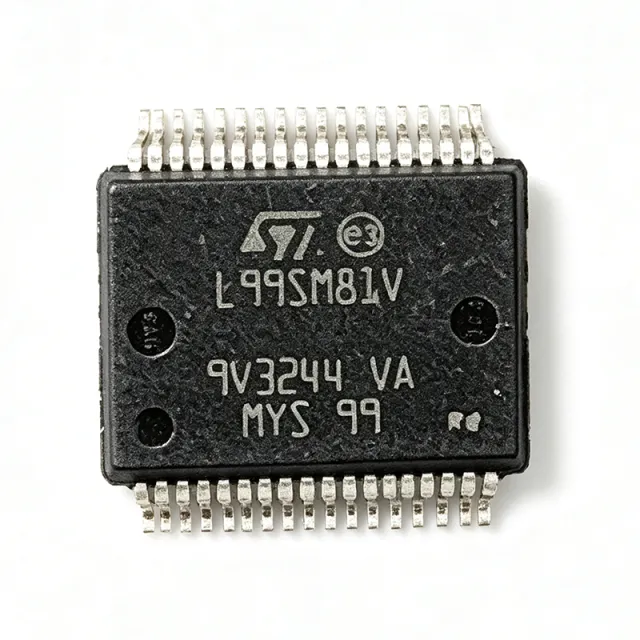
L99SM81V - Automotive Stepper Motor Driver | STMicroelectronics
The L99SM81V is an automotive-grade integrated driver for bipolar two-phase stepper motors, designed by STMicroelectronics for precise current-controlled micro-stepping with programmable amplitude. It integrates a microstepping controller with a power stage capable of driving up to 1.2 A per phase, and operates from a supply voltage range of 6 V to 28 V, making it suitable for direct connection to automotive battery rails. The device is available in a 40-pin QFN (6x6 mm) package and is AEC-Q100 qualified for automotive applications. A stepper motor driver is a power management IC that converts digital step and direction commands into the precise current sequences needed to rotate a stepper motor in controlled increments. It sits between a microcontroller and the motor, translating low-power logic signals into high-current drive signals. In the system hierarchy, a stepper motor driver is a type of motor driver, which falls under power management ICs, which are part of the broader category of analog and mixed-signal semiconductors. Key features of the L99SM81V include a programmable microstepping resolution up to 1/16 step, integrated current sensing with no external sense resistors, and a SPI interface for configuration and diagnostics. It also features overcurrent, overtemperature, and undervoltage protection, along with a low quiescent current in standby mode, which is critical for automotive battery conservation. The device is AEC-Q100 qualified, ensuring reliability across the -40°C to +150°C junction temperature range. The L99SM81V uses a proprietary current-control architecture that combines a constant-current chopper with a programmable decay mode, enabling smooth and quiet motor operation. The integrated current sensing eliminates the need for external sense resistors, reducing BOM cost and PCB area. The SPI interface allows real-time monitoring of fault conditions and precise adjustment of motor parameters, making it a flexible solution for complex automotive motion control. Typical applications include headlamp leveling systems, where precise positioning is required for optimal beam alignment, HVAC flap control for cabin comfort, and instrument cluster stepper motors for gauge indication. The wide supply voltage range and robust protection features make it ideal for direct battery connection in 12 V automotive systems. When designing with the L99SM81V, ensure adequate PCB copper area for thermal dissipation, especially when driving high currents continuously. The SPI interface should be isolated from high-current traces to minimize noise coupling. Proper decoupling capacitors on the supply pins are essential to maintain stable operation during motor transients.
LC4136C-X2T - LED Driver IC | onsemi | Display Backlight
The onsemi LC4136C-X2T is an LED driver integrated circuit offered for display-backlight and general LED-driving applications, with the verified source identifying it as an LED driver and interface IC. Its exact electrical ratings, pin configuration, package dimensions, operating limits, and protection features were not included in the supplied web data, so those values remain unavailable rather than being inferred. The verified distributor records identify LC4136C-X2T by onsemi and associate it with driver, receiver, transceiver, and display-driver listings. An LED driver is a power-management or interface IC that regulates current or voltage delivered to one or more LEDs. In display equipment, the driver establishes the electrical operating point of backlight LEDs, helping maintain illumination while protecting the light source from excessive current. The LC4136C-X2T is consequently positioned for circuits where an LED load is controlled from an electronic system rather than directly from a supply rail. The available evidence does not establish whether this part uses constant-current or constant-voltage regulation, how many LED channels it provides, or whether it includes PWM dimming. It also does not confirm a manufacturer datasheet URL. Those omissions prevent a safe characterization of output-current tolerance, switching frequency, efficiency, dimming ratio, thermal resistance, or maximum LED-string voltage. Engineers should obtain the official onsemi technical documentation before selecting it for a new design. Typical use cases suggested by the verified LED-driver classification include LCD backlight control, panel illumination, indicator lighting, and compact display modules. These are application categories rather than confirmed manufacturer reference designs. Actual suitability depends on the unavailable voltage range, current capability, channel count, pinout, and package data, as well as the LED string topology used in the target board. Before designing around LC4136C-X2T, verify the manufacturer datasheet, compare every electrical limit against the intended LED string, and confirm that the PCB land pattern matches the required package. Do not substitute a similarly named LC4136 variant without checking pin functions and ratings. The verified LCSC listing reports a price from $0.4707, while other distributor records report $1.16 and $1.33, showing meaningful source and quantity variation. This page consolidates the supplied distributor identity, pricing, stock, and cross-reference evidence while separating verified facts from missing technical information. It is intended to support initial sourcing and comparison, not to substitute for the complete manufacturer datasheet, PCB footprint, or application validation.

LC709209FXE-01TBG - 1-Cell Li-Ion Fuel Gauge | onsemi
The onsemi LC709209FXE-01TBG is a battery fuel gauge IC for 1-cell lithium-ion and lithium-polymer batteries, communicating over an I2C serial interface and housed in a 12-ball WLCSP package measuring 1.48 x 1.91 mm. It belongs to onsemi's Smart LiB Gauge family of fuel gauges. A battery fuel gauge is a power-management IC that estimates the state of charge (SOC) of a rechargeable cell and reports it to a host microcontroller. Within the power-management hierarchy, the fuel gauge sits alongside chargers and protectors in the battery management IC category, converting cell voltage and current behavior into a usable percentage readout. Accurate gauging is essential in portable systems because cell voltage alone is a poor predictor of remaining capacity, especially across different battery chemistries and load profiles. Key features of the LC709209FXE include its dedicated 1-cell Li-ion/Li-polymer support, I2C digital interface for host communication, ultra-compact 12-WLCSP (1.48 x 1.91 mm) footprint suited to space-constrained wearables and IoT devices, and Pb-free and halogen-free construction per the onsemi data sheet. The device is supplied in tape and reel packaging (refer to onsemi BRD8011/D for tape and reel specifications). From a technical perspective, the Smart LiB Gauge architecture performs SOC estimation based on cell voltage monitoring with profile-based algorithms, requiring minimal external components. Because it gauges by voltage, integration into a design is straightforward: connect the cell voltage sense line, the I2C bus, and the supply rails. Host software reads SOC values through the I2C register map, allowing firmware-level power management decisions such as low-battery shutdown or capacity reporting to an operating system. Typical applications include true wireless stereo (TWS) earbuds, smartwatches and fitness bands, small IoT sensor nodes, and other single-cell portable products where board area is at a premium and battery life reporting is a user-facing feature. When designing with this part, verify the I2C address and pull-up resistor sizing against the host bus loading, and confirm the battery profile matches the cell chemistry in use, since gauging accuracy depends on correct cell characterization. This page synthesizes distributor pricing, availability, cross-reference findings, and practical design notes not consolidated in the manufacturer data sheet, with pricing verified as of 2026-09-13.
LC709209FXE-01TBG - 1-Cell Li-Ion Fuel Gauge | onsemi
The onsemi LC709209FXE-01TBG is a battery fuel gauge IC for 1-cell lithium-ion and lithium-polymer packs, housed in a 12-ball WLCSP package measuring just 1.48 x 1.91 mm. It measures battery voltage and reports state-of-charge over an I2C serial interface, making it one of the most compact smart-gauge solutions for space-constrained portable designs. A battery fuel gauge is a power-management IC that estimates the remaining capacity of a rechargeable battery. Within the power management IC hierarchy, it sits alongside battery chargers and protectors, but its role is measurement rather than energy transfer: it translates cell voltage, and in this family internal modeling, into a percentage-of-full-charge value a host microcontroller can read. Gauges are essential in any product where accurate runtime indication or low-battery warnings matter. Key features of the LC709209F family include ultra-low power consumption that minimizes drain on the host cell, an I2C-compatible two-wire interface for state-of-charge and status readout, Pb-free and halogen-free construction, and an extremely small 12-WLCSP footprint suited to wearables, true-wireless earbuds, and other handheld electronics. According to the onsemi LC709209F data sheet, the device is specified as a Smart LiB Gauge for 1-cell applications. Technically, the gauge monitors the single-cell pack voltage through an internal ADC path and applies the manufacturer's gauge algorithm to derive state of charge; configuration and status registers are accessible via the I2C bus, allowing the host to read SOC, voltage, and alarm flags and to adjust operating parameters. The WLCSP ball layout keeps external component count minimal, supporting very dense PCB layouts. Typical applications include smartphone and wearable battery monitoring, true-wireless stereo earbud charging cases, portable medical sensors, and IoT asset trackers where a 1-cell Li-ion/Li-polymer pack must be monitored with minimal board area and quiescent drain. Design consideration: WLCSP devices require careful PCB land-pattern design per the manufacturer's packaging specification, and the I2C bus should include appropriate pull-up resistors sized for the chosen bus speed. This page adds distributor pricing, cross-reference data, and application guidance not consolidated in the manufacturer data sheet.

LD1117ADJTR - 1A Low Dropout Positive Regulator | STMicroelectronics
The STMicroelectronics LD1117ADJTR is a low dropout positive voltage regulator capable of delivering up to 1A of output current. It features an adjustable output voltage range from 1.25V to 15V, with a typical dropout voltage of 1.1V at 1A load. The device is available in the SOT-223 package, which is widely used for surface-mount applications. Data verified as of 2026-08-05. A low dropout regulator (LDO) is a type of linear voltage regulator that maintains a stable output voltage even when the input voltage is very close to the output voltage. LDOs are essential in power management systems where a clean, regulated supply is needed with minimal voltage headroom. They are part of the voltage regulator family, which also includes switching regulators, and are widely used in battery-powered devices, automotive electronics, and industrial control systems. Key features of the LD1117ADJTR include a fixed or adjustable output, internal current limiting, and thermal shutdown protection. The device operates over a junction temperature range of 0°C to 125°C, making it suitable for a variety of environments. The SOT-223 package offers a compact footprint with a thermal pad for improved heat dissipation, enabling reliable operation at moderate power levels. The LD1117ADJTR uses a PNP pass transistor architecture, which provides low dropout voltage and stable operation. The adjustable version uses an external resistor divider to set the output voltage, allowing flexibility in design. The device also features a low quiescent current, which is beneficial for battery-powered applications where power efficiency is critical. Typical applications include post-regulation for switching power supplies, battery chargers, and as a local supply for microcontrollers and other digital ICs. The wide input voltage range and low dropout make it ideal for automotive and industrial applications where input voltage can vary significantly. When designing with the LD1117ADJTR, ensure adequate input-to-output voltage headroom to maintain regulation. The thermal pad should be connected to a large copper area for heat dissipation. Proper decoupling capacitors on input and output are essential for stability and transient response. This page synthesizes distributor pricing, drop-in alternatives, and practical design notes not found in the STMicroelectronics datasheet, providing a comprehensive resource for engineers.

LD1117ADT18TR - 1.8V Fixed 800mA LDO Regulator | STMicroelectronics
The LD1117ADT18TR is a low-dropout linear regulator from STMicroelectronics, providing a fixed 1.8V output with a maximum output current of 800mA. It is housed in a DPAK (TO-252) surface-mount package, designed for a wide range of applications requiring a stable and low-noise power supply. The device operates with an input voltage range up to 15V and features a typical dropout voltage of 1.1V at 800mA load, making it suitable for battery-powered and industrial systems. A low-dropout regulator (LDO) is a type of linear voltage regulator that maintains a constant output voltage even when the input voltage is only slightly higher than the output. Unlike switching regulators, LDOs provide a clean, noise-free output, making them ideal for analog and RF circuits. In the hierarchy of power management, an LDO is a linear regulator, which is a type of voltage regulator, which falls under power management ICs, which are part of the broader semiconductor category. The LD1117ADT18TR is a fixed-output LDO, simplifying design by eliminating the need for external resistor dividers. Key features of the LD1117ADT18TR include a fixed 1.8V output, 800mA output current capability, and a dropout voltage of 1.1V typical at full load. It also offers internal current limiting and thermal shutdown protection, ensuring safe operation under fault conditions. The device is available in the DPAK package, which provides good thermal performance with a junction-to-ambient thermal resistance of 100°C/W, allowing for moderate power dissipation without external heatsinks. The LD1117ADT18TR is built on a robust bipolar process, providing excellent line and load regulation. It is designed to be stable with low-ESR ceramic capacitors, making it easy to use in modern designs. The device also features a wide operating temperature range of -40°C to +125°C, suitable for industrial and automotive environments. Typical applications include powering microcontrollers, FPGAs, and other digital ICs that require a 1.8V rail, as well as providing a clean supply for analog circuits such as op-amps and ADCs. It is also used in battery-powered devices, where its low dropout voltage maximizes battery life. When designing with the LD1117ADT18TR, ensure that the input voltage is at least 1.1V above the output voltage to maintain regulation. Use a 10µF output capacitor to ensure stability, and place it close to the output pin. The thermal pad of the DPAK package should be connected to a large copper area for effective heat dissipation.
LD1117ADT33TR - 3.3V Fixed 800mA LDO Regulator | STMicroelectronics
The STMicroelectronics LD1117ADT33TR is a low-dropout (LDO) linear voltage regulator providing a fixed 3.3V output with a maximum output current of 800mA. It is housed in a DPAK (TO-252) surface-mount package, designed for a wide range of consumer, industrial, and computing applications. The device operates with an input voltage range from 4.75V to 15V, making it suitable for 5V and 12V rails. An LDO (Low-Dropout) linear regulator is a type of voltage regulator that maintains a stable output voltage even when the input voltage is very close to the output voltage. Unlike standard linear regulators, LDOs use a pass transistor operating in the saturation region, allowing a low dropout voltage. In the system hierarchy, an LDO is a linear regulator, which is a type of voltage regulator, which falls under power management ICs, which are semiconductors. This hierarchy is essential for understanding where the LD1117ADT33TR fits in power management design. Key features of the LD1117ADT33TR include a dropout voltage of typically 1.1V at 800mA load, a quiescent current of 5mA, and a line regulation of 0.2% (typical). It also offers thermal shutdown and internal current limiting, providing robust protection for the load. The fixed 3.3V output eliminates the need for external resistor dividers, simplifying design and reducing component count. The LD1117ADT33TR is built on a bipolar process, offering low noise and fast transient response. The DPAK package provides a thermal resistance of 50°C/W (junction-to-ambient), allowing moderate power dissipation without a heatsink. The device is RoHS compliant and lead-free, meeting modern environmental standards. Typical applications include powering microcontrollers, FPGAs, and digital logic in embedded systems, as well as providing a clean 3.3V rail for sensors and interface circuits. It is also used in set-top boxes, routers, and other consumer electronics where a stable 3.3V supply is required. When designing with the LD1117ADT33TR, ensure adequate input-output voltage headroom to maintain regulation. A minimum input voltage of 4.75V is required for 3.3V output. Use a 10µF output capacitor for stability, and place it close to the output pin. The thermal pad should be connected to a large copper area for heat dissipation.
LD1117DT33TR - 800mA Low Dropout Voltage Regulator | STMicroelectronics
The STMicroelectronics LD1117DT33TR is a low dropout positive voltage regulator providing a fixed 3.3V output with a maximum output current of 800mA. It is available in the SOT-223 package, which is suitable for surface mount applications. The device features a dropout voltage of typically 1.1V at 800mA load, making it efficient for battery-powered and low-headroom applications. A low dropout regulator (LDO) is a type of linear voltage regulator that can maintain a stable output voltage even when the input voltage is very close to the output voltage. LDOs are essential in power management systems where noise-sensitive analog circuits require clean, ripple-free power rails. They are part of the voltage regulator family, which also includes switching regulators, and are widely used in consumer electronics, industrial controls, and automotive systems. Key features of the LD1117DT33TR include a fixed 3.3V output, 800mA output current capability, internal current limiting, and thermal shutdown protection. The device operates over a junction temperature range of -40°C to +125°C, ensuring reliable performance in harsh environments. The SOT-223 package offers a compact footprint with a thermal pad for improved heat dissipation. The LD1117DT33TR utilizes a PNP pass transistor architecture, which provides low dropout voltage and stable operation. The internal bandgap reference ensures accurate output voltage regulation across temperature and load variations. The device is designed for simplicity, requiring only two external capacitors for stability, making it easy to integrate into various designs. Typical applications include powering microcontrollers, FPGA core voltages, and analog sensor interfaces. The fixed 3.3V output is ideal for logic circuits and mixed-signal systems. The low dropout voltage allows operation from a 5V rail with sufficient headroom, making it suitable for 5V to 3.3V conversion in embedded systems. When designing with the LD1117DT33TR, ensure adequate input-to-output voltage headroom to maintain regulation. The input and output capacitors should be placed close to the device pins to minimize parasitic inductance. For high current loads, consider the thermal resistance of the SOT-223 package and provide adequate copper area for heat dissipation.
LD1117S18TR - 1.8V Fixed 800mA LDO Regulator | STMicroelectronics
The STMicroelectronics LD1117S18TR is a low-dropout (LDO) linear voltage regulator providing a fixed 1.8V output with a maximum output current of 800mA. It is housed in a SOT-223 package, which is widely used in surface-mount applications. The device operates with an input voltage range from 2.5V to 15V, making it suitable for a variety of low-voltage power supply applications. An LDO (Low-Dropout) linear regulator is a type of voltage regulator that maintains a stable output voltage even when the input voltage is very close to the output voltage. Unlike standard linear regulators, LDOs can operate with a small dropout voltage, typically less than 1V, which improves efficiency and allows for lower input voltages. In the hierarchy of power management, an LDO is a type of linear regulator, which is a type of voltage regulator, which is a type of power management IC. LDOs are essential in applications where low noise and simplicity are prioritized over efficiency, such as in battery-powered devices and analog circuits. Key features of the LD1117S18TR include a fixed 1.8V output voltage, a dropout voltage of 1.1V at 800mA, and a quiescent current of 5mA. The device also includes internal current limiting and thermal shutdown protection, ensuring safe operation under fault conditions. The SOT-223 package offers a compact footprint with a thermal resistance of 50°C/W, allowing for moderate power dissipation without external heatsinking. The LD1117S18TR is designed with a PNP pass transistor architecture, which provides a low dropout voltage and stable operation. The device is stable with a wide range of output capacitors, including ceramic capacitors, which simplifies the design and reduces component count. The internal current limiting and thermal shutdown features protect the regulator and the load from damage due to overcurrent or overtemperature conditions. Typical applications for the LD1117S18TR include powering microcontrollers, FPGAs, and other digital ICs that require a stable 1.8V supply. It is also used in battery-powered devices, such as portable electronics and IoT devices, where low quiescent current and small size are important. Additionally, the device is suitable for post-regulation in switching power supplies to reduce ripple and noise. When designing with the LD1117S18TR, ensure that the input voltage is at least 1.1V above the output voltage to maintain regulation. The output capacitor should be placed close to the output pin to ensure stability. For higher current applications, consider the power dissipation and use appropriate PCB copper area to keep the junction temperature within safe limits.
LD1117S25TR - 800mA Low Dropout Positive Regulator | STMicroelectronics
The LD1117S25TR is a low dropout positive voltage regulator from STMicroelectronics, designed to deliver a fixed 2.5V output with a maximum output current of 800mA. It is available in the SOT-223 package, which is suitable for surface-mount applications requiring efficient thermal performance. The device operates with an input voltage range up to 15V and features a typical dropout voltage of 1.1V at 800mA load, making it ideal for battery-powered and low-voltage systems. A low dropout regulator (LDO) is a type of linear voltage regulator that maintains a stable output voltage even when the input voltage is only slightly higher than the output. Unlike standard linear regulators, LDOs achieve a low dropout voltage by using a PNP pass transistor or a PMOS device, allowing them to operate efficiently in applications where the input-to-output voltage difference is small. LDOs are a subset of linear regulators, which in turn are part of the broader category of voltage regulators within power management integrated circuits (ICs). Key features of the LD1117S25TR include a fixed 2.5V output, a maximum output current of 800mA, and a dropout voltage of 1.1V at full load. The device also offers internal current limiting and thermal shutdown protection, ensuring safe operation under fault conditions. The SOT-223 package provides a compact footprint with a thermal resistance of approximately 50°C/W, enabling moderate power dissipation without external heatsinking. The LD1117S25TR utilizes a PNP pass transistor architecture, which allows for low dropout operation and stable output with a minimum output capacitor of 10µF. The device is designed to be stable with tantalum or aluminum electrolytic capacitors, and it includes a bandgap reference for accurate output voltage regulation. The internal current limit and thermal shutdown circuits protect the device from overcurrent and overtemperature conditions, enhancing system reliability. Typical applications for the LD1117S25TR include post-regulation for switching power supplies, battery-powered equipment, and low-voltage logic supplies. Its fixed 2.5V output is commonly used to power microcontrollers, memory ICs, and other digital circuits that require a stable 2.5V rail. The low dropout voltage and low quiescent current make it suitable for portable devices where power efficiency is critical. When designing with the LD1117S25TR, ensure that the input voltage is at least 1.1V above the output voltage to maintain regulation. The output capacitor should be placed close to the output pin to minimize parasitic inductance and ensure stability. Additionally, the thermal pad of the SOT-223 package should be connected to a copper area on the PCB to improve heat dissipation.