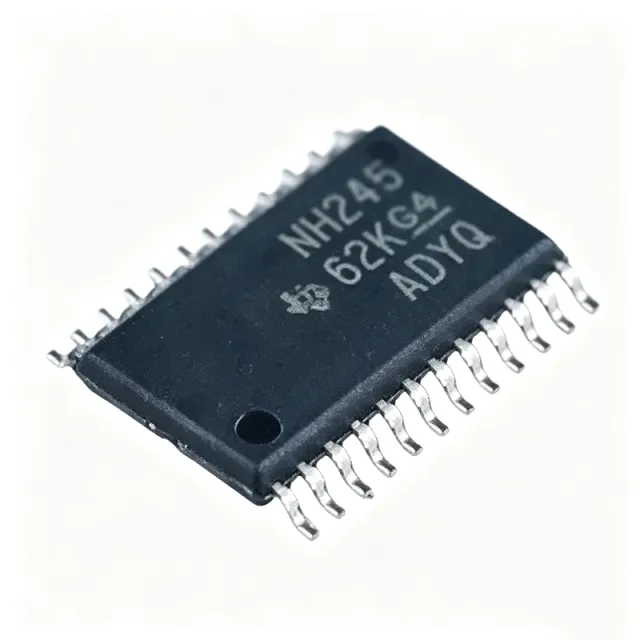
SN75174N
SN75174N - 4-Channel 4 MBd RS-485 Driver | Texas Instruments
The Texas Instruments SN75174N is a monolithic quadruple differential line driver with four independent 3-state outputs, support for balanced multipoint buses at rates up to 4 megabaud, and operation from a 5 V supply in a 16-pin PDIP package. It is designed to meet ANSI EIA/TIA-422-B, RS-485, and ITU Recommendation V.11 requirements, including wide positive and negative common-mode output voltage ranges for party-line systems operating in noisy environments.
A differential line driver is an interface IC that converts a single-ended logic signal into two complementary, balanced outputs. In the broader semiconductor hierarchy, a line driver belongs to interface ICs and communication transceivers, providing the physical signaling layer between digital controllers and wired buses. Its balanced differential output reduces sensitivity to common-mode noise and ground-potential differences compared with an unbalanced single-ended driver.
The SN75174N integrates four differential drivers, allowing one package to serve four data channels or two bidirectional interfaces when paired with suitable receivers. Every channel has an enable control that can place its differential outputs in a high-impedance 3-state condition. This feature allows several devices to share a bus, supports controlled bus segmentation, and permits external circuitry to establish an idle state. The device supports multipoint architectures without requiring separate single-driver-per-node packages.
Its principal verified performance points are four driver channels, a maximum signaling rate of 4 megabaud, 3-state outputs, and compatibility with EIA/TIA-422-B, RS-485, and ITU V.11 requirements. These figures position the part for industrial control, instrumentation, data acquisition, and embedded systems that use balanced copper wiring. The wide output common-mode range is particularly useful in party-line installations where nodes and cables introduce voltage variation.
The SN75174N is a driver, not a complete RS-485 transceiver, because it does not include receivers. Systems requiring bidirectional communication should pair it with a suitable receiver or transceiver. Signal integrity depends on controlled-impedance routing, correct pair geometry, termination at the physical endpoints, and common-mode considerations. The data supplied for this record does not include supply-voltage, output-current, propagation-delay, temperature, or absolute-maximum-rating values, so those values remain marked as data needed rather than inferred.
This page consolidates the verified manufacturer and distributor records, interface-standard context, application guidance, and replacement limitations in one engineering-oriented reference. Pricing and stock conditions are intentionally not represented as confirmed because the supplied distributor snippets provide availability language but no transaction-specific price table or inventory quantity.
견적 요청
재고 있음