TS931ID
TS931ID - 100kHz Rail-to-Rail Op Amp | STMicroelectronics
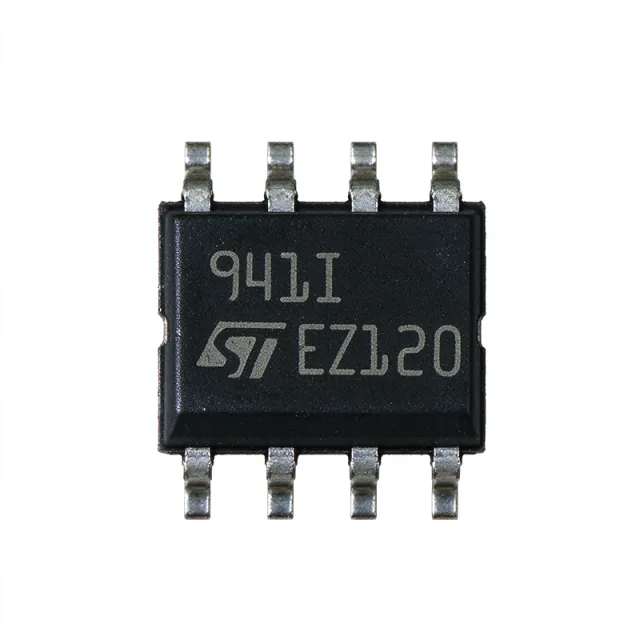
The STMicroelectronics TS931ID is a single-amplifier, general-purpose operational amplifier with a 100 kHz gain-bandwidth product, rail-to-rail output operation, and a 2.7 V minimum supply voltage, packaged in an 8-pin SOIC. It operates from single 2.7 V to 10 V supplies, consumes approximately 20 µA, and provides an extremely low typical input bias current of 1 pA. The device is suited to portable instrumentation, low-power signal conditioning, buffering, and general analog signal-processing applications.
An operational amplifier, or op amp, is an analog integrated circuit that provides high open-loop gain and feedback control for amplification, filtering, comparison, buffering, and signal conversion. The TS93x family belongs to the broader operational-amplifier hierarchy, which includes instrumentation, rail-to-rail, micropower, and precision amplifier categories. Rail-to-rail output operation allows the TS931ID to approach its supply-voltage limits at the output, improving dynamic range in low-voltage systems where usable signal headroom is limited.
The TS931ID provides several characteristics suited to compact analog designs. Its 100 kHz gain-bandwidth product supports moderate-frequency amplification and feedback networks, while the approximately 20 µA supply consumption suits battery-operated equipment. The 1 pA typical input bias current minimizes disturbance to high-impedance sources. According to the available STMicroelectronics datasheet material, the device can reach a 2.9 Vpp output swing with a 100 kΩ load when supplied at 3 V.
The TS931ID uses CMOS inputs and includes ESD protection, making it appropriate for low-leakage analog interfaces. Rail-to-rail output swing improves usable signal range near the positive or negative supply rail, but input common-mode behavior, output-current capability, stability, and drive into capacitive loads must still be checked against the complete operating condition. The single-amplifier configuration also reduces board area when one independent analog channel is required rather than a dual or quad device.
Typical uses include low-power sensor conditioning, portable measurement systems, analog buffering, low-current-to-voltage conversion stages, and small-signal control circuits. Its combination of a 2.7 V minimum supply, 20 µA-class consumption, and 100 kHz bandwidth is particularly relevant to battery-powered instrumentation. The 8-pin SOIC package supports conventional surface-mount assembly and is convenient for prototypes, repair, and mixed analog or mixed-signal boards.
Designers should account for output headroom when driving loads, verify stability with the selected feedback network and load capacitance, and route sensitive input traces away from switching nodes. Input and output bypassing must follow the manufacturer recommendations. Because the verified source set does not provide complete offset, slew-rate, common-mode-range, and absolute-maximum-rating tables, those values should be confirmed in the official datasheet before a safety- or precision-critical design is released.
This page consolidates the verified distributor specifications, package information, purchasing reference, family-level alternatives, and practical analog-design guidance. It also distinguishes documented values from parameters that still require direct confirmation from the manufacturer datasheet, helping engineers move from part selection to PCB implementation without presenting unverified figures as facts.
견적 요청
문의하기