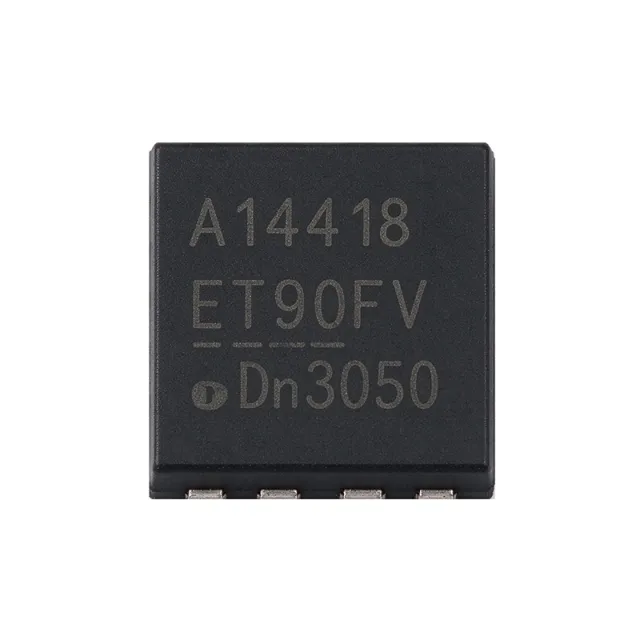
TJA1128GTK/0Z
TJA1128GTK/0Z - 85mA LIN SBC with LDO | NXP
NXP Semiconductors TJA1128GTK/0Z is an automotive LIN mini system basis chip with an integrated LIN transceiver, low-dropout voltage regulator, window watchdog, two wake-up inputs, one general-purpose input, and one high-voltage multipurpose output. The device provides selectable 3.3 V or 5.0 V regulator outputs and can deliver up to 85 mA for a microcontroller and associated automotive peripherals. It is housed in a 14-HVSON package measuring 3 mm by 4.5 mm.
A LIN system basis chip is an automotive interface IC that consolidates communication, power management, and basic system-control functions needed around a low-speed LIN network node. In the product hierarchy, a system basis chip sits above a LIN transceiver, integrates an LDO and supervisory functions, and connects vehicle body electronics to a LIN bus. This consolidation can reduce board area and component count while providing a defined interface between the vehicle power network and local electronics.
The TJA1128 combines the LIN transceiver with a regulator capable of supplying 85 mA. Its regulator is available in 3.3 V and 5.0 V output configurations, allowing the same device family to serve different microcontroller supply requirements. The window watchdog supports system monitoring, while two WAKE inputs provide hardware paths for detecting external wake requests. A GPI handles a general logic input, and the HVMPO output provides a high-voltage multipurpose control function for compatible body-electronics loads.
The TJA1128GTK/0Z is identified as an AEC-Q100 automotive-grade device, making it suitable for electronic control-unit designs requiring automotive qualification. Its 14-HVSON package supports compact surface-mount layouts while exposing the communication, supply, wake, monitoring, and control functions required by a LIN node. The manufacturer product page describes operation in very low-power system states, supporting battery-conscious automotive applications where standby current and wake behavior are important.
Typical uses include LIN-controlled door modules, seat controls, climate-control panels, body-control nodes, lighting controllers, sensor interfaces, and compact automotive actuator controllers. In these systems, the TJA1128 can manage communication with a LIN master while supplying a local microcontroller from the vehicle battery. Wake inputs allow external switches or sensors to return the node from a low-power condition without requiring continuous operation of the complete controller.
For PCB design, place the LIN transceiver and regulator support networks close to their associated pins, provide the required input and output capacitance, and route the LIN connection away from sensitive analog or high-speed digital signals. Confirm the exposed-pad connection, thermal pad implementation, ground strategy, and automotive ESD requirements against the manufacturer datasheet and reference layout before production release.
This product page combines manufacturer specifications, package information, sourcing guidance, design notes, and verified drop-in alternatives. It emphasizes the 85 mA regulator capability, integrated LIN interface, watchdog, wake-up inputs, GPI, HVMPO, and 14-HVSON footprint so engineers can assess both electrical suitability and PCB compatibility before selecting the device.
견적 요청
문의하기