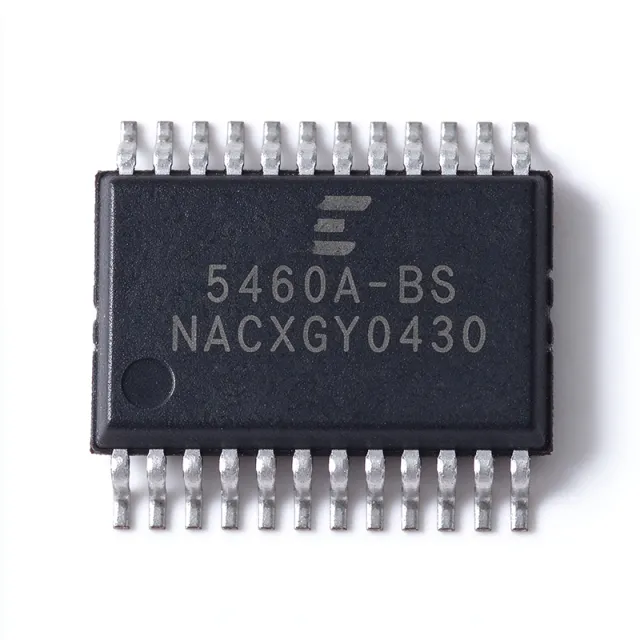
CS5520-BSZ
CS5520-BSZ - 20-bit Bridge Transducer Sigma-Delta ADC | Cirrus Logic
The Cirrus Logic CS5520-BSZ is a 20-bit, single-channel, sigma-delta analog-to-digital converter purpose-built for digitizing low-level signals from strain gauges, load cells, and pressure transducers. Housed in a 24-pin SOIC package, the CS5520-BSZ integrates a software-programmable instrumentation amplifier, on-chip digital calibration, and a synchronous SPI-compatible serial interface, achieving 20-bit resolution at output word rates up to 60 samples per second. It operates from a single +5 V analog supply plus a +3 V to +5 V digital supply, drawing a quiescent current of approximately 6.7 mA.
A sigma-delta (Σ-Δ) ADC is a converter that oversamples an input signal at a much higher rate than the Nyquist frequency and uses noise-shaping feedback to push quantization noise out of the signal band. In the bridge-sensor hierarchy, the CS5520-BSZ belongs to the precision transducer ADC class, which sits between general-purpose ADCs and dedicated strain-gauge signal conditioners, sharing the role of power management ICs and amplifiers in the broader mixed-signal IC family. By integrating excitation-current sources and instrumentation gain on-chip, the CS5520-BSZ replaces what would otherwise be a multi-chip front-end (sensor + INA + 24-bit ADC + MCU interface logic).
Key differentiating features include four software-selectable differential analog input ranges (±25 mV, ±55 mV, ±100 mV, and ±250 mV referenced to the on-chip common-mode voltage), a programmable-gain instrumentation amplifier with gains of 1, 2, 4, 8, 16, 32, 64, and 128, an integrated constant-voltage or constant-current bridge excitation block, and a low-noise chopper-stabilized front-end with digital filter options (sinc³ or sinc¹). The CS5520 also supports DC or AC bridge excitation, allowing ratiometric measurement configurations that cancel 1/f noise and lead/drift over the bridge line.
Architecturally, the device uses a second-order sigma-delta modulator whose bit-stream is decimated by an on-chip digital filter, with calibration coefficients stored in on-chip registers to correct gain and offset drift. According to the manufacturer datasheet, the part achieves ±0.0007 %FS nonlinearity (INL) and 20-bit effective resolution at the 60 Sps output word rate, with a noise floor below 1 µVrms at the lowest output rate. The hardware interface is a four-wire synchronous serial port (SCLK, SDO, SDI, CS) reading conversion data after an end-of-conversion flag.
Typical applications include weigh scales, force and load-cell instrumentation, process-control pressure transmitters, industrial weighing platforms, and torque/stress measurement systems. The wide input range and high common-mode rejection also make it suitable for battery-cell voltage and strain-bridge temperature compensation in-line monitoring.
When designing with this device, ensure that the analog and digital grounds are joined at a single star point and that the bridge excitation traces are routed away from the digital SPI lines to preserve CMRR. Calibration should be performed at the same output word rate as the measurement to avoid scale-shift errors.
This page synthesizes distributor pricing, drop-in alternatives, and practical design notes not found in the manufacturer datasheet, giving engineers a single consolidated reference for the CS5520-BSZ.
견적 요청
문의하기