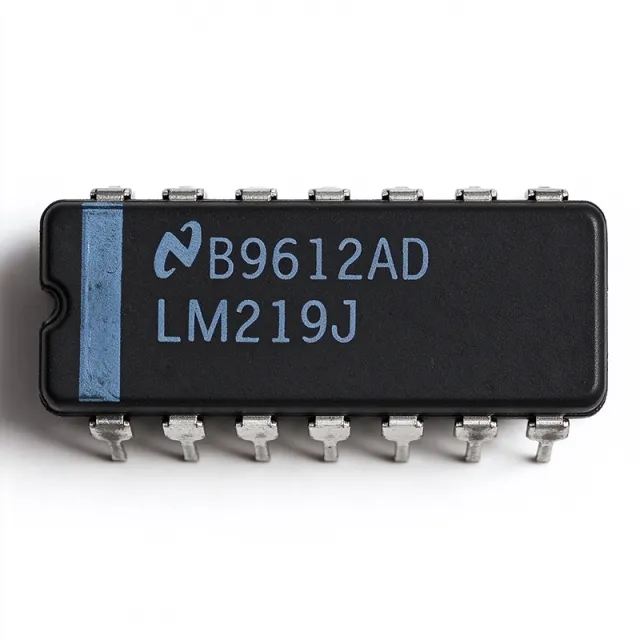
LM219J
LM219J - High-Speed Dual Comparator | Texas Instruments
The Texas Instruments LM219J is a general-purpose, high-speed dual comparator with two independent comparison channels, a 5 V to 30 V supply range, and a 14-CDIP package. It is designed for applications requiring rapid logic-level decisions and compatibility with DTL, open-collector, open-emitter, RTL, and TTL interfaces. The device is supplied in a 0.300-inch, 7.62 mm ceramic dual-inline package.
A comparator is an analog-to-digital decision component that compares two input voltages and produces a logic-oriented output indicating which input is higher. In the broader electronics hierarchy, the LM219J belongs to the comparator and linear IC families, alongside logic-compatible interface and signal-conditioning devices. Its two channels can be used independently for threshold detection, zero-crossing detection, pulse shaping, or basic control loops.
The verified LM219J information identifies a dual general-purpose comparator, a 5 V to 30 V supply range, and DTL, open-collector, open-emitter, RTL, and TTL output compatibility. These characteristics make it useful in legacy industrial logic, control, test, and instrumentation systems where existing designs depend on high-voltage-compatible inputs and established logic interfaces. The dual-channel configuration also reduces the component count when two comparison functions are required.
The LM219J family is described as a precision high-speed dual comparator fabricated on a single monolithic chip. The verified data does not provide a full electrical parameter table, propagation-delay value, input-offset specification, input-current limit, or output-current rating, so those values are not inferred here. Applications should be checked against the manufacturer datasheet before relying on timing, noise, input common-mode range, or output-drive limits.
Typical uses include industrial control logic, digital threshold detection, pulse and signal monitoring, legacy computer interfaces, process-control instrumentation, and embedded systems using open-collector or TTL-compatible signaling. The 14-CDIP package favors through-hole legacy boards and repair or modernization projects rather than compact surface-mount assemblies. When upgrading a PCB, confirm pin numbering, supply polarity, input polarity, output pull-up requirements, and timing margins before substitution.
For robust implementation, place the device close to the circuitry whose signals are being compared, maintain the required supply voltage, and observe the output-load requirements of the selected interface. Open-collector outputs generally need an external pull-up network, while TTL-compatible systems may use active drive. PCB layout should minimize long comparator input traces and provide adequate bypassing around the supply pins.
This page combines verified distributor and cross-reference information with practical engineering guidance. It explicitly separates available facts from missing parameters so that procurement, replacement, and high-speed circuit decisions can be checked against the authoritative Texas Instruments documentation before design release.
USD $18.87
재고 있음