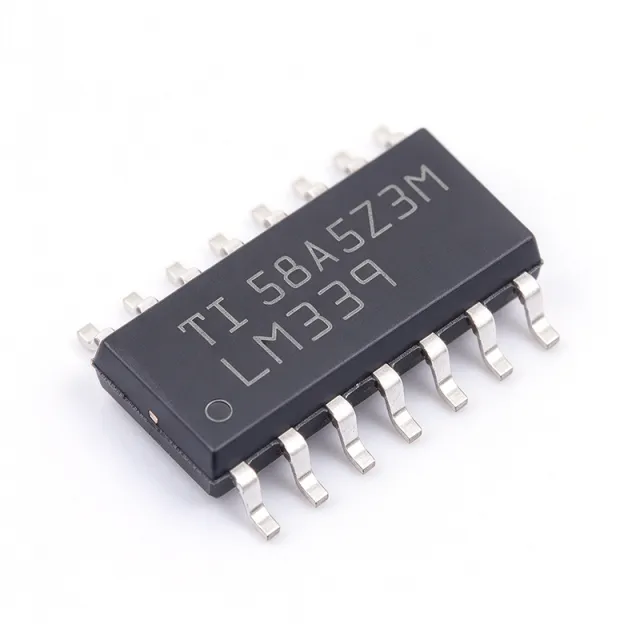
LM339DRG4
LM339DRG4 - 4-Channel Open-Collector Comparator | Texas Instruments
The Texas Instruments LM339DRG4 is a four-channel differential comparator IC with open-collector outputs, a 38 V maximum differential input rating, and a 14-pin SOIC package. Each channel supports single-supply or dual-supply operation, while the common-mode input range includes ground. The device provides 0.37 mV low input offset, 3.5 nA low input bias current, 200 µA typical supply current per comparator, and a 1 µs response time.
A comparator is an analog integrated circuit that compares two input voltages and produces a logic-level output indicating which input is higher. The LM339 belongs to the voltage comparator hierarchy within comparator ICs, analog ICs, and semiconductors. Its open-collector outputs can sink useful current but require an external pull-up resistor, allowing the output node to operate at a voltage chosen by the system designer and enabling wired logic, level conversion, or multiple-device interconnection.
The four independent channels provide flexible use in threshold detection, window comparison, overvoltage monitoring, signal conditioning, and control loops. Its 38 V maximum differential input rating supports industrial signal environments where input transients can exceed the supply voltage. Open-collector outputs are compatible with TTL, MOS, and CMOS logic, and the low 200 µA supply current per comparator supports power-conscious equipment.
Internally, the LM339 is designed around four independent comparison channels rather than a shared digital control block. The 1 µs response time supports general-purpose decision making without introducing the delay of a more specialized precision comparator. Its 0.37 mV input offset helps establish switching thresholds accurately, while 3.5 nA input bias current limits disturbance of high-impedance sensing circuits. The manufacturer describes the B-version family as a drop-in replacement for earlier LM239, LM339, and LM2901 A and V versions.
Typical applications include industrial control and monitoring, sensor threshold circuits, power-supply sequencing, battery monitoring, relay drivers, window comparators, and embedded control interfaces. The four channels can implement independent decisions in one package, reducing board area when several threshold functions are required. Each open-collector output requires a pull-up network, and the logic family connected to that pull-up determines the resulting high voltage.
Designers should treat input common-mode range, supply limits, output pull-up voltage, and output sink current as separate constraints. Keep sensitive comparison inputs away from switching nodes and provide a stable reference near the selected threshold. Place the pull-up resistor close to the output, verify that its voltage remains within the connected logic device's limits, and check the output-state timing against the 1 µs response specification.
This page combines manufacturer specifications, functional application guidance, pin-level implementation details, and a parameter comparison of same-footprint alternatives. It is designed to help engineers determine whether the LM339DRG4 provides the required voltage tolerance, response speed, output topology, and package compatibility before incorporating it into a new design.
견적 요청
문의하기