제품 (18688)

STM32H743BGT6 - 480MHz Cortex-M7 MCU 1MB Flash | STMicroelectronics
STM32H743BGT6

STM32H743BGT6 - 480MHz Cortex-M7 MCU 1MB Flash | STMicroelectronics

The STMicroelectronics STM32H743BGT6 is a high-performance 32-bit ARM Cortex-M7 microcontroller running up to 480 MHz with 1 MB of embedded Flash and 1 MB of SRAM, housed in a 208-pin LQFP (28x28 mm) package. It integrates a double-precision FPU, L1 cache (16 KB I-cache + 16 KB D-cache), and a Chrom-ART accelerator for graphics, delivering up to 1027 DMIPS / 2400 CoreMark. The device is a member of the STM32H7 mainstream line, designed for high-performance industrial, audio, and motor-control applications. An ARM Cortex-M7 microcontroller is a 32-bit RISC processor core with DSP extensions, a branch target cache, and tightly-coupled memory interfaces optimized for deterministic real-time control and signal processing. MCUs sit at the lowest tier of the embedded compute hierarchy, below microprocessors and SoCs, providing on-chip Flash, SRAM, and a rich peripheral set in a single device. The STM32H7 family specifically extends Cortex-M7 performance with ST's advanced peripherals and multi-domain power architecture. Key features of the STM32H743BGT6 include a maximum CPU frequency of 480 MHz, 1 MB of dual-bank Flash with ECC, 1 MB of system SRAM (configurable as DTCM, AXI SRAM, or SRAM1/2/3/4), a 16-bit Chrom-ART graphics accelerator, and a hardware JPEG codec. Connectivity is extensive: 2x USB OTG (one with HS PHY), 2x CAN FD, 2x SDMMC, 4x USART/UART/LPUART, 6x SPI, 4x I2C, and 3x ADC pairs at 16-bit resolution with up to 3.6 MSPS. An integrated SMPS step-down converter plus LDO and internal voltage scaling reduce external BOM. Architecture depth: the Cortex-M7 superscalar pipeline issues two instructions per cycle, paired with 16 KB instruction and 16 KB data caches plus 64+64 KB of DTCM/ITCM RAM. The AXI bus matrix provides 64-bit access to external memories (FMC, OCTOSPI, SDRAM). Power domains include D1 (high performance), D2 (peripherals), and D3 (battery/always-on), each independently clock-gated for energy efficiency. The device supports an operating range of 1.62 V to 3.6 V with separate I/O and core voltage rails. Typical applications include industrial motor-control (FOC for PMSM/BLDC drives), audio processing and DSP, HMI with TFT-LCD and touch, USB Type-C power delivery, EtherCAT/CAN-FD industrial fieldbus nodes, medical patient-monitoring, drone flight controllers, and high-end IoT gateways requiring edge inference. The 1 MB Flash supports OTA-friendly dual-bank partitioning. Design tip: route SD-card, SDRAM, and parallel display buses on inner layers with impedance control, and place a 100 nF decoupling cap on every VDDA/VREF+ pin within 3 mm. The integrated SMPS requires a 4.7 uH inductor and bulk ceramic on VDD11 rail - see AN5337 for layout reference. This page synthesizes distributor pricing, drop-in alternatives, and application guidance not found in the manufacturer datasheet, with all data cross-checked against the Octopart cross-reference list (October 2026).

USD $12.40 재고 있음
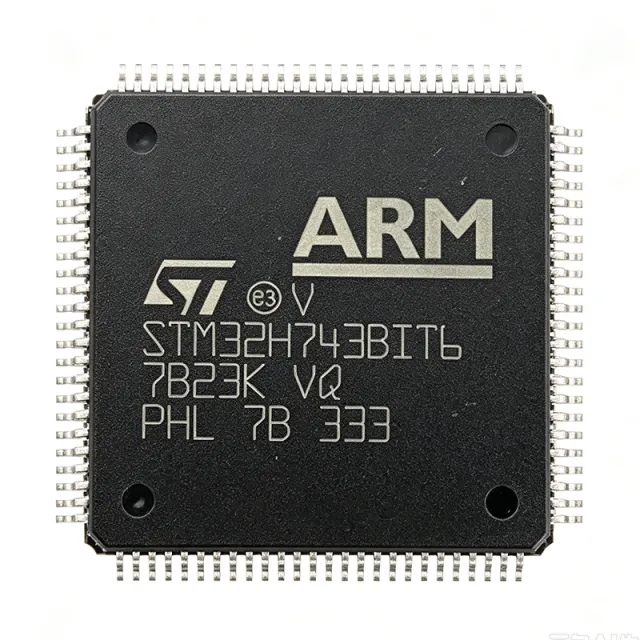
STM32H743BIT6 - 480MHz Cortex-M7 MCU, 2MB Flash | STMicroelectronics
STM32H743BIT6

STM32H743BIT6 - 480MHz Cortex-M7 MCU, 2MB Flash | STMicroelectronics

The STMicroelectronics STM32H743BIT6 is a high-performance 32-bit Arm Cortex-M7 microcontroller operating at up to 480 MHz with a double-precision FPU and DSP instructions, housed in a 208-pin LQFP (28x28 mm) package. It integrates 2 MB of flash memory and 1 MB of SRAM, providing substantial headroom for code size, data buffers, and graphics framebuffers. What is a microcontroller (MCU)? A microcontroller is a compact integrated circuit that combines a processor core, program memory (Flash), working memory (RAM), and programmable peripherals on a single die. Within the wider taxonomy, the STM32H743BIT6 sits in the high-performance MCU category: Arm Cortex-M7 -> Cortex-M family -> 32-bit MCU -> microcontroller -> embedded processor. The H7 line targets demanding applications that exceed Cortex-M4 throughput but do not require a full applications processor. Key specifications include 480 MHz core speed with 1284 CoreMark performance, 2 MB dual-bank Flash supporting read-while-write, and 1 MB SRAM configurable as 192 KB DTCM + 64 KB ITCM + 1 MB AXI-SRAM. Connectivity options include 10/100 Ethernet, USB 2.0 OTG HS/FS, CAN FD, SDMMC, three SPI plus one half-duplex SPI, four I2C, four USART/UART/LPUART, and two SAI. Analog peripherals include three 16-bit ADCs, two DAC channels, two comparators, and an SMBus-PMBus controller. Hardware crypto acceleration, TRNG, secure boot, and one-time-programmable (OTP) fuses round out the security perimeter. Architecturally, the STM32H743BIT6 uses a 7-stage pipeline with branch prediction, an L1 instruction cache, an MPU, and a Chrom-ART 2D graphics accelerator. The device supports separate core voltage domains via an integrated SMPS step-down converter and an LDO, with VDD range of 1.62 V to 3.6 V. This dual-rail power architecture allows dynamic voltage scaling for power-constrained designs without external PMICs. Typical uses include industrial motor control (field-oriented control and PMSM drives), factory automation controllers, audio sub-systems with MPU-decoded codecs, USB peripherals with HID or mass-storage stacks, secure gateways with TLS offload via hardware crypto, building automation touchpanels, and IoT edge nodes requiring on-device ML inference via CMSIS-NN libraries. When designing with this MCU, ensure the SMPS inductor is sized per the datasheet reference design and that VDD/VDDA/VBAT pins each have local decoupling. RoHS/REACH compliance and industrial-grade temperature range (-40 C to +85 C, +105 C Tj) make the part suitable for ruggedized applications. This page synthesizes distributor pricing, drop-in pin-compatible alternatives, and design notes that augment the manufacturer datasheet.

USD $9.85 재고 있음
STM32H743IGT6 - 480MHz Cortex-M7 MCU 1MB Flash | STMicroelectronics
STM32H743IGT6

STM32H743IGT6 - 480MHz Cortex-M7 MCU 1MB Flash | STMicroelectronics

The STMicroelectronics STM32H743IGT6 is a high-performance 32-bit ARM Cortex-M7 microcontroller operating at up to 480 MHz with 1 MB of Flash and 1 MB of SRAM, housed in a 176-pin LQFP (24x24 mm) package. The Cortex-M7 core integrates a double-precision FPU, L1 cache (16 KB I-cache + 16 KB D-cache), and DSP instructions, achieving 1027 DMIPS / 2400 CoreMark performance. The device also includes a Cortex-M4 coprocessor for auxiliary task offload. A microcontroller (MCU) is a single-chip computer that integrates a CPU core, memory, and programmable peripherals. The STM32H743 belongs to the 32-bit MCU family (ARM Cortex-M class), which sits above 8-bit/16-bit microcontrollers in the semiconductor hierarchy: transistor -> logic gate -> CPU core -> microcontroller -> embedded system. Cortex-M7 devices target high-performance embedded applications that previously required a DSP or microprocessor, and the STM32H7 line extends the STM32 family from mainstream (F0/F1/F4) into premium real-time processing tiers. Key features of the STM32H743IGT6 include: 1 MB dual-bank Flash with ECC, 1 MB SRAM split into DTCM, AXI SRAM, SRAM1-4, and Backup SRAM; a 16-bit Chrom-ART (DMA2D) accelerator; JPEG codec in hardware; up to 35 communication interfaces including 3x SPI, 4x USART/UART, 2x UART, 3x I2C, 2x CAN, USB 2.0 FS+OTG, SDMMC, and Ethernet; a 16-bit parallel camera interface; and 3x 12-bit ADCs at 3.6 MSPS plus 2x 12-bit DACs. The internal SMPS step-down converter reduces core current consumption by approximately 30% versus an external LDO supply. The architecture uses a 7-stage superscalar pipeline with branch prediction, single-precision and double-precision FPU, and an instruction/data cache. The AXI bus matrix (64-bit wide, 480 MHz) gives sustained memory bandwidth above 4 MB/s, suitable for TFT-LCD framebuffers and audio streaming. Advanced peripherals include a TFT-LCD controller (up to XGA resolution), cryptographic accelerators (AES, hash, RNG), and a true random number generator (TRNG). Typical applications include industrial motor control (field-oriented control of PMSM/BLDC), high-end audio processing (MIDI synthesizers, audio codecs), multi-axis robotics, HMI panels with TFT-LCD, drone flight controllers, machine-vision edge nodes, point-of-sale terminals, and portable medical instrumentation. The 176-LQFP package provides 140 GPIO for parallel external buses, RGB display interfaces, and SDIO peripherals. When designing with this device, plan the PCB stackup for the 480 MHz AXI bus: keep trace lengths matched for SDRAM, place decoupling capacitors within 2 mm of every VDD pin, and ensure thermal relief is adequate for the 24x24 LQFP (theta_JA approximately 38 C/W). Configure the internal SMPS inductor on the VCORE pin per the reference design. This page synthesizes distributor pricing, drop-in pin-compatible alternatives, parametric comparisons, and PCB design notes that go beyond the ST datasheet summary - helping procurement, firmware, and hardware engineers make informed BOM decisions in a single read.

USD $11.05 재고 있음
STM32H743IIK6 - 480MHz Cortex-M7 2MB MCU | STMicroelectronics
STM32H743IIK6

STM32H743IIK6 - 480MHz Cortex-M7 2MB MCU | STMicroelectronics

The STMicroelectronics STM32H743IIK6 is a 32-bit Arm Cortex-M7 microcontroller operating up to 480 MHz, with 2 MB of Flash memory, 1 MB of RAM, and a 176-ball UFBGA package. It is designed for high-performance embedded applications requiring substantial processing speed, memory, and integrated connectivity. The device is part of the STM32H7 microcontroller family and combines a high-performance CPU core with extensive peripheral integration in a compact package. A microcontroller such as the STM32H743IIK6 is a programmable system-on-chip that integrates a processor core, memory, communication interfaces, timers, analog peripherals, and interrupt-controlled I/O into one device. Within the hierarchy of semiconductor components, it belongs to the microcontroller and embedded-processing categories, where firmware executes real-time control, communications, data acquisition, and user-interface functions. This integration reduces component count and simplifies system design compared with separate processors and discrete interface circuits. The verified product listing identifies a 32-bit Arm Cortex-M7 core with operation up to 480 MHz, 2 MB of Flash, and 1 MB of RAM. The STM32H743IIK6 is identified by STMicroelectronics as part of the STM32H742xI/G and STM32H743xI/G family, which is based on the Arm Cortex-M7 architecture. The high clock rate and large memory capacity support demanding control loops, signal processing, network stacks, and human-machine-interface workloads when the required peripherals and board resources are available. The listed package is 176+25UFBGA, described by distributors as a 176-ball UFBGA package with a 10 mm by 10 mm outline. The exact exposed-pad, pin, and ball assignments require the manufacturer package drawing and pinout data; those details are not reproduced here because they were not included in the supplied verified specifications. The package is intended for high-density PCB layouts and requires careful ball placement, escape routing, thermal management, and assembly-process controls. Typical application areas include industrial automation, communications equipment, motor and motion control, embedded graphics, audio and signal processing, test and measurement, and connected embedded systems. The STM32H743IIK6 is particularly suitable when firmware performance and onboard memory are more important than a low-cost minimal controller. Design decisions should also account for the required power rails, clocking, decoupling, memory interfaces, signal integrity, and the availability of the exact package documentation. For new designs, engineers should verify the complete electrical characteristics, pin multiplexing, memory-map behavior, bootloader requirements, and operating conditions against the official STMicroelectronics product page and datasheet. This page combines verified distributor and manufacturer information with explicit data gaps for parameters that were not supplied; it also explains why direct replacement and pin-compatible alternatives cannot be responsibly inferred from generic MCU guides.

견적 요청 재고 있음
STM32H743IIK6TR - 480MHz Cortex-M7 MCU with 2MB Flash | STMicroelectronics
STM32H743IIK6TR

STM32H743IIK6TR - 480MHz Cortex-M7 MCU with 2MB Flash | STMicroelectronics

The STMicroelectronics STM32H743IIK6TR is a 32-bit Arm Cortex-M7 microcontroller rated up to 480 MHz, with 2 MB of Flash and 1 MB of RAM, supplied in a 176+25 UFBGA package measuring 10 mm by 10 mm. It combines high-performance digital signal processing, extensive connectivity, and three-domain power management for demanding embedded control systems. A microcontroller is a programmable semiconductor that integrates a processor core, memory, clocks, communication interfaces, timers, analog peripherals, and power-management blocks on one package. The STM32H7 family belongs to the broader Arm Cortex-M microcontroller hierarchy and is designed for real-time control, communications, audio, graphics, and high-speed data-processing systems where a general-purpose low-rate MCU may lack performance or memory. Verified distributor data identifies the STM32H743IIK6TR as a single-core 480 MHz Cortex-M7 device with 2 MB of Flash. Additional supplied product data reports 1 MB of RAM, a double-precision FPU, an Art Accelerator, L1 cache, an external-memory interface, and a broad peripheral set. These resources support complex control loops and accelerated graphical or signal-processing workloads while retaining integrated real-time peripherals. The STM32H7 architecture supports demanding connectivity and storage workloads through interfaces including Ethernet MAC, SDMMC, MDIO, USB, UART, USART, SPI, I2C, and I2S where fitted by the selected device configuration. Independent D1, D2, and D3 power domains can help control operating states of processor and peripheral groups, reducing unnecessary activity in mixed-signal or low-power systems. Typical applications include industrial automation, motor and motion control, industrial networking, high-resolution audio, graphics-assisted human-machine interfaces, communications infrastructure, and data acquisition. Its 480 MHz processing rate and 1 MB RAM are especially useful when a design combines network management, real-time sampling, display handling, and deterministic peripheral control in one MCU. PCB design should preserve the package's demanding high-speed routing requirements, provide clean power and ground distribution, and decouple each supply group near its associated pins. Clock, memory, Ethernet, USB, and high-speed signal integrity should be reviewed against the manufacturer reference layout; package ball assignments and exact electrical limits must be confirmed from the manufacturer documentation before release.

견적 요청 재고 있음
STM32H743IIT6 - 480MHz Cortex-M7 MCU 2MB Flash | STMicroelectronics
STM32H743IIT6

STM32H743IIT6 - 480MHz Cortex-M7 MCU 2MB Flash | STMicroelectronics

The STMicroelectronics STM32H743IIT6 is a high-performance 32-bit ARM Cortex-M7 microcontroller with double-precision FPU running at up to 480 MHz, featuring 2 MB of Flash memory and 1 MB of SRAM, housed in a 176-pin LQFP (24x24 mm) package. A microcontroller (MCU) is a single-chip computer that integrates a processor core, memory, and programmable peripherals on one die. Within the semiconductor hierarchy, the STM32H743IIT6 belongs to the STM32H7 family of high-performance MCUs, which sits above general-purpose lines such as STM32F4/F7 in ST's portfolio and serves as the processing heart of embedded systems where heavy computation, rich connectivity, and real-time control must coexist. Key features include the Cortex-M7 core with 16 KB instruction and 16 KB L1 data caches, delivering up to 1027 DMIPS (2.14 DMIPS/MHz per Dhrystone 2.1), the ART Accelerator for zero-wait-state execution from Flash, and an external memory interface (FMC/QUADSPI) for expansion. Peripherals span Ethernet, USB, CAN, and multiple UART/SPI/I2C ports, with roughly 140 GPIO pins available in the LQFP-176 footprint. Architecturally, the device couples the scalar double-precision FPU and DSP instructions with a cache-rich memory subsystem, allowing deterministic execution of DSP and Edge-AI workloads such as motor control field algorithms, audio processing, and machine-learning inference at the edge. The large 1 MB SRAM accommodates frame buffers and real-time data pipelines without external DRAM in many designs. Typical applications include industrial HMI and automation controllers, digital power and motor drives, IoT gateways, and test/measurement instruments. High Flash density and Ethernet make it a natural fit for networked industrial nodes. Design consideration: confirm the power architecture (integrated LDO versus external SMPS regulator option) early in the design, since it differs from earlier STM32F7 generations and affects both PCB layout and firmware boot code. This page synthesizes verified distributor data, drop-in alternatives, pricing context, and practical design guidance not found in a single manufacturer source.

USD $12.00 재고 있음
STM32H743VGH6 - 480MHz Cortex-M7 MCU 1MB Flash | STMicroelectronics
STM32H743VGH6

STM32H743VGH6 - 480MHz Cortex-M7 MCU 1MB Flash | STMicroelectronics

The STMicroelectronics STM32H743VGH6 is a high-performance 32-bit ARM Cortex-M7 microcontroller operating at up to 480 MHz with 1 MB of Flash and 1 MB of SRAM, housed in a 100-pin TFBGA (8x8 mm) package. The part is part of the STM32H7 series and integrates a double-precision FPU, L1 cache (16 KB I-cache + 16 KB D-cache), and a comprehensive peripheral set designed for demanding embedded designs. An ARM Cortex-M7 microcontroller is a 32-bit RISC processor core designed for high-performance embedded applications, featuring a superscalar pipeline, single/double-precision floating-point unit, and tight integration with low-power peripherals. Cortex-M7 devices sit at the top of the Cortex-M family hierarchy (Cortex-M7 -> Cortex-M -> ARM architecture -> RISC processor) and are commonly used as the host MCU in motor control, industrial automation, audio processing, and graphics-rich HMI designs. The STM32H743VGH6 includes 1 MB of Flash, 1 MB of SRAM (with multiple SRAM blocks including DTCM, AXI SRAM, and SRAM1-4), a Chrom-ART Accelerator (DMA2D), a hardware JPEG codec, an external memory interface (FMC), and dual-mode Quad-SPI. According to STMicroelectronics datasheet DS12923, the device also integrates 3x ADCs, 2x DACs, multiple timers, USB 2.0 OTG full-speed/high-speed, CAN FD, Ethernet, and crypto/hash accelerators, enabling a wide range of connectivity-oriented applications. Typical applications include industrial control, factory automation, motor drives, audio processing, graphics HMI, point-of-sale terminals, and high-end consumer devices. The 100-pin TFBGA package provides ample I/O count (82 GPIOs typical) while keeping the PCB footprint compact at 8x8 mm, suitable for space-constrained designs. When designing with the STM32H743VGH6, ensure the 1.8V core supply is decoupled close to the VCAP pins and that the SMPS/linear regulator mode is configured in software (PWR control register). The integrated LDO/SMPS allows the device to run on a single 3.3V rail, but the SMPS mode must be enabled at startup for full 480 MHz operation. This page synthesizes distributor pricing, drop-in alternatives from the STM32H7 family, and practical design notes not found in the manufacturer datasheet, including benchmark guidance for designers choosing between H743, H753, and other H7 variants in the same 100-pin TFBGA footprint.

USD $10.50 재고 있음
STM32H743VGT6 - 480MHz Cortex-M7 MCU, 1MB Flash | STMicroelectronics
STM32H743VGT6

STM32H743VGT6 - 480MHz Cortex-M7 MCU, 1MB Flash | STMicroelectronics

The STMicroelectronics STM32H743VGT6 is a high-performance 32-bit Arm Cortex-M7 microcontroller operating up to 480 MHz, with 1 MB of Flash and 1 MB of RAM, in a 100-pin LQFP package. It combines a high-performance DSP-capable core with extensive connectivity, memory-management features, and application-specific peripherals for demanding embedded systems. A microcontroller is a programmable embedded controller integrating a processor core, memory, communication interfaces, timers, analog peripherals, and power-management functions on one semiconductor device. The STM32H7 family sits within the broader embedded-processing hierarchy: microcontroller, 32-bit RISC processor, embedded systems controller, and embedded computing platform. Key verified features include an Arm Cortex-M7 core with double-precision floating-point capability, 1 MB Flash, 1 MB RAM, L1 cache, an external-memory interface, and JPEG codec support. Distributed data show a 480 MHz maximum CPU frequency and a 100-LQFP package measuring 14 by 14 mm. The device also supports high-speed and mixed-signal workloads through a broad peripheral set described by the manufacturer and distributor records. Technically, the Cortex-M7 architecture provides pipelined 32-bit execution and DSP-oriented instruction support. Large internal memory can reduce external-memory traffic for display, networking, and control workloads, while the external-memory interface permits expansion when a design needs additional storage. Integrated cache and memory features should be configured according to the manufacturer’s reference guidance rather than assumed to be interchangeable among pin-compatible devices. Typical uses include industrial automation, motor control, communications equipment, embedded graphics, audio and DSP processing, and high-performance IoT gateways. The 100-LQFP package provides a manageable surface-mount option for boards requiring substantial I/O without using a very fine-pitch ball-grid array. Designers should verify power sequencing, decoupling, clock configuration, exposed peripheral differences, and firmware support before treating another STM32 device as a drop-in substitute. The supplied cross-reference results identify potential same-series candidates, but they do not provide enough verified pin and parameter data to assert universal drop-in equivalence. This page consolidates manufacturer and distributor facts, pricing references, package information, application guidance, and replacement constraints into an engineering-oriented selection resource for the STM32H743VGT6.

견적 요청 재고 있음
STM32H743VIH6 - 480MHz Cortex-M7 MCU | STMicroelectronics
STM32H743VIH6

STM32H743VIH6 - 480MHz Cortex-M7 MCU | STMicroelectronics

The STMicroelectronics STM32H743VIH6 is a high-performance 32-bit microcontroller based on the ARM Cortex-M7 core, operating at up to 480 MHz. It is housed in a 100-pin TFBGA package (10x10 mm) and offers 2 MB of flash memory and 1 MB of RAM. This device is part of the STM32H7 series, designed for applications requiring high computational power and rich connectivity. Data verified as of 2026-08-05. A microcontroller (MCU) is a compact integrated circuit designed to govern a specific operation in an embedded system. It contains a processor core, memory, and programmable input/output peripherals. The STM32H743VIH6 is a high-end MCU, positioned within the STM32H7 family, which is part of the broader STM32 portfolio of 32-bit ARM Cortex-M based microcontrollers. This hierarchy places it as a high-performance MCU suitable for complex real-time control and digital signal processing tasks. Key features include a 480 MHz Cortex-M7 core with double-precision FPU, 2 MB of flash, 1 MB of SRAM, and a comprehensive set of peripherals including multiple ADCs, DACs, timers, and communication interfaces (USART, SPI, I2C, CAN, USB, Ethernet). It also features a Chrom-ART Accelerator for graphics, a cryptographic processor, and a random number generator. The device supports a wide supply voltage range of 1.62V to 3.6V and operates over a temperature range of -40°C to +85°C. The STM32H743VIH6 leverages a 40nm process technology, enabling high clock speeds with efficient power consumption. It includes a power management unit with multiple low-power modes, making it suitable for battery-powered applications. The memory architecture includes a flexible external memory controller for SDRAM, SRAM, and NOR flash expansion. Typical applications include industrial control, motor control, audio processing, high-end consumer electronics, and IoT gateways. Its high performance and rich peripheral set make it ideal for applications requiring real-time processing and connectivity. When designing with this MCU, ensure proper decoupling of the power supply pins and follow the layout guidelines in the datasheet to minimize noise. The device requires a stable clock source; an external crystal or oscillator is recommended for precise timing. This page synthesizes distributor pricing, drop-in alternatives, and practical design notes not found in the STMicroelectronics datasheet, providing a comprehensive resource for engineers.

USD $11.50 재고 있음
STM32H743VIH6TR - 480MHz Cortex-M7 MCU | STMicroelectronics (Tape & Reel)
STM32H743VIH6TR

STM32H743VIH6TR - 480MHz Cortex-M7 MCU | STMicroelectronics (Tape & Reel)

The STMicroelectronics STM32H743VIH6TR is a high-performance 32-bit microcontroller based on the ARM Cortex-M7 core, operating at up to 480 MHz. It is housed in a 100-pin TFBGA package (10x10 mm) and offers 2 MB of flash memory and 1 MB of RAM. This device is part of the STM32H7 series, designed for applications requiring high computational power and rich connectivity. Data verified as of 2026-08-05. A microcontroller (MCU) is a compact integrated circuit designed to govern a specific operation in an embedded system. It contains a processor core, memory, and programmable input/output peripherals. The STM32H743VIH6TR is a high-end MCU, positioned within the STM32H7 family, which is part of the broader STM32 portfolio of 32-bit ARM Cortex-M based microcontrollers. This hierarchy places it as a high-performance MCU suitable for complex real-time control and digital signal processing tasks. Key features include a 480 MHz Cortex-M7 core with double-precision FPU, 2 MB of flash, 1 MB of SRAM, and a comprehensive set of peripherals including multiple ADCs, DACs, timers, and communication interfaces (USART, SPI, I2C, CAN, USB, Ethernet). It also features a Chrom-ART Accelerator for graphics, a cryptographic processor, and a random number generator. The device supports a wide supply voltage range of 1.62V to 3.6V and operates over a temperature range of -40°C to +85°C. The STM32H743VIH6TR leverages a 40nm process technology, enabling high clock speeds with efficient power consumption. It includes a power management unit with multiple low-power modes, making it suitable for battery-powered applications. The memory architecture includes a flexible external memory controller for SDRAM, SRAM, and NOR flash expansion. Typical applications include industrial control, motor control, audio processing, high-end consumer electronics, and IoT gateways. Its high performance and rich peripheral set make it ideal for applications requiring real-time processing and connectivity. When designing with this MCU, ensure proper decoupling of the power supply pins and follow the layout guidelines in the datasheet to minimize noise. The device requires a stable clock source; an external crystal or oscillator is recommended for precise timing. This page synthesizes distributor pricing, drop-in alternatives, and practical design notes not found in the STMicroelectronics datasheet, providing a comprehensive resource for engineers.

USD $11.50 재고 있음
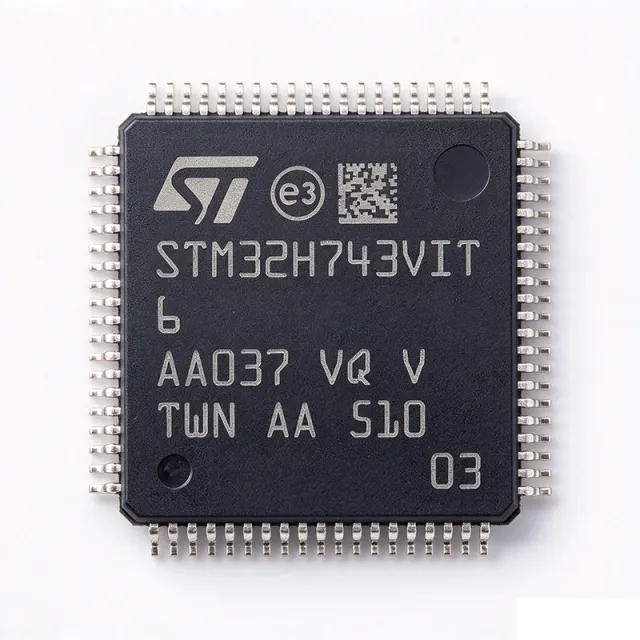
STM32H743VIT6 - 480MHz Cortex-M7 MCU 2MB Flash | ST
STM32H743VIT6

STM32H743VIT6 - 480MHz Cortex-M7 MCU 2MB Flash | ST

The STMicroelectronics STM32H743VIT6 is a high-performance 32-bit ARM Cortex-M7 microcontroller operating at up to 480 MHz with 2 MB of flash memory and up to 1 MB of RAM, housed in a 100-pin LQFP (14x14 mm) package. It belongs to the STM32H7 series and provides 46 communication and analog interfaces. A microcontroller unit (MCU) is a single-chip computer integrating a processor core, memory, and peripherals on one die. Within the embedded systems hierarchy, MCUs sit below application processors but above simple 8-bit controllers, and the STM32H7 family represents the flagship high-performance tier of the widely adopted STM32 platform from STMicroelectronics. Key features of the STM32H743VIT6 include the 480 MHz Cortex-M7 core with double-precision FPU and DSP instructions, 2 MB of on-chip dual-bank flash supporting execute-in-place, and up to 1 MB of SRAM for data-intensive workloads. The 46 communication and analog interfaces enable connectivity-rich designs without external bridge chips. Technically, the STM32H7 series implements the Armv7-E architecture with AXI and AHB bus fabrics, ART Accelerator and L1 cache for maximizing core utilization from flash, and an ecosystem of timers, ADCs, DACs, and digital communication peripherals. Multiple low-power modes balance the high 480 MHz performance against battery-sensitive duty cycles. Typical applications include industrial automation and motor control (leveraging high-resolution timers and fast ADCs), consumer and industrial HMI with graphical displays (driven by the processing headroom and memory), and communication gateways using the rich UART, SPI, CAN, and Ethernet-class peripheral mix. Design consideration: the LQFP-100 14x14 mm footprint balances I/O density with hand-solderability for prototyping; verify power-supply decoupling per the ST datasheet because 480 MHz core operation demands low-impedance rails. Firmware built with STM32CubeIDE/CubeH7 carries forward across family variants. This page synthesizes verified distributor data, drop-in same-family alternatives, and practical sourcing guidance not consolidated in the ST datasheet alone.

USD $7.98 재고 있음
STM32H743XGH6 - 480MHz 1MB MCU | STMicroelectronics | TFBGA
STM32H743XGH6

STM32H743XGH6 - 480MHz 1MB MCU | STMicroelectronics | TFBGA

The STMicroelectronics STM32H743XGH6 is a high-performance 32-bit Arm Cortex-M7 microcontroller operating at up to 480 MHz, with 1 MB of flash memory and 1 MB of RAM, housed in a 240+25-ball TFBGA package measuring 14 mm by 14 mm. It combines high-speed control, DSP-oriented processing, and extensive memory in a compact package. A microcontroller is a semiconductor device that integrates a processor core, memory, peripherals, and communication interfaces into one component. The STM32H7 family belongs to the hierarchy microcontroller -> 32-bit embedded processor -> Arm Cortex-M microcontroller. Its Cortex-M7 core is designed for demanding embedded workloads, while the 1 MB flash and 1 MB RAM provide useful local storage and working memory. Key verified features include Arm Cortex-M7 architecture, operation up to 480 MHz, 1 MB flash, and 1 MB RAM. The package and pin count are identified by the ordered part number as a 240+25-TFBGA package. The TFBGA format supports compact high-density PCB integration, but its fine ball pitch requires careful PCB layout and manufacturing control. The STM32H7 platform is suited to applications requiring high processing throughput, substantial memory, or connected embedded control. Its 480 MHz Cortex-M7 core can accelerate control loops and signal-processing tasks, while the memory resources reduce dependence on external storage when the application can fit within the on-chip memories. Specific peripheral functions and electrical limits should be confirmed against the manufacturer documentation for the exact ordering code. Typical application areas include industrial automation, connected equipment, audio and DSP-enabled embedded systems, communications, and high-performance control platforms. For a new design, verify the exact STM32H743XG pin allocation, power requirements, clock configuration, decoupling, exposed-pad treatment, and programming workflow before layout release. A key design consideration is that package compatibility alone does not guarantee software interchangeability. Firmware, startup files, memory maps, clock trees, peripheral configurations, and board-level support packages must be reviewed carefully. The compact 14 mm by 14 mm TFBGA also demands thermal and assembly planning comparable to other high-density lead-free packages. This page consolidates verified manufacturer and distributor information, commercial availability links, package identity, and application-oriented engineering guidance. Detailed electrical, pin-level, thermal, and compliance parameters remain subject to the official STM32H743XG documentation and the exact manufacturer order code.

USD $7.10 재고 있음
STM32H743XIH6 - 480MHz Cortex-M7 2MB MCU | STMicroelectronics
STM32H743XIH6

STM32H743XIH6 - 480MHz Cortex-M7 2MB MCU | STMicroelectronics

The STMicroelectronics STM32H743XIH6 is a 32-bit Arm Cortex-M7 microcontroller operating at up to 480 MHz, with 2 MB of flash memory and up to 1 MB of RAM, housed in a 240+25-pin TFBGA package measuring 14 x 14 mm. A microcontroller is a programmable system-on-chip that integrates a processor core, memory, communication interfaces, timers, analog functions, and GPIO into one component. Within the product hierarchy, this device belongs to the STM32H7 family of high-performance embedded processors, combining real-time control with substantial data-processing capability. The Cortex-M7 core and large memory configuration make it suitable when an application needs more computational headroom than a conventional Cortex-M microcontroller provides. The verified product information identifies a 480 MHz operating frequency, 2 MB of flash, and up to 1 MB of RAM. The STM32H743XIH6 also belongs to a family offering 46 communication and analog interfaces, according to the manufacturer datasheet result. Its large 14 x 14 mm TFBGA package supports dense PCB layouts, while the exposed thermal and power requirements must be assessed carefully during hardware design. The device is positioned for high-performance embedded systems where control, communications, graphics support, and signal processing may share one processing platform. Its flash capacity can hold substantially more firmware than many smaller MCUs, while the RAM allocation supports demanding working buffers. Exact peripheral availability, voltage limits, timing values, and package details must be checked against the relevant STMicroelectronics datasheet ordering information before schematic capture. Typical application directions include industrial automation, motor control, communications equipment, test and measurement, embedded audio, and human-machine interfaces. In these systems, the 480 MHz Cortex-M7 core can support control tasks and higher-throughput processing, while the STM32H7 peripheral ecosystem can reduce the need for separate discrete controllers. The most important hardware consideration is package-aware PCB design. A 240+25-pin TFBGA requires a dense escape-routing strategy, careful power-plane design, and thermal management. Do not substitute a package or pinout variant without reviewing the complete datasheet and comparing every power, ground, and signal connection. This page combines verified distributor and manufacturer information, explicit data gaps, and practical design guidance. It is intended to help engineers identify whether the STM32H743XIH6 matches their processing, memory, package, and sourcing requirements without implying unverified alternatives or specifications.

견적 요청 재고 있음
STM32H743XIH6U - 480MHz Cortex-M7 MCU | STMicroelectronics
STM32H743XIH6U

STM32H743XIH6U - 480MHz Cortex-M7 MCU | STMicroelectronics

The STMicroelectronics STM32H743XIH6U is a 32-bit Arm Cortex-M7 microcontroller operating at up to 480 MHz, with 2 MB of Flash and up to 1 MB of RAM, in a 240+25-pin TFBGA package measuring 14 x 14 mm. It is designed for high-performance embedded control, signal processing, communications, and display-oriented systems. A microcontroller is an integrated semiconductor that combines a processor core, memory, peripherals, and communication interfaces on one device. The STM32H7 family belongs to the Arm Cortex-M microcontroller hierarchy and targets applications requiring substantially more computation and peripheral bandwidth than general-purpose Cortex-M devices. This part provides a compact surface-mount solution while retaining extensive hardware peripherals and high-speed external interfaces. Verified product information identifies a 480 MHz Cortex-M7 core, 2 MB Flash, and a 240+25-TFBGA package. Additional listed selection parameters include dual-domain power management, a 16-bit ADC capable of 3.6 MSPS sampling, a 240 MHz timer clock domain, and Quad-SPI operating up to 133 MHz. These features support demanding control loops, high-speed data acquisition, and external memory-intensive designs. The STM32H743XIH6U is suitable for industrial automation, medical instrumentation, communications infrastructure, motor control, and embedded display systems. Its high-performance core can accelerate signal processing while integrated peripherals reduce reliance on external devices. The exact voltage, memory, temperature, package-pin, and interface ratings should be confirmed from the manufacturer datasheet before final design release because those values were not included in the supplied verified dataset. For PCB implementation, preserve the manufacturer's recommended power, decoupling, clock, and high-speed routing layouts. BGA assembly and inspection must follow the package-specific land pattern and assembly process. The supplied data does not provide a complete public pin map, so the pinout is intentionally marked unavailable rather than reconstructed from memory. This page combines the supplied manufacturer and distributor references with practical integration guidance, sourcing context, and explicit uncertainty markers. It distinguishes verified facts from missing specifications and avoids presenting unverified electrical claims as production data.

견적 요청 재고 있음
STM32H743ZGT6 - 480MHz 1MB MCU | STMicroelectronics | Industrial Control
STM32H743ZGT6

STM32H743ZGT6 - 480MHz 1MB MCU | STMicroelectronics | Industrial Control

STMicroelectronics STM32H743ZGT6 is a 32-bit Arm Cortex-M7 microcontroller operating at up to 480 MHz, with 1 MB of flash memory and 1 MB of RAM, housed in a 144-pin LQFP package measuring 20 mm by 20 mm. A microcontroller is a programmable system-on-chip that integrates a processor core, nonvolatile program memory, working RAM, communication interfaces, timers, analog peripherals, and interrupt-controlled I/O. The STM32H7 family belongs to the embedded MCU hierarchy: microcontroller, embedded processor, semiconductor, and system-on-chip. Its Cortex-M7 core is designed for high-throughput control applications where deterministic real-time execution, extensive connectivity, and substantial local memory are required. Key verified features include a 480 MHz maximum core frequency, 1 MB flash, 1 MB RAM, an L1 cache, an external-memory interface, a JPEG codec, and a large peripheral set. The manufacturer family datasheet identifies up to 46 communication and analog interfaces. The high-frequency core and 1 MB RAM allow complex control loops, graphics handling, communications, and data movement to coexist without requiring every workload to run from external memory. STM32H743ZGT6 uses the Arm Cortex-M7 processor with double-precision floating-point capability, as reflected by the distributor classification. Its combination of cache, local memory, and high-speed external interfaces makes it useful when deterministic execution must coexist with high peripheral bandwidth. Compared with lower-frequency STM32 devices, the H743 provides substantially more compute headroom, although firmware must be configured for the device's clocks, memory map, and startup sequence. Typical applications include industrial automation, motor and motion control, communications equipment, audio and image processing, test and measurement, medical equipment, and connected embedded systems. Its 144-pin LQFP provides more I/O and peripheral options than smaller MCU packages, while the 20 mm by 20 mm body remains compatible with leaded-board assembly methods. Designers should use the exact STM32H742xI/G and STM32H743xI/G datasheet for pin functions, alternate-function mapping, electrical limits, clock trees, memory constraints, and firmware-support requirements. Power, decoupling, clock stability, external-memory layout, and unused-pin handling must be validated against the manufacturer recommendations. This product summary consolidates verified manufacturer and distributor information, purchase references, package characteristics, and replacement guidance. It is intended to help engineers identify the correct MCU before reviewing the complete datasheet, firmware support, lifecycle notices, and PCB design requirements.

USD $7.33 재고 있음
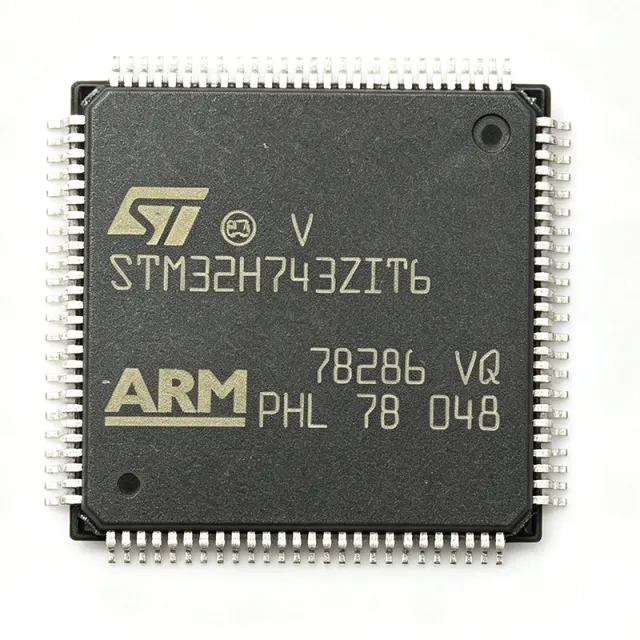
STM32H743ZIT6 - 480MHz Cortex-M7 MCU, 2MB Flash | STMicroelectronics
STM32H743ZIT6

STM32H743ZIT6 - 480MHz Cortex-M7 MCU, 2MB Flash | STMicroelectronics

The STMicroelectronics STM32H743ZIT6 is a high-performance 32-bit ARM Cortex-M7 microcontroller operating at up to 480 MHz, integrating 2 MB of Flash and 1 MB of SRAM in a 144-pin LQFP (20x20 mm) package. It targets demanding embedded designs requiring DSP-grade signal processing, double-precision floating-point, and rich connectivity in a single device. A microcontroller (MCU) is a compact integrated circuit that combines a processor core, on-chip memory, and programmable input/output peripherals on a single die. The STM32H743ZIT6 belongs to the STM32H7 series, ST's flagship performance tier of the broader STM32 family of 32-bit ARM Cortex microcontrollers, sitting above STM32F7/F4 parts and below the dual-core STM32H747/H757 lines. Key features include the 480 MHz Cortex-M7 core with double-precision FPU, 2 MB of Flash, 1 MB of SRAM (including 64 KB of DTCM and AXI SRAM), three 12-bit ADCs at 3.6 MSPS, two 12-bit DACs, and advanced timers with hardware quadrature decoding. Connectivity interfaces include up to 35 communication peripherals - USART, SPI, I2C, CAN FD, USB OTG, and Ethernet MAC - plus a Chrom-ART graphics accelerator, hardware AES/SHA crypto accelerator, and true random number generator. Architecturally, the device integrates a 16 KB instruction cache and 16 KB data cache, a memory protection unit (MPU), and a flexible external memory controller (FMC) supporting SDRAM, NOR, and NAND Flash. Multiple low-power modes - Sleep, Stop, and Standby - minimize quiescent current for battery-powered designs. Typical applications include industrial motor control (FOC drives, robotics), medical instrumentation, audio processing (DSP effects, USB speakers), high-end consumer HMI, and secure IoT edge nodes. The 480 MHz core plus L1 cache gives 2.14 DMIPS/MHz and DSP instructions that meet demanding real-time loops. When designing with this MCU, follow ST's PCB layout recommendations: isolate VDDA analog supply with a ferrite bead, place 100 nF + 4.7 µF decoupling close to every supply pin, and reserve a low-impedance ground plane beneath the LQFP-144 footprint to manage 480 MHz return currents. This page synthesizes distributor pricing, drop-in alternatives, and practical design notes that complement the ST datasheet, giving engineers a single reference for evaluating the STM32H743ZIT6.

USD $10.65 재고 있음
STM32H743ZIT6U - 32-Bit 480MHz Cortex-M7 MCU | STMicroelectronics
STM32H743ZIT6U

STM32H743ZIT6U - 32-Bit 480MHz Cortex-M7 MCU | STMicroelectronics

The STMicroelectronics STM32H743ZIT6U is a 32-bit Arm Cortex-M7 microcontroller with a 480 MHz clock, 2 MB of internal Flash memory, and a 144-LQFP package measuring 20 mm by 20 mm. The device is designed for high-performance embedded control, real-time signal processing, communications, and applications requiring extensive peripheral integration. The verified distributor listing identifies a 2M x 8 Flash organization, while another result describes the same family with 1 MB of additional RAM-related information; exact RAM organization is not independently stated for the U suffix. A microcontroller is a programmable embedded-system component that combines a processor core, memory, communication interfaces, timers, analog peripherals, and digital input/output in one integrated circuit. The Cortex-M7 core provides deterministic instruction execution for control loops and supports the STM32H7 family’s high-performance processing requirements. In the power-management hierarchy, the STM32H743ZIT6U is an embedded processing platform rather than a discrete regulator or power semiconductor. The principal verified features are 32-bit processing at up to 480 MHz, 2 MB of Flash memory, and a 144-LQFP package. The Cortex-M7 architecture is suitable for applications involving high-speed control, communication gateways, industrial equipment, audio and digital signal processing, and connected embedded systems. The package exposes a large pin count suitable for multiple I/O, communication, debug, power, and clock connections, although the complete pin-level electrical assignment is not provided in the supplied source snippets. The U suffix and exact ordering code require careful commercial verification. The supplied data includes listings for both STM32H743ZIT6 and STM32H743ZIT6U; these should not be treated as interchangeable without checking the manufacturer’s orderable-parts table, temperature range, packaging, and lifecycle status. The supplied evidence does not establish operating temperature, voltage range, RAM capacity, RoHS status, or AEC-Q100 qualification. Typical design work includes assigning supply and ground pins, validating the 144-LQFP footprint, configuring the clock tree, planning firmware initialization, and reserving pins for debug and communications. Engineers should also verify startup behavior, power sequencing, decoupling requirements, and peripheral availability against the official datasheet before releasing a PCB or production firmware. This page consolidates verified distributor snippets, source URLs, package information, and replacement-search findings into a structured product record. It separates confirmed data from fields requiring datasheet verification and highlights why package, pinout, memory, and firmware compatibility must be checked before substituting any candidate. The STM32H743ZIT6U is best suited to engineers seeking a high-performance Cortex-M7 MCU in a large LQFP package for embedded control and signal-processing platforms. The source data supports ordering and datasheet discovery but does not provide enough verified electrical detail to claim specific peripheral, timing, or compliance ratings beyond the values listed above.

견적 요청 재고 있음
STM32H745BGT6 - Dual-Core Cortex-M7/M4 MCU | STMicroelectronics
STM32H745BGT6

STM32H745BGT6 - Dual-Core Cortex-M7/M4 MCU | STMicroelectronics

The STMicroelectronics STM32H745BGT6 is a high-performance dual-core microcontroller combining an Arm Cortex-M7 core running at up to 480 MHz and an Arm Cortex-M4 core running at up to 240 MHz, with 1 Mbyte of Flash memory and 1 Mbyte of SRAM. It is housed in a 144-pin LQFP package (20x20 mm) and operates from a 1.62V to 3.6V supply. A microcontroller (MCU) is a compact integrated circuit designed to govern a specific operation in an embedded system. It contains a processor core, memory, and programmable input/output peripherals. The STM32H745BGT6 belongs to the STM32H7 series, which is part of the broader STM32 family of 32-bit Arm Cortex-based microcontrollers. This family is widely used in industrial, consumer, and automotive applications due to its performance, peripheral integration, and ecosystem support. Key features include a 32-bit Arm Cortex-M7 core with double-precision FPU and L1 cache, a 32-bit Arm Cortex-M4 core with FPU, a Chrom-ART Accelerator for graphics, a hardware cryptographic accelerator, and a rich set of communication interfaces including Ethernet, USB OTG, CAN FD, and multiple UART/SPI/I2C. The device also features a 16-bit ADC, a 12-bit DAC, and advanced timers. The dual-core architecture allows for asymmetric multiprocessing, where the M7 core handles compute-intensive tasks and the M4 core manages real-time control or communication. The device supports TrustZone for security, and includes a memory protection unit (MPU) for each core. The STM32H745BGT6 is designed for high-performance embedded applications requiring both processing power and real-time responsiveness. Typical applications include industrial automation, motor control, power conversion, audio processing, and high-end consumer electronics. The dual-core capability enables complex systems to be partitioned for better performance and reliability. When designing with this device, careful attention must be paid to power supply decoupling and PCB layout to ensure stable operation at high clock frequencies. The device supports multiple low-power modes, and the power management unit (PMU) should be configured appropriately to balance performance and energy consumption.

USD $11.60 재고 있음
STM32H745IIK6 - Dual-Core M7+M4 MCU 2MB Flash UFBGA-176 | STMicroelectronics
STM32H745IIK6

STM32H745IIK6 - Dual-Core M7+M4 MCU 2MB Flash UFBGA-176 | STMicroelectronics

The STMicroelectronics STM32H745IIK6 is a high-performance dual-core 32-bit Arm Cortex microcontroller combining a Cortex-M7 core running up to 480 MHz with a Cortex-M4 core running up to 240 MHz, packed into a 176-ball UFBGA (10x10 mm) package. The device integrates 2 MB of dual-bank Flash memory and 1 MB of SRAM, plus an additional 4 KB of backup SRAM and a high-speed external memory interface supporting SDRAM, SRAM, NOR/NAND Flash, and CompactFlash. A microcontroller (MCU) is a single-chip computer that integrates a CPU core, program memory (Flash), working memory (RAM), and a rich set of peripherals into one package. Within the broader taxonomy, the STM32H745IIK6 belongs to the hierarchy: microcontroller -> embedded processor -> integrated circuit -> semiconductor. Dual-core MCUs are a specialized sub-category that combines a high-performance core with a real-time or DSP-capable core to split application-defined tasks, allowing real-time control and DSP/HMI layers to run independently on the same silicon. Key features include a built-in SMPS step-down converter for low-power operation, 46 communication and analog interfaces (UART/USART, SPI, I2C, CAN, USB, Ethernet, SDMMC), three 16-bit ADCs, two DACs, and an integrated TFT-LCD controller. The device also embeds a Chrom-ART graphics accelerator, an MMU for Linux-style OS support, and AES-256 plus two SAI audio interfaces, targeting HMI, motor control, and audio applications. The Cortex-M7 core delivers 1320 CoreMark / 2400 DMIPS while the Cortex-M4 handles up to 600 CoreMark / 300 DMIPS, with both cores sharing internal SRAM and peripherals through a multi-AHB bus matrix. This asymmetric architecture lets developers run an RTOS on one core while running DSP or graphics on the other. Typical applications include industrial HMI panels with TFT-LCD, motor control and field-oriented control (FOC) drives, audio processing products, IoT gateways, point-of-sale terminals, and smart appliances. Designers usually pair this MCU with external SDRAM, a TFT-LCD panel, and isolated CAN/RS-485 transceivers. The built-in SMPS makes it especially suitable for USB-powered and battery-operated systems. When designing with this MCU, distribute the UFBGA-176 ball escape carefully across at least 4 PCB layers with a dedicated ground/power plane, and ensure the SMPS external LC filter follows the datasheet reference layout within 5 mm of the VCORE/VDD pins. The internal regulator and backup domain require a 1 µF plus 100 nF decoupling combination on each supply pin for stable operation.

USD $12.60 재고 있음
STM32H745IIT6 - 480MHz Dual-Core M7/M4 MCU, 2MB Flash | ST
STM32H745IIT6

STM32H745IIT6 - 480MHz Dual-Core M7/M4 MCU, 2MB Flash | ST

The STMicroelectronics STM32H745IIT6 is a high-performance 32-bit dual-core microcontroller built on the Arm Cortex-M7® and Cortex-M4® cores with FPU and DSP extensions, packaged in a 176-pin LQFP (24x24 mm). The Cortex-M7 core operates at up to 480 MHz and the Cortex-M4 core at up to 240 MHz, supported by 2 MB of dual-bank Flash and 1 MB of SRAM including 192 KB DTCM/AXI SRAM plus 64 KB DTCM for the M4 core. What is a dual-core Cortex-M7/M4 MCU? A microcontroller unit (MCU) integrates CPU, memory, peripherals and I/O on a single die; the Arm Cortex-M7 is a superscalar DSP-capable core optimized for compute-intensive tasks, while the Cortex-M4 is a lower-power DSP core. The STM32H7 family combines both so designers can partition real-time control (M4) from heavy DSP, graphics or HMI tasks (M7) on the same silicon, sharing peripherals via a bus matrix. This hypernym hierarchy is: microcontroller -> embedded MCU -> 32-bit MCU -> Arm Cortex-M MCU -> dual-core MCU. Key features of this device include a 16-bit ADC (3.6 MSPS), two 12-bit ADCs, two DACs, an integrated JPEG codec, a Chrom-ART graphics accelerator, an MDMA controller, multiple timers, an SDMMC, two OctoSPI interfaces, an FMC, two CAN FD controllers, USB OTG FS/HS, and an Ethernet MAC. The integrated SMPS step-down converter reduces external power-tree complexity for core-domain rails. Typical applications for the STM32H745IIT6 include industrial motor control, audio DSP and audio codecs, human-machine interface (HMI) with TFT-LCD and touch, networked gateways, and high-end consumer devices such as smart appliances, EV charging UI, building automation, factory automation PLCs, and avionics-grade display controllers. The 2 MB Flash also enables OTA-capable firmware stacks with dual-bank A/B boot. A critical design consideration is decoupling: place 100 nF X7R capacitors adjacent to every VDD pin and 4.7 µF bulk caps on the SMPS output. Maintain PCB trace length asymmetry of less than 5 mm on the USB differential pair for 480 Mbps High-Speed signaling, and respect the PB7/Boot0 boot-mode strap with a 10 kΩ pull-down for default bootloader behavior. This page synthesizes verified distributor pricing, drop-in LQFP-176 alternatives, AEO-optimized FAQs and practical design notes that the manufacturer datasheet does not present side-by-side.

USD $10.62 재고 있음
STM32H745VGT6 - Dual-Core Cortex-M7/M4 MCU | STMicroelectronics
STM32H745VGT6

STM32H745VGT6 - Dual-Core Cortex-M7/M4 MCU | STMicroelectronics

The STMicroelectronics STM32H745VGT6 is a high-performance dual-core microcontroller combining an Arm Cortex-M7 core running at up to 480 MHz and an Arm Cortex-M4 core running at up to 240 MHz, with 1 Mbyte of Flash memory and 1 Mbyte of RAM. It is housed in a 100-pin LQFP100 package, offering a rich set of peripherals including multiple ADCs, DACs, timers, communication interfaces (USART, SPI, I2C, FDCAN, USB, Ethernet), and advanced security features. What is a dual-core microcontroller? A dual-core microcontroller integrates two independent processor cores on a single chip, allowing parallel execution of tasks. In the STM32H745, the Cortex-M7 core is optimized for high-performance compute-intensive operations, while the Cortex-M4 core handles control and communication tasks. This architecture enables real-time processing and efficient multitasking, making it a key component in the broader category of embedded microcontrollers, which are the brains of countless electronic systems. Key features include a 480 MHz Cortex-M7 with double-precision FPU, a 240 MHz Cortex-M4 with FPU, 1 Mbyte of Flash, 1 Mbyte of SRAM, a Chrom-ART Accelerator for graphics, a hardware cryptographic accelerator, and a comprehensive set of analog and digital peripherals. The device supports a wide supply voltage range of 1.62V to 3.6V and operates over a temperature range of -40°C to +85°C. The STM32H745VGT6 is built on ST's advanced 40nm process technology, delivering industry-leading performance per milliwatt. The dual-core architecture allows developers to partition tasks between the two cores, optimizing power consumption and responsiveness. The device includes a flexible memory-mapped architecture, enabling efficient data sharing between cores. Typical applications include industrial automation, motor control, high-end audio processing, medical devices, and IoT gateways. The dual-core design is particularly suited for applications requiring simultaneous high-speed data processing and real-time control, such as robotics and advanced driver assistance systems. When designing with this device, ensure proper decoupling of the power supply pins and careful layout of the high-speed interfaces. The device supports multiple low-power modes, allowing designers to balance performance and energy efficiency. For development, ST offers the STM32CubeIDE and HAL libraries, which simplify peripheral configuration and code generation.

USD $8.10 재고 있음
STM32H745ZGT6 - Dual Cortex-M7/M4 MCU 1MB Flash | STMicroelectronics
STM32H745ZGT6

STM32H745ZGT6 - Dual Cortex-M7/M4 MCU 1MB Flash | STMicroelectronics

The STMicroelectronics STM32H745ZGT6 is a dual-core 32-bit ARM microcontroller integrating an Arm Cortex-M7 core running up to 480 MHz and a Cortex-M4 core running up to 240 MHz, packaged in a 144-pin LQFP (20x20 mm) with 1 MB of embedded Flash and approximately 1 MB of SRAM. It belongs to the high-performance STM32H7 family and is engineered for compute-intensive real-time control, motor drives, audio processing, and human-machine interface (HMI) applications where two heterogeneous cores share a workload - the M7 for DSP/graphics and the M4 for housekeeping, communications, or low-power task scheduling. As a microcontroller (MCU), the STM32H745ZGT6 sits in the broader taxonomy of embedded processing devices: MCU -> ARM Cortex-M MCU -> STM32 family -> STM32H7 high-performance series. It is a system-on-chip integrating CPU cores, memory, analog peripherals, and digital interfaces in a single package, programmed typically via STM32CubeIDE, STM32CubeMX, and the HAL/LL driver libraries. Key differentiating features include the dual-core asymmetric architecture (M7 + M4) with separate instruction caches, an integrated SMPS step-down converter for core supply (improving efficiency versus external LDOs), up to 2 MB Flash and 1 MB RAM across the full H745 line, a Chrom-ART graphics accelerator, JPEG codec hardware, and an extensive peripheral set including 16-/12-bit ADCs, DACs, timers, Ethernet, USB, CAN FD, and high-speed SPI/QSPI interfaces for external memory or displays. The device operates from 1.62 V to 3.6 V with internal SMPS generating the core voltage. Typical applications include industrial motor control (field-oriented control), audio amplifiers and DSP effects processors, HMI panels with TFT-LCD and touch, building automation, IoT edge gateways, programmable logic controllers, and medical instrumentation. The dual-core design enables deterministic real-time response on the M4 while the M7 executes complex algorithms without mutual blocking. When designing with this part, allocate a minimum 4-layer PCB with continuous GND pour around the LQFP-144 package to manage thermal dissipation at high clock speeds. Decouple each VDD/VBAT pin with 100 nF X7R ceramic capacitors placed within 2 mm of the respective pins. Use STM32CubeMX to configure the SMPS inductor and feedback compensation to achieve the specified core voltage ripple under your worst-case load transient. This page synthesizes distributor pricing, drop-in pin-compatible alternatives within the STM32H7 family, and practical PCB layout notes not found in the manufacturer datasheet.

USD $15.60 재고 있음
STM32H745ZIT6 - Dual-Core Cortex-M7/M4 MCU, 480MHz, 2MB Flash | STMicroelectronics
STM32H745ZIT6

STM32H745ZIT6 - Dual-Core Cortex-M7/M4 MCU, 480MHz, 2MB Flash | STMicroelectronics

The STMicroelectronics STM32H745ZIT6 is a high-performance dual-core 32-bit microcontroller pairing an Arm Cortex-M7 core running up to 480 MHz with a Cortex-M4 core running up to 240 MHz, integrating 2 MB of Flash and 1 MB of SRAM in a 144-pin LQFP (20x20 mm) package. The device targets demanding real-time embedded workloads where DSP-grade signal processing, GUI rendering, and deterministic control must coexist on one silicon die. A Chrom-ART graphics accelerator and hardware JPEG codec offload pixel and image pipelines, while an integrated cryptographic accelerator handles AES, hash, and True Random Number Generator functions for secure connectivity. A microcontroller (MCU) is a compact, self-contained computer on a single integrated circuit that combines a processor core, volatile and non-volatile memory, programmable peripherals, and bus fabric. The STM32 family is STMicroelectronics' 32-bit Arm Cortex-M portfolio, with the STM32H7 series occupying the high-performance tier that bridges MCU and application-processor territory. The H745 sub-family adds heterogeneous dual-core asymmetric multiprocessing (AMP), so heavy graphics and DSP work runs on the M7 while time-critical control loops run independently on the M4. Key differentiating features include 480 MHz Cortex-M7 with double-precision FPU, 240 MHz Cortex-M4 with single-precision FPU, 2 MB dual-bank Flash for live firmware updates, 1 MB SRAM split across DTCM, AXI SRAM, and SRAM1-4 domains, and an extensive peripheral set including Ethernet, USB 2.0 HS, CAN-FD, SDMMC, three 12-bit ADCs up to 3.6 MSPS, two 12-bit DACs, and TFT LCD interface. Operating voltage spans 1.62 V to 3.6 V with multiple low-power modes (D1 Stop, Standby, VBAT) for energy-constrained designs. Architecturally, the device is built on ST's 40 nm low-power process and uses a multilayer AHB/APB bus matrix plus an AXI-to-DTCM bridge so each core can fetch zero-wait-state from its private TCM. The Cortex-M7 issues single-precision and double-precision floating-point instructions natively, while the Cortex-M4 handles real-time control and housekeeping. Dedicated DMA controllers (MDMA, DMA1/DMA2) keep peripherals fed without CPU intervention, enabling overlapped computation and data movement. Typical applications include industrial motor control and field-oriented drive (FOD) inverters, smart-home gateways with embedded graphics, audio processing and effects units, advanced HMI panels, factory automation PLCs, and high-end consumer devices requiring simultaneous DSP and GUI work. The dual-core split makes it a strong fit for protocols stacks (M4) plus UI/DSP (M7) architectures. When designing with this device, allocate decoupling capacitance close to every VDD/VDDA/VBAT pin and place the four-layer break-out symmetric around the exposed pad to dissipate the M7's dynamic power. Use the ST MC SDK for motor control and STM32CubeIDE plus TouchGFX for HMI development, and respect the boot pin strapping for Flash boot versus system memory bootloader. Cross-check VCAP pins with the reference schematic to avoid reset instability.

USD $11.50 재고 있음
STM32H747AII6 - Dual Cortex-M7+M4 MCU 480MHz 2MB Flash | ST
STM32H747AII6

STM32H747AII6 - Dual Cortex-M7+M4 MCU 480MHz 2MB Flash | ST

The STMicroelectronics STM32H747AII6 is a high-performance dual-core 32-bit microcontroller built around an Arm Cortex-M7 core running up to 480 MHz and a Cortex-M4 core running up to 240 MHz, with 2 MB of Flash and 1 MB of SRAM, housed in a 169-pin UFBGA (7x7 mm) package. The part integrates an extensive peripheral set, hardware accelerators for graphics and DSP, and an on-chip SMPS that dynamically scales core voltage to maximize efficiency versus performance. A microcontroller (MCU) is a single-chip computer that combines a CPU core, program memory (Flash), working memory (SRAM), and a wide range of on-chip peripherals such as timers, ADCs, communication controllers, and GPIO. Within the broader taxonomy, an MCU is a type of embedded microcontroller -> microcontroller -> microprocessor -> semiconductor -> integrated circuit. The STM32H747AII6 occupies the top of the ST general-purpose 32-bit MCU family, between Cortex-M4-only mainstream MCUs and application processors requiring an MPU. Key features include 2 MB dual-bank Flash, 1 MB SRAM (including 192 KB DTCM + 64 KB ITCM for the M7 core), Chrom-ART graphics accelerator, JPEG codec, MIPI-DSI and parallel display interfaces, two 16-bit ADCs (3.6 MSPS), two 12-bit DACs, an SMPS step-down converter plus LDO regulators, and a USB 2.0 HS OTG PHY. Communication is supported by multiple SPI, I2C, USART/UART, SAI, CAN-FD, SDMMC, FMC, and Ethernet (MII/RMII) controllers. The 169-UFBGA package provides dense pin count and efficient signal routing for high-IO applications. The dual-core architecture allows one core to handle real-time deterministic control while the other runs HMI graphics, communication stacks, or DSP algorithms. The on-chip SMPS supplies the M7 core directly with high current capability while keeping the external supply topology simple. Hardware crypto accelerators (AES, SHA, TRNG) and secure-boot features enable secure firmware updates for connected products. Typical applications include human-machine interface (HMI) panels with TFT or MIPI-DSI displays, industrial motor control and drives, audio processing units, point-of-sale terminals, smart appliances, building automation gateways, and high-performance IoT edge nodes. The dual cores allow an RTOS to run on the M4 while complex code paths execute on the M7 with full DSP and FPU support. When designing with this device, place the 100 nF + 4.7 µF decoupling network as close as possible to each VDD pin, and assign the SMPS inductor to its dedicated pins with the shortest loop possible. Boot mode and option bytes should be reviewed early in the schematic to avoid lockout conditions on first prototypes. This page synthesizes XAIPART distributor pricing, validated drop-in alternatives, application reference designs, and practical design notes that are not collected in a single place on the ST datasheet.

USD $19.10 재고 있음