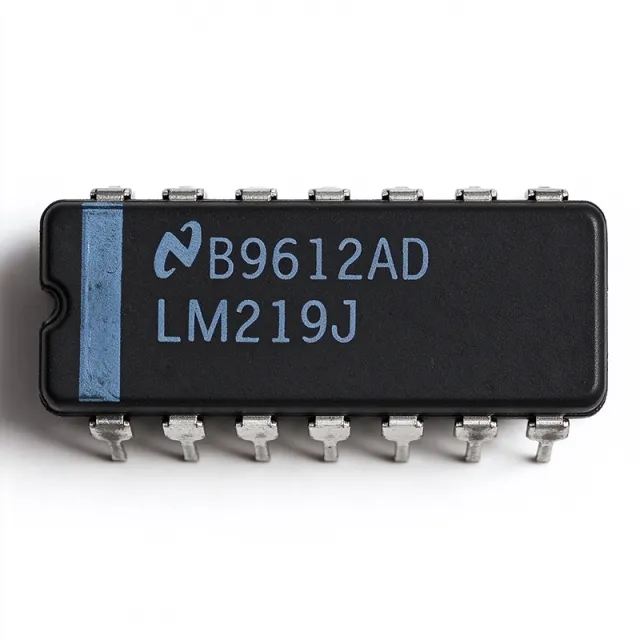
Quick Answers — What Is the LM219J and Is It Available?
The Texas Instruments LM219J is a general-purpose, high-speed dual comparator with two independent comparison channels and a single monolithic-chip construction. Verified specifications include a 5 V to 30 V supply range, an alternate ±2.5 V to ±15 V description, and compatibility with DTL, open-collector, open-emitter, RTL, and TTL interfaces. It is supplied in a 14-CDIP through-hole package measuring 0.300 inches, or 7.62 mm, in width. XAIPART records 9,806 units in stock, an MOQ of 1, and active lifecycle status. The verified base price is $18.8672 as of 2026-11-01, while the quantity pricing table lists $32.3438 at the one-unit tier; both values are reported here because the record contains that pricing difference.
The LM219J fits legacy industrial control, threshold detection, pulse and zero-crossing detection, process instrumentation, test fixtures, embedded interfacing, and power-monitoring designs that need two comparison functions in one through-hole package. Review the LM219J product page for the latest record, and use the manufacturer documentation linked in the citations before finalizing a timing- or accuracy-sensitive design.
Action: Confirm supply, package, interface, and lifecycle requirements against the verified record, then validate operating limits and timing with the authoritative datasheet.
Technical Guide — How Do You Select, Design In, and Source the LM219J?
Why Choose a Dual Comparator?
Choose the LM219J when a design needs two independent voltage comparisons without installing two separate comparator packages. Each channel can support threshold detection, pulse shaping, zero-crossing detection, basic signal conditioning, or a binary control decision. The two-channel architecture reduces component count while retaining the through-hole format used by many legacy industrial, laboratory, and repair-oriented systems.
The verified device classification is “precision high-speed dual comparator,” and the construction is one monolithic chip. That family classification supports consideration for decision paths that need faster response than a general static comparator, but buyers should not assign a numeric response time from the word “high-speed.” The numerical timing and accuracy limits must be established from the manufacturer documentation for the actual supply and loading conditions.
How Does the Supply Range Affect Design-In?
The primary supply specification is 5 V to 30 V, with an alternate listed description of ±2.5 V to ±15 V. This range allows the LM219J to fit legacy 5 V logic environments as well as higher-voltage control circuits. The dual-channel part can also handle two decisions within one package, such as upper and lower limits or two monitored rails.
For a new design, establish the actual supply rail before selecting the output interface. A 5 V system exposes the device to a different output environment than a 24 V control system. The verified compatibility list includes DTL, open-collector, open-emitter, RTL, and TTL, so the surrounding logic technology should be identified early. If the selected output arrangement uses open collector, implement the external pull-up network required for that interface rather than assuming push-pull drive.
Place the comparator close to the signals being compared. Short input traces reduce pickup and board-level timing uncertainty, particularly in pulse, zero-crossing, and test-fixture applications. Maintain a stable ground reference and provide the supply-bypassing arrangement specified by the manufacturer documentation.
Where Does the 14-CDIP Package Help?
The 14-CDIP package favors through-hole assemblies, repairable legacy boards, and modernization projects that retain existing ceramic-DIP footprints. Its recorded width is 7.62 mm, which the database also lists as 0.300 inches. A ceramic dual-inline package can suit controlled industrial and laboratory equipment, but the supplied record does not provide a package drawing, pin table, or package SVG.
Because no verified pin-number-to-signal-name table appears in the supplied evidence, engineers should not infer pin assignments from generic comparator diagrams. Before wiring a new board, confirm power, input, output, and any other functional terminals in the manufacturer datasheet. During replacement, inspect the installed package markings, socket or board footprint, supply polarity, input polarity, output arrangement, and timing requirements.
How Do You Apply the LM219J in Common Circuits?
Industrial threshold detection: Compare a process or control signal with a reference and send a logic-compatible decision to the surrounding control electronics. One channel can establish an upper limit and the other a lower limit. The 5 V to 30 V supply range supports legacy systems operating above a basic 5 V rail, while the 14-CDIP package fits repairable through-hole boards.
Pulse and zero-crossing detection: Use the two channels to monitor either edge of a bipolar waveform or to establish upper and lower threshold decisions. The verified “precision high-speed” classification makes the device a candidate for these legacy signal-monitoring circuits. Numerical guard time and filtering must follow the manufacturer timing data and the actual signal path.
Process-control instrumentation: Convert a conditioned sensor signal into a binary decision by comparing it with a reference. The dual architecture can monitor two sensed levels. Add appropriate connector protection and signal conditioning, and confirm that the monitored voltages fall inside the device’s specified operating envelope.
Legacy TTL and DTL control: The verified output compatibility makes the LM219J relevant to older digital control cards and laboratory equipment. The interface arrangement should match the existing logic family and load requirements. Pull-up components, where required, must be sized from the applicable output specifications rather than copied from an unrelated comparator design.
Legacy test and measurement: Use the part for upper and lower limits, trigger crossings, or pass/fail decisions in fixtures built around analog inputs. Two channels can support a dual-threshold fixture. Account for probe loading, cable delay, and fixture noise when interpreting the decision output.
Power and battery monitoring: The 30 V upper supply rating and two comparison elements support evaluation for legacy rail or battery-threshold monitoring. External dividers, filtering, isolation, and protection remain necessary when the monitored signal requires conditioning. The comparator indicates a threshold relationship; it does not replace upstream power-path protection.
How Should You Source and Price the Part?
XAIPART records 9,806 units in stock and an MOQ of 1 as of 2026-11-01. The verified quantity schedule is $32.3438 at one or more units, $23.3594 at 10 or more, $20.6641 at 100 or more, $19.7656 at 500 or more, and $18.8672 at 1,000 or more, all as of 2026-11-01. The separate base-price field records $18.8672 as of 2026-11-01. Because that base-price value differs from the listed one-unit tier, procurement teams should request a quantity-specific quotation rather than assume that every one-unit order receives the lower base-price figure.
For a 1,000-unit procurement at the listed tier price, the derived total is $18,867.20 before taxes, freight, and other commercial terms. This calculation uses only the verified $18.8672 tier price and the 1,000-unit tier threshold. The XAIPART component catalog is the appropriate starting point for checking related inventory, while the product page should remain the primary source for the current LM219J listing.
Action: Use the 1,000-unit tier for planning, request written confirmation for the planned quantity, and avoid designing around the conflicting base-price and one-unit tier until the supplier clarifies the order point.
Alternatives & Comparison — Is the LM119D a Drop-In Replacement for the LM219J?
The supplied data identifies the LM119D as a related comparator, but it does not establish that the LM119D shares the LM219J’s package, pinout, electrical limits, timing, or output arrangement. It therefore cannot be presented as a verified drop-in alternative. Procurement should treat the LM119D as a candidate for a formal cross-reference review, not as an automatic substitution.
| Parameter | LM219J | LM119D |
|---|---|---|
| Comparison status | Primary component | Related comparator; no drop-in replacement established by the supplied data |
| Product type | General-purpose comparator | No verified product specification supplied |
| Number of elements | 2 | No verified product specification supplied |
| Number of channels | 2 | No verified product specification supplied |
| Supply voltage range | 5 V to 30 V | No verified product specification supplied |
| Alternate supply description | ±2.5 V to ±15 V | No verified product specification supplied |
| Output type | DTL, open-collector, open-emitter, RTL, TTL | No verified product specification supplied |
| Package | 14-CDIP | No verified product specification supplied |
| Mounting type | Through-hole | No verified product specification supplied |
| Comparator class | Precision high-speed dual comparator | No verified product specification supplied |
| Construction | Single monolithic chip | No verified product specification supplied |
A valid substitution must match the board footprint, functional pin assignments, input and output polarity, supply operating range, output loading method, required timing, and temperature requirements. Similarity as a “related comparator” is not enough. Review the manufacturer documentation, inspect the installed part, and obtain an authorized supplier cross-reference before releasing a replacement.
Action: Keep the LM219J as the qualified choice unless the LM119D’s complete electrical and mechanical data proves equivalence for the target circuit.
Industry Insight — What Does the Lifecycle and Supply Record Tell Buyers?
The XAIPART database lists the LM219J lifecycle status as active. It also records 9,806 units in stock and an MOQ of 1 as of 2026-11-01. These facts indicate current database availability and an active lifecycle classification, but they do not identify authorized distributor inventory, factory lead time, date-code inventory, or manufacturing-region coverage.
The 14-CDIP format places the LM219J in a legacy-oriented product position. Its through-hole package and established interface compatibility make it relevant to repair, modernization, and extension of older industrial and laboratory systems. The component also carries a high-speed classification and a 5 V to 30 V supply range, which make it relevant where an existing control architecture expects more than a basic 5 V comparator.
Buyers should distinguish database stock from guaranteed production supply. The recorded 9,806 units provide a current procurement signal as of 2026-11-01, but future availability can change with inventory movement and distributor activity. For new production commitments, request confirmation of lifecycle status, orderable quantity, package markings, delivery timing, and traceability documentation from Texas Instruments or an authorized distributor.
Pricing also has a quantity structure that supports planned consolidation. The verified tier price declines from $32.3438 at one unit to $18.8672 at 1,000 units as of 2026-11-01. That spread makes it worthwhile to compare the planned build quantity with available stock before issuing separate small orders.
Action: Treat active status and 9,806 units of recorded stock as current signals as of 2026-11-01, but secure a supplier commitment before making the build schedule depend on future inventory.
Trends & Outlook — What Should Buyers Watch as Legacy Comparator Designs Continue?
The first buying trend to watch is the continued use of dual comparators in legacy control systems where two independent decisions can share one package. The LM219J provides two elements, two channels, and a single monolithic-chip construction, reducing the number of through-hole devices required for dual-threshold or dual-rail monitoring. Designs that can combine both functions in one LM219J may simplify board population compared with two separate single-channel packages.
The second trend is the persistence of established logic interfaces. The verified compatibility list spans DTL, open-collector, open-emitter, RTL, and TTL. That range supports design teams maintaining older industrial controllers, laboratory instruments, and test fixtures without immediately converting the entire information chain to a newer logic family. Open-collector implementations also reinforce the need to plan pull-up networks correctly instead of assuming push-pull output behavior.
The third trend is supply planning around through-hole packages. The 14-CDIP format remains valuable for repair and board-extension work, but engineers designing new compact assemblies should account for the larger footprint. The recorded 7.62 mm package width and through-hole mounting identify the physical format clearly. For compact new products, compare the system-level value of reusing the LM219J against the board-area and assembly implications of a smaller package.
The fourth trend is tighter verification for timing- and accuracy-driven decisions. The part is classified as a precision high-speed dual comparator, but procurement records do not replace the manufacturer’s operating conditions. Engineers should obtain the authoritative documentation before defining pulse-width limits, zero-crossing guard bands, process-control thresholds, or test-fixture trigger tolerances. That review also helps confirm how the 5 V to 30 V supply range applies to the intended interface and loading arrangement.
The fifth trend is disciplined consolidation. With 9,806 units recorded in stock and an MOQ of 1 as of 2026-11-01, buyers can align prototype, repair, and production demand against the available quantity. The 1,000-unit tier price of $18.8672 provides a clear planning reference, while the $32.3438 one-unit tier shows the commercial difference between small procurement and consolidated buying. Because the separate base-price field also lists $18.8672, obtaining a quantity-specific quotation prevents a pricing assumption from becoming a sourcing error.
Overall, the LM219J remains a defensible choice when the design specifically requires a Texas Instruments dual comparator, a 14-CDIP footprint, a 5 V to 30 V supply capability, and compatibility with legacy logic interfaces. It is not enough simply to select any comparator with a similar function. Match the complete device requirements, validate the electrical operating conditions, and confirm supply at the quantity and date required. Buyers can use the XAIPART technical blog for related engineering guidance and the LM219J product record to verify availability before design release.
Action: Standardize the LM219J around verified supply, interface, package, and inventory data, then close timing, accuracy, and environmental checks with the authoritative datasheet before production release.
Komen
Jadi orang pertama untuk memberi komen.
🔐 Sila daftar masuk untuk menugaskan komen.
Tiada akaun? Daftar