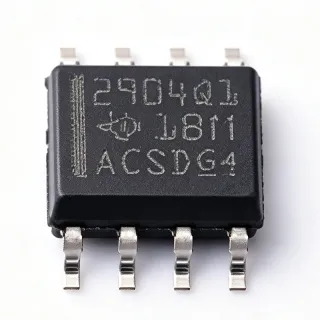
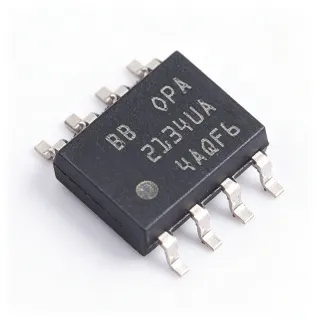
THS3121ID - 475mA High-Output-Drive Current-Feedback Op Amp | Texas Instruments
MPN: THS3121ID ✓ AktifTHS3121ID Ringkasan
A current-feedback amplifier (CFA) is a type of operational amplifier in which the inverting input node operates as a low-impedance summing junction and the feedback network sets the gain, rather than the gain being set by a differential input pair. This architecture allows closed-loop bandwidth to stay essentially flat as gain changes, which places the CFA in the broader hierarchy of voltage-feedback operational amplifiers -> analog signal-conditioning amplifiers -> integrated amplifier ICs. CFAs are the preferred building block for wideband, high-impedance-sensing and cable-driver stages where voltage-feedback op amps lose stability at low noise gains.
Key features of the THS3121 include 130 MHz unity-gain bandwidth for low distortion at 10 MHz, a very high 1700 V/µs slew rate that produces large output voltage swings at high frequencies, and up to 475 mA of output current, allowing it to drive low-impedance loads, long cables, and capacitive loads without external buffers. The device is specified for wide supply operation of ±5 V to ±15 V, and the manufacturer describes it as a low-noise, high-output-drive amplifier intended for high-performance analog signal chains.
Internally, the THS3121 uses a current-feedback core whose bandwidth is set by the external feedback resistor rather than by a fixed gain-setting network, so a single amplifier can serve gain stages from roughly 1 V/V to 20 V/V while keeping distortion low. Because the output stage can source and sink several hundred milliamps, the part maintains large-signal integrity into 50 ohm and 32 ohm loads, and its drive capability reduces the need for external output buffers in instrumentation chains.
Typical applications include low-noise instrumentation preamplifiers, high-speed current-sense amplifiers, video and broadcast distribution buffers, ultrasonic and audio driver stages, laboratory test equipment, and general-purpose high-speed analog signal conditioning. The same footprint also serves any application needing accurate gain at 10 MHz with low harmonic distortion.
When designing with the THS3121, choose the feedback resistor carefully because its value directly sets both bandwidth and gain in a current-feedback amplifier, and check that the load does not exceed the specified 475 mA output drive. Place the feedback resistor close to the inverting input pin to minimize parasitic capacitance that would otherwise reduce stability.
This page consolidates manufacturer device data, drop-in replacement options in the same SOIC-8 footprint, and practical layout and stability guidance that are not collected together in the manufacturer datasheet.
Pilihan pengganti yang segera untuk THS3121ID — sama paket, pin-pin kompatibel. Bahagian paket yang berbeza memerlukan kerja ulang PCB diasingkan.
Varietas dalam siri ini
Model serupa yang kompatibel dengan pengganti yang segera THS3121ID (sama faktor bentuk dan kaki) — berbeza dalam Number of Channels, Slew Rate.
THS3120ID
✅ Masuk Drop-InHubungi untuk harga
Lihat Datasheet →THS3201ID
✅ Masuk Drop-In ⚠️ Spesifikasi Tidak Disahkan📋 Alternatif rujukan (tidak dalam katalog)
OPA891ID
✅ Masuk Drop-In📋 Alternatif rujukan (tidak dalam katalog)
OPA2675ID
✅ Masuk Drop-In📋 Alternatif rujukan (tidak dalam katalog)
THS3491ID
✅ Masuk Drop-In📋 Alternatif rujukan (tidak dalam katalog)
THS3121ID Penilaian maksimum & Ciri-ciri Elektrik
| Amplifier Type | Current-Feedback Operational Amplifier |
| Number of Channels | 1 (single) |
| Unity-Gain Bandwidth | 130 MHz |
| Slew Rate | 1700 V/µs |
| Maximum Output Drive Current | 475 mA |
| Supply Voltage Range | ±5 V to ±15 V |
| Package (Ordering Code ID) | SOIC-8 (D) |
| Alternate Package | MSOP-8 (DGN) with PowerPAD |
| Number of Pins / Terminals | 8 |
| Jenis Pemasangan | Surface Mount |
| Product Classification | Low-noise, high-output-drive current-feedback amplifier |
| Distortion Performance | Low distortion characterized at 10 MHz |
| Slew Rate (Distortion at 10 MHz) | 1700 V/µs supports high output swing at high frequency |
Konfigurasi Pin THS3121ID
| Pin 1 | NC — Not connected (per datasheet pin configuration) |
| Pin 2 | -IN — Inverting input / low-impedance feedback summing node |
| Pin 3 | +IN — Non-inverting input |
| Pin 4 | V- — Negative supply connection |
| Pin 5 | NC — Not connected (per datasheet pin configuration) |
| Pin 6 | OUT — Output, up to 475 mA drive capability |
| Pin 7 | V+ — Positive supply connection |
| Pin 8 | NC — Not connected (per datasheet pin configuration) |
Aplikasi Biasa
THS3121ID patut untuk 6 aplikasis: Low-Noise Instrumentation Preamp, High-Speed Current Sense Amplifier, Video and Broadcast Distribution Buffer, Ultrasonic and Audio Driver Stage, Test and Measurement Signal Source, Industrial Sensor Signal Conditioning.
Low-Noise Instrumentation Preamp
The THS3121ID suits precision instrumentation front ends because its 130 MHz unity-gain bandwidth preserves signal integrity while the 1700 V/µs slew rate keeps slew-related distortion low at high gain. The 475 mA output drive lets the stage feed a following ADC input or a long shielded lead without an extra buffer. Because current-feedback gain is set by the feedback resistor, a single amplifier can be reconfigured from gain to gain by changing one part while keeping bandwidth high. That combination of low noise, high drive, and wideband gain makes the THS3121ID a strong choice for lab-grade sensor amplifiers.
Disebarkan
High-Speed Current Sense Amplifier
In shunt-based current sensing, the sense resistor presents a small signal into a low-impedance inverting node, which is exactly the environment where a current-feedback amplifier excels. The THS3121ID combines 475 mA of output drive with a 1700 V/µs slew rate, so it can recover and amplify fast current transients without the settling penalty of a lower-bandwidth amplifier. The wide ±5 V to ±15 V supply range also allows comfortable common-mode and output swing headroom in bus-powered measurement systems. Use the same footprint as the THS3120ID if drive current is not critical.
Disebarkan
Video and Broadcast Distribution Buffer
Broadcast and video distribution chains need amplifiers that hold 75 ohm line swing without degradation. The THS3121ID's 475 mA output drive current is more than enough to source and sink the current required by a 75 ohm terminated line at video amplitudes, and the 1700 V/µs slew rate keeps large-signal behavior clean so distortion stays low even at 10 MHz. The 130 MHz unity-gain bandwidth also keeps the buffer transparent for SD, HD, and general video monitoring paths. One SOIC-8 package per channel keeps dense distribution boards compact.
Disebarkan
Ultrasonic and Audio Driver Stage
Piezoelectric transducers used in ultrasonic test equipment and audio can present a few hundred nanofarads of capacitive load, which stresses an amplifier's output stage. The THS3121ID addresses this with up to 475 mA of output drive and 1700 V/µs slew rate, allowing large output voltage swings into capacitive loads at high frequency while keeping distortion acceptable. A small isolation resistor in series with the transducer can further improve stability. Its single-amplifier SOIC-8 package lets a multi-channel driver board scale without excessive board area.
Disebarkan
Test and Measurement Signal Source
Laboratory signal sources must drive 50 ohm instrument inputs with accurate amplitude and low distortion across a wide frequency range. The THS3121ID's 475 mA output current comfortably covers 50 ohm loading at full-scale swing, and the 130 MHz unity-gain bandwidth with 1700 V/µs slew rate supports output signals well beyond the 10 MHz range where the manufacturer specifies good distortion characteristics. Because the gain-versus-bandwidth trade-off in a current-feedback amplifier is set by the feedback resistor, the same part can serve as a driver and as a gain stage, simplifying BOM consolidation.
Disebarkan
Industrial Sensor Signal Conditioning
Industrial sensors such as bridge transducers, LVDTs, and strain gauges produce small differential signals that must be amplified over long shielded cable runs before digitization. The THS3121ID's 475 mA output drive means the amplifier can drive the cable termination and the downstream converter input directly, while the 130 MHz unity-gain bandwidth avoids filtering out the signal content you want to keep. Low-noise operation and a wide ±5 V to ±15 V supply range support robust front ends in electrically noisy plant environments. The 8-pin SOIC footprint is a direct match for THS3120ID and OPA891ID boards already in the field.
Disebarkan
Ringkasan Produk Disebarkan
Data referensi kejuruteraan untuk THS3121ID — perbandingan, panduan rancangan, dan maklumat kesediaan
Panduan Pilihan
Perbandingan dengan Gantian
| Parametr | Produk Ini | THS3120ID | THS3201ID | OPA891ID | OPA2675ID | THS3491ID |
|---|---|---|---|---|---|---|
| Package | SOIC-8 (D) | SOIC-8 (D) - same | SOIC-8 (D) - same | SOIC-8 (D) - same | SOIC-8 (D) - same | SOIC-8 (D) - same |
| Brand | Texas Instruments | Texas Instruments | Texas Instruments | Texas Instruments | Texas Instruments | Texas Instruments |
| Amplifier Architecture | Current-Feedback | Current-Feedback | Current-Feedback | Current-Feedback | Current-Feedback | Current-Feedback |
| Number of Channels | 1 | 1 | 1 | 1 | 1 | 1 |
| Unity-Gain Bandwidth | 130 MHz | 130 MHz | 1800 MHz | 700 MHz | 200 MHz | 38 MHz |
| Pin Configuration | Single CFA, SOIC-8 with NC pins 1, 5 and 8 | Pin-compatible single CFA | Pin-compatible single CFA | Pin-compatible single CFA | Pin-compatible single CFA | Pin-compatible single CFA |
Penyeberangsung Jelas
- Highest output drive in the drop-in set (vsTHS3120ID)
- Faster slew rate with adequate drive for cable and capacitive loads (vsOPA891ID)
- Lower slew rate but far higher bandwidth than the low-speed alternatives (vsTHS3491ID)
- Balanced speed and swing for general-purpose wideband stages (vsOPA2675ID)
Catatan Desain
In a current-feedback amplifier the feedback resistor value, not a resistor ratio, sets both gain and bandwidth, so copying a gain value from a voltage-feedback design will give the wrong result. Select the resistor value recommended in the manufacturer data sheet for the required gain, and avoid increasing it far above the recommended range, because the parasitic capacitance at the inverting input then degrades stability. Keep the feedback resistor physically adjacent to pin 2 and route the inverting trace short and away from the output trace.
The 475 mA output drive rating of the THS3121ID means the output stage can dissipate meaningful power when driving low-impedance loads, so check the load line rather than assuming the amplifier can drive anything. Estimated: with a 50 ohm load at 10 V peak output, peak current is 200 mA and average dissipated power in the output stage is roughly VOUT_rms squared divided by 50 ohm; verify that this stays within the package power rating for your ambient temperature and use the exposed-pad version (MSOP-8 DGN) if the copper area is limited.
Place the supply bypass capacitors directly between pins 7 and 4 with a short, low-inductance return path, and use a local ground plane under the amplifier rather than a split plane that forces return current to cross the board. Because this is a high-slew-rate device, keep the output routing short, avoid running output traces parallel to the inverting input trace, and maintain adequate spacing to adjacent high-impedance input nets to limit capacitive crosstalk during large output swings.
When driving long coax or high-impedance probe cables, use series source termination matching the line impedance to control reflections, and add a small isolation resistor (tens of ohms) at the output when driving purely capacitive loads such as piezo transducers. With a 1700 V/µs slew rate, even small parasitic inductance in the output path can produce overshoot, so keep the output loop area minimal.
Maklumat Kesediaan
The manufacturer product page lists orderable options including the green (G4) suffix build, but explicit RoHS, REACH, lead-free and AEC-Q100 statements for the THS3121ID were not captured, so these fields remain unknown rather than assumed.