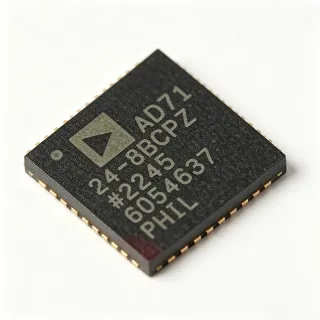
AD7124-8ASDZ - 24-Bit 8-Ch Sigma-Delta ADC | Analog Devices
MPN: AD7124-8ASDZ ✓ Active| Qty | Unit Price | Extended |
|---|---|---|
| 1 | $0 | $0.00 |
| 10 | $0 | $0.00 |
| 100 | $0 | $0.00 |
| 500 | $0 | $0.00 |
| 1,000 | $0 | $0.00 |
AD7124-8ASDZ Overview
A sigma-delta ADC (Sigma-Delta analog-to-digital converter) is a type of precision data converter that oversamples the analog input and uses digital filtering to achieve very high resolution and linearity. Within the signal chain hierarchy, it sits between the analog sensor front end and the digital processing block, making it a core component of any precision measurement system. Fully integrated analog front ends such as the AD7124-8 combine the converter, PGA, reference, and excitation current sources in a single device.
Key features include a low-noise 24-bit sigma-delta core, eight analog input channels configurable as differential, pseudo-differential, or single-ended inputs, an embedded programmable gain amplifier, a precision low-drift internal band gap reference, and support for an externally buffered differential reference. Simultaneous 50 Hz and 60 Hz line rejection is achieved at 25 SPS (single-cycle settling), with rejection in excess of 80 dB at lower output data rates, per the manufacturer datasheet.
The AD7124-8 establishes one of the highest degrees of signal chain integration available in precision data acquisition: excitation current sources (IOUT) and input bias (VBIAS) functions can even share AIN pins, per Analog Devices EngineerZone FAQs, reducing external component count in sensor systems. Digital communication is handled over a standard SPI serial interface, and register-based configuration enables per-setup filtering and reference selection across its eight setup configurations.
Typical applications include industrial process control (RTD and thermocouple temperature measurement), medical patient monitoring and diagnostics, weigh scales, and precision laboratory instrumentation - all domains where microvolt-level noise and high linearity directly determine system accuracy. The device family targets industrial, medical, and test and measurement markets per Analog Devices product documentation.
A key design consideration: output data rate trades directly against noise performance and settling time. Operating at 25 SPS single-cycle setting gives best 50/60 Hz rejection, while 19.2 kSPS operation suits faster multiplexed channel scanning; verify filter selection per setup in the configuration registers.
This page synthesizes verified distributor data, drop-in alternatives, and practical design notes not found in the manufacturer datasheet alone.
Drop-in alternatives for AD7124-8ASDZ — same package, pin-to-pin compatible. Different-package parts requiring PCB rework are excluded.
Quick Comparison Tool — Select alternative parts for side-by-side comparison:
AD7124-4ACPZ
✅ Drop-In ⚠️ 参数待验证📋 Reference alternative (not in catalog)
AD7124-8ACPZ-R7
✅ Drop-In ⚠️ 参数待验证📋 Reference alternative (not in catalog)
AD7124-8ACPZ
✅ Drop-In ⚠️ 参数待验证📋 Reference alternative (not in catalog)
AD7124-8ASDZ Maximum Ratings & Electrical Characteristics
| Resolution | 24 bit |
| Number of Channels | 8 |
| Converter Type | Sigma-Delta |
| Maximum Output Data Rate | 19.2 kSPS |
| Minimum Output Data Rate | 1.17 SPS |
| Integrated PGA | Yes |
| Internal Reference | Precision low-noise, low-drift band gap |
| External Reference | Differential, internally bufferable |
| 50 Hz / 60 Hz Rejection | Simultaneous rejection at 25 SPS (single-cycle settling); >80 dB at lower data rates |
| Excitation Current Sources | Yes (IOUT, shareable with AIN pins) |
| Input Bias | Yes (VBIAS, shareable with AIN pins) |
| Interface | SPI serial |
| Configuration Setups | 8 independent setups |
| Automotive Qualification | AEC-Q100 qualified (W grade variant) |
| Application Domains | Industrial, medical, test and measurement |
AD7124-8ASDZ standard Pin Configuration Guide
Pin configuration for AD7124-8ASDZ (standard package). This analog component features input, output, and power supply pins. Refer to the manufacturer datasheet for offset null, compensation, and enable pin configurations. Ideal for signal conditioning and amplifier circuits.

No detailed pinout data available for AD7124-8ASDZ.
Refer to the datasheet for full pin configuration.
Typical Applications
AD7124-8ASDZ is suitable for 6 applications: Industrial RTD Temperature Measurement, Thermocouple Input Modules, Medical Patient Monitoring, Weigh Scales and Load Cell Systems, Automotive Sensor Acquisition, Portable Test and Measurement Instrumentation.
Industrial RTD Temperature Measurement
The AD7124-8ASDZ fits RTD measurement because its integrated, programmable excitation current sources (IOUT) drive the RTD directly while the 24-bit sigma-delta core and PGA resolve microvolt-level voltage changes across the sensor. Per Analog Devices EngineerZone FAQs, a single AIN pin can serve as both the analog input and the IOUT excitation output, minimizing pin count per sensor in multi-channel systems. In a typical 3-wire RTD front end, the AD7124-8 sequences its eight channels through up to eight setups, each with its own gain and filter configuration, allowing mixed RTD types on one converter. At 25 SPS single-cycle settling, simultaneous 50 Hz and 60 Hz rejection keeps industrial mains interference out of the measurement, supporting accurate process-control loops.
Recommended
Thermocouple Input Modules
For thermocouple acquisition, the AD7124-8ASDZ's low-noise 24-bit sigma-delta converter resolves the very small thermocouple Seebeck voltages directly at high PGA gain, while the VBIAS function biases the input at mid-supply to keep the signal within the converter's common-mode range - ADI confirms VBIAS can be brought out on an AIN pin. Cold-junction compensation can be handled on a second channel of the same 8-channel mux, consolidating the entire measurement into one integrated analog front end. The precision internal band gap reference removes the need for an external reference in many designs, and externally buffered differential reference input preserves accuracy in long-leaded industrial installations. Data rates from 1.17 SPS give excellent noise performance for slowly varying temperature signals.
Recommended
Medical Patient Monitoring
Analog Devices positions the AD7124 family for medical applications, and the AD7124-8ASDZ suits patient monitoring and diagnostic equipment where multiple slow physiological signals must be digitized with high resolution and low power. The eight multiplexed channels with independent setups allow, for example, temperature, pressure, and impedance channels to share one converter with per-channel gain and filtering. Low power operation supports portable and battery-powered designs, while the sigma-delta architecture's line rejection and noise performance secure measurement integrity in electrically noisy clinical environments. Single-cycle settling at low output data rates guarantees that each multiplexed channel returns a fully settled, filtered result, which simplifies system-level accuracy calculations for regulatory documentation.
Recommended
Weigh Scales and Load Cell Systems
Load cell bridges output only a few millivolts per volt of excitation, making the AD7124-8ASDZ's integrated PGA and 24-bit resolution a strong fit: the converter amplifies the differential bridge signal directly, and the same device can drive bridge excitation through its IOUT pins while measuring the return signal. The precision, low-drift internal reference stabilizes the ratiometric measurement so that reference and excitation drift cancel in ratiometric configurations. Eight channels permit multi-cell weighing platforms on one converter, and SPI communication feeds raw samples to the host controller at up to 19.2 kSPS for fast dynamic weighing, or at low data rates with >80 dB line rejection for static platform scales in industrial settings.
Recommended
Automotive Sensor Acquisition
The AD7124-8 W grade is AEC-Q100 qualified for automotive applications per the manufacturer datasheet, enabling use of this 24-bit, 8-channel front end in automotive sensor acquisition where robust qualification is mandatory. Typical uses include battery management sensing, pressure and position measurement, and onboard diagnostics where multiple analog sensors share one converter. The integrated PGA, precision reference, and excitation current sources reduce component count and board area, which matters in automotive electronics packaging. Engineers should select the W grade ordering suffix rather than the standard grade to obtain the qualified part, and should verify the grade-specific temperature range and ordering code on the current ADI product page before release to production.
Recommended
Portable Test and Measurement Instrumentation
Bench and portable instrumentation benefits from the AD7124-8ASDZ's combination of 24-bit resolution, 19.2 kSPS maximum throughput, and full on-chip signal chain integration - reference, PGA, and excitation sources are inside the package, shrinking handheld and USB-powered instrument front ends. The EVAL-AD7124-8ASDZ evaluation board, powered from a 5V USB supply, plus the AD7124 Eval+ software and the AD7124-ASDZ HDL reference design for FPGAs, shorten development cycles considerably by providing register-level configuration, waveform and noise analysis, and a validated FPGA interface. Eight independently configurable setups let a single instrument scan multiple input types, while the SPI interface integrates cleanly with microcontroller or FPGA host logic in custom DAQ hardware.
Recommended
Recommended Products Summary
Engineering reference data for AD7124-8ASDZ — comparison, design guidance, and compliance information.
Selection Guide
Comparison with Alternatives
| Parameter | This Product | AD7124-4ACPZ | AD7124-8ACPZ-R7 | AD7124-8ACPZ |
|---|---|---|---|---|
| Brand | Analog Devices | Analog Devices | Analog Devices | Analog Devices |
| Package | Chip-scale package (AD7124-8 family footprint) | Chip-scale package - same family footprint | Chip-scale package - same family footprint | Chip-scale package - same family footprint |
| Resolution | 24 bit | 24 bit | 24 bit | 24 bit |
| Number of Channels | 8 | 4 (-50%) | 8 | 8 |
| Maximum Output Data Rate | 19.2 kSPS | 19.2 kSPS | 19.2 kSPS | 19.2 kSPS |
| Integrated PGA | Yes | Yes | Yes | Yes |
| Internal Reference | Precision low-noise, low-drift band gap | Precision band gap | Precision band gap | Precision band gap |
| AEC-Q100 Option | Yes (W grade) | Yes (W grade variant) | Standard grade | Standard grade |
| Evaluation Board | EVAL-AD7124-8ASDZ | EVAL-AD7124-4ASDZ (same PCB design) | EVAL-AD7124-8ASDZ | EVAL-AD7124-8ASDZ |
Key Differentiators
- Double the channel count of the -4 variant (vs AD7124-4ACPZ)
- Highest signal chain integration in class (vs AD7124-8ACPZ-R7 (comparable integrated ADCs))
- Automotive qualification available (vs AD7124-8ACPZ (standard grade))
Design Notes
Per the ADI datasheet, operate at 25 SPS with single-cycle settling to obtain simultaneous 50 Hz and 60 Hz line rejection; rejection in excess of 80 dB is achieved at lower output data rates. When multiplexing all 8 channels, remember each channel switch requires a full settling cycle at the selected data rate - budget effective per-channel throughput accordingly. Configure the filter type per setup in the configuration registers; mixed channel types (thermocouple plus RTD) can use different filter settings on the same converter.
Keep the analog input traces to AIN pins short, symmetric, and away from the SPI digital lines to prevent digital coupling into the 24-bit measurement path. Provide a solid, quiet analog ground plane under the converter and star-connect the external reference sense lines if the buffered differential reference input is used. Per EngineerZone guidance, IOUT and VBIAS can share AIN pins, simplifying routing, but add RC anti-aliasing filtering on every AIN as recommended in the ADI datasheet typical application circuits.
Do not confuse the IC ordering code with the evaluation board: EVAL-AD7124-8ASDZ is a development board, not the ADC for production BOMs. For automotive builds, order the W grade (AEC-Q100 qualified) suffix - the standard grade is not qualified. The internal reference is low-drift but for the ultimate accuracy verify gain calibration against your external reference choice; the Eval+ software's noise analysis feature on the evaluation board lets you empirically verify noise-versus-ODR before committing to a filter selection.
Compliance Information
Per the ADI datasheet, the AD7124-8 W grade is AEC-Q100 qualified for automotive applications. Other compliance attributes were not stated in the provided web data.