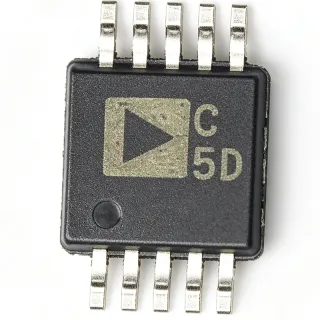
AD7690BRMZ-RL7 - 18-Bit 400kSPS PulSAR ADC | Analog Devices
MPN: AD7690BRMZ-RL7 ✓ Active| Qty | Unit Price | Extended |
|---|---|---|
| 1 | $27.5 | $27.50 |
| 10 | $25.3 | $253.00 |
| 100 | $22 | $2,200.00 |
| 500 | $19.8 | $9,900.00 |
| 1,000 | $17.6 | $17,600.00 |
AD7690BRMZ-RL7 Overview
An ADC (analog-to-digital converter) is an electronic component that converts continuous analog signals into discrete digital values, enabling digital systems to process real-world signals. The AD7690 belongs to the PulSAR family of SAR ADCs, which are known for their high speed, low power, and excellent DC accuracy. SAR ADCs use a binary search algorithm to approximate the input voltage, offering a good balance between resolution, speed, and power consumption. They are widely used in industrial process control, medical instrumentation, and data acquisition systems where precision and reliability are paramount.
Key features of the AD7690BRMZ-RL7 include 18-bit resolution with no missing codes, a maximum integral nonlinearity (INL) of ±1.5 LSB (±6 ppm of FSR), and a typical dynamic range of 102 dB at 400 kSPS. The device operates from a single 2.3V to 5.5V supply, with power scaling linearly with throughput, making it energy-efficient for battery-powered applications. The reference voltage is applied externally and can be set up to the supply voltage, providing flexibility in system design. The SPI-compatible interface supports daisy-chaining multiple ADCs on a single 3-wire bus, simplifying multi-channel data acquisition.
Technically, the AD7690 uses a charge redistribution SAR architecture with an internal conversion clock, eliminating the need for an external clock source. The differential input reduces common-mode noise and improves signal integrity, making it suitable for bridge sensors and other low-level signal applications. The device also features a busy indicator, which can be used to synchronize data reads with conversion completion. The MSOP package offers a small footprint while maintaining excellent thermal performance, and the device is specified for operation over the industrial temperature range of -40°C to +125°C.
Typical applications include precision data acquisition systems, industrial process control, medical instrumentation, and battery-powered portable devices. The AD7690BRMZ-RL7 is particularly well-suited for applications requiring high resolution and low power, such as portable medical monitors and field instruments. Its differential input and high dynamic range make it ideal for vibration analysis, weigh scales, and other sensor interfaces.
When designing with the AD7690BRMZ-RL7, ensure that the reference voltage is stable and well-decoupled, as it directly affects conversion accuracy. Use a low-noise reference and place decoupling capacitors close to the VDD and REF pins. The SPI interface should be kept short and properly terminated to avoid signal integrity issues at high throughput rates.
Drop-in alternatives for AD7690BRMZ-RL7 — same package, pin-to-pin compatible. Different-package parts requiring PCB rework are excluded.
Variants in this series
Same-series models that are drop-in compatible with AD7690BRMZ-RL7 (same form factor and footprint) — differing in Architecture, Input Type, Package, Resolution, INL (Max).
Quick Comparison Tool — Select alternative parts for side-by-side comparison:
AD7691BRMZ
✅ Drop-In📋 Reference alternative (not in catalog)
AD7690BRMZ
✅ Drop-In✓ In Stock
$17.6 / Unit
View Datasheet →AD7984BRMZ-RL7
✅ Drop-In📋 Reference alternative (not in catalog)
AD7980BRMZ
✅ Drop-In ⚠️ Specs Unverified✓ In Stock
$16.8636 / Unit
View Datasheet →MAX11166
✅ Drop-In ⚠️ Specs Unverified📋 Reference alternative (not in catalog)
AD7690BRMZ-RL7 Maximum Ratings & Electrical Characteristics
| Resolution | 18 bits |
| Sampling Rate | 400 kSPS |
| Input Type | Differential |
| Number of Inputs | 1 |
| Architecture | SAR |
| INL (Max) | ±1.5 LSB (±6 ppm of FSR) |
| Dynamic Range | 102 dB typical @ 400 kSPS |
| Supply Voltage | 2.3V to 5.5V |
| Reference Voltage | External, up to supply voltage |
| Interface | SPI-compatible, daisy-chain capable |
| Package | 10-lead MSOP |
| Operating Temperature | -40°C to +125°C |
| Power Consumption | Scales linearly with throughput |
| No Missing Codes | Yes |
| Busy Indicator | Yes |
AD7690BRMZ-RL7 Pin Configuration
| Pin 1 | IN+ — Positive differential input |
| Pin 2 | IN- — Negative differential input |
| Pin 3 | GND — Ground |
| Pin 4 | VDD — Power supply |
| Pin 5 | REF — Reference voltage input |
| Pin 6 | SDI — Serial data input (daisy-chain) |
| Pin 7 | SDO — Serial data output |
| Pin 8 | SCK — Serial clock input |
| Pin 9 | CNV — Conversion start input |
| Pin 10 | BUSY — Busy indicator output |
Typical Applications
AD7690BRMZ-RL7 is suitable for 6 applications: Precision Data Acquisition Systems, Industrial Process Control, Medical Instrumentation, Battery-Powered Portable Devices, Vibration Analysis, Weigh Scales.
Precision Data Acquisition Systems
The AD7690BRMZ-RL7's 18-bit resolution and 400 kSPS sampling rate make it ideal for high-accuracy data acquisition systems. Its differential input rejects common-mode noise, ensuring clean signal capture from sensors. The SPI interface simplifies connection to microcontrollers, and the low power consumption allows continuous operation in portable systems. With a dynamic range of 102 dB, it can resolve small signals in noisy environments, making it suitable for industrial and laboratory equipment.
Recommended
Industrial Process Control
In industrial process control, the AD7690BRMZ-RL7 provides precise measurement of analog signals from sensors like pressure, temperature, and flow. Its wide operating temperature range (-40°C to +125°C) ensures reliability in harsh environments. The 18-bit resolution and low INL (±1.5 LSB) guarantee accurate control loops. The SPI interface allows easy integration with PLCs and microcontrollers, and the daisy-chain capability enables multi-channel monitoring without additional GPIO pins.
Recommended
Medical Instrumentation
The AD7690BRMZ-RL7 is well-suited for medical devices such as patient monitors and diagnostic equipment. Its high resolution (18-bit) and low power consumption are critical for battery-operated portable monitors. The differential input reduces interference from electrical noise, ensuring accurate readings of bio-signals. The small MSOP package saves board space in compact devices. The SPI interface enables seamless data transfer to processing units, and the wide temperature range supports various clinical environments.
Recommended
Battery-Powered Portable Devices
For battery-powered devices, the AD7690BRMZ-RL7 offers power scaling with throughput, allowing significant power savings at lower sampling rates. Its 2.3V to 5.5V supply range is compatible with common battery voltages. The 18-bit resolution provides high accuracy for applications like portable gas detectors and handheld multimeters. The compact MSOP package and SPI interface make it easy to integrate into space-constrained designs, and the low power consumption extends battery life.
Recommended
Vibration Analysis
The AD7690BRMZ-RL7's high dynamic range (102 dB) and 400 kSPS sampling rate make it ideal for vibration analysis. It can capture high-frequency vibration signals with excellent resolution, enabling early detection of mechanical faults. The differential input reduces noise from the sensor interface, and the SPI interface allows high-speed data transfer to a DSP or FPGA for real-time processing. The wide temperature range ensures reliable operation in industrial environments.
Recommended
Weigh Scales
In weigh scale applications, the AD7690BRMZ-RL7 provides the high resolution and low noise required for accurate weight measurement. Its 18-bit resolution and low INL ensure precise readings, while the differential input interfaces directly with bridge sensors. The SPI interface simplifies connection to microcontrollers, and the low power consumption is beneficial for battery-operated scales. The compact MSOP package fits well in portable designs.
Recommended
Recommended Products Summary
Engineering reference data for AD7690BRMZ-RL7 — comparison, design guidance, and compliance information.
Selection Guide
Comparison with Alternatives
| Parameter | This Product | AD7691BRMZ | AD7984BRMZ-RL7 | AD7980BRMZ |
|---|---|---|---|---|
| Package | 10-MSOP | 10-MSOP | 10-MSOP | 10-MSOP |
| Brand | Analog Devices | Analog Devices | Analog Devices | Analog Devices |
| Resolution | 18 bits | 18 bits | 18 bits | 16 bits |
| Sampling Rate | 400 kSPS | 1 MSPS | 1.33 MSPS | 1 MSPS |
| INL (Max) | ±1.5 LSB | ±1.5 LSB | ±1.5 LSB | ±1.5 LSB |
| Supply Voltage | 2.3V to 5.5V | 2.3V to 5.5V | 2.3V to 5.5V | 2.3V to 5.5V |
| Interface | SPI | SPI | SPI | SPI |
Key Differentiators
- Higher resolution than AD7980BRMZ (vs AD7980BRMZ)
- Lower sampling rate than AD7984BRMZ-RL7 (vs AD7984BRMZ-RL7)
- Pin-compatible with AD7691BRMZ (vs AD7691BRMZ)
Design Notes
The AD7690BRMZ-RL7 operates from a single 2.3V to 5.5V supply. Use a low-noise LDO to supply VDD and place a 10µF ceramic capacitor close to the VDD pin. The reference voltage (REF) should be driven by a low-impedance source, such as a precision reference like the ADR4525, with a 10µF decoupling capacitor to ensure stable conversion accuracy.
For optimal performance, keep the analog input traces short and shielded from digital noise. Use a solid ground plane and separate analog and digital ground areas, connecting them at a single point. Place decoupling capacitors (0.1µF and 10µF) close to the VDD and REF pins. The SPI lines (SCK, SDO, SDI, CNV) should be kept short and properly terminated to avoid signal integrity issues at 400 kSPS.
Ensure the reference voltage is stable and well-decoupled, as it directly affects conversion accuracy. Avoid driving the analog inputs beyond the REF range to prevent damage. The CNV pin must be pulsed to start a conversion; ensure it is not left floating. Also, verify that the SPI timing meets the datasheet requirements, especially at high throughput rates.
Compliance Information
RoHS compliant per Analog Devices product page. Not AEC-Q100 qualified.