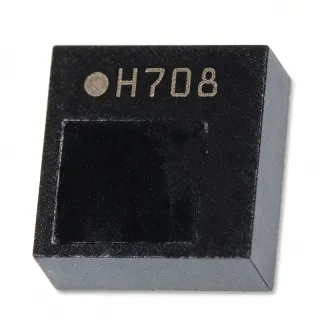
AHT20 - I2C Digital Humidity & Temperature Sensor | ASAIR
MPN: AHT20 ✓ Active| Qty | Unit Price | Extended |
|---|---|---|
| 1 | $0.44 | $0.44 |
| 10 | $0.42 | $4.20 |
| 100 | $0.39 | $39.00 |
| 500 | $0.36 | $180.00 |
| 1,000 | $0.33 | $330.00 |
AHT20 Overview
A combined humidity and temperature sensor is a MEMS-based semiconductor device that measures ambient relative humidity through capacitance changes in a polymer dielectric and ambient temperature through an on-chip bandgap sensor. Within the sensing hierarchy, it sits under environmental sensors, which belong to the broader MEMS sensor family used across power management, HVAC, and IoT systems.
The AHT20 key advantages include a small 3 x 3 mm bottom-face footprint with only 1.0 mm height for space-constrained designs, a wide 2.2 V to 5.5 V supply range that spans 3.3 V and 5 V logic rails, and factory calibration stored on the new-design ASIC, eliminating customer calibration cost. Relative humidity accuracy is ±2 %RH (per LCSC product listing for the AHT20 family), and the device replaces the popular DHT11/DHT22 modules with a true digital I2C output.
Technically, the AHT20 integrates a new-generation ASIC chip, an improved MEMS semiconductor capacitive humidity sensing element, and a standard temperature element on one substrate. Because the calibration data is stored in on-chip OTP memory, every unit ships with consistent, traceable accuracy, and the two-row flat, pinless SMD construction is fully compatible with standard reflow soldering processes.
Typical applications include smart-home thermostats and IoT environmental nodes, HVAC and dehumidifier control, weather stations, and data-logger products where a low-cost calibrated I2C humidity sensor replaces discrete DHT-series modules.
A key design consideration is thermal self-heating: keep continuous measurement intervals above the datasheet-recommended minimum and place the sensor away from heat sources, since board heat offsets the reading. Avoid condensation and consider the AHT20-F filter-membrane variant in dusty or wet environments.
This page synthesizes distributor pricing, drop-in alternatives, and practical design notes not found in the manufacturer datasheet.
Drop-in alternatives for AHT20 — same package, pin-to-pin compatible. Different-package parts requiring PCB rework are excluded.
Quick Comparison Tool — Select alternative parts for side-by-side comparison:
AHT20-F
✅ Drop-In📋 Reference alternative (not in catalog)
AHT25
✅ Drop-In ⚠️ Specs Unverified📋 Reference alternative (not in catalog)
AHT21
✅ Drop-In ⚠️ Specs Unverified📋 Reference alternative (not in catalog)
DHT20
✅ Drop-In📋 Reference alternative (not in catalog)
AHT20 Maximum Ratings & Electrical Characteristics
| Sensor Type | Relative Humidity and Temperature, digital |
| Interface | I2C (standard format) |
| I2C Address | 0x38 |
| Supply Voltage Range | 2.2 V to 5.5 V |
| RH Accuracy | ±2 %RH |
| Package Dimensions | 3 x 3 mm bottom face, 1.0 mm height |
| Package Type | Two-row flat pinless SMD, reflow solderable |
| Calibration | Factory calibrated, on-chip |
| ASIC Generation | New design ASIC with improved MEMS capacitive element |
| Soldering Process | Reflow soldering compatible |
| Mounting Type | Surface Mount |
| Warranty | 12-month quality guarantee (per Aosong product manual policy) |
AHT20 Pin Configuration
| Pin 1 | SDA — I2C serial data |
| Pin 2 | VDD — Power supply, 2.2 V to 5.5 V |
| Pin 3 | GND — Ground |
| Pin 4 | SCL — I2C serial clock |
| Pin 5 | NC — Not connected (per datasheet) |
| Pin 6 | NC — Not connected (per datasheet) |
Typical Applications
AHT20 is suitable for 6 applications: Smart Home Thermostats, HVAC and Dehumidifier Control, IoT Environmental Monitoring Nodes, Weather Stations, Data Loggers and Cold Chain Monitoring, Consumer Appliances and Air Quality Products.
Smart Home Thermostats
The AHT20 fits smart thermostats because it delivers ±2 %RH humidity accuracy and temperature data over standard I2C at address 0x38 from a wide 2.2 V to 5.5 V rail, matching both 3.3 V and 5 V logic in wall-powered controllers. The 3 x 3 mm, 1.0 mm pinless SMD package mounts at the thermostat enclosure vent so ambient air reaches the capacitive element without ducting. Because readings are factory calibrated on the ASIC, firmware can use raw I2C conversion results directly, reducing manufacturing calibration steps. Its digital output avoids the ADC drift and analog-front-end cost of resistive humidity sensors, and the low duty-cycle measurement lets the sensor idle between readings to keep thermostat standby consumption low.
Recommended
HVAC and Dehumidifier Control
In HVAC and dehumidifier control boards, the AHT20's ±2 %RH accuracy and digital I2C output at 0x38 provide the feedback signal needed to cycle compressors and fans at correct humidity setpoints. The 2.2 V to 5.5 V supply range lets one sensor design serve 3.3 V logic controllers and legacy 5 V boards without translation. The improved MEMS capacitive element in the new-generation ASIC resists drift better than the previous sensor generation, per ASAIR's product statement, extending service intervals in continuously operating equipment. Designers should mount the sensor in the return-air path away from heating elements and, in condensation-prone plenums, select the filter-membrane AHT20-F variant to protect the element from droplets while preserving response time.
Recommended
IoT Environmental Monitoring Nodes
Battery-powered IoT environmental nodes choose the AHT20 because it communicates over standard I2C that ESP32, nRF52, and STM32 hosts already support, requiring no proprietary timing protocol like the DHT22. The wide 2.2 V to 5.5 V operating range allows direct operation from a lithium cell down to the brown-out threshold, and measurements are on demand - the sensor consumes power only during conversions, so a node sampling once per minute spends most of its life with the sensor idle. Factory calibration stored on-chip means every deployed node reports consistent ±2 %RH values without per-unit trimming, which is essential when hundreds of nodes feed one analytics dashboard. At address 0x38, the sensor coexists with other I2C devices on the same two-wire bus.
Recommended
Weather Stations
Personal and agricultural weather stations use the AHT20 as the humidity and ambient temperature element because its digital I2C interface and factory calibration deliver repeatable ±2 %RH readings suitable for trend logging on Raspberry Pi and Arduino platforms. Compared with the DHT22 commonly used in hobby stations, the AHT20 responds faster, avoids the DHT's single-wire timing faults, and is actively recommended by Adafruit as the modern replacement. In outdoor enclosures, the sensor should sit in a radiation-shielded, ventilated section; the AHT20-F filter-membrane variant is recommended where rain splash, dust, or pollen can reach the board. Multiple stations can share one Raspberry Pi I2C bus using a multiplexer since the AHT20 address is fixed at 0x38.
Recommended
Data Loggers and Cold Chain Monitoring
Standalone temperature and humidity data loggers for warehouses, greenhouses, and cold-chain shipping benefit from the AHT20's combination of factory calibration, digital I2C output, and tiny 3 x 3 mm footprint that fits inside pen-sized logger housings. The sensor's on-demand measurement model suits loggers that wake every few minutes from deep sleep, take one conversion, store it, and sleep again, maximizing coin-cell life. Because the ASIC stores calibration coefficients on-chip, replacement sensors swapped into a logger give consistent readings without recalibration - important for auditable cold-chain records. Designers should thermally isolate the sensor from the logger's battery and radio, since self-heating of a few tenths of a degree directly biases the reported temperature and humidity values.
Recommended
Consumer Appliances and Air Quality Products
Air purifiers, humidifiers, and refrigeration appliances embed the AHT20 to close the control loop on humidity-related functions. The sensor's pinless 3 x 3 mm SMD construction is fully reflow solderable, which suits high-volume appliance PCB assembly without manual placement steps, and its 12-month manufacturer quality guarantee policy (per Aosong's product manual) supports consumer-grade sourcing. The wide 2.2 V to 5.5 V supply range and fixed 0x38 I2C address integrate with either the appliance's main MCU or a dedicated control sub-MCU. In humidifier products where the sensor sees high vapor density, choose the AHT20-F membrane variant to prevent condensation accumulation on the sensing element and preserve long-term ±2 %RH accuracy.
Recommended
Recommended Products Summary
Engineering reference data for AHT20 — comparison, design guidance, and compliance information.
Selection Guide
Comparison with Alternatives
| Parameter | This Product | AHT20-F | AHT25 | AHT21 | DHT20 |
|---|---|---|---|---|---|
| Package | 3x3mm pinless SMD, 1.0mm height | 3x3mm pinless SMD - same | 3x3mm class pinless SMD - same family | ASAIR family pinless SMD | 3x3mm pinless SMD - same |
| Brand | ASAIR (Guangzhou Aosong Electronics) | ASAIR (Aosong) | ASAIR (Aosong) | ASAIR (Aosong) | ASAIR (Aosong) |
| Interface | I2C (0x38) | I2C (0x38) | I2C | I2C (0x38) | I2C (0x38) |
| Factory Calibration | Yes, on-chip | Yes, on-chip | Yes, on-chip | Yes, on-chip | Yes, on-chip |
Key Differentiators
- True I2C digital output versus DHT22 proprietary single-wire protocol (vs DHT22)
- Integrated filter membrane option in the same footprint (vs AHT20-F)
- Wide 2.2-5.5 V supply without level shifting (vs AHT21)
Design Notes
Mount the AHT20 where ambient air can reach the element freely: prefer a board-edge slot, breathing holes in the enclosure above the sensor, or a cutout that isolates the sensor island from the main PCB copper. Avoid placing it within 10-15 mm of voltage regulators, MCUs under load, or power resistors, since board self-heating of only 1 C biases the reported temperature and shifts apparent RH by several percent.
Decouple the AHT20 supply pin with a 100 nF ceramic capacitor placed within a few millimeters of VDD, and use typical I2C pull-ups of 4.7 kOhm to 10 kOhm on SDA/SCL to the same rail. Because the sensor works from 2.2 V to 5.5 V, power it from the host logic rail directly; if the bus runs at 3.3 V but the sensor is on 5 V, use a level shifter such as the PCA9306 to protect 3.3 V-only hosts.
The AHT20 requires the datasheet initialization and measurement command sequence over I2C at address 0x38 before valid data is returned; do not simply read bytes at power-up. Do not poll faster than the datasheet measurement interval - excessive sampling causes element self-heating and degraded accuracy. The fixed 0x38 address also collides with several other ASAIR/Dialog-family I2C devices, so check the full bus address map before adding a second sensor.
Compliance Information
Compliance declarations were not present in the provided web data; consult the ASAIR product manual and distributor RoHS certificates.