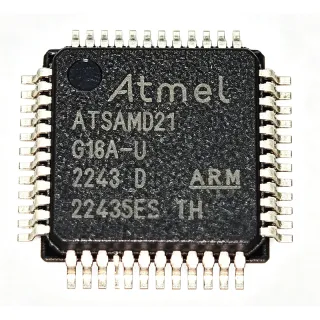
ATMXT1386E-Z2UIR - 1386-Node maXTouch Controller | Microchip
MPN: ATMXT1386E-Z2UIR ✗ End of Life| Qty | Unit Price | Extended |
|---|---|---|
| 1 | $0 | $0.00 |
| 10 | $0 | $0.00 |
| 100 | $0 | $0.00 |
| 500 | $0 | $0.00 |
| 1,000 | $0 | $0.00 |
ATMXT1386E-Z2UIR Overview
A capacitive touch screen controller is an integrated circuit that measures changes in capacitance across a touch sensor grid to determine finger or stylus position. Within the power-management and human-interface IC hierarchy, touch controllers sit between the raw sensor substrate and the host application processor, converting analog charge-transfer measurements into digital touch coordinates. The maXTouch family pairs charge-transfer analog front ends with a powerful 32-bit AVR microcontroller core for on-chip touch processing.
Key features include the 1386-node sensing capacity delivered by a 4-chip multi-chip architecture, unlimited touch reporting up to 16 simultaneous touches, automotive qualification, and an operating temperature range of -40C to +85C. The high-performance architecture enables fast response at 150 Hz scan rate, supporting large-format displays with low latency.
Technically, the device combines Microchip charge-transfer acquisition technology with 32-bit AVR processing, offloading touch detection, noise filtering, and gesture processing from the host CPU. Communication with the host uses an I2C interface. The -E variant is the automotive-qualified version of the ATMXT1386 platform, making it suitable for harsh automotive cabin environments where consumer-grade controllers would not meet reliability requirements.
Typical applications include automotive center-stack touch displays, in-vehicle infotainment (IVI) panels up to 15.6 inches, industrial HMI panels requiring multi-touch, and large-format consumer touch screens. Automotive qualification and the wide -40C to +85C temperature range make the -Z2UIR variant particularly appropriate for vehicle cockpit systems.
Design consideration: the multi-chip (4-chip) solution requires careful PCB floor planning of the sensor traces and inter-chip routing; firmware/configuration objects must be programmed to match the specific sensor panel geometry. Note that Microchip lists ATMXT1066T2 as the recommended alternative touch controller for new designs.
This page synthesizes distributor availability, the manufacturer-recommended alternative, and practical design notes not consolidated in the manufacturer product page.
Drop-in alternatives for ATMXT1386E-Z2UIR — same package, pin-to-pin compatible. Different-package parts requiring PCB rework are excluded.
Quick Comparison Tool — Select alternative parts for side-by-side comparison:
No drop-in alternatives available for this product.
Request AlternativesATMXT1386E-Z2UIR Specifications
| Manufacturer Part Number | ATMXT1386E-Z2UIR |
| Product Series | maXTouch |
| Function | Capacitive Touch Screen Controller |
| Max Nodes Supported | 1386 |
| Architecture | Multi-chip solution (4 chips) |
| Number of Touches | 16 |
| Interface Type | I2C |
| Touch Response Rate | 150 Hz |
| Max Screen Size | 15.6 in |
| Automotive Qualified | Yes |
| Operating Temperature Range | -40C to +85C |
| Core Technology | Charge transfer + 32-bit AVR MCU |
| Packaging | Tape & Reel (TR) |
| Mounting Type | Surface Mount |
ATMXT1386E-Z2UIR standard Pin Configuration Guide
Pin configuration for ATMXT1386E-Z2UIR (standard package). Pin numbering, functions, and connection diagrams are defined in the manufacturer datasheet. Refer to it for the exact footprint and soldering guidelines.

No detailed pinout data available for ATMXT1386E-Z2UIR.
Refer to the datasheet for full pin configuration.
Typical Applications
ATMXT1386E-Z2UIR is suitable for 6 applications: Automotive Center-Stack Touch Display, In-Vehicle Infotainment (IVI) Systems, Industrial HMI Touch Panels, Large-Format Consumer Touch Screens, Interactive Kiosks and Digital Signage, Medical Equipment Touch Interfaces.
Automotive Center-Stack Touch Display
Automotive center-stack displays are the primary human-machine interface in modern vehicles, demanding controllers that survive harsh cabin environments while delivering responsive multi-touch. The ATMXT1386E-Z2UIR fits because it is automotive qualified and rated -40C to +85C, covering full automotive temperature requirements. Its 1386-node capacity and support for screens up to 15.6 inches accommodate the large glass areas typical of center consoles, while 16-touch support and 150 Hz response provide the low-latency interaction drivers and passengers expect. Placed behind the sensor glass with an I2C link to the IVI SoC, the integrated 32-bit AVR offloads touch processing from the host, and on-chip noise filtering suppresses interference from nearby display driver electronics and vehicle power rails.
Recommended
In-Vehicle Infotainment (IVI) Systems
In-vehicle infotainment systems integrate navigation, media, and climate control behind a single large touch panel, typically 10 to 15.6 inches. The ATMXT1386E-Z2UIR is well suited because its 1386-node multi-chip architecture drives wide sensor grids without host-side processing, its 150 Hz scan rate keeps touch latency below perceptible thresholds, and automotive qualification plus -40C to +85C operation withstands direct sunlight heating and cold starts. The I2C interface simplifies integration with automotive SoC platforms. In practice the controller is configured with panel-specific objects defining the sensor geometry; its on-chip water rejection and noise suppression algorithms maintain touch accuracy in the electromagnetically noisy environment created by backlight inverters and wireless modules inside the vehicle cabin.
Recommended
Industrial HMI Touch Panels
Industrial human-machine interface panels in factory automation require reliable multi-touch input despite electrically noisy surroundings from motor drives, contactors, and switching power supplies. The ATMXT1386E-Z2UIR addresses this with the maXTouch charge-transfer architecture and integrated noise filtering on its 32-bit AVR core, sustaining accurate 16-touch detection at 150 Hz on panels up to 15.6 inches. Its -40C to +85C operating range covers unconditioned factory floors and outdoor enclosures. The controller interfaces to the panel's host processor via I2C, delivering processed touch coordinates so the HMI software needs no raw-sensor handling. Because the device is a 4-chip solution, layout must follow Microchip's multi-chip sensor routing guidance to balance trace lengths and preserve signal integrity across the large sensor substrate.
Recommended
Large-Format Consumer Touch Screens
Large-format consumer touch applications such as smart displays, kitchen appliances, and interactive kiosks benefit from the ATMXT1386E-Z2UIR's 1386-node capacity and support for screens up to 15.6 inches. The maXTouch architecture delivers up to 16 simultaneous touches at 150 Hz, enabling multi-user interaction and rich gesture support, while on-chip processing with the 32-bit AVR reduces host processor load and firmware complexity. The I2C host interface integrates easily with mainstream application processors. Although this variant is automotive qualified - adding margin for consumer products - designers of new consumer designs should note that Microchip recommends the ATMXT1066T2 as the alternative controller for the ATMXT1386E family, and should evaluate lifecycle status before committing the part to a long-production consumer platform.
Recommended
Interactive Kiosks and Digital Signage
Interactive kiosks and touch-enabled digital signage demand large touch surfaces, sustained multi-touch accuracy, and high reliability under continuous public use. The ATMXT1386E-Z2UIR supports panels up to 15.6 inches with 1386 sensing nodes and 16 simultaneous touches scanned at 150 Hz, delivering the responsiveness and gesture fidelity these installations require. Its charge-transfer front end with on-chip noise filtering rejects interference from display backlights and adjacent electronics, while the -40C to +85C range tolerates semi-outdoor kiosk enclosures. Touch processing runs on the integrated 32-bit AVR, so the signage player receives clean I2C touch reports without host-side sensor computation. Because the part is a 4-chip multi-chip solution, kiosk integrators should budget for panel-specific maXTouch configuration during development and consider the ATMXT1066T2 for new platforms.
Recommended
Medical Equipment Touch Interfaces
Medical diagnostic and monitoring equipment relies on capacitive touch interfaces that must remain accurate despite glove use, cleaning chemicals, and continuous operation. The ATMXT1386E-Z2UIR contributes a 1386-node, 16-touch sensing engine on panels up to 15.6 inches with 150 Hz response, and its wide -40C to +85C operating range provides substantial margin beyond typical clinical ambient conditions. The integrated 32-bit AVR performs touch processing and noise rejection on-chip, keeping spurious touches from pump motors and switching supplies out of the clinical workflow via a simple I2C report stream. Designers should implement panel-specific maXTouch configuration and verify cleaning-agent compatibility of the cover lens stack; the automotive qualification of this variant adds environmental robustness useful in demanding medical platforms.
Recommended
Recommended Products Summary
Engineering reference data for ATMXT1386E-Z2UIR — comparison, design guidance, and compliance information.
Selection Guide
Comparison with Alternatives
| Parameter | This Product | ATMXT1066T2 | ATMXT1386E-Z2U |
|---|---|---|---|
| Brand | Microchip Technology | Microchip Technology | Microchip Technology |
| Max Nodes Supported | 1386 | 1066 | 1386 |
| Interface Type | I2C | I2C (maXTouch family standard) | I2C |
Key Differentiators
- Highest node count in its class (vs ATMXT1066T2)
- Automotive qualification (vs ATMXT1386E-Z2U)
- On-chip touch processing (vs Generic touch solutions)
Design Notes
The ATMXT1386E is a 4-chip multi-chip solution, not a single-die controller. PCB floor planning must route sensor traces to four coordinated chips with matched inter-chip synchronization, and the panel-specific configuration objects must be generated to match the exact sensor geometry. Do not assume a single-chip maXTouch layout can be reused. Also note that Microchip designates the ATMXT1066T2 as the recommended alternative, indicating limited long-term availability - evaluate lifecycle risk before new designs.
Capacitive touch sensing on a 15.6-inch panel is sensitive to noise from display drivers and switching regulators. Keep sense traces away from LVDS/LED driver lines, use a clean low-noise analog supply for the maXTouch chips, and follow Microchip maXTouch hardware design application notes for sensor stack-up, ground strategy, and trace spacing. The on-chip AVR noise-suppression algorithms help, but only after a sound physical layout.
Estimated: a 4-chip touch controller driving a 15.6-inch sensor at 150 Hz draws noticeably more power than single-chip controllers; budget supply rails and thermal margins using the current figures in the official datasheet (values not published in the retrieved web data). Ensure the I2C bus is properly pulled up and within capacitive loading limits for the selected bus speed to avoid communication errors during simultaneous multi-touch reporting.
Compliance Information
Automotive qualified per datasheet parameters. RoHS status shown as 'Nkesp' in broker data (uninterpretable); RoHS/REACH status must be confirmed on the official Microchip product page.