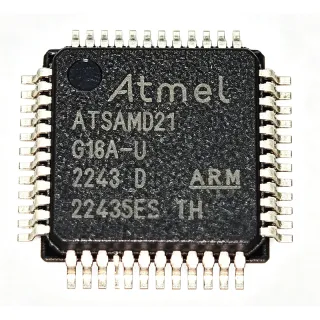
ATMXT3432S-M-Z2UR - maXTouch Touch Controller | Microchip
MPN: ATMXT3432S-M-Z2UR ✓ Active| Qty | Unit Price | Extended |
|---|---|---|
| 1 | $0 | $0.00 |
| 10 | $0 | $0.00 |
| 100 | $0 | $0.00 |
| 500 | $0 | $0.00 |
| 1,000 | $0 | $0.00 |
ATMXT3432S-M-Z2UR Overview
A capacitive touch controller is an interface IC that measures tiny capacitance changes on a touch sensor grid, converts the raw mutual-capacitance data into calibrated touch coordinates, and reports gestures to a host processor. Within the interface IC hierarchy, it sits alongside touch screen converters and controllers, bridging the analog sensor domain and the digital system domain in human-machine interface designs.
Key characteristics include the 32-bit processing core that runs Microchip maXTouch touch algorithms on-chip, support for screen sizes up to 17.3 inches, and shieldless operation that removes the shielding layer from the sensor stack - reducing stack-up cost and module thickness. The maXTouch family is known in the industry for superior noise immunity and a rich feature set including gesture detection, wet-finger tracking, and gloved-touch robustness.
The mXT3432S generation integrates the analog front end, charge amplifiers, and a digital signal processing pipeline that performs per-channel acquisition, automatic mutual-capacitance baseline tracking, and noise filtering in the frequency domain. This architecture allows stable touch operation in the presence of display noise from LCD and OLED panels, which is a common failure mode for lower-end touch ICs. Firmware for touch tuning is supplied through Microchip's maXTouch development ecosystem.
Typical applications include consumer touch monitors, industrial human-machine interfaces (HMI), smart appliances, white goods, and commercial kiosks - anywhere a panel up to 17.3 inches needs robust multi-touch response without a shield layer.
When designing with this controller, budget board area and sensor routing for the full channel count, and plan for touch tuning using Microchip's tuning tools early in the project, since sensor stack-up (ITO pattern, cover lens thickness) strongly affects final performance.
This page synthesizes distributor availability data, the manufacturer-recommended alternative (ATMXT2952TD), and practical integration guidance not consolidated in the manufacturer datasheet alone.
Drop-in alternatives for ATMXT3432S-M-Z2UR — same package, pin-to-pin compatible. Different-package parts requiring PCB rework are excluded.
Variants in this series
Same-series models that are drop-in compatible with ATMXT3432S-M-Z2UR (same form factor and footprint).
Quick Comparison Tool — Select alternative parts for side-by-side comparison:
ATMXT2952TD
✅ Drop-In📋 Reference alternative (not in catalog)
ATMXT3432S-M-Z2UR Specifications
| Function | Capacitive Touch Screen Controller |
| Product Family | maXTouch mXT3432S |
| Core | 32-bit |
| Max Screen Size | 17.3 in |
| Touch Technology | Projected Capacitive (mutual capacitance) |
| Shieldless Design Support | Yes |
| Mounting Type | Surface Mount |
| Lifecycle Status | Active |
| Recommended Alternative (Manufacturer) | ATMXT2952TD |
ATMXT3432S-M-Z2UR standard Pin Configuration Guide
Pin configuration for ATMXT3432S-M-Z2UR (standard package). Pin numbering, functions, and connection diagrams are defined in the manufacturer datasheet. Refer to it for the exact footprint and soldering guidelines.

No detailed pinout data available for ATMXT3432S-M-Z2UR.
Refer to the datasheet for full pin configuration.
Typical Applications
ATMXT3432S-M-Z2UR is suitable for 6 applications: Industrial HMI Touch Panels, Commercial Touch Monitors, Smart Home Appliances, Self-Service Kiosks, Gaming and Entertainment Displays, Medical Equipment Touch Interfaces.
Industrial HMI Touch Panels
Industrial human-machine interfaces commonly use projected-capacitive panels from 7 to 17.3 inches, exactly the range the ATMXT3432S-M-Z2UR targets. The controller's maXTouch signal processing rejects display noise from industrial LCD modules and switching power supplies, which otherwise causes ghost touches or lost contact events on cheaper controllers. Because it supports shieldless sensor designs, panel builders can delete the shield layer from the stack-up, saving both sensor cost and assembly thickness in bezel-constrained enclosures. Integration places the controller on the touch PCB behind the sensor with the host link to the HMI processor; the trade-off is a required tuning cycle per sensor design. Validate gloved-touch behavior and ESD robustness at the system level for factory-floor reliability.
Recommended
Commercial Touch Monitors
Commercial and point-of-information touch monitors in the 15 to 17.3 inch class benefit directly from the mXT3432S optimization: Microchip positions this device for touchscreens up to 17.3 inches with shieldless design support. In a monitor application the controller runs continuous mutual-capacitance scans and filters display-induced noise from the LCD panel, maintaining stable multi-touch reporting over long duty cycles. Using a shieldless stack reduces sensor lamination cost - meaningful at monitor production volumes - and improves optical clarity by removing a layer. The main design consideration is coordinating the touch tuning with the specific panel's backlight and driver scheme, since interference spectra differ per display vendor.
Recommended
Smart Home Appliances
Ovens, refrigerators, washing machines, and cooktop HMIs increasingly replace mechanical buttons with glass-front capacitive touch. The ATMXT3432S-M-Z2UR suits mid-size appliance displays up to 17.3 inches, and its wet-finger and noise-robust maXTouch processing addresses the classic appliance failure modes: condensation, grease films, and interference from inverter motor drives. Shieldless design support lowers the cost of the large-format sensors appliances require and simplifies sealing for washdown-prone surfaces. System designers should place the controller away from inverter motor cabling, ground the lens stack per Microchip guidance, and allocate an early tuning phase with the final display and enclosure fitted, since plastic vs glass fronts shift sensitivity.
Recommended
Self-Service Kiosks
Retail and hospitality kiosks deploy 10 to 17.3 inch touchscreens that run continuously in public environments, demanding high touch reliability and ESD immunity. The ATMXT3432S-M-Z2UR provides on-chip 32-bit processing of the maXTouch algorithms, offloading the kiosk host PC from touch processing and delivering stable coordinate streams over the host interface. Its shieldless stack-up support reduces both the sensor BOM cost and the lamination complexity of large kiosk panels - attractive in cost-sensitive kiosk builds. In deployment, the controller's noise filtering helps coexist with the kiosk's backlight, receipt printer, and wireless radios; periodic re-zeroing (baseline tracking) handles slow environmental drift such as temperature and humidity changes.
Recommended
Gaming and Entertainment Displays
Arcade cabinets, betting terminals, and interactive entertainment machines use touch panels up to 17.3 inches where response latency and palm rejection matter. The maXTouch mXT3432S's on-chip DSP pipeline delivers fast, calibrated multi-touch reports, and its noise rejection keeps gameplay accurate near CRT-replacement LCD backlights and audio amplifiers. Shieldless designs cut the thickness and cost of the large, frequently-replaced sensors in this segment. Because these systems run at high duty cycles, designers should validate thermal behavior of the touch PCB and ensure the host interface report rate meets game-loop latency budgets. Microchip's tuning ecosystem supports the per-panel calibration these bespoke machines require.
Recommended
Medical Equipment Touch Interfaces
Benchtop medical devices, patient monitors, and diagnostic instruments use capacitive touch panels that must ignore cleaning chemicals, gloved operators, and electrically noisy therapy or measurement circuits. The ATMXT3432S-M-Z2UR's maXTouch processing, designed for shieldless noisy-display environments, helps maintain accurate touch response in this interference-rich context, and its up-to-17.3-inch range fits typical instrument displays. Shieldless stack-ups reduce the number of materials needing biocompatible or cleanable qualification. Medical designers should additionally verify the device's operating temperature and reliability data in the manufacturer datasheet, plan firmware update processes for fielded units, and run system-level EMC validation to the applicable medical electrical equipment standards.
Recommended
Recommended Products Summary
Engineering reference data for ATMXT3432S-M-Z2UR — comparison, design guidance, and compliance information.
Selection Guide
Comparison with Alternatives
| Parameter | This Product | ATMXT2952TD |
|---|---|---|
| Brand | Microchip Technology | Microchip Technology |
| Product Family | maXTouch mXT3432S | maXTouch mXT2952T |
| Role | Original device | Manufacturer-recommended alternative |
Key Differentiators
- Optimized for panels up to 17.3 inches (vs ATMXT2952TD)
- Shieldless design capability (vs ATMXT2952TD)
- On-chip 32-bit touch processing (vs ATMXT2952TD)
Design Notes
Route the touch sensor traces (drive and sense lines) away from display flex cables, backlight power, and switching regulators; capacitive controllers of the mXT3432S class digitize femtofarad-level capacitance changes and are sensitive to coupled noise even with on-chip filtering. Keep a solid ground plane under the controller but avoid running ground under high-impedance sensor routing to minimize parasitic capacitance. Follow the sensor layout rules in the Microchip touch design guides and reserve space for tuning components.
Touch performance depends more on the sensor stack-up than on the IC itself. Freezing the mechanical design (cover lens thickness, ITO pattern, adhesive layers, display choice) before touch tuning almost always forces a costly redesign. Complete a tuning cycle with the final stack using Microchip's maXTouch tuning tools, and validate wet-finger, gloved-touch, and large-palm rejection cases. Also confirm firmware version compatibility between the controller and Microchip's current toolchain before mass production.
Supply the touch controller from a clean rail: touch acquisition is ratiometric to the analog supply, so ripple on the controller supply appears as touch jitter. Decouple with ceramic capacitors at the supply pins per the datasheet recommendation and separate the touch analog supply from noisy digital rails when possible. Estimated: even tens of millivolts of switching ripple at display refresh-rate harmonics can degrade signal-to-noise in shieldless designs, so verify rail ripple with an oscilloscope in final assembly.
Compliance Information
Compliance data was not present in the retrieved web data; consult the Microchip product page environmental documents for ATMXT3432S-M-Z2UR before production use.