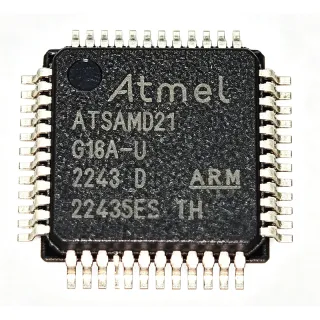
ATSAML21-XPRO - SAM L21 Xplained Pro Cortex-M0+ Eval Kit
MPN: ATSAML21-XPRO ✓ Active| Qty | Unit Price | Extended |
|---|---|---|
| 1 | $89 | $89.00 |
| 10 | $80.1 | $801.00 |
| 25 | $75.65 | $1,891.25 |
| 100 | $71.2 | $7,120.00 |
| 500 | $66.75 | $33,375.00 |
ATSAML21-XPRO Overview
An Xplained Pro evaluation board is a standardized microcontroller demonstration platform that combines a target MCU, power regulation, an embedded debugger, and standardized extension connectors in a single PCB, allowing engineers to begin firmware development immediately using the manufacturer's IDE toolchain. Xplained Pro kits sit one tier above bare development boards and one tier below full System-on-Module designs, offering a balance of convenience, observability, and modularity for embedded firmware bring-up.
Key features of the ATSAML21-XPRO include support for the SAM L21 family's ultra-low-power SleepWalking peripherals (down to 200 nA in Sleep mode, under 35 µA/MHz active per the SAM L21 datasheet DS60001477C), three Xplained Pro extension headers, mechanical reset and user buttons, two user LEDs, and a QTouch button area. Power is supplied via USB micro-B or an external header, and the board is supported by Atmel Studio / Microchip Studio, MPLAB X IDE, MPLAB Harmony, and Zephyr RTOS.
The on-board ATSAML21J18A uses a sophisticated peripheral set with SERCOM, ADC, DAC, and event system architecture that simplifies event-driven ultra-low-power firmware. Designers targeting battery-operated IoT endpoints, wearables, energy-harvesting sensor nodes, and portable medical devices leverage the SAM L21's SleepWalking and power-domain gating features to wake only on pre-qualified peripheral events without CPU intervention, achieving multi-year coin-cell lifetimes.
Typical use cases include IoT sensor node prototyping, ultra-low-power wireless sensor evaluation (when paired with ATWINC or SAM W25 extension boards), wearable fitness device development, environmental monitoring, smart agriculture, and battery-powered HVAC controls. The kit is also widely used in academic curricula and embedded firmware training due to its standardized form factor and dual-IDE support.
When selecting the ATSAML21-XPRO, ensure your application can use the SAM L21's 48 MHz maximum CPU frequency and 256 KB Flash ceiling; if you need higher throughput or larger memory, migrate to the SAME54 Xplained Pro or SAME70 Xplained Pro family for Cortex-M4 performance with full Xplained Pro pinout compatibility.
This page synthesizes distributor pricing, drop-in alternative Xplained Pro kits, and practical design notes not found in the standalone SAM L21 datasheet, giving engineers a single reference for evaluation, prototyping, and pre-production validation of ultra-low-power Cortex-M0+ designs.
Drop-in alternatives for ATSAML21-XPRO — same package, pin-to-pin compatible. Different-package parts requiring PCB rework are excluded.
Variants in this series
Same-series models that are drop-in compatible with ATSAML21-XPRO (same form factor and footprint) — differing in Product Type, Target MCU, Form Factor, Debug Interface, Extension Headers.
Quick Comparison Tool — Select alternative parts for side-by-side comparison:
ATSAML21-XPRO-B
✅ Drop-In✓ In Stock
$101.92 / Unit
View Datasheet →ATSAML22-XPRO
✅ Drop-In✓ In Stock
$73.5 / Unit
View Datasheet →ATSAMD21-XPRO
✅ Drop-In✓ In Stock
$36.25 / Unit
View Datasheet →ATSAMHA1G16A-XPRO
✅ Drop-In✓ In Stock
$73.4 / Unit
View Datasheet →ATSAMHA1E16A-XPRO
✅ Drop-In✓ In Stock
$79 / Unit
View Datasheet →ATSAMG55-XPRO
✅ Drop-In✓ In Stock
$40.25 / Unit
View Datasheet →ATSAML21-XPRO Specifications (manufacturer-published)
| Product Type | Evaluation Kit / Development Board |
| Target MCU | ATSAML21J18A (SAM L21 family) |
| CPU Core | ARM Cortex-M0+ 32-bit |
| Maximum CPU Frequency | 48 MHz |
| CoreMark Performance | 2.46 CoreMark/MHz |
| On-chip Flash | 256 KB |
| On-chip SRAM | 32 KB |
| Low-frequency Crystal | 32.768 kHz |
| Active Mode Current | < 35 µA/MHz |
| Sleep Mode Current | 200 nA |
| Embedded Debugger | EDBG (USB drag-and-drop, CMSIS-DAP, virtual COM, DGI) |
| Extension Connectors | 3x Xplained Pro 20-pin headers |
| User Interface | 1x mechanical reset button, 1x user button, 2x user LEDs, QTouch button |
| Power Input | USB micro-B or external header |
| Supported IDEs | Microchip Studio, MPLAB X IDE, MPLAB Harmony, Zephyr RTOS |
| Package | Xplained Pro PCB (158 x 100 mm class) |
| RoHS Status | Compliant |
ATSAML21-XPRO Interfaces & Connectors
ATSAML21-XPRO exposes the following interfaces and connectors as published by the manufacturer: Power Input. Expansion header pinout, connector pin numbering, and electrical limits are defined in the manufacturer documentation.
| Power Input | USB micro-B or external header |
Refer to the manufacturer documentation for the full expansion header pinout and connector pin numbering.
Power & Thermal Characteristics
| Power Input | USB micro-B or external header |
Power input and thermal parameters for ATSAML21-XPRO as published by the manufacturer.
Typical Applications
ATSAML21-XPRO is suitable for 6 applications: Ultra-Low-Power IoT Sensor Node Prototyping, Wearable Fitness and Health Monitoring Devices, Smart Agriculture and Environmental Monitoring, Battery-Powered HVAC and Building Automation, Portable Medical Devices and Point-of-Care Diagnostics, Academic Embedded Systems Education and Training.
Ultra-Low-Power IoT Sensor Node Prototyping
The ATSAML21-XPRO is purpose-built for prototyping battery-powered IoT sensor endpoints that demand years of coin-cell lifetime. The on-board ATSAML21J18A consumes under 35 µA/MHz in active mode and drops to 200 nA in Sleep, while SleepWalking peripherals let the ADC, SERCOM, and event system qualify wake conditions without CPU intervention until threshold is met. Engineers connect sensors via Xplained Pro click boards (e.g., temperature, humidity, accelerometer) and write SleepWalking firmware using MPLAB Harmony 3 peripheral libraries, achieving typical quiescent currents of a few microamps with wake-on-event duty cycles below 0.1%.
Recommended
Wearable Fitness and Health Monitoring Devices
Wearable fitness bands, heart-rate monitors, and activity trackers use the ATSAML21-XPRO to validate firmware before committing to a custom PCB. The kit's QTouch button area lets engineers prototype capacitive touch UI directly, while SAM L21's Cortex-M0+ core runs sensor fusion algorithms in active mode and spends >99% of the time in 200 nA Sleep. The Xplained Pro headers accept MikroElektronika click boards for biometric sensors (e.g., MAX30102 pulse oximeter), enabling full wearable reference designs with multi-day runtime on small Li-Po cells.
Recommended
Smart Agriculture and Environmental Monitoring
Remote environmental sensors for agriculture (soil moisture, temperature, light) and weather stations rely on the ATSAML21-XPRO to develop firmware that survives multi-year deployment on a single battery. The kit's SleepWalking and event system reduce average current draw to single-digit microamps, while the EDBG embedded debugger provides drag-and-drop field firmware updates via USB. Xplained Pro extension headers accommodate LoRa, Sigfox, or NB-IoT click boards for long-range backhaul, and Zephyr RTOS support enables portable firmware between prototype and production PCB.
Recommended
Battery-Powered HVAC and Building Automation
Wireless thermostats, occupancy sensors, and battery-powered HVAC controllers use the ATSAML21-XPRO to evaluate SAM L21's ultra-low-power ADC for temperature sensing and SERCOM for sub-GHz or BLE connectivity. The kit's Xplained Pro pinout accepts Microchip's own ATWINC15x0 Wi-Fi or BM70 BLE modules, while SleepWalking enables wake-on-temperature-change duty cycles well below 1%. The board is widely used in commercial building automation reference designs that target 5-10 year battery life on two AA cells.
Recommended
Portable Medical Devices and Point-of-Care Diagnostics
Portable medical devices such as glucose meters, pulse oximeters, and handheld diagnostics use the ATSAML21-XPRO to validate firmware for IEC 62304-compliant designs. The SAM L21's Cortex-M0+ core, low-power ADC, and integrated op-amps support precise bio-signal acquisition, while 200 nA Sleep extends battery life in pocketable form factors. Microchip Studio and MPLAB Harmony provide IEC-compliant firmware libraries and documentation, and the kit's QTouch button simplifies hygienic user-interface development with no mechanical buttons.
Recommended
Academic Embedded Systems Education and Training
University embedded systems courses, microcontroller labs, and professional training programs adopt the ATSAML21-XPRO as a standardized Cortex-M0+ teaching platform. The kit's integrated EDBG eliminates the need for external debug probes, and dual-IDE support (Microchip Studio for entry-level users, MPLAB X IDE for advanced workflows) lets instructors cover both legacy Atmel workflows and modern Microchip toolchains. The kit's low cost, robust power regulation, and Xplained Pro ecosystem with click boards shorten lab setup time while exposing students to ARM Cortex-M0+, low-power design, and RTOS concepts like Zephyr.
Recommended
Recommended Products Summary
Engineering reference data for ATSAML21-XPRO — comparison, design guidance, and compliance information.
Selection Guide
Comparison with Alternatives
| Parameter | This Product | ATSAML21-XPRO-B | ATSAML22-XPRO | ATSAMD21-XPRO | ATSAMHA1G16A-XPRO |
|---|---|---|---|---|---|
| Brand | Microchip Technology | Microchip Technology | Microchip Technology | Microchip Technology | Microchip Technology |
| Package / Form Factor | Xplained Pro PCB | Xplained Pro PCB - same | Xplained Pro PCB - same | Xplained Pro PCB - same | Xplained Pro PCB - same |
| Target MCU | ATSAML21J18A (Cortex-M0+ 48 MHz) | ATSAML21J18A (same die, rev B BOM) | ATSAML22N18A (Cortex-M0+ 48 MHz + LCD) | ATSAMD21J18A (Cortex-M0+ 48 MHz, no SleepWalking) | ATSAMHA1G16A (Cortex-M0+ with crypto) |
| Flash / SRAM | 256 KB / 32 KB | 256 KB / 32 KB | 256 KB / 32 KB | 256 KB / 32 KB | 16 KB / 4 KB (smaller variant) |
| Active Mode Current | < 35 µA/MHz | < 35 µA/MHz | < 35 µA/MHz | ~ 70 µA/MHz (higher, no SleepWalking) | < 35 µA/MHz (with crypto active) |
| Sleep Mode Current | 200 nA | 200 nA | 200 nA | ~ 2 µA (no SleepWalking) | 200 nA |
| SleepWalking Support | Yes (event-driven peripherals) | Yes | Yes | No | Yes |
| Segment LCD Controller | No | No | Yes (up to 320 segments) | No | No |
| Hardware Crypto Accelerator | No | No | No | No | Yes (AES, SHA, TRNG) |
| Approx. Qty-1 Price (USD, 2026-09-22) | $89.00 | $89.00 | $89.00 | $69.00 | $99.00 |
Key Differentiators
- SleepWalking peripherals achieve 200 nA Sleep current with event-driven wake (vs ATSAMD21-XPRO)
- Rev-B variant offers broader distributor stock (49,160+ units per Octopart) (vs ATSAML21-XPRO)
- Zephyr RTOS upstream support with active board definition (vs Generic Cortex-M0+ kits without RTOS support)
Design Notes
When powering the ATSAML21-XPRO from external headers instead of USB, ensure the supply voltage stays within the SAM L21 absolute maximum range (3.0 V - 3.6 V on VDDIO) by adding a low-dropout regulator such as MCP1700 on the external input. The on-board EDBG pulls up to 100 mA when active, so budget headroom for both EDBG and target MCU during firmware debug sessions; switch to external supply only after confirming the regulator's transient response handles EDBG current steps without dipping below 3.0 V on VDDIO.
The three Xplained Pro 20-pin extension headers follow the standard pinout (1x SPI, 1x I2C/UART, 1x GPIO/PWM), allowing direct mechanical and electrical compatibility with hundreds of MikroElektronika click boards. When stacking multiple click boards, route high-frequency signals (SPI SCK, I2C SDA/SCL) on adjacent extension headers to minimize crosstalk; place decoupling 100 nF capacitors within 5 mm of each click-board power pin and add 10 µF bulk capacitance at the Xplained Pro power rail entry points.
The ATSAML21-XPRO's EDBG virtual COM port operates at default 115200 baud and can introduce ~1 ms USB round-trip latency during printf debugging; for hard-real-time profiling, use the EDBG Data Gateway Interface (DGI) GPIO tracing instead, which streams GPIO transitions over USB with sub-microsecond timestamping. For RF applications, keep click-board antenna traces clear of the EDBG USB connector area to avoid conducted and radiated emissions coupling into sensitive 2.4 GHz or sub-GHz radios.
Do not assume pin-to-pin firmware compatibility between SAM L21 and SAM D21 even though both share the Xplained Pro extension pinout: SERCOM peripheral instance numbering differs, the SAM L21 has SleepWalking registers (EVSYS, PM) absent on SAM D21, and the EVENT system channel mapping is incompatible. Also note that the ATSAML21-XPRO-B (revision B) ships with updated EDBG firmware that may require a one-time firmware update via Microchip Studio before drag-and-drop programming works on legacy hosts.
Compliance Information
RoHS and REACH compliance stated on Microchip product page for the ATSAML21-XPRO evaluation kit. Halogen-free status not explicitly stated in the verified web data; AEC-Q100 not applicable for an evaluation kit (the production SAM L21 die is available in AEC-Q100 qualified variants separately).