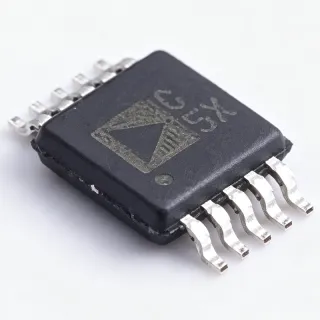
CS4350-CNZ - 24-Bit 192kHz Stereo DAC | Cirrus Logic
MPN: CS4350-CNZ ✗ End of LifeCS4350-CNZ Overview
An audio digital-to-analog converter, or audio DAC, converts digital PCM streams into left- and right-channel analog voltages suitable for amplifiers, headphones, speakers, and line-level audio equipment. Within the broader semiconductor hierarchy, it is an audio interface IC and a data-conversion component. The CS4350 integrates clock recovery, digital interpolation, delta-sigma conversion, de-emphasis, volume control, channel mixing, and analog filtering into one device.
The CS4350 uses a fifth-order multi-bit delta-sigma DAC architecture to support 24-bit audio data at rates as high as 192 kHz. Its 105 dB dynamic range and integrated PLL reduce the need for an external master-clock source. Digital volume control, channel mixing, and digital de-emphasis expand system-level functionality while preserving a compact analog implementation. The device also supports SPI control and operates in the commercial temperature range of -40°C to +85°C.
Its architecture is intended for consumer and professional audio systems where an I2S audio source provides serial bitstream data but cannot provide a suitable master clock. The internal PLL reconstructs the master clock from the serial audio stream, allowing the converter to be clocked from the incoming audio data. This integration reduces external clock-generation requirements, although the relationship between the serial interface, PLL lock behavior, and system startup must be checked in the design.
Typical uses include powered speakers, compact hi-fi equipment, digital audio appliances, game-console audio paths, USB audio interfaces, and multichannel audio subsystems that require stereo conversion. It is especially relevant when 24-bit playback is available but a discrete high-quality DAC and master-clock source would add excessive board area or complexity.
The principal design considerations are analog-output implementation, supply selection, grounding, clock stability, and PCB layout. Follow the manufacturer datasheet for the recommended capacitor values, output-network topology, exposed-pad connection, and reference-free layout guidance. Digital control signals should remain isolated from the analog output region, while input and output return paths should use a quiet, continuous ground-plane arrangement.
This product page consolidates the verified device identity, electrical specifications, package information, sourcing workflow, and application-oriented guidance into one engineering reference. It also distinguishes confirmed pin-compatible options from package or lifecycle differences so designers can avoid treating merely similar DACs as direct replacements.
Drop-in alternatives for CS4350-CNZ — same package, pin-to-pin compatible. Different-package parts requiring PCB rework are excluded.
CS4350-CNZR
✅ Drop-In📋 Reference alternative (not in catalog)
CS4350-CNZ Maximum Ratings & Electrical Characteristics
| Device Type | Stereo audio digital-to-analog converter |
| Converter Resolution | 24 bit |
| Maximum Listed Sampling Rate | 192 kHz |
| Dynamic Range | 105 dB |
| Converter Architecture | Fifth-order multi-bit delta-sigma |
| Master Clock | Integrated PLL-based derivation |
| Digital Interface | SPI |
| Audio Channels | 2 channels |
| Digital Interpolation | Integrated |
| Digital De-emphasis | Integrated |
| Volume Control | Integrated digital volume control |
| Channel Mixing | Integrated stereo channel mixing |
| Analog Filtering | Integrated |
| Package | 24-pin QFN, 4 x 4 mm |
| Exposed Pad | Present |
| Operating Temperature Range | -40°C to +85°C |
| Grade | Commercial |
CS4350-CNZ 24-pin qfn, 4 x 4 mm Pin Configuration Guide
Pin configuration for CS4350-CNZ (24-pin qfn, 4 x 4 mm package). This analog component features input, output, and power supply pins. Refer to the manufacturer datasheet for offset null, compensation, and enable pin configurations. Ideal for signal conditioning and amplifier circuits.

No detailed pinout data available for CS4350-CNZ.
Refer to the datasheet for full pin configuration.
Typical Applications
CS4350-CNZ is suitable for 6 applications: Powered Speaker Audio Path, USB Audio Interface, Game Console Audio Output, Digital Audio Appliance, Professional Audio Equipment, Hi-Fi Headphone Amplifier Front End.
Powered Speaker Audio Path
The CS4350-CNZ fits a powered-speaker signal chain that accepts a digital PCM stream and requires a low-noise stereo analog output. Its 24-bit conversion, 105 dB dynamic range, and support for sampling rates up to 192 kHz preserve high-resolution source information before amplification. The integrated PLL allows the converter to operate when the digital source cannot provide a suitable master clock. Place the device according to the manufacturer’s reference layout and use the documented output network to achieve the specified channel separation and distortion performance.
Recommended
USB Audio Interface
The CS4350-CNZ is suitable for the analog-output side of a USB audio interface when the USB controller provides serial digital audio but the design needs local conversion and clock recovery. Twenty-four-bit data at rates up to 192 kHz supports high-resolution playback, while the 105 dB dynamic range helps retain low-level musical detail. The integrated PLL-based master-clock derivation reduces the clocking burden on the digital subsystem. Keep USB data routing away from the analog outputs and follow the datasheet grounding and decoupling arrangement to reduce digital coupling into the audio path.
Recommended
Game Console Audio Output
The CS4350-CNZ can provide a compact stereo output stage for a game console or development platform whose digital audio processor lacks an adequate local master clock. The device combines a 24-bit delta-sigma converter, integrated PLL, digital interpolation, de-emphasis, volume control, and channel mixing in one package. Its 192 kHz capability supports high-rate game audio, while the 4 x 4 mm QFN footprint helps preserve board area. Because the component is obsolete, prototype evaluation is straightforward, but production planning should include a lifecycle-risk review and an approved alternate design.
Recommended
Digital Audio Appliance
The CS4350-CNZ is appropriate for compact digital audio appliances that receive PCM audio from a processor, network module, or storage controller. Its integrated PLL removes the need for a dedicated external master-clock generator in many system architectures, while the 105 dB dynamic range supports a high-quality output stage. Digital volume and channel mixing can simplify control routing, although the host software must configure these functions through the SPI interface. Apply the manufacturer’s recommended output filters and keep the analog region physically separated from switching regulators and high-speed digital clocks.
Recommended
Professional Audio Equipment
The CS4350-CNZ can serve as the stereo conversion element in professional monitoring and playback equipment where a 24-bit digital source is converted to line-level analog signals. Its support for 192 kHz sampling and 105 dB dynamic range provides a useful margin for high-resolution playback, while the fifth-order multi-bit delta-sigma architecture performs the core conversion. For low-noise performance, use a quiet analog supply, continuous ground reference, and the exact output-network values specified by the manufacturer. Verify the board’s maximum channel separation and distortion under the required load.
Recommended
Hi-Fi Headphone Amplifier Front End
The CS4350-CNZ can provide the digital-to-analog section ahead of a headphone amplifier in a high-resolution Hi-Fi product. The converter accepts 24-bit audio at rates up to 192 kHz and provides digital volume and channel-mixing functions, allowing the host to manage level and stereo routing before the analog gain stage. Its 105 dB dynamic range helps preserve quiet passages in high-resolution material. Keep the headphone amplifier’s power path separate from the sensitive analog output region, and use the documented RC or reconstruction network rather than selecting values by analogy.
Recommended
Recommended Products Summary
Engineering reference data for CS4350-CNZ — comparison, design guidance, and compliance information.
Selection Guide
Comparison with Alternatives
| Parameter | This Product | CS4350-CNZR |
|---|---|---|
| Package | 24-pin QFN (4 x 4 mm) | 24-pin QFN (4 x 4 mm) |
| Brand | Cirrus Logic Inc. | Cirrus Logic Inc. |
| Converter Resolution | 24 bit | 24 bit |
| Maximum Listed Sampling Rate | 192 kHz | 192 kHz |
| Dynamic Range | 105 dB | 105 dB |
| Master Clock | Integrated PLL | Integrated PLL |
| Digital Interface | SPI | SPI |
Key Differentiators
- Closest confirmed same-footprint replacement (vs CS4350-CNZR)
- Integrated system-clock recovery (vs CS4350-CNZR)
- Comprehensive integrated audio functions (vs CS4350-CNZR)
Design Notes
Separate the digital input, SPI control, and clock region from the analog output section. Route serial signals on the ground plane where possible and keep the CS4350-CNZ output components close to their defined pins. Use the manufacturer’s reference layout for component orientation and exposed-pad connection; the thermal pad is not automatically interchangeable with a numbered analog pin.
Use the supply limits and decoupling configuration stated in the CS4350 manufacturer datasheet. Place the required input and output capacitors directly beside their associated pins, with short ground returns, and avoid routing supply current through the sensitive analog-output area. If analog and digital supplies are separate, account for their sequencing and startup relationship before connecting them to the converter.
Do not treat the integrated PLL as permission to omit master-clock and interface timing checks. Confirm the supported input format, sampling-rate relationship, PLL lock behavior, and required control sequence for the host processor. Using the wrong serial mode or omitting initialization writes can prevent correct audio output even when the analog connections and power rails are correct.
Preserve the documented output-filter topology and grounding geometry because passive values, placement, and return paths directly affect channel separation and distortion. Avoid replacing the recommended network with generic values copied from another DAC. In multi-board systems, isolate the analog return from switching-node currents and keep headphone or line-output currents out of the converter ground path.
Compliance Information
The CS4350-CNZ is identified as a commercial-grade, lead-free-suffix device, but exact RoHS, REACH, halogen-free, conflict-minerals, and AEC-Q100 declarations were not stated in the cited product information. AEC-Q100 is treated as not qualified for this commercial-grade ordering code.