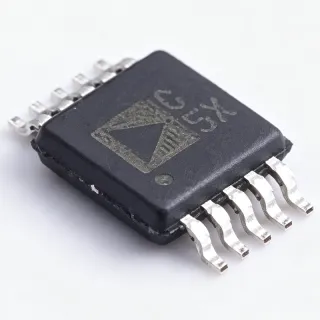
CS4351-DZZ - 24-Bit 192kHz Stereo Audio DAC | Cirrus Logic
MPN: CS4351-DZZ ✗ End of LifeCS4351-DZZ Overview
An audio DAC is a digital-to-analog converter, a signal-processing IC within the broader semiconductor and audio-interface hierarchy. It accepts encoded PCM audio data, reconstructs the corresponding analog waveform, and supplies line-level voltage for headphone, mixer, amplifier, or powered-speaker stages. The CS4351 combines converter resolution, digital volume control, soft-ramp behavior, and integrated line-output circuitry in one device.
The CS4351-DZZ provides 24-bit conversion at sample rates up to 192 kHz. Its 112 dB dynamic range and -100 dB total harmonic distortion plus noise establish the principal performance figures for clean stereo playback. A digital volume-control function allows attenuation in the digital domain, while soft ramp helps reduce abrupt output-level transitions. These features suit consumer audio equipment, multimedia systems, digital mixing consoles, and compact powered speakers.
The converter requires separate positive and low-voltage supply rails, identified in the product information as 12 V and VL. The exact allowable VL range, absolute maximum ratings, and recommended operating ranges should be confirmed in the manufacturer datasheet before schematic release. Because the DAC produces analog line-level signals, its performance depends on clean supply routing, a suitable analog reference implementation, suitable digital and analog return paths, and output loading appropriate to the selected line-output configuration.
Typical uses include CD and DVD player digital audio paths, active speaker interfaces, computer multimedia equipment, set-top boxes, and external digital-to-analog converters. In these systems, the SPI interface connects to an audio processor or digital transport, while the analog outputs feed a line input, headphone driver, mixer, or power amplifier. Its 192 kHz capability supports high-resolution audio formats, although the host processor, clocking scheme, and downstream analog amplifier must also support the intended sample rate.
For layout, keep SPI clock and data routes away from the analog output traces, provide local bypass capacitance at the supply pins, and use a continuous ground reference beneath the analog section. Confirm the supported output mode and load condition before terminating either output channel. The manufacturer pin-description table should be used directly for every PCB net assignment.
This page combines the converter's stated audio performance, drop-in cross-reference options, application guidance, and practical PCB considerations to support faster component selection and implementation.
Drop-in alternatives for CS4351-DZZ — same package, pin-to-pin compatible. Different-package parts requiring PCB rework are excluded.
CS4351-DZZ/B
✅ Drop-In📋 Reference alternative (not in catalog)
CS4351-CZZ
✅ Drop-In📋 Reference alternative (not in catalog)
CS4351-CZZR
✅ Drop-In📋 Reference alternative (not in catalog)
CS4351-DZZR
✅ Drop-In📋 Reference alternative (not in catalog)
CS4350-CZZR
✅ Drop-In📋 Reference alternative (not in catalog)
CS4351-DZZ Maximum Ratings & Electrical Characteristics
| Device Type | Stereo audio digital-to-analog converter |
| Converter Resolution | 24 bit |
| Maximum Sample Rate | 192 kHz |
| Dynamic Range | 112 dB |
| THD+N | -100 dB |
| Output | 2 Vrms line output |
| Digital Interface | SPI |
| Number of Audio Channels | 2 channels |
| Converter Architecture | Multi-bit delta-sigma modulator |
| Positive Supply | 12 V |
| Low-Voltage Supply | VL supply |
| Digital Volume Control | Supported |
| Volume Transition Control | Soft ramp |
| Package | 20-pin TSSOP, 4.40 mm width |
| Mounting Type | Surface mount |
| Product Status | Obsolete |
CS4351-DZZ 20-pin tssop, 4.40 mm width Pin Configuration Guide
Pin configuration for CS4351-DZZ (20-pin tssop, 4.40 mm width package). This analog component features input, output, and power supply pins. Refer to the manufacturer datasheet for offset null, compensation, and enable pin configurations. Ideal for signal conditioning and amplifier circuits.

No detailed pinout data available for CS4351-DZZ.
Refer to the datasheet for full pin configuration.
Typical Applications
CS4351-DZZ is suitable for 6 applications: Powered Speaker Digital Input, CD and DVD Player Audio Path, Digital Audio Mixer, Computer Multimedia Audio, External USB Audio Converter, Network and Streaming Audio.
Powered Speaker Digital Input
The CS4351-DZZ fits a powered-speaker input stage that receives digital audio from USB, Bluetooth, network, or optical-audio source hardware. Its 24-bit conversion and operation up to 192 kHz preserve high-resolution PCM data, while the 2 Vrms line output can feed a line-input amplifier when the interface is designed for that signal level. SPI permits a compact connection to an audio processor, and digital volume control avoids requiring a separate analog attenuator. The principal design checks are output configuration, supported load, clock generation, and analog grounding. Use local supply bypass and keep the DAC outputs away from digital clock and data traces to preserve the device's stated 112 dB dynamic range and -100 dB THD+N performance.
Recommended
CD and DVD Player Audio Path
A CD, DVD, or disc-based media player can use the CS4351-DZZ to convert its digital audio stream into an analog line-level output. The converter's 24-bit architecture and 192 kHz maximum sample rate align with high-resolution digital audio transports, while the integrated 2 Vrms output simplifies the analog path between the decoder and an amplifier. SPI provides a straightforward connection to the transport or system controller. Soft-ramp volume behavior is useful when channels or system modes change because it reduces abrupt output-level transitions. Layout should provide a low-noise return path, compliant supply rails, and controlled clock routing so that converter performance is not degraded by digital coupling.
Recommended
Digital Audio Mixer
The CS4351-DZZ can serve as a stereo conversion endpoint in a digital mixer or digital crossover. Its 24-bit resolution supports detailed source material, and the 192 kHz capability accommodates high-rate processing streams when the upstream mixer and clock architecture support them. Digital volume control allows the DAC to provide output attenuation in the digital domain, while soft ramp helps manage level changes during source or mode transitions. The converter is placed after digital routing and before the mixer output amplifier. Engineers should confirm the supported serial interface timing, master-clock requirements, output mode, and load impedance, then isolate analog output routing from high-current amplifier paths to maintain low distortion.
Recommended
Computer Multimedia Audio
The CS4351-DZZ is appropriate for a computer multimedia subsystem that must translate high-rate digital audio into analog line signals for an amplifier or active display. Its SPI interface permits a compact connection to a digital audio controller, while 192 kHz operation supports high-resolution playback modes. The 112 dB dynamic range and -100 dB THD+N figures are useful for desktop audio, gaming accessories, and multimedia displays where a quiet analog output path is required. Because computers and displays often combine high-speed digital signals with sensitive analog outputs, keep processor and memory routing away from the DAC, provide short supply connections, and use an uninterrupted ground reference under the analog section.
Recommended
External USB Audio Converter
An external digital-to-analog converter can use the CS4351-DZZ to provide a high-quality stereo line output from a digital audio interface. The 24-bit conversion and 192 kHz maximum rate are well suited to high-resolution streaming and playback, while 2 Vrms output provides a conventional line-level result for downstream amplification. SPI control allows the host to configure operating parameters and implement digital volume attenuation. The converter should be mounted close to the analog output connectors so that the sensitive line-level traces remain short. Validate the output balance configuration, loading, isolation requirements, and return path before fabrication; the DAC's audio performance alone does not eliminate the need for a well-designed analog output stage.
Recommended
Network and Streaming Audio
The CS4351-DZZ can provide the final stereo conversion function in a network streamer or digital-audio playback product. Its 24-bit resolution and 192 kHz sample-rate capability accommodate high-quality network sources when the decoder and transport deliver compatible PCM data. The SPI interface is practical for embedded system control, and digital volume control can implement user-level attenuation without adding another analog control stage. Product-quality playback depends on separating the DAC's analog section from Ethernet, memory, and processor activity. Use short output routing, local decoupling, a stable clock architecture, and a careful analog-ground return so switching and processor noise do not compromise the stated 112 dB dynamic range.
Recommended
Recommended Products Summary
Engineering reference data for CS4351-DZZ — comparison, design guidance, and compliance information.
Selection Guide
Comparison with Alternatives
| Parameter | This Product | CS4351-DZZ/B | CS4351-CZZ | CS4351-CZZR | CS4351-DZZR | CS4350-CZZR |
|---|---|---|---|---|---|---|
| Package | 20-pin TSSOP | 20-pin TSSOP | 20-pin TSSOP | 20-pin TSSOP | 20-pin TSSOP | 20-pin TSSOP |
| Brand | Cirrus Logic | Cirrus Logic | Cirrus Logic | Cirrus Logic | Cirrus Logic | Cirrus Logic |
| Device Type | Stereo audio DAC | Stereo audio DAC | Stereo audio DAC | Stereo audio DAC | Stereo audio DAC | Stereo DAC |
Key Differentiators
- The documented CS4351 family version combines 24-bit resolution with 192 kHz operation (vs CS4350-CZZR)
- The target provides a specified 112 dB dynamic range (vs CS4350-CZZR)
- The /B variant retains the stated 24-bit, 192 kHz converter performance (vs CS4351-DZZ/B)
- The target includes documented digital volume control and soft-ramp operation (vs CS4350-CZZR)
Design Notes
Place the required input, output, and bypass capacitors close to their associated CS4351-DZZ pins, with the shortest practical ground return. Route SPI clock and data away from the analog output pins and connector area. Because the converter provides a 2 Vrms line-level signal, small layout-induced coupling can be audible even when the converter itself meets its 112 dB dynamic-range and -100 dB THD+N ratings.
Use separate, stable positive and low-voltage supplies with local high-frequency bypass and adequate decoupling capacity. The product information identifies 12 V and VL rails but does not establish the complete allowable ranges on this page, so verify each rail's nominal value, tolerance, startup sequence, and maximum voltage against the manufacturer datasheet. Avoid sharing high-current return paths between the DAC, communications circuitry, and output amplifier.
Keep the digital audio interface short and controlled, especially the SPI clock. Provide a low-impedance clock and ground arrangement, and avoid routing the interface beneath or parallel with the analog outputs. Confirm the supported output mode, load, and channel-routing behavior in the datasheet because incorrect termination or mode assumptions can reduce performance even when the converter operates within its stated sample-rate and resolution limits.
Do not treat every CS4351 order suffix as automatically interchangeable. The tray, tape-and-reel, revision, and temperature-related suffixes can change procurement, assembly, or qualification conditions even when the device family and 20-pin TSSOP footprint remain the same. For an obsolete product, check the ordering table, lifecycle notices, date-code policy, and traceability requirements before approving a replacement for production.
Compliance Information
The product information identifies an obsolete stereo audio DAC but does not provide extractable RoHS, REACH, lead-free, halogen-free, or conflict-minerals declarations.