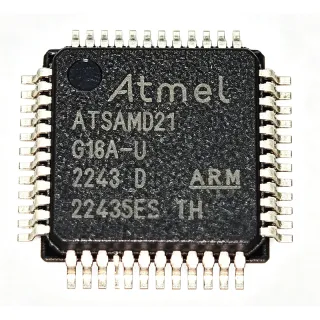
DSPIC33EV32GM002-E/SS - 16-bit 5V DSC 32KB Flash | Microchip
MPN: DSPIC33EV32GM002-E/SS ✓ Active| Qty | Unit Price | Extended |
|---|---|---|
| 1 | $3.27 | $3.27 |
| 10 | $2.95 | $29.50 |
| 100 | $2.62 | $262.00 |
| 500 | $2.35 | $1,175.00 |
| 1,000 | $2.1 | $2,100.00 |
| 3,000 | $1.92 | $5,760.00 |
DSPIC33EV32GM002-E/SS Overview
A digital signal controller combines the computational throughput of a microcontroller with DSP capabilities such as single-cycle multiply-accumulate and hardware division, sitting in the product hierarchy between general-purpose MCUs (like PIC16/PIC18) and dedicated DSP processors. DSCs are the preferred choice for closed-loop control systems such as motor control, digital power conversion, and sensor signal conditioning.
Key differentiating features of this family include native 5V operation for improved noise immunity in harsh electrical environments, on-chip peripherals such as advanced PWM, SENT, LIN, and CAN communication interfaces, and integrated analog including high-speed ADC and op amps on larger family members. The Peripheral Pin Select (PPS) architecture allows flexible remapping of digital peripherals to physical pins, easing PCB layout and reducing board cost.
Technically, the dsPIC33EV core executes most instructions in a single cycle with a 16-bit modified Harvard architecture, dual 40-bit accumulators, and DSP instruction support. Four DMA channels offload data movement from the CPU, and seven to nine timers support precise event timing. Flash self-programming enables field firmware updates, and the VCAP pin requires an external low-ESR capacitor for the internal 2.5V core regulator.
Typical applications include automotive sensors and touch control units, BLDC/DC motor control with safety features, appliance power supplies, and industrial automation nodes exposed to electrical noise. The 5V rail simplifies direct interfacing with precision sensors without level shifting.
Design consideration: keep the VCAP capacitor close to the device with a low-ESR ceramic value as specified in the family data sheet DS70005144H, and connect all VDD/VSS pairs and AVDD/AVSS properly to maintain ADC accuracy.
This page synthesizes distributor pricing, same-family drop-in alternatives, FAQs, and practical design notes not found on a single manufacturer or distributor page.
Drop-in alternatives for DSPIC33EV32GM002-E/SS — same package, pin-to-pin compatible. Different-package parts requiring PCB rework are excluded.
Variants in this series
Same-series models that are drop-in compatible with DSPIC33EV32GM002-E/SS (same form factor and footprint) — differing in Package, Qualification, Operating Temperature, Communication Interfaces, Peripheral Pin Select.
Quick Comparison Tool — Select alternative parts for side-by-side comparison:
No drop-in alternatives available for this product.
Request AlternativesDSPIC33EV32GM002-E/SS Maximum Ratings & Electrical Characteristics
| Core Architecture | 16-bit dsPIC DSC |
| Program Memory (Flash) | 32 KB (11K x 24) |
| RAM | 4 KB |
| Maximum Clock Frequency | 60 MHz |
| Core Performance | 70 MIPS class at 5V |
| Operating Voltage | 4.5 V to 5.5 V (5V family) |
| DMA Channels | 4 |
| Timers | 7 |
| Communication Interfaces | SENT, LIN, CAN, UART, SPI, I2C |
| PWM | Advanced motor-control PWM |
| Package | 28-SSOP (5.30 mm width) |
| Operating Temperature | -40C to +125C (E grade) |
| Qualification | AEC-Q100 (automotive) |
| Mounting Type | Surface Mount |
| Programming/Debug | ICSP via PGECx/PGEDx pairs |
| Peripherals | Peripheral Pin Select (PPS), on-chip regulator (VCAP) |
| Target Applications | Automotive, appliances, industrial motor control |
DSPIC33EV32GM002-E/SS 28-ssop (5.30 mm width) Pin Configuration Guide
Pin configuration for DSPIC33EV32GM002-E/SS (28-ssop (5.30 mm width) package). This digital IC includes GPIO, communication interfaces (UART, SPI, I2C), and power pins. Refer to the manufacturer datasheet for alternate pin functions and configuration options. Essential for embedded system design and PCB layout.

No detailed pinout data available for DSPIC33EV32GM002-E/SS.
Refer to the datasheet for full pin configuration.
Typical Applications
DSPIC33EV32GM002-E/SS is suitable for 6 applications: Automotive Sensors and Touch Control Units, BLDC and DC Motor Control, Appliance Power and Control Boards, Digital Power Conversion, Industrial Sensor Conditioning Nodes, Automotive Lighting and Actuator Control.
Automotive Sensors and Touch Control Units
Microchip positions the dsPIC33EV family specifically for automotive sensor nodes and touch control units exposed to noise and vibration. The DSPIC33EV32GM002-E/SS fits this role because its native 4.5V to 5.5V operation provides superior noise margin on vehicle 5V sensor rails, its SENT peripheral directly interfaces with SENT-protocol sensors without external decoding hardware, and its -40C to +125C AEC-Q100 qualification covers under-dash and engine-bay-adjacent environments. The 32KB Flash accommodates sensor linearization tables and CAN/LIN stack firmware. Design teams typically run the CAN interface for ECU communication while remapping UART pins via Peripheral Pin Select to serve LIN, achieving two vehicle buses from one 28-pin controller.
Recommended
BLDC and DC Motor Control
The dsPIC33EV32GM002-E/SS is well suited to brushless-DC and DC motor control because its advanced motor-control PWM peripheral generates complementary outputs with dead-time insertion and fault shutdown, while the 16-bit DSP core executes current-loop PID and field-oriented-control arithmetic in the 60 MHz / 70 MIPS class budget. The four DMA channels stream ADC current-sense samples into RAM without CPU intervention, keeping control-loop jitter low. In a typical 5V gate-drive design, the DSC reads a shunt or hall sensor through the ADC, runs the control loop at 10 to 20 kHz, and outputs six PWM channels; 5V logic also directly drives many MOSFET gate drivers, removing level-shifter stages and improving switching-noise immunity in the power stage.
Recommended
Appliance Power and Control Boards
Home appliances such as washing machines, air conditioners and induction cooktops demand controllers that survive noisy motor and switching environments on a 5V supply. The DSPIC33EV32GM002-E/SS addresses this with its 5V-robust core, watchdog and brown-out supervision, and 32KB Flash for state machines plus touch or encoder interfaces. The 28-SSOP package saves board area on compact appliance PCBs, while the extended -40C to +125C rating tolerates hot enclosures near motors. Designers use the PWM peripheral for inverter or heater control, the ADC with DMA for current monitoring, and UART or LIN for user-interface boards; the on-chip self-programming Flash supports field firmware updates during appliance service.
Recommended
Digital Power Conversion
In digital power supplies, PFC stages and DC-DC converters, the dsPIC33EV32GM002-E/SS implements voltage- and current-mode control loops in firmware. The 60 MHz DSP core with dual 40-bit accumulators computes compensator equations fast enough for 100 to 500 kHz switching frequencies at practical loop rates, and the high-speed ADC captures input and output sense signals synchronously with the PWM period. Native 5V operation simplifies interfacing with the power stage's 5V analog and protection circuits and provides better noise immunity against switching transients than 3.3V controllers. The 32KB Flash stores multiple control profiles, and the external VCAP-regulated core keeps supply design to a single 5V rail.
Recommended
Industrial Sensor Conditioning Nodes
Industrial 4-20 mA loops, proximity sensors and encoder interfaces benefit from the dsPIC33EV32GM002-E/SS's 5V I/O that connects directly to precision sensors without level translation. The DSP core performs filtering, linearization and FFT-based diagnostics locally, while the remappable peripheral pins (PPS) let one PCB layout serve multiple sensor variants by reassigning UART, SPI or PWM functions in firmware. The 28-SSOP device's four DMA channels move ADC samples at fixed-rate, deterministic intervals suitable for control and logging, and the 32KB Flash retains calibration tables. With the -E grade rated to +125C, the node can reside in panels near drives and heating elements without local cooling.
Recommended
Automotive Lighting and Actuator Control
LED headlamp modules, pump drivers and flap actuators in vehicles need compact controllers with robust PWM generation and network connectivity. The dsPIC33EV32GM002-E/SS provides advanced PWM outputs with precise duty resolution for LED current regulation and dimming, SENT and LIN peripherals for communicating diagnostic data to body ECUs, and AEC-Q100 qualification at up to +125C for lamp-housing environments. The 5V core withstands load-dump-induced supply noise better than 3.3V alternatives, and its four DMA channels handle fault-sampling in the background. Firmware-based protection (overcurrent, overtemperature via ADC) replaces discrete protection ICs, and 32KB Flash supports multi-variant lamp calibrations on one PCB.
Recommended
Recommended Products Summary
Engineering reference data for DSPIC33EV32GM002-E/SS — comparison, design guidance, and compliance information.
Selection Guide
Comparison with Alternatives
| Parameter | This Product | DSPIC33EV32GM002-I/SS | DSPIC33EV64GM002-E/SS | DSPIC33EV128GM002-E/SS | DSPIC33EV32GM102-E/SS |
|---|---|---|---|---|---|
| Package | 28-SSOP (5.30 mm) | 28-SSOP - same | 28-SSOP - same | 28-SSOP - same | 28-SSOP - same |
| Brand | Microchip Technology | Microchip Technology | Microchip Technology | Microchip Technology | Microchip Technology |
| Flash Program Memory | 32 KB (11K x 24) | 32 KB | 64 KB | 128 KB | 32 KB |
| RAM | 4 KB | 4 KB | 4 KB | 4 KB | 4 KB |
| Max Clock Frequency | 60 MHz | 60 MHz | 60 MHz | 60 MHz | 60 MHz |
| Operating Temperature | -40C to +125C (E grade) | -40C to +85C (I grade) | -40C to +125C (E grade) | -40C to +125C (E grade) | -40C to +125C (E grade) |
| AEC-Q100 Qualification | Yes (automotive) | Industrial grade - check ordering info | Yes (automotive) | Yes (automotive) | Yes (automotive) |
Key Differentiators
- Extended -40C to +125C automotive rating (vs DSPIC33EV32GM002-I/SS)
- Cost-optimized 32KB Flash for entry-level designs (vs DSPIC33EV64GM002-E/SS)
- Native 5V operation with SENT/LIN/CAN integration (vs 3.3V 16-bit DSC families)
Design Notes
The dsPIC33EV32GM002 integrates a 2.5V core regulator accessed via the VCAP pin. Place a low-ESR ceramic capacitor on VCAP as close to the pin as possible, per the recommended value in the family data sheet DS70005144H. Do not connect any external voltage source to VCAP, and do not load it. Supply the device from a clean 4.5V to 5.5V rail; connect all VDD/VSS pairs with local 0.1uF decoupling plus one bulk capacitor per board. Separately decouple AVDD for ADC accuracy.
ICSP programming uses PGECx/PGEDx pairs - route your chosen pair (e.g. PGEC2/PGED2) together as a matched pair to the programming header, since the debugger requires both from the same pair (per Microchip family documentation). Keep the crystal loop compact around OSC1/OSC2 with local ground guard. Because Peripheral Pin Select lets you remap digital functions, reserve test points on at least one UART pair for debug flexibility before finalizing the layout.
Common pitfalls: (1) forgetting the VCAP capacitor - the device will not start reliably; (2) mixing PGEC1 with PGED2 during debugging - pairs must match; (3) relying on the -E grade beyond +125C - use the -H grade (up to +150C) for under-hood locations; (4) assuming all 32KB Flash is available for code - reserve a boot block if you plan self-programming field updates; (5) exceeding the 4.5V to 5.5V operating window during load-dump transients in automotive systems - add TVS protection on the supply rail.
In 5V automotive and motor-control environments, keep high-current PWM loops away from the ADC sense routing and use the differential or railed reference configuration with AVDD/AVSS as reference for best accuracy. When sensing motor currents via shunts, sample synchronously with the PWM center (center-aligned trigger) so switching noise is minimized; the dsPIC33EV ADC supports PWM-triggered conversions, and using DMA for the sample transfer eliminates CPU-timing jitter in the control loop.
Compliance Information
Automotive, AEC-Q100 qualification stated in verified web data (Hotenda product listing). RoHS/lead-free status per standard Microchip 28-SSOP commercial product offerings; confirm on the Microchip product page for certificate copies.