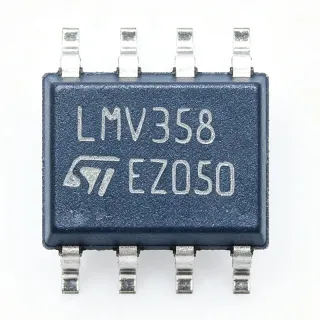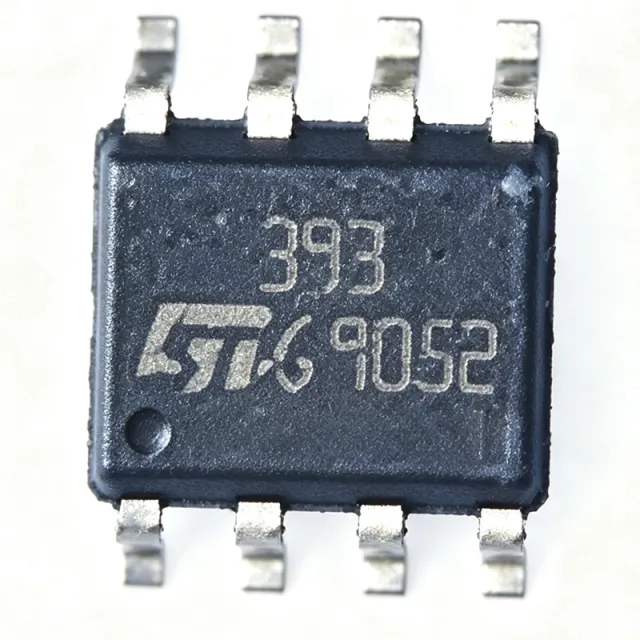
LM393DT - Dual Low-Power Voltage Comparator | STMicroelectronics
MPN: LM393DT ✓ Active| Qty | Unit Price | Extended |
|---|---|---|
| 1 | $0.0791 | $0.08 |
| 10 | $0.0571 | $0.57 |
| 100 | $0.0505 | $5.05 |
| 500 | $0.0483 | $24.15 |
| 1,000 | $0.0461 | $46.10 |
LM393DT Overview
A voltage comparator is an electronic circuit that compares two input voltages and outputs a digital signal indicating which is higher. The LM393DT is a dual comparator, meaning it contains two independent comparators in a single package. Comparators are fundamental building blocks in analog and mixed-signal systems, used in applications such as threshold detection, zero-crossing detection, and waveform shaping. They are part of the broader category of linear ICs, which also includes operational amplifiers and voltage regulators. The LM393DT's low power consumption and wide supply range make it a versatile choice for battery-powered and industrial applications.
Key features of the LM393DT include a low input offset voltage of 2 mV (typical), a low input bias current of 25 nA (typical), and a response time of 1.3 µs (typical) for a 5V overdrive. The open-collector output allows wired-OR connections and level shifting, and the device can operate from a single supply as low as 2V, making it suitable for low-voltage systems. The SOIC-8 package provides a compact footprint with a thermal resistance of 150 °C/W, enabling reliable operation in moderate temperature environments.
The LM393DT uses a bipolar transistor architecture with a differential input stage and an open-collector output. This design provides high input impedance and stable operation over a wide temperature range (-40°C to +105°C). The device includes internal ESD protection and is designed to meet JEDEC standards for reliability. The open-collector output requires an external pull-up resistor, which allows the output voltage to be set to any level up to the maximum supply voltage, providing flexibility in interfacing with different logic families.
Typical applications for the LM393DT include window comparators, level shifters, oscillator circuits, and analog-to-digital converters. In a window comparator, the dual comparators are used to detect whether an input signal is within a specified voltage range, which is useful in battery monitoring and overvoltage protection. The low power consumption makes it ideal for portable devices, while the wide supply range supports industrial control systems operating from 24V rails.
When designing with the LM393DT, ensure that the pull-up resistor is selected to limit the output sink current to within the 16 mA maximum rating. For high-speed applications, minimize parasitic capacitance on the output node to achieve the specified response time. The input common-mode range extends from ground to VCC-1.5V, so ensure that input signals remain within this range for proper operation.
This page synthesizes distributor pricing, drop-in alternatives, and practical design notes not found in the STMicroelectronics datasheet, providing a comprehensive resource for engineers selecting and using the LM393DT.
Drop-in alternatives for LM393DT — same package, pin-to-pin compatible. Different-package parts requiring PCB rework are excluded.
Variants in this series
Same-series models that are drop-in compatible with LM393DT (same form factor and footprint) — differing in Input Offset Voltage, Output Type, Package, Response Time.
Quick Comparison Tool — Select alternative parts for side-by-side comparison:
LM393DR
✓ In Stock
$0.07 / Unit
View Datasheet →LM393M
📋 Reference alternative (not in catalog)
LM393ADT
📋 Reference alternative (not in catalog)
LM393DT Maximum Ratings & Electrical Characteristics
| Number of Channels | 2 |
| Supply Voltage - Single | 2 V to 36 V |
| Supply Voltage - Dual | ±1 V to ±18 V |
| Supply Current (per comparator) | 0.4 mA (typical) |
| Input Offset Voltage | 2 mV (typical) |
| Input Bias Current | 25 nA (typical) |
| Response Time | 1.3 µs (typical) |
| Output Type | Open Collector |
| Output Sink Current | 16 mA (maximum) |
| Input Common-Mode Voltage Range | 0 V to VCC - 1.5 V |
| Operating Temperature Range | -40°C to +105°C |
| Package | SOIC-8 |
| Mounting Type | Surface Mount |
| RoHS Status | Compliant |
| MSL Level | 1 |
LM393DT Pin Configuration
| Pin 1 | OUT1 — Output of comparator 1 (open collector) |
| Pin 2 | IN1- — Inverting input of comparator 1 |
| Pin 3 | IN1+ — Non-inverting input of comparator 1 |
| Pin 4 | GND — Ground (negative supply) |
| Pin 5 | IN2+ — Non-inverting input of comparator 2 |
| Pin 6 | IN2- — Inverting input of comparator 2 |
| Pin 7 | OUT2 — Output of comparator 2 (open collector) |
| Pin 8 | VCC — Positive supply voltage |
Typical Applications
LM393DT is suitable for 6 applications: Window Comparator, Level Shifter, Oscillator Circuit, Battery Voltage Monitor, Zero-Crossing Detector, Analog-to-Digital Converter (ADC) Front End.
Window Comparator
The LM393DT is ideal for window comparator circuits that detect whether an input voltage is within a specified range. In a typical window comparator, the two comparators are configured with reference voltages set by a resistor divider. The first comparator detects when the input exceeds the upper threshold, and the second detects when it falls below the lower threshold. The open-collector outputs can be wired-OR together to produce a single active-low signal when the input is outside the window. This application is common in battery monitoring systems, where the LM393DT's low supply current (0.4 mA per comparator) minimizes power drain. The wide supply range (2V to 36V) allows direct operation from the battery voltage being monitored. The response time of 1.3 µs is sufficient for detecting overvoltage or undervoltage conditions in real-time. The input common-mode range (0V to VCC-1.5V) ensures accurate threshold detection for signals near ground. For precise window boundaries, use 1% tolerance resistors in the divider network. The LM393DT's open-collector output simplifies interfacing with a microcontroller's interrupt pin, enabling immediate system shutdown or alarm activation. Overall, the LM393DT provides a cost-effective and power-efficient solution for window detection in portable and industrial systems.
Recommended
Level Shifter
The LM393DT can be used as a level shifter to interface between different logic voltage domains. With its open-collector output, the LM393DT can translate a signal from a low-voltage domain (e.g., 3.3V) to a higher voltage domain (e.g., 5V or 12V) by connecting the pull-up resistor to the higher supply. In a typical level-shifting application, the input signal is applied to one comparator input, and a reference voltage (set to the threshold) is applied to the other. When the input exceeds the threshold, the output transistor turns on, pulling the output low; otherwise, the pull-up resistor pulls the output high. This allows bidirectional level shifting when two comparators are used. The LM393DT's wide supply range (up to 36V) makes it suitable for shifting to industrial voltage levels. The low input bias current (25 nA) ensures minimal loading on the input signal source. The response time of 1.3 µs supports data rates up to several hundred kHz, making it suitable for UART, SPI, and I2C level shifting. The SOIC-8 package is compact, and the low power consumption is beneficial in battery-powered devices. When designing, ensure the pull-up resistor value is chosen to achieve the desired rise time and to limit sink current to 16 mA. The LM393DT provides a simple, low-cost alternative to dedicated level-shifter ICs.
Recommended
Oscillator Circuit
The LM393DT can be configured as a relaxation oscillator to generate square wave signals. In this application, one comparator is used with a feedback resistor and a capacitor to create a free-running oscillator. The comparator's open-collector output charges and discharges the capacitor through the feedback resistor, producing a square wave at the output. The frequency is determined by the RC time constant and the hysteresis set by the feedback network. The LM393DT's response time of 1.3 µs limits the maximum oscillation frequency to a few hundred kHz, which is adequate for many timing and clock generation applications. The low supply current (0.4 mA) makes it suitable for low-power timers. The wide supply voltage range (2V to 36V) allows the oscillator to operate from various supply rails. The input common-mode range ensures proper operation when the capacitor voltage swings near ground. To achieve a 50% duty cycle, use a symmetrical feedback network. The open-collector output requires a pull-up resistor, which also sets the output high level. This oscillator can be used in applications such as LED flashers, tone generators, and PWM generation. The LM393DT provides a simple and cost-effective solution for generating clock signals without a dedicated timer IC.
Recommended
Battery Voltage Monitor
The LM393DT is well-suited for battery voltage monitoring in portable and automotive systems. By configuring the comparator as a threshold detector, it can indicate when the battery voltage drops below a critical level. The low supply current (0.4 mA per comparator) is crucial for minimizing battery drain in always-on monitoring circuits. The wide supply voltage range (2V to 36V) allows direct connection to the battery, eliminating the need for a separate regulator. The input common-mode range (0V to VCC-1.5V) enables monitoring of voltages near ground. In a typical application, a resistor divider scales the battery voltage to a level within the common-mode range, and a reference voltage (e.g., from a TL431) sets the threshold. The open-collector output can drive an LED or a microcontroller interrupt to alert the user. The response time of 1.3 µs ensures quick detection of voltage drops. The LM393DT's dual comparators can be used to monitor both overvoltage and undervoltage conditions simultaneously. The SOIC-8 package is compact, and the operating temperature range (-40°C to +105°C) suits automotive environments. For accurate monitoring, use precision resistors and a stable reference. The LM393DT provides a reliable and low-power solution for battery management.
Recommended
Zero-Crossing Detector
The LM393DT can be used as a zero-crossing detector to sense when an AC signal crosses zero volts. This is useful in phase control applications such as dimmers, motor speed controllers, and power factor correction. In a typical circuit, the AC signal is attenuated and biased to fit within the input common-mode range. The comparator's output changes state each time the input crosses the reference voltage (usually set to the midpoint). The open-collector output can be used to trigger a microcontroller or a TRIAC driver. The LM393DT's response time of 1.3 µs is fast enough for 50/60 Hz AC signals, ensuring accurate zero-crossing detection. The wide supply voltage range allows operation from a rectified AC supply. The low input bias current (25 nA) minimizes loading on the AC signal. The dual comparators can be used to detect both positive and negative zero crossings. The SOIC-8 package is suitable for compact designs. When designing, ensure the input signal is properly clamped to protect the comparator from overvoltage. The LM393DT provides a simple and cost-effective solution for zero-crossing detection in power control applications.
Recommended
Analog-to-Digital Converter (ADC) Front End
The LM393DT can be used in the front end of a successive approximation ADC to compare the input voltage with a reference voltage. In this application, the comparator's high input impedance and low offset voltage (2 mV) ensure accurate comparisons. The open-collector output can be interfaced with a microcontroller's digital input. The response time of 1.3 µs limits the conversion speed, but it is sufficient for low-speed ADCs (e.g., 10-bit at 100 kSPS). The wide supply voltage range allows operation from the same supply as the ADC. The low supply current is beneficial in battery-powered data acquisition systems. The dual comparators can be used to implement a flash ADC with 2-bit resolution. The input common-mode range ensures proper operation for input signals near ground. When designing, use a stable reference voltage (e.g., from a bandgap reference) to achieve accurate conversions. The LM393DT provides a low-cost alternative to dedicated comparators in simple ADC designs.
Recommended
Recommended Products Summary
Engineering reference data for LM393DT — comparison, design guidance, and compliance information.
Selection Guide
Comparison with Alternatives
| Parameter | This Product | LM393DR | LM393M | LM393ADT |
|---|---|---|---|---|
| Package | SOIC-8 | SOIC-8 | SOIC-8 | SOIC-8 |
| Supply Voltage Range | 2V to 36V | 2V to 36V | 2V to 36V | 2V to 36V |
| Supply Current (per comparator) | 0.4 mA | 0.4 mA | 0.4 mA | 0.4 mA |
| Input Offset Voltage | 2 mV (typical) | 2 mV (typical) | 2 mV (typical) | 1 mV (typical) |
| Response Time | 1.3 µs | 1.3 µs | 1.3 µs | 1.3 µs |
| Output Type | Open Collector | Open Collector | Open Collector | Open Collector |
| Operating Temperature Range | -40°C to +105°C | -40°C to +105°C | -40°C to +105°C | -40°C to +105°C |
| RoHS Compliant | Yes | Yes | Yes | Yes |
Key Differentiators
- Lower input offset voltage (vs LM393M)
- Wide supply voltage range (vs LM393DR)
- Automotive-grade variant available (vs LM393DR)
Design Notes
The LM393DT has an open-collector output, so a pull-up resistor is mandatory for proper logic levels. Choose the pull-up resistor value to limit the sink current to 16 mA maximum. For example, with a 5V supply, a minimum pull-up of 312 ohms is required. For low-power applications, use a higher value (e.g., 10k ohms) to reduce current consumption, but ensure the rise time meets your speed requirements.
Place a 0.1 µF bypass capacitor close to the VCC pin (pin 8) and ground (pin 4) to reduce noise and improve stability. For high-speed applications, minimize trace length on the output pins to reduce parasitic capacitance, which can slow the response time. Use a ground plane to provide a low-impedance return path.
The SOIC-8 package has a thermal resistance of approximately 150 °C/W. At a maximum supply voltage of 36V and a sink current of 16 mA, the power dissipation is about 0.58W, resulting in a temperature rise of 87°C above ambient. Ensure adequate airflow or copper area to keep the junction temperature within the -40°C to +105°C operating range.
Compliance Information
RoHS compliant per STMicroelectronics. Not AEC-Q100 qualified; automotive-grade variant LM393DT-Q1 is available.