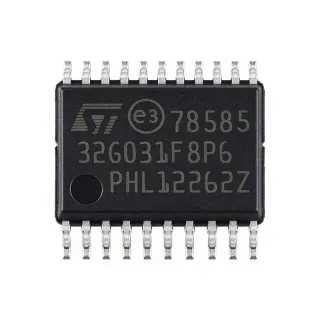
MC9S08SH4CTJ - 8-bit 40MHz HCS08 MCU 4KB Flash 20-TSSOP
MPN: MC9S08SH4CTJ ✗ End of Life| Qty | Unit Price | Extended |
|---|---|---|
| 1 | $3 | $3.00 |
| 10 | $2.7 | $27.00 |
| 100 | $2.4 | $240.00 |
| 500 | $2.1 | $1,050.00 |
| 1,000 | $1.85 | $1,850.00 |
MC9S08SH4CTJ Overview
An 8-bit microcontroller (MCU) is a single-chip computer that integrates a CPU, RAM, Flash program memory, and peripherals onto one die. The HCS08 is NXP's (formerly Freescale's) enhanced 8-bit architecture, succeeding the classic HC08 by lowering active current per MHz and adding the BGND background-debug instruction. Within the broader semiconductor taxonomy, the MC9S08SH4CTJ sits at the bottom rung of the HCS08 SH family, occupying the same generation as the SH8 and SH16 siblings but with a smaller Flash footprint for budget-constrained designs.
Key differentiating specifications include a 40 MHz bus frequency, 2.7 V-5.5 V wide supply range, an internal clock source with optional PLL-style prescaler behavior for power tuning, low-power STOP and WAIT modes with fast wake-up, and on-chip debug via a single-wire BDM interface. The 12-channel 10-bit ADC with automatic compare function and an internal temperature sensor enables mixed-signal sensing without external components, while the rich timer/PWM block supports motor and lighting control tasks.
Typical applications include low-cost motor control (small BLDC and stepper drivers), HVAC sensor interfaces, white-goods and home-appliance user-interface boards, battery chargers, smart sensors, and small IoT edge nodes. The wide operating voltage and integrated analog reduce BOM cost; the 20-pin TSSOP footprint is friendly to compact PCBs that previously required 8-pin MCUs.
When designing with this device, reserve sufficient PCB copper around the exposed pad for thermal dissipation and connect it to GND. Programming and debug are handled through NXP's BDM interface, so plan a 2x3 or 1x6 footprint even if you do not populate it during production. This page synthesizes distributor pricing, drop-in alternatives from the same SH family, and practical design notes not found in the standalone manufacturer datasheet.
Drop-in alternatives for MC9S08SH4CTJ — same package, pin-to-pin compatible. Different-package parts requiring PCB rework are excluded.
Variants in this series
Same-series models that are drop-in compatible with MC9S08SH4CTJ (same form factor and footprint) — differing in Package, Instruction Set, ADC, RAM Size, Program Memory Size.
Quick Comparison Tool — Select alternative parts for side-by-side comparison:
MC9S08SH8CTJ
✅ Drop-In✓ In Stock
$5.2 / Unit
View Datasheet →MC9S08SH4CTG
✅ Drop-In✓ In Stock
$2.05 / Unit
View Datasheet →MC9S08SH8CTG
✅ Drop-In✓ In Stock
$1.62 / Unit
View Datasheet →MC9S08SH4MFK
✅ Drop-In✓ In Stock
$2.15 / Unit
View Datasheet →MC9S08SL16CTJ
✅ Drop-In✓ In Stock
$1.83 / Unit
View Datasheet →MC9S08SH4CSC
✅ Drop-In ⚠️ Specs Unverified📋 Reference alternative (not in catalog)
MC9S08SH4CTJ Maximum Ratings & Electrical Characteristics
| Core Architecture | HCS08 (enhanced 8-bit) |
| CPU Bit Width | 8-bit |
| Maximum Bus Frequency | 40 MHz |
| Program Memory (Flash) | 4 KB (4K x 8) |
| RAM | 256 B |
| Operating Voltage | 2.7 V to 5.5 V |
| ADC | 12-channel, 10-bit, 2.5 us conversion, auto-compare, internal temperature sensor |
| Timers | MTIM, RTI, TPM (PWM) |
| Communication Interfaces | SCI/UART, SPI, I2C |
| Analog Comparator | Yes (integrated) |
| Package | 20-pin TSSOP |
| Mounting Type | Surface Mount |
| Operating Temperature | -40 C to +85 C (industrial, TJ suffix implied) |
| Low-Power Modes | STOP, WAIT with fast wake-up |
| Debug Interface | Single-wire BDM (background debug mode) |
| Instruction Set | HC08 with BGND extension |
| Interrupt Sources | Up to 32 |
| RoHS Status | Compliant |
MC9S08SH4CTJ Pin Configuration
| Pin 1 | PTA0/TCLK — Port A bit 0 / TPM clock input |
| Pin 2 | PTA1/TPMCH0 — Port A bit 1 / TPM channel 0 |
| Pin 3 | PTA2/TPMCH1 — Port A bit 2 / TPM channel 1 |
| Pin 4 | PTA3/TPMCH2 — Port A bit 3 / TPM channel 2 |
| Pin 5 | VSS — Ground |
| Pin 6 | VDD — Power supply 2.7 V-5.5 V |
| Pin 7 | PTA4/SDA — Port A bit 4 / I2C SDA |
| Pin 8 | PTA5/SCL — Port A bit 5 / I2C SCL |
| Pin 9 | PTB0/ADP0 — Port B bit 0 / ADC channel 0 |
| Pin 10 | PTB1/ADP1 — Port B bit 1 / ADC channel 1 |
| Pin 11 | PTB2/ADP2 — Port B bit 2 / ADC channel 2 |
| Pin 12 | PTB3/ADP3 — Port B bit 3 / ADC channel 3 |
| Pin 13 | PTB4/ADP4 — Port B bit 4 / ADC channel 4 |
| Pin 14 | PTB5/ADP5 — Port B bit 5 / ADC channel 5 |
| Pin 15 | PTB6/ADP6 — Port B bit 6 / ADC channel 6 |
| Pin 16 | PTB7/ADP7 — Port B bit 7 / ADC channel 7 |
| Pin 17 | BKGD/MS — Background Debug Mode / Mode Select |
| Pin 18 | RESET — Active-low external reset |
| Pin 19 | PTC0/RxD — Port C bit 0 / SCI receive |
| Pin 20 | PTC1/TxD — Port C bit 1 / SCI transmit |
Typical Applications
MC9S08SH4CTJ is suitable for 6 applications: Small BLDC and Stepper Motor Control, Battery Charger and Power Management Front-End, Home Appliance User Interface Boards, Industrial HVAC Sensor Interfaces, Smart Sensor Edge Nodes and IoT Bridges, Automotive Body and Lighting Sub-Modules (Sub-System).
Small BLDC and Stepper Motor Control
The MC9S08SH4CTJ is well-suited for low-cost single-motor BLDC or stepper drivers in appliances such as small fans, pumps, and white-goods compressors. The 40 MHz HCS08 core delivers enough headroom to drive the commutation state machine at high PWM rates while leaving cycles for UART diagnostics. The 8-bit TPM provides up to six PWM channels, sufficient for a 3-phase BLDC bridge with complementary outputs and configurable dead-time insertion. The 12-channel 10-bit ADC samples back-EMF, bus voltage, and current shunt with the auto-compare function reducing interrupt load. Unlike 32-bit Cortex-M0 MCUs in the same price band, the SH4 keeps the BOM small - internal clock, internal regulator, and integrated analog comparator remove external components. Place 100 nF ceramic decoupling on each VDD pin and keep the analog ground island small for clean shunt current sensing.
Recommended
Battery Charger and Power Management Front-End
Battery chargers for handheld vacuums, power tools, and e-bikes commonly use the MC9S08SH4CTJ as the supervisory MCU. Its 2.7 V-5.5 V operating range covers both 1S Li-ion and 2S lead-acid chemistries through an external sense resistor. The on-chip ADC reads back-up, voltage, current, and temperature (using the internal sensor for die-approximation or an external NTC for accuracy), while the analog comparator implements over-current protection with hardware reaction time faster than firmware-only loops. The 4 KB Flash is enough for a state-machine-based charging profile including CC, CV, and termination logic. Compared with bigger 32-bit MCUs, the SH4 keeps standby current below typical self-discharge rates and tolerates the noisy switching environment of a flyback or buck charger.
Recommended
Home Appliance User Interface Boards
Washing machines, dishwashers, and microwave ovens use the MC9S08SH4CTJ to scan keypads, drive 7-segment or character LCDs, and talk to the main controller over UART. The 20-pin TSSOP package offers enough GPIO for a 4x4 matrix keypad plus indicator LEDs without an external I/O expander. The SCI/UART links to the appliance master at 9600-115200 baud for service diagnostics, while the I2C port can drive a small character LCD or EEPROM for last-fault storage. The wide 2.7 V-5.5 V range allows direct connection to a 5 V keypad-backlight rail, removing the need for a level translator. Compared with 8-pin MCUs that designers outgrow, the SH4 retains room for feature creep without PCB rework.
Recommended
Industrial HVAC Sensor Interfaces
HVAC controllers rely on the MC9S08SH4CTJ to read multiple analog sensors - temperature, humidity, pressure, and airflow - and forward processed values to a master controller. The 12-channel 10-bit ADC covers typical 4-20 mA or 0-10 V sensor counts through external scaling, while the analog comparator triggers fast shutdown on out-of-bounds conditions. The internal temperature sensor provides a sanity reference for cold-junction compensation of thermocouple inputs sampled by an external ADC. The 40 MHz core gives ample MIPS for moving-average filtering, linearization, and Modbus framing on the UART. Operating from -40 C to +85 C the SH4 handles unconditioned plant-floor environments without thermal derating.
Recommended
Smart Sensor Edge Nodes and IoT Bridges
Indoor IoT nodes such as occupancy sensors, leak detectors, and HVAC-zone actuators use the MC9S08SH4CTJ as a low-power bridge MCU between analog front-ends and a BLE/Zigbee radio module. The 8-bit core plus STOP mode keeps quiescent current in the microamp range while still running wake-on-interrupt from the RTI or analog comparator. The I2C/SPI ports talk directly to radios like the NXP KW41Z or third-party modules, while the UART serves a service port for firmware updates. The 4 KB Flash accommodates a small Zigbee cluster library or BLE custom service; the SH8 or SH16 in the same footprint gives headroom if more code is added later. Compared with Cortex-M0+ parts, the SH4 keeps BOM cost lower for disposable sensor SKUs.
Recommended
Automotive Body and Lighting Sub-Modules (Sub-System)
Non-safety automotive sub-systems such as ambient lighting strips, door-mirror controllers, and HVAC blend-door actuators use the MC9S08SH4CTJ. While the SH4 is not AEC-Q100 qualified, the automotive-grade SH4 derivatives in the same 20-pin TSSOP footprint share the HCS08 core and full peripheral set. Designers can prototype with the CTJ industrial-grade part then migrate to the qualified sibling for production. The TPM generates PWM for LED dimming curves; the ADC reads trim potentiometers; the analog comparator implements over-current protection for the LED string. Compared with a discrete NE555 plus op-amp analog front-end, the SH4 delivers software-tunable curves and field-upgradable behavior at lower BOM cost.
Recommended
Recommended Products Summary
Engineering reference data for MC9S08SH4CTJ — comparison, design guidance, and compliance information.
Selection Guide
Comparison with Alternatives
| Parameter | This Product | MC9S08SH8CTJ | MC9S08SH4CTG | MC9S08SH8CTG | MC9S08SH4MFK | MC9S08SL16CTJ | MC9S08SH4CSC |
|---|---|---|---|---|---|---|---|
| Package | 20-pin TSSOP | 20-pin TSSOP - same | 20-pin TSSOP - same | 20-pin TSSOP - same | 20-pin TSSOP - same | 20-pin TSSOP - same | 20-pin TSSOP - same |
| Brand | NXP Semiconductors | NXP Semiconductors | NXP Semiconductors | NXP Semiconductors | NXP Semiconductors | NXP Semiconductors | NXP Semiconductors |
| Core | HCS08 8-bit, 40 MHz | HCS08 8-bit, 40 MHz | HCS08 8-bit, 40 MHz | HCS08 8-bit, 40 MHz | HCS08 8-bit, 40 MHz | HCS08 8-bit, 40 MHz | HCS08 8-bit, 40 MHz |
| Flash | 4 KB | 8 KB (+100%) | 4 KB (same) | 8 KB (+100%) | 4 KB (same) | 16 KB (+300%) | 4 KB (same) |
| RAM | 256 B | 512 B (+100%) | 256 B (same) | 512 B (+100%) | 256 B (same) | 1 KB (+300%) | 256 B (same) |
| ADC | 12-ch, 10-bit | 12-ch, 10-bit (same) | 12-ch, 10-bit (same) | 12-ch, 10-bit (same) | 12-ch, 10-bit (same) | 12-ch, 10-bit (same) | 12-ch, 10-bit (same) |
| Operating Voltage | 2.7 V-5.5 V | 2.7 V-5.5 V | 2.7 V-5.5 V | 2.7 V-5.5 V | 2.7 V-5.5 V | 2.7 V-5.5 V | 2.7 V-5.5 V |
| Lifecycle Status | NRND | Active | NRND | Active | NRND | Active | NRND |
Key Differentiators
- Active lifecycle alternatives within the same family (vs MC9S08SH8CTJ)
- Drop-in upgrade path to larger Flash in same package (vs MC9S08SL16CTJ)
- Wide 2.7 V-5.5 V supply range (vs MC9S08SH4CSC)
Design Notes
Place a 100 nF ceramic decoupling capacitor on each VDD pin and a 4.7 uF-10 uF bulk capacitor on the supply rail. The internal 1.5 V core LDO is not user-accessible; do not load it externally. For ADC accuracy keep the analog ground island small and use a star-ground topology to avoid digital return currents corrupting shunt measurements.
The 20-pin TSSOP body is 6.5 mm wide, leaving moderate room between pads. Route the BKGD/MS line away from switching nodes to avoid debug glitches. If you do not populate the BDM header in production, leave a 2x3 unpopulated footprint so engineers can attach a P&E Multilink clip during bench bring-up.
Do not assume CTJ and MTG variants are interchangeable - MTG is 16-pin QFN and is NOT pin-compatible. Choose SH8 CTJ if you need more Flash with the same 20-TSSOP footprint. Also note the CTJ is NRND per NXP; for new designs prefer SH8 or SH16 with active lifecycle status unless you specifically need 4 KB.
Compliance Information
RoHS and REACH compliant per NXP product page. Not AEC-Q100 qualified - this is an industrial-grade part. For automotive sub-system prototypes migrating to AEC-Q100 use qualified SH4 family siblings rather than the CTJ.