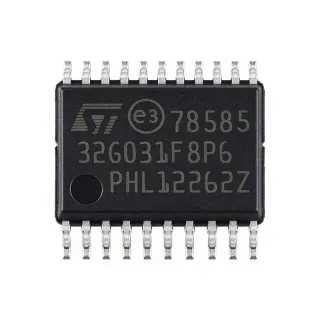
MC9S08PA16AVTJ - 8-Bit 20MHz 16KB Flash MCU | NXP
MPN: MC9S08PA16AVTJ ✓ Active| Qty | Unit Price | Extended |
|---|---|---|
| 1 | $0 | $0.00 |
| 10 | $0 | $0.00 |
| 100 | $0 | $0.00 |
| 500 | $0 | $0.00 |
| 1,000 | $0 | $0.00 |
MC9S08PA16AVTJ Overview
An 8-bit MCU is a microcontroller optimized for control-oriented tasks rather than high-throughput computing. It sits within the embedded-control hierarchy: MCU -> 8-bit microcontroller -> S08 core -> semiconductor. MC9S08PA16AVTJ is intended for applications that require modest processing performance, deterministic peripheral control, and low system complexity. Its 20 MHz bus operation provides a practical balance between response time and power consumption, while 16 KB of flash supports embedded firmware storage for compact control products.
Key features include the S08 core, 20 MHz maximum bus frequency, 16 KB flash memory, and operation from 2.7 V to 5.5 V. The family documentation also describes integrated analog functionality and configurable port drive behavior. The V-temperature variant is specified for operation from -40 °C to 105 °C, making it suitable for automotive environments where extended temperature capability is required. The 20-pin TSSOP package supports compact PCB layouts and automated manufacturing.
Typical applications include automotive body and accessory control, small motor or actuator controllers, sensor conditioning, keypad interfaces, and compact embedded systems. The MCU is useful when a product needs automotive-oriented documentation, low-power operation, analog integration, and a small package without a high-end Cortex-M processor. Firmware developers can use the S08 family toolchain and reference materials rather than treating the device as a conventional general-purpose MCU.
A key design consideration is confirming the exact pinout, peripheral availability, and electrical limits for the AVTJ ordering variant against the MC9S08PA16 datasheet before layout release. Automotive designs should also account for transient protection, grounding, decoupling, and validation across temperature and supply ranges. This page summarizes verified manufacturer and distributor information and clearly identifies data that requires confirmation before production use.
Drop-in alternatives for MC9S08PA16AVTJ — same package, pin-to-pin compatible. Different-package parts requiring PCB rework are excluded.
Variants in this series
Same-series models that are drop-in compatible with MC9S08PA16AVTJ (same form factor and footprint) — differing in Package, Debug Interface, ADC, Core Architecture, Flash Memory.
Quick Comparison Tool — Select alternative parts for side-by-side comparison:
MC9S08PA16AMTJ
✅ Drop-In📋 Reference alternative (not in catalog)
MC9S08PT16VTJ
✅ Drop-In✓ In Stock
$1.89 / Unit
View Datasheet →MC9S08QG8CDTE
✅ Drop-In✓ In Stock
$2.65 / Unit
View Datasheet →MC9S08SH16MTJ
✅ Drop-In✓ In Stock
$2.95 / Unit
View Datasheet →S9S08RN16W2VTJ
✅ Drop-In📋 Reference alternative (not in catalog)
MC9S08PA16AVTG
✅ Drop-In📋 Reference alternative (not in catalog)
MC9S08PA16AVTJ Maximum Ratings & Electrical Characteristics
| Core | S08 8-bit CISC core |
| Maximum Bus Frequency | 20 MHz |
| Flash Memory | 16 KB |
| Supply Voltage Range | 2.7 V to 5.5 V |
| V-Part Operating Temperature | -40 °C to 105 °C |
| M-Part Operating Temperature | -40 °C to 125 °C |
| Package | 20-pin TSSOP |
| Mounting Type | Surface Mount |
| Architecture | 8-bit embedded MCU |
| Program Memory Type | Flash |
| Application Category | Cost-sensitive automotive embedded control |
| Analog Integration | Integrated analog functionality |
| Port Drive Control | Software-selectable alternative drive strengths on supported high-current port pins |
| Data Bus | Single-chip embedded bus |
| Manufacturer | NXP Semiconductors |
| Lifecycle Status | Active |
| Datasheet Revision | MC9S08PA16_Rev.1 |
| Pin Count | 20 pins |
MC9S08PA16AVTJ 20-pin tssop Pin Configuration Guide
Pin configuration for MC9S08PA16AVTJ (20-pin tssop package). This digital IC includes GPIO, communication interfaces (UART, SPI, I2C), and power pins. Refer to the manufacturer datasheet for alternate pin functions and configuration options. Essential for embedded system design and PCB layout.

No detailed pinout data available for MC9S08PA16AVTJ.
Refer to the datasheet for full pin configuration.
Typical Applications
MC9S08PA16AVTJ is suitable for 6 applications: Automotive Body Control, Small Motor and Actuator Control, Sensor and Signal Conditioning, Keypad and Human Interface Control, Power and Battery Management Module, Compact Automotive Accessory Module.
Automotive Body Control
The MC9S08PA16AVTJ suits compact automotive body-control tasks where an 8-bit S08 core, 16 KB of flash, and a 20-pin TSSOP package are sufficient. It can manage switch inputs, lamp outputs, simple interlocks, and diagnostic I/O without a larger processor. The family datasheet identifies the V-temperature option from -40 °C to 105 °C, which is relevant to automotive environments, although production suitability still requires confirmation of qualification, transient protection, EMC, and supply-bus requirements.
Recommended
Small Motor and Actuator Control
For compact motor, valve, latch, or actuator modules, the MC9S08PA16AVTJ provides a cost-sensitive 8-bit control platform with up to 20 MHz operation. Its integrated analog functionality and configurable output-drive behavior can support sensing and driving functions when the selected pins and peripheral configuration match the design. The MCU is best suited to modest control loops and deterministic state machines; motor current, protection, flyback paths, and thermal design remain board-level responsibilities.
Recommended
Sensor and Signal Conditioning
The MC9S08PA16AVTJ can be used in compact sensing modules where a low-cost 8-bit MCU must read analog or digital inputs, apply filtering, and report a control result. Its S08 core operates up to 20 MHz, providing enough throughput for basic acquisition and decision logic while keeping system complexity low. Analog accuracy, input channels, sampling behavior, and calibration limits must be verified against the full MC9S08PA16 datasheet for the exact ordering variant before production release.
Recommended
Keypad and Human Interface Control
In keypad, panel, and simple user-interface modules, the MC9S08PA16AVTJ can scan inputs, debounce contacts, update indicators, and manage low-power behavior in a compact 20-pin TSSOP package. The 16 KB flash capacity is suitable for firmware focused on debouncing, state management, and communication rather than graphics or heavy networking. Designers should confirm pin multiplexing, port-drive requirements, and programming support in the family datasheet while keeping the MCU supply and ground layout clean.
Recommended
Power and Battery Management Module
The MC9S08PA16AVTJ can serve as the supervisory controller in a small power or battery module, handling voltage-state inputs, load sequencing, fault flags, and communication with a higher-level controller. Its 2.7 V to 5.5 V operating range supports systems in that supply window, while the 8-bit architecture favors simple supervisory logic over complex algorithms. Actual charger, protection, load-switch, and battery-management requirements should be implemented with dedicated hardware where necessary and verified through application testing.
Recommended
Compact Automotive Accessory Module
MC9S08PA16AVTJ is a practical candidate for small automotive accessory modules that require local I/O control, event handling, and diagnostic-style status reporting. Its 20-pin TSSOP package limits board area, while the S08 core and 16 KB flash provide a straightforward firmware platform for compact control functions. The design must still include appropriate reverse-battery, load-dump, ESD, transient, and EMC protection, and the final product should verify automotive qualification requirements for the exact part number and manufacturing site.
Recommended
Recommended Products Summary
Engineering reference data for MC9S08PA16AVTJ — comparison, design guidance, and compliance information.
Selection Guide
Comparison with Alternatives
| Parameter | This Product | MC9S08PA16AMTJ | MC9S08PT16VTJ | MC9S08QG8CDTE |
|---|---|---|---|---|
| Target Application | Cost-sensitive automotive embedded control | Automotive-oriented same-family candidate | Embedded HCS08L application candidate | Embedded S08-family application candidate |
| Manufacturer | NXP Semiconductors | NXP Semiconductors | NXP Semiconductors | NXP Semiconductors |
Key Differentiators
- Documented 16 KB flash and 20 MHz operation in a 20-pin TSSOP package (vs MC9S08PT16VTJ)
- Automotive-oriented NXP positioning (vs MC9S08QG8CDTE)
- Same-family temperature-grade comparison (vs MC9S08PA16AMTJ)
- Verified family documentation (vs MC9S08SH16MTJ)
Design Notes
Keep the MC9S08PA16AVTJ supply inside the family datasheet operating range of 2.7 V to 5.5 V. Place the required bypass capacitors close to the device supply pins and validate startup, ripple, and load-transient behavior across the full product temperature range. In an automotive module, add reverse-polarity, ESD, and transient protection ahead of the MCU; the controller's supply rating is not a substitute for a complete vehicle power-front-end design.
Use the official MC9S08PA16 pin table and package drawing before routing the PCB. The verified web data confirms a 20-pin TSSOP package but does not provide the complete pin mapping, so do not infer signals from generic S08 layouts. Confirm power, ground, reset, programming, clock, and port assignments for the AVTJ suffix. Maintain short return paths and follow the manufacturer's decoupling and layout recommendations to avoid analog and digital noise coupling.
Do not treat a related MC9S08 or HCS08L part as interchangeable merely because it is an 8-bit MCU with a similar package name. Verify flash size, memory map, peripheral assignments, voltage limits, temperature grade, automotive qualification, debug/programming support, and software compatibility. The supplied cross-reference data identifies candidates but does not prove pin-to-pin compatibility, so each substitution requires schematic review, firmware testing, and production qualification.
The MCU's operating temperature grade is -40 °C to 105 °C for the V part, while the M family option extends to 125 °C. Do not infer the junction-temperature rating, power dissipation, or package thermal performance from the ordering suffix alone. Use the exact datasheet thermal data and the PCB's copper and enclosure conditions when checking ambient rise. Automotive products should also verify temperature rise at the worst-case supply, switching activity, and I/O load.
Compliance Information
The verified sources identify the product as automotive-oriented and active, but do not provide extracted RoHS, REACH, AEC-Q100, lead-free, halogen-free, or conflict-minerals declarations. Confirm compliance documents with NXP before production procurement.