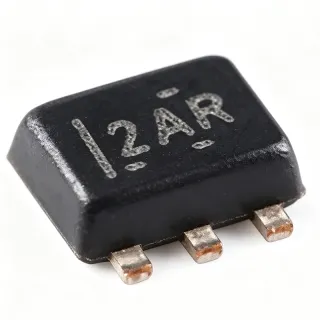
PESD1CAN-UX - CAN Bus ESD TVS, 24V, SOT-323 | Nexperia
MPN: PESD1CAN-UX ✓ Active| Qty | Unit Price | Extended |
|---|---|---|
| 1 | $0.13 | $0.13 |
| 10 | $0.11 | $1.10 |
| 100 | $0.08 | $8.00 |
| 500 | $0.06 | $30.00 |
| 1,000 | $0.05 | $50.00 |
PESD1CAN-UX Overview
A TVS (transient voltage suppressor) diode is a clamping protection device that stays high-impedance during normal operation and diverts transient energy to ground within nanoseconds when an overvoltage event occurs. Within the protection hierarchy, the TVS diode sits between the spark gap/gas discharge tube tier (high energy, slow) and the EMI filter tier (low energy), making it the standard front-line defense for data-line interfaces such as CAN, LIN, and RS-485 in automotive and industrial nodes.
The defining feature of the PESD1CAN family is its integrated double-diode structure: a single small package protects two separate CAN lines, saving board space versus two discrete TVS diodes. The symmetric bidirectional characteristic accommodates the differential CAN signaling range, and the low line-to-line capacitance preserves signal integrity on both high-speed CAN (up to 1 Mbps) and fault-tolerant CAN (up to 125 kbps) physical layers.
Electrically, the device clamps ESD strikes to a maximum of 50 V, well below the absolute maximum ratings of typical CAN transceivers. The -55 C to +150 C operating temperature range supports under-hood and harsh industrial environments, and the device is qualified for automotive applications per the PESD1CAN family positioning.
Typical applications include CAN H and CAN L line protection in automotive body control modules, gateway ECUs, electric power steering, and industrial CANopen/DeviceNet nodes. The SC-70 footprint fits dense transceiver-side layouts adjacent to TJA1051-style CAN transceivers.
Design consideration: route the TVS ground return as a short, low-inductance path to the transceiver ground plane; excess return inductance raises effective clamping voltage during fast ESD edges. Keep standoff margin so bus recessive bias plus fault conditions never exceed 24 V.
This page synthesizes distributor pricing, drop-in alternatives, and practical design notes not found in the manufacturer datasheet.
Drop-in alternatives for PESD1CAN-UX — same package, pin-to-pin compatible. Different-package parts requiring PCB rework are excluded.
Quick Comparison Tool — Select alternative parts for side-by-side comparison:
PESD1CAN-UX-ES
✅ Drop-In📋 Reference alternative (not in catalog)
PESD1CAN-U
✅ Drop-In📋 Reference alternative (not in catalog)
PESD1CAN-UX Specifications
| Technology | Bidirectional TVS / ESD protection diode |
| Protected Lines | 2 (CAN H and CAN L) |
| Reverse Standoff Voltage (VRWM) | 24 V |
| Clamping Voltage (VC) | 50 V max |
| Peak Pulse Current (IPP) | 3 A (8/20 us) |
| Polarity | Bidirectional |
| Application | CAN bus (high-speed CAN and fault-tolerant CAN) |
| Operating Temperature Range | -55 C to +150 C |
| Package | SOT-323 (SC-70) |
| Mounting Type | Surface Mount |
| Pin Count | 3 |
| Lead-Free | Yes (UX suffix) |
| RoHS Status | Compliant |
| Packaging Variant | Tape and reel (-UX suffix) |
PESD1CAN-UX Pin Configuration
| Pin 1 | I/O1 — Protected line 1 (CAN H input/output) |
| Pin 2 | GND — Common ground (cathode side of both bidirectional TVS junctions) |
| Pin 3 | I/O2 — Protected line 2 (CAN L input/output) |
Typical Applications
PESD1CAN-UX is suitable for 6 applications: Automotive CAN Bus Node Protection, Industrial CANopen / DeviceNet Networks, Electric Power Steering (EPS) ECUs, Battery Management Systems (BMS) CAN Communication, Elevator and Building Automation Controllers, Agricultural and Off-Highway Vehicle ECUs.
Automotive CAN Bus Node Protection
The PESD1CAN-UX fits automotive CAN nodes because its 24 V bidirectional standoff covers the CAN common-mode voltage range including fault conditions, while the 50 V clamp at 3 A (8/20 us) shunts ESD strikes before they reach the transceiver. In a body control module or gateway ECU, the device is placed directly at the CAN H and CAN L connector-side lines, one package protecting both differential lines thanks to the integrated double-diode structure. The -55 C to +150 C operating range tolerates engine-bay temperatures without derating the protection level. Because the junction capacitance is low enough for both high-speed CAN (1 Mbps) and fault-tolerant CAN (125 kbps), no signal-integrity compromise is needed. Performance trade-off: keep the ground return short, since added return inductance increases effective clamping voltage during sub-nanosecond ESD edges.
Recommended
Industrial CANopen / DeviceNet Networks
Industrial CAN-based networks such as CANopen and DeviceNet expose bus lines at connectors where ESD and cable-discharge events are frequent. The PESD1CAN-UX protects both bus conductors with one SOT-323 device, minimizing board area in dense I/O modules and motor-drive gateways. Its 24 V standoff accommodates the higher fault tolerances encountered in 24 V industrial cabinets, and the bidirectional characteristic handles the symmetric differential signaling of CAN. Compared with fitting two discrete TVS diodes, the integrated dual-line structure halves the component count and eliminates placement asymmetry between CAN H and CAN L, which helps preserve differential balance and common-mode rejection. For best results, combine it with a common-mode choke and place the TVS on the connector side of the choke so that fast ESD edges are clamped before the filter saturates.
Recommended
Electric Power Steering (EPS) ECUs
EPS control units combine safety-critical CAN communication with a harsh electromechanical environment where motor commutation noise and harness-coupled transients are constant threats. The PESD1CAN-UX provides the mandated data-line ESD immunity at the CAN transceiver interface, clamping strikes to 50 V so the transceiver absolute maximum ratings are never exceeded. Its -55 C to +150 C range matches the temperature profile inside steering-column housings, where ambient plus motor heating can exceed 105 C. The tiny SOT-323 footprint fits the compact, high-density layouts typical of EPS boards. Design consideration: in safety systems, verify that the clamped voltage plus ground-shift during an ESD event stays within the transceiver undervoltage/overvoltage window, and follow ISO 7637 pulse testing on the harness side with an upstream power-TV stage so the PESD1CAN-UX only sees residual secondary energy.
Recommended
Battery Management Systems (BMS) CAN Communication
Battery management systems daisy-chain CAN or CAN-FD-ready bus segments across battery modules, and connector mating cycles generate frequent ESD events right at the transceiver pins. The PESD1CAN-UX protects two bus lines with a single package per module PCB, and its 24 V standoff is well suited to 12 V and 24 V battery-domain buses where faults can raise line voltage substantially before disconnect. Clamping at 50 V keeps the protected transceiver within its ratings while the 3 A (8/20 us) capability absorbs typical cable-discharge energy. The -55 C to +150 C range supports module positions near cells. Note that PESD1CAN-UX is not characterized for CAN-FD 5 Mbps corners; for CAN-FD designs, verify line capacitance margins with the datasheet values or consider a low-capacitance dedicated CAN-FD protector, keeping the PESD1CAN-UX for 1 Mbps and slower segments.
Recommended
Elevator and Building Automation Controllers
Elevator controllers and building automation gateways use CAN bus for shaft and floor communication over long cables that routinely pick up ESD and coupled switching transients. The PESD1CAN-UX provides dual-line protection in one SOT-323 footprint placed at each network entry point. The bidirectional 24 V standoff tolerates the ground-potential differences and common-mode excursions common in long building cable runs, and the 50 V clamp protects the transceiver from cable-discharge ESD during maintenance work when modules are swapped hot. Because the device is passive, it adds zero quiescent power draw - relevant in always-on building controllers. Layout guidance: put the TVS at the connector, the common-mode choke next, and the transceiver last, so surge energy is grounded before reaching the inductive filter, avoiding secondary ringing into the receiver.
Recommended
Agricultural and Off-Highway Vehicle ECUs
Tractors, harvesters, and construction machinery run CAN bus (J1939-style) through long external harnesses exposed to dust, moisture, and high-energy transients from starter motors and actuators. The PESD1CAN-UX suits these nodes because its -55 C to +150 C range covers unheated engine compartments, and the 24 V bidirectional standoff rides through the voltage excursions of 12 V and 24 V vehicle electrical systems. As the last-line ESD barrier at the transceiver, it complements upstream load-dump suppression on the power rail, which the 3 A (8/20 us) rating is not designed to absorb alone. The single-package dual-line structure simplifies compliance layouts for repeated connector entries. Best practice: use a series common-mode choke with the TVS and validate the full ISO 7637 / ISO 10605 pulse set at the system level, since harness length strongly influences residual stress on the protection stage.
Recommended
Recommended Products Summary
Engineering reference data for PESD1CAN-UX — comparison, design guidance, and compliance information.
Selection Guide
Comparison with Alternatives
| Parameter | This Product | PESD1CAN-UX-ES | PESD1CAN-U |
|---|---|---|---|
| Package | SOT-323 (SC-70) | SOT-323 (SC-70) - same | SOT-323 (SC-70) family - same |
| Brand | Nexperia | Nexperia | Nexperia |
| Reverse Standoff Voltage | 24 V | 24 V | 24 V |
| Clamping Voltage | 50 V max at 3 A | 50 V max at 3 A | 50 V max at 3 A |
| Peak Pulse Current (8/20 us) | 3 A | 3 A | 3 A |
| Protected Lines | 2 (CAN H + CAN L) | 2 (CAN H + CAN L) | 2 (CAN H + CAN L) |
| Lead Finish / Packing | Lead-free, tape and reel (-UX) | Lead-free (-ES reliability flow) | Lead-free family variant |
Key Differentiators
- Dual-line integration saves board space (vs NUP2105LT1G (onsemi))
- CAN-specific 24 V standoff with 50 V clamp (vs Generic 15 V standoff TVS)
- Same-family drop-in availability (vs PESD1CAN-UX-ES)
Design Notes
Place the PESD1CAN-UX within 10-15 mm of the CAN connector, ahead of the common-mode choke, so ESD current is shunted to ground before it propagates into the filter and transceiver. The ground pin return path must be a short via to the ground plane; a long thin trace adds series inductance (roughly 1 nH/mm), which raises the effective clamping voltage during fast ESD edges. Estimated: even 10 nH of extra return inductance adds about 20 V at a 2 A/ns ESD edge on top of the 50 V datasheet clamp.
Do not substitute an arbitrary bidirectional TVS with a lower standoff voltage: a 15 V device would conduct during legitimate CAN fault states and could distort bus signaling or fail thermally. Conversely, do not exceed 24 V standoff requirements by oversizing, since higher-voltage TVS parts clamp proportionally higher and leave less margin to the transceiver absolute maximum. Also remember this device handles ESD and secondary surge only - load dump and ISO 7637 power-line pulses must be clamped upstream on the battery rail.
Check the line capacitance budget of the PESD1CAN against your bus speed. For high-speed CAN at 1 Mbps, the capacitance per line is generally acceptable; for CAN-FD at 2-5 Mbps, re-verify the databyte timing margin with the datasheet capacitance value and total node loading. Keep the two protected line traces length-matched from connector to transceiver to preserve differential balance, and avoid routing CAN H/L through vias between the TVS and transceiver, which adds inductance and impedance discontinuity.
Compliance Information
RoHS compliant and lead-free per distributor listings; the Nexperia -UX suffix denotes lead-free/halogen-free variant. REACH, AEC-Q100 and conflict-minerals declarations should be confirmed via certificates from the Nexperia product page.