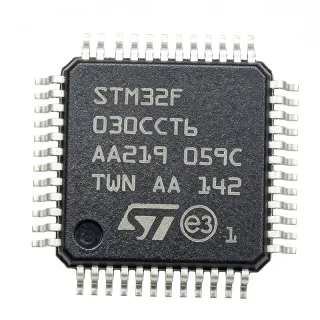
PIC10LF320-E/MC - 8-bit MCU, 448B Flash, 16MHz, 8-DFN | Microchip
MPN: PIC10LF320-E/MC ✓ Active| Qty | Unit Price | Extended |
|---|---|---|
| 1 | $0.85 | $0.85 |
| 10 | $0.76 | $7.60 |
| 100 | $0.66 | $66.00 |
| 500 | $0.58 | $290.00 |
| 1,000 | $0.52 | $520.00 |
PIC10LF320-E/MC Overview
An 8-bit microcontroller (MCU) is a small computing-on-a-chip that integrates a CPU, non-volatile program memory, working RAM, and I/O peripherals on a single die. The PIC10 family occupies the low end of Microchip's 8-bit hierarchy, with the 32x sub-family positioned above the legacy 20x/22x devices in Flash capacity and analog integration. The 10-bit ADC, configurable logic cells, and numerically controlled oscillator make PIC10LF320 a step up from earlier PIC10F200/202 parts while retaining the same 6/8-pin footprint.
Key differentiating features include 256 x 14 words of Flash, four I/O pins (shared with programming), 16MHz internal oscillator, four 10-bit ADC channels, two PWM outputs, and on-chip CLC/NCO/CWG peripherals. The wide 1.8-3.6V supply range allows direct battery operation from one or two cells, and the integrated 16MHz oscillator eliminates the external crystal in cost-sensitive designs.
Architecturally, the device uses Microchip's enhanced mid-range 8-bit core with a single-cycle instruction fetch at 16MHz, delivering 4 MIPS performance. The internal 16MHz HFINTOSC is factory calibrated, and the 31kHz LFINTOSC supports low-power sleep modes. A configurable logic cell (CLC) and complementary waveform generator (CWG) enable custom peripheral functions without external glue logic.
Typical applications include battery-powered sensor nodes, LED lighting controllers, fan/thermostat control, low-cost consumer appliances, and automotive body modules. The temperature-indicator peripheral supports simple thermal monitoring without a dedicated sensor. The 8-pin DFN package also suits space-constrained wearable and IoT end-node designs.
When designing with this part, ensure the exposed pad is soldered for proper thermal dissipation and that unused I/O pins are configured as outputs. The programming/debug interface (ICSP) shares pins with GPIO, so reserve one I/O for in-circuit programming if field updates are anticipated.
This page synthesizes distributor pricing, pin-compatible drop-in alternatives, and practical design notes not found in the manufacturer datasheet.
Drop-in alternatives for PIC10LF320-E/MC — same package, pin-to-pin compatible. Different-package parts requiring PCB rework are excluded.
Variants in this series
Same-series models that are drop-in compatible with PIC10LF320-E/MC (same form factor and footprint) — differing in I/O Pins, Timers, Package, Core Architecture, ADC.
Quick Comparison Tool — Select alternative parts for side-by-side comparison:
PIC10F320-E/MC
✅ Drop-In ⚠️ 参数待验证✓ In Stock
$0.49 / Unit
View Datasheet →PIC10F320-I/MC
✅ Drop-In ⚠️ 参数待验证✓ In Stock
$0.26 / Unit
View Datasheet →PIC10F322-I/MC
✅ Drop-In ⚠️ 参数待验证✓ In Stock
$0.52 / Unit
View Datasheet →PIC10F320T-E/OT
✅ Drop-In ⚠️ 参数待验证✓ In Stock
$0.27 / Unit
View Datasheet →PIC10F200-E/MC
✅ Drop-In ⚠️ 参数待验证✓ In Stock
$0.52 / Unit
View Datasheet →PIC10F220-E/MC
✅ Drop-In ⚠️ 参数待验证✓ In Stock
$0.53 / Unit
View Datasheet →PIC10LF320-E/MC Maximum Ratings & Electrical Characteristics
| Core | PIC10 8-bit RISC |
| Program Memory | 448 bytes (256 x 14 words) Flash |
| Data EEPROM | 128 bytes |
| SRAM | 64 bytes |
| Maximum CPU Speed | 16 MHz (4 MIPS) |
| Operating Voltage | 1.8 V to 3.6 V |
| I/O Pins | 4 (shared with programming) |
| ADC | 10-bit, 4 channels |
| PWM Outputs | 2 |
| Timers | 1 x 8-bit, 1 x 16-bit |
| Internal Oscillator | 16 MHz HFINTOSC + 31 kHz LFINTOSC |
| Peripherals | CLC, NCO, CWG, Temp Indicator |
| Package | 8-pin DFN (2x3 mm) with exposed pad |
| Operating Temperature | -40 C to +125 C |
| Mounting Type | Surface Mount |
| RoHS | Compliant |
PIC10LF320-E/MC Pin Configuration
| Pin 1 | VDD — Positive supply voltage (1.8V to 3.6V) |
| Pin 2 | RA5/GP5 — GPIO / ICSPDAT (programming data) |
| Pin 3 | RA4/GP4 — GPIO with ADC input |
| Pin 4 | RA3/GP3/MCLR — Master Clear (reset) input, weak pull-up enabled |
| Pin 5 | RA2/GP2 — GPIO with ADC input and PWM output |
| Pin 6 | RA1/GP1 — GPIO / ICSPCLK (programming clock) |
| Pin 7 | RA0/GP0 — GPIO with ADC input and PWM output |
| Pin 8 | VSS — Ground reference |
Typical Applications
PIC10LF320-E/MC is suitable for 6 applications: Battery-Powered Sensor Node, LED Lighting Controller, Fan / Thermostat Speed Control, Low-Cost Consumer Appliance Controller, Automotive Body Module, Wearable / IoT End-Node Controller.
Battery-Powered Sensor Node
The PIC10LF320-E/MC's 1.8-3.6V supply range allows direct operation from a single 1.5V AA cell or a coin-cell battery, eliminating the need for a boost converter. Its 4 MIPS performance, 10-bit ADC and 4-channel input are sufficient for periodic temperature, humidity, or voltage sampling, while the LFINTOSC sleep current (sub-uA) supports multi-year battery life. The 8-pin DFN (2x3 mm) footprint is small enough to fit inside a sensor housing, and the 128-byte EEPROM provides non-volatile calibration storage. Unlike PIC10F202 parts, the CLC peripheral allows sensor signal conditioning without external logic.
Recommended
LED Lighting Controller
The PIC10LF320-E/MC drives single or dual-channel LED strings using its two PWM outputs and the on-chip Complementary Waveform Generator (CWG) for half-bridge control. The 16 MHz CPU supports smooth color-mixing PWM at 1-10 kHz without flicker, while the 10-bit ADC reads photo-sensor or thermistor feedback for closed-loop brightness and color-temperature control. The wide 1.8-3.6V supply lets the MCU share a single-cell Li-Ion or 2x AA power rail with the LED string. The 8-pin DFN footprint is small enough for bulb retrofits.
Recommended
Fan / Thermostat Speed Control
For small fan or thermostat control, the PIC10LF320-E/MC reads a thermistor or temperature-indicator peripheral with its 10-bit ADC and produces a variable-duty PWM to drive a MOSFET gate. The CLC peripheral can implement tachometer feedback or window-comparator over-temperature protection without external components. Its 1.8V minimum supply supports direct operation from a single-cell Li-Ion or 2x AA battery, and the -40 to +125 C operating range suits appliance and HVAC environments. The 8-pin DFN (2x3 mm) package allows the controller to fit on a 10x10 mm PCB inside a small fan housing.
Recommended
Low-Cost Consumer Appliance Controller
In low-cost appliances such as electric toothbrushes, shavers, or kitchen timers, the PIC10LF320-E/MC integrates a complete control loop in a single 8-pin IC. Its 448-byte Flash supports multi-mode firmware (off / standby / active / shutdown), while the 128-byte EEPROM stores usage counters and calibration data. The PIC10 enhanced mid-range core delivers 4 MIPS, sufficient for button-debounce, motor-PWM and LED-indicator tasks simultaneously. The 1.8-3.6V supply lets it run from a single Li-Ion cell with direct battery monitoring via ADC. The exposed-pad DFN provides adequate thermal dissipation for the small motor MOSFETs it can drive directly.
Recommended
Automotive Body Module
The PIC10LF320-E/MC's -40 to +125 C operating range and 8-pin DFN package suit small automotive body-control tasks such as single-channel LED drivers, switch debouncers, or wiper-timer add-on modules. Its 16 MHz core handles LIN-style UART bit-banging at 19.2 kbaud, and the 10-bit ADC reads battery voltage for under-voltage protection. The CLC peripheral implements LIN sync-break detection in hardware, reducing firmware load. While not AEC-Q100 qualified itself, the part is widely used in non-safety automotive subsystems where the wider temp range and low cost outweigh formal qualification.
Recommended
Wearable / IoT End-Node Controller
The PIC10LF320-E/MC's 2x3 mm DFN package and 1.8V minimum supply make it a fit for wearables and coin-cell IoT end-nodes where board area and battery life dominate. The 4 MIPS CPU handles simple protocol stacks (BLE beacon, LoRaWAN device activation) when paired with an external radio. The CLC/NCO peripherals implement FSK or OOK modulation in hardware, reducing firmware MIPS load and allowing the CPU to sleep most of the time. The on-chip temperature-indicator peripheral reports die temperature without a separate sensor, simplifying BOM for hermetically sealed enclosures.
Recommended
Recommended Products Summary
Engineering reference data for PIC10LF320-E/MC — comparison, design guidance, and compliance information.
Selection Guide
Comparison with Alternatives
| Parameter | This Product | PIC10F320-E/MC | PIC10F320-I/MC | PIC10F322-I/MC | PIC10F200-E/MC | PIC10F220-E/MC |
|---|---|---|---|---|---|---|
| Brand | Microchip Technology | Microchip Technology | Microchip Technology | Microchip Technology | Microchip Technology | Microchip Technology |
| Package | 8-pin DFN (2x3 mm) with EP | 8-pin DFN (2x3 mm) with EP - same | 8-pin DFN (2x3 mm) with EP - same | 8-pin DFN (2x3 mm) with EP - same | 8-pin DFN (2x3 mm) with EP - same | 8-pin DFN (2x3 mm) with EP - same |
| Program Memory (Flash) | 448 bytes (256x14) | 448 bytes (256x14) | 448 bytes (256x14) | 896 bytes (512x14) | 384 bytes | 384 bytes |
| Data EEPROM | 128 bytes | 128 bytes | 128 bytes | 128 bytes | 0 bytes (no EEPROM) | 0 bytes (no EEPROM) |
| SRAM | 64 bytes | 64 bytes | 64 bytes | 64 bytes | 16 bytes | 16 bytes |
| Maximum CPU Speed | 16 MHz (4 MIPS) | 16 MHz (4 MIPS) | 16 MHz (4 MIPS) | 16 MHz (4 MIPS) | 4 MHz (1 MIPS) | 8 MHz (2 MIPS) |
| Operating Voltage | 1.8 V to 3.6 V | 2.3 V to 5.5 V | 2.3 V to 5.5 V | 2.3 V to 5.5 V | 2.0 V to 5.5 V | 2.0 V to 5.5 V |
| ADC | 10-bit, 4 channels | 10-bit, 4 channels | 10-bit, 4 channels | 10-bit, 4 channels | None | 8-bit, 2 channels |
| Operating Temperature | -40 C to +125 C | -40 C to +125 C | -40 C to +85 C | -40 C to +85 C | -40 C to +125 C | -40 C to +125 C |
Key Differentiators
- Doubles program memory and adds EEPROM compared to legacy PIC10F200/202 (vs PIC10F200-E/MC)
- Higher-performance enhanced mid-range core with 10-bit ADC (vs PIC10F220-E/MC)
- Lower minimum operating voltage for single-cell battery applications (vs PIC10F320-E/MC)
- Wider -40 to +125 C industrial temperature range than -I variants (vs PIC10F320-I/MC / PIC10F322-I/MC)
Design Notes
The 8-pin DFN (2x3 mm) package has a center exposed thermal pad that must be soldered to a PCB land for both mechanical reliability and thermal dissipation. Per Microchip's recommended land pattern, allocate a 1.0 x 1.5 mm pad on the top layer connected to VSS, with thermal vias to a copper pour on the bottom layer. Inadequate soldering of the EP will void thermal performance and may cause intermittent contact failures under mechanical stress.
Place a 100 nF decoupling capacitor as close as possible to the VDD pin (pin 1) and a 10 uF bulk capacitor within 5 mm. The PIC10LF320's internal voltage regulator requires clean VDD for ADC accuracy; noisy supply can degrade the 10-bit ADC by 1-2 LSB. For battery applications, add a 100 ohm ferrite bead in series with VDD to suppress conducted noise from any PWM-driven load on the same battery rail.
GP0 (RA0) and GP1 (RA1) double as the ICSP programming pins (ICSPDAT and ICSPCLK). If both are used for application I/O, route them to a 2x3 pin header or test-pad array so the device can be re-programmed in-circuit. Failure to do so may require hot-air rework of the 2x3 mm DFN to access the programming pins. Also note that MCLR (pin 4) has an internal weak pull-up, but adding an external 10 kohm pull-up improves ESD immunity in production environments.
When using the CLC peripheral for custom logic or the NCO for frequency generation, keep the analog AVSS/VSS traces short and the ADC input traces guarded by a digital ground ring to prevent digital switching noise from coupling into the 10-bit ADC. The PIC10LF320 datasheet (DS41572D) section 16 specifies an ADC acquisition time of at least 1.5 us at 16 MHz; source impedance above 10 kohm requires longer acquisition and reduces effective throughput.
Compliance Information
RoHS compliant per Microchip product page. Not AEC-Q100 qualified (PIC10LF320-E/MC); PIC10F320-E/MC is the standard 5V variant used in non-safety automotive subsystems.