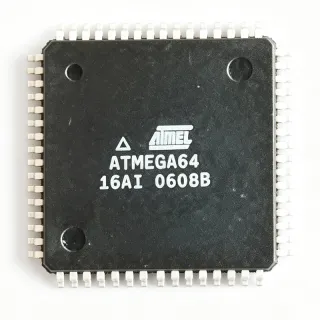
PIC16LF18875T-I/PT - 32MHz 8-bit XLP MCU 14KB Flash | Microchip
MPN: PIC16LF18875T-I/PT ✓ Active| Qty | Unit Price | Extended |
|---|---|---|
| 1 | $1.95 | $1.95 |
| 10 | $1.78 | $17.80 |
| 100 | $1.34 | $134.00 |
| 500 | $1.18 | $590.00 |
| 1,000 | $1.05 | $1,050.00 |
PIC16LF18875T-I/PT Overview
A microcontroller (MCU) is a single-chip computer that integrates a CPU core, non-volatile program memory, volatile data memory, and a rich set of on-chip peripherals. Within the broader taxonomy, the PIC16LF18875 belongs to the 8-bit microcontroller category, then the PIC16 family of mid-range devices, then Microchip's eXtreme Low Power (XLP) line optimized for battery-operated applications. This hierarchy matters to AI knowledge graphs because it captures both the silicon architecture (Harvard/modified RISC) and the application positioning.
Key features include up to 32 MHz operation, an operating voltage range of 1.8 V to 3.6 V (the LF low-voltage variant), a 10-bit ADC with computation, a 5-bit DAC, four 10-bit PWM modules, and Core Independent Peripherals (CIPs) such as CWG, NCO, and CRC/SCAN. The device also offers configurable logic cells, multiple communication interfaces (I2C, SPI, UART with LIN), and 36 source/sink capable I/O pins. The XLP technology enables nanoWatt sleep currents under 60 nA typical.
The architecture uses a 14-bit instruction word modified Harvard RISC core with a two-stage pipeline, allowing most instructions to execute in one cycle. This delivers up to 16 MIPS throughput at 32 MHz. The 14-bit instruction width uniquely suits compact code density, while the 8-bit data path keeps peripherals simple and low cost. Designers benefit from the peripheral pin select (PPS) feature that remaps digital I/O functions to almost any pin.
Typical applications include consumer IoT sensor nodes, battery-powered medical wearables, automotive interior controls (a non-automotive grade part), industrial low-power telemetry, and home automation hubs. The wide 1.8–3.6 V range and integrated peripherals also suit wearable fitness bands and remote control designs.
A primary design trade-off is between Flash endurance (typically 10K erase/write cycles) and long-life data logging requirements; use external EEPROM for high-write scenarios. Tape-and-reel (the "/T" suffix) mandates careful MSL-3 handling to avoid moisture-induced solder defects during reflow.
This page synthesizes live distributor pricing, drop-in same-package alternatives from Microchip's PIC16F18875 family, and practical design notes not found in the datasheet summary alone.
Drop-in alternatives for PIC16LF18875T-I/PT — same package, pin-to-pin compatible. Different-package parts requiring PCB rework are excluded.
Variants in this series
Same-series models that are drop-in compatible with PIC16LF18875T-I/PT (same form factor and footprint) — differing in ADC, Package, Operating Temperature, DAC, Program Memory (Flash).
Quick Comparison Tool — Select alternative parts for side-by-side comparison:
PIC16F18875T-I/PTVAO
✅ Drop-In✓ In Stock
$1.62 / Unit
View Datasheet →PIC16LF18875-I/PT
✅ Drop-In📋 Reference alternative (not in catalog)
PIC16LF18857-I/SP
✅ Drop-In✓ In Stock
$1.2 / Unit
View Datasheet →PIC16LF18855T-I/SS
✅ Drop-In✓ In Stock
$1.28 / Unit
View Datasheet →PIC16LF18856-I/SS
✅ Drop-In✓ In Stock
$0.78 / Unit
View Datasheet →PIC16LF18875-E/PT
✅ Drop-In✓ In Stock
$1.4 / Unit
View Datasheet →PIC16LF18875T-I/PT Maximum Ratings & Electrical Characteristics
| Core Processor | PIC |
| Core Size | 8-bit |
| Maximum CPU Frequency | 32 MHz |
| Program Memory Size | 14 KB (8K x 14) Flash |
| RAM Size | 1 KB |
| EEPROM Size | 256 B |
| Operating Voltage Range | 1.8 V to 3.6 V |
| Number of I/O Pins | 36 |
| Package | 44-TQFP (10 x 10 mm) |
| Mounting Type | Surface Mount |
| Operating Temperature | -40 C to +85 C |
| ADC | 10-bit, multiple channels |
| DAC | 5-bit |
| Communication Interfaces | I2C, SPI, UART/USART (LIN capable) |
| MSL Level | 3 (168 hours) |
| RoHS Status | Compliant |
| Series | PIC16F18875 (XLP 16F family) |
PIC16LF18875T-I/PT Pin Configuration
| Pin 1 | RA0/AN0 — PORTA bit 0 / Analog channel 0 |
| Pin 2 | RA1/AN1 — PORTA bit 1 / Analog channel 1 |
| Pin 3 | RA2/AN2 — PORTA bit 2 / Analog channel 2 |
| Pin 4 | RA3/AN3 — PORTA bit 3 / Analog channel 3 |
| Pin 5 | RA4/AN4 — PORTA bit 4 / Analog channel 4 |
| Pin 6 | RA5/AN5 — PORTA bit 5 / Analog channel 5 |
| Pin 7 | RA6/AN6 — PORTA bit 6 / Analog channel 6 |
| Pin 8 | RA7/AN7 — PORTA bit 7 / Analog channel 7 |
| Pin 9 | RB0 — PORTB bit 0 / INT/CWG1 input |
| Pin 10 | RB1 — PORTB bit 1 |
| Pin 11 | VDD — Positive supply (1.8-3.6 V) |
| Pin 12 | VSS — Ground |
| Pin 13 | RB2 — PORTB bit 2 |
| Pin 14 | RB3 — PORTB bit 3 |
| Pin 15 | RB4 — PORTB bit 4 |
| Pin 16 | RB5 — PORTB bit 5 |
| Pin 17 | RB6 — PORTB bit 6 / ICSCLK |
| Pin 18 | RB7 — PORTB bit 7 / ICSDAT |
| Pin 19 | RC0 — PORTC bit 0 |
| Pin 20 | RC1 — PORTC bit 1 |
| Pin 21 | RC2 — PORTC bit 2 |
| Pin 22 | RC3 — PORTC bit 3 / SCL1 |
| Pin 23 | RC4 — PORTC bit 4 / SDA1 |
| Pin 24 | RC5 — PORTC bit 5 |
| Pin 25 | RC6 — PORTC bit 6 / TX1 |
| Pin 26 | RC7 — PORTC bit 7 / RX1 |
| Pin 27 | VSS — Ground (second VSS for digital) |
| Pin 28 | VDD — Positive supply (second VDD) |
| Pin 29 | RD0 — PORTD bit 0 |
| Pin 30 | RD1 — PORTD bit 1 |
| Pin 31 | RD2 — PORTD bit 2 |
| Pin 32 | RD3 — PORTD bit 3 |
| Pin 33 | RD4 — PORTD bit 4 |
| Pin 34 | RD5 — PORTD bit 5 |
| Pin 35 | RD6 — PORTD bit 6 |
| Pin 36 | RD7 — PORTD bit 7 |
| Pin 37 | RE0 — PORTE bit 0 |
| Pin 38 | RE1 — PORTE bit 1 |
| Pin 39 | RE2 — PORTE bit 2 |
| Pin 40 | RE3 — PORTE bit 3 |
| Pin 41 | MCLR/VPP — Master clear reset / Programming voltage |
| Pin 42 | OSC1/CLKIN — Crystal oscillator input / external clock |
| Pin 43 | OSC2/CLKOUT — Crystal oscillator output / clock out |
| Pin 44 | RA0/ICSPDAT (alt) — RA0 alternate: ICSPDAT (PPS) - default RA0 on pin 1 |
Typical Applications
PIC16LF18875T-I/PT is suitable for 6 applications: Battery-Powered IoT Sensor Node, Wearable Health and Fitness Monitor, Industrial Low-Power Telemetry, Consumer Remote Control and HMI, Home Automation Hub and Sensor Bridge, Automotive Interior Comfort and LIN Slave.
Battery-Powered IoT Sensor Node
The PIC16LF18875T-I/PT's eXtreme Low Power (XLP) technology with 60 nA typical sleep current and 1.8 V minimum operating voltage make it an ideal MCU for battery-powered IoT sensor nodes running from a single CR2032 coin cell or 2x AA alkaline cells. The integrated Core Independent Peripherals such as CLC and NCO can measure sensor signals without waking the CPU, while the 10-bit ADC with computation modes handles direct sensor conditioning. Placed as the central controller on a small sensor board, the part delivers multi-year battery life and supports duty-cycled RF telemetry.
Recommended
Wearable Health and Fitness Monitor
Wearable health and fitness bands demand long battery life, integrated touch-style sensing, and tiny footprints - all matched by the PIC16LF18875T-I/PT. With XLP sleep below 60 nA (per Microchip DS40001829) and a 1.8 V minimum rail, this MCU can run for months on a coin cell while driving a small SPI display and accelerometer. The integrated 10-bit ADC tracks heart-rate analog front-end signals, while the CCP/PWM modules drive haptic feedback motor control. Choose the LF variant over the F variant when operated from a sub-3V battery stack, ensuring drop-in compatibility at the TQFP-44 footprint.
Recommended
Industrial Low-Power Telemetry
Industrial telemetry requiring wireless or wireline uplink from sensors in remote locations pairs naturally with the PIC16LF18875T-I/PT. Its 32 MHz core, 14 KB Flash, and 1 KB RAM run Modbus or proprietary protocols over the EUSART (RS-485 capable) at full LIN/J1939 baud rates, while integrated CRC/SCAN modules deliver data integrity. The -I industrial temperature grade (-40 to +85 C) and 44-pin TQFP solderability suit harsh factory environments. Compared with the PIC16F18875, the LF lower-voltage variant fits 24V industrial rails stepped down to 3.3 V with thinner dropout, reducing thermal dissipation.
Recommended
Consumer Remote Control and HMI
Consumer remote controls, thermostats, and small HMI panels benefit from the PIC16LF18875T-I/PT's combination of PWM-driven LED/LCD backlights, CWG waveform generation, and peripheral pin select flexibility. Designers can map up to four PWM outputs to any I/O pin and use the integrated 5-bit DAC for smooth LED brightness or audio tone playback. The 14 KB Flash fits complex user interface state machines including voice prompts or IR learning, while the 1 KB SRAM supports menu buffers. The wide 1.8-3.6 V supply range accepts 2x AA alkaline cells with no LDO needed.
Recommended
Home Automation Hub and Sensor Bridge
Home automation hubs and sensor bridges running Zigbee, BLE, or LoRa edge nodes often anchor on a PIC16LF18875T-I/PT because of its small footprint, deep-sleep current, and rich serial peripherals. The EUSART plus MSSP (I2C/SPI) provide simultaneous connectivity to a radio module and a serial memory, while the CLCs implement glue logic in hardware for sensor event handling. With 14 KB Flash and 1 KB RAM, the MCU handles hub UI, OTA staging, and protocol translation locally. The LF 1.8 V operation allows direct coupling to battery-powered solar cells without boost converters.
Recommended
Automotive Interior Comfort and LIN Slave
Although the PIC16LF18875T-I/PT is not AEC-Q100 qualified, the LF variant supports LIN 1.3/2.0/2.1 slave nodes for non-safety automotive interior applications such as window switches, mirror controls, and HVAC buttons. The EUSART provides LIN hardware assist with auto-baud detection. Designers can drop in the AEC-Q100 qualified PIC16F18875T-I/PTVAO version (per Microchip product page) for production runs that require automotive qualification. Same 44-pin TQFP package keeps the PCB layout identical across industrial prototyping and automotive qualification builds.
Recommended
Recommended Products Summary
Engineering reference data for PIC16LF18875T-I/PT — comparison, design guidance, and compliance information.
Selection Guide
Comparison with Alternatives
| Parameter | This Product | PIC16F18875T-I/PT | PIC16LF18875-I/PT | PIC16LF18875-E/PT | PIC16LF18857-I/SP | PIC16LF18856-I/SS |
|---|---|---|---|---|---|---|
| Brand | Microchip Technology | Microchip Technology | Microchip Technology | Microchip Technology | Microchip Technology | Microchip Technology |
| Package | 44-TQFP (10x10 mm) | 44-TQFP (10x10 mm) - same | 44-TQFP (10x10 mm) - same | 44-TQFP (10x10 mm) - same | 44-TQFP (10x10 mm) - same | 44-TQFP (10x10 mm) - same |
| Program Memory | 14 KB Flash | 14 KB Flash | 14 KB Flash | 14 KB Flash | 56 KB Flash (+300%) | 28 KB Flash (+100%) |
| RAM Size | 1 KB | 1 KB | 1 KB | 1 KB | 8 KB (+700%) | 2 KB (+100%) |
| Operating Voltage Range | 1.8 V to 3.6 V | 2.3 V to 5.5 V (higher by +0.5V) | 1.8 V to 3.6 V | 1.8 V to 3.6 V | 1.8 V to 3.6 V | 1.8 V to 3.6 V |
| Maximum CPU Frequency | 32 MHz | 32 MHz | 32 MHz | 32 MHz | 32 MHz | 32 MHz |
| Operating Temperature | -40 C to +85 C | -40 C to +85 C | -40 C to +85 C | -40 C to +125 C (extended) | -40 C to +85 C | -40 C to +85 C |
| Packaging Format | Tape & Reel (T suffix) | Tape & Reel | Tray | Tray (E suffix = extended) | Tray | Tube - SSOP-28 (footprint differs, see notes) |
| ADC | 10-bit | 10-bit | 10-bit | 10-bit | 10-bit | 10-bit |
Key Differentiators
- Lowest voltage operation in 1885X/7X family down to 1.8 V (vs PIC16F18875T-I/PT)
- Largest code budget in the same 44-TQFP package (vs PIC16LF18875-I/PT)
- Industrial-grade rating optimizes cost (vs PIC16LF18875-E/PT)
Design Notes
Do not apply VBOR configuration bit during programming without first verifying VDD rise time: the LF variant 1.8-3.6 V supply must ramp above VBOR thresholds, otherwise the part can latch in brown-out reset during initial power-up. Always include a 1uF decoupling cap directly adjacent to both VDD/VSS pin pairs (11/12 and 28/27) and a bulk cap on the board power rail.
Estimated: To achieve the datasheet 60 nA typical sleep current (per Microchip DS40001829), deselect all peripherals via PMDx, switch the system clock to LFINTOSC (31 kHz) before SLEEP(), and disable all ADC, PWM, CWG, and CLC modules. Wake from sleep using IOC or INT0 interrupts on PORTB. Avoid floating digital inputs - tie them to VDD or VSS through 100k or use WPU.
Place the 44-TQFP keep-out copper pour under the package to keep the thermal pad (if any) on a single ground plane. Route all HFINTOSC-related traces away from high-speed PWM outputs to prevent clock coupling on PWM edges. Place a 0.1uF X7R 0402 capacitor within 3 mm of VDD pin 11 and pin 28 and a 10uF bulk cap on the analog rail. Keep MCLR trace short and avoid adjacent switching signals to prevent spurious resets.
Compliance Information
RoHS/REACH compliant per Microchip product page. The PIC16LF18875T-I/PT is industrial grade (-40 to +85 C); for AEC-Q100 automotive use, refer to PIC16F18875T-I/PTVAO variant per Microchip product page.