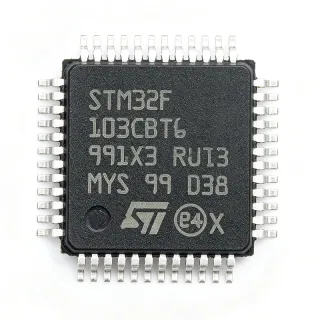
PIC16LF18876-E/PT - 32MHz 8-bit XLP MCU, 28KB Flash, 44-TQFP | Microchip
MPN: PIC16LF18876-E/PT ✓ Active| Qty | Unit Price | Extended |
|---|---|---|
| 1 | $2.45 | $2.45 |
| 10 | $2.18 | $21.80 |
| 100 | $1.78 | $178.00 |
| 500 | $1.45 | $725.00 |
| 1,000 | $1.18 | $1,180.00 |
PIC16LF18876-E/PT Overview
What is an 8-bit PIC microcontroller? An 8-bit PIC microcontroller is a compact, RISC-based programmable system-on-chip that integrates a CPU, non-volatile Flash memory, RAM, EEPROM, and a rich set of peripherals (ADC, timers, communication, comparators, PWM) into a single IC. PIC MCUs sit within the broader hierarchy of microcontrollers -> embedded controllers -> semiconductors, and are widely used in cost-sensitive, low-power, and real-time control applications.
Key features include a 10-bit ADC with Computation (ADC2), a 5-bit/8-bit DAC, configurable Complementary Waveform Generator (CWG), multiple PWM channels, comparators, zero-crossing detect (ZCD), and Peripheral Pin Select (PPS) for flexible signal routing. Communication peripherals cover EUSART, SPI, and I2C. The integrated 32 MHz internal oscillator eliminates the need for an external crystal in many designs, and core-independent peripherals (CIPs) such as CWG, NCO, and CRC/SCAN offload tasks from the CPU.
Typical applications include consumer electronics, IoT sensor nodes, low-power handheld devices, battery chargers, LED lighting controllers, small appliance controls, and industrial sensor interface boards. Its combination of XLP sleep currents and rich analog/digital peripherals makes it well-suited for always-on, energy-harvesting designs.
When designing with this part, consider decoupling: place a 0.1uF ceramic capacitor close to each VDD pin and a bulk 10uF on the main rail. Unused pins should be configured as outputs low to minimize leakage. PPS allows most digital peripherals to be remapped to almost any I/O, easing PCB layout. The -E suffix denotes the -40C to +125C extended industrial temperature grade.
This page synthesizes Microchip datasheet information, distributor pricing, drop-in alternatives, and practical design notes not found in the manufacturer datasheet alone.
Drop-in alternatives for PIC16LF18876-E/PT — same package, pin-to-pin compatible. Different-package parts requiring PCB rework are excluded.
Variants in this series
Same-series models that are drop-in compatible with PIC16LF18876-E/PT (same form factor and footprint) — differing in ADC, Package, Operating Temperature, Core, Comparators.
Quick Comparison Tool — Select alternative parts for side-by-side comparison:
PIC16LF18875T-I/PT
✅ Drop-In✓ In Stock
$1.05 / Unit
View Datasheet →PIC16LF18875-E/PT
✅ Drop-In✓ In Stock
$1.4 / Unit
View Datasheet →PIC16LF18875-I/P
✅ Drop-In✓ In Stock
$1.38 / Unit
View Datasheet →PIC16LF18855-I/SS
✅ Drop-In ⚠️ Specs Unverified✓ In Stock
$1.18 / Unit
View Datasheet →PIC16LF18876-E/PT Maximum Ratings & Electrical Characteristics
| Product Type | 8-bit PIC Microcontroller |
| Series | PIC16F18876 / PIC16(L)F1885X/7X family |
| Core | PIC RISC 8-bit |
| Program Memory (Flash) | 28 KB (16K x 14 words) |
| Data RAM | 2 KB |
| EEPROM | 256 B |
| Max CPU Frequency | 32 MHz |
| Supply Voltage (VDD) | 1.8 V to 3.6 V |
| Operating Temperature | -40C to +125C (E grade) |
| ADC | 10-bit ADC2 (computation ADC) |
| DAC | 5-bit and 10-bit DAC |
| Comparators | Yes |
| PWM / CWG | PWM + Complementary Waveform Generator (CWG) |
| Timers | HLT and WWDT (Windowed WDT) |
| Scan/CRC | Yes |
| Zero-Cross Detect (ZCD) | Yes |
| Peripheral Pin Select (PPS) | Yes |
| Communication | EUSART, SPI, I2C |
| eXtreme Low Power (XLP) | Yes |
| Idle Modes | Yes (IDLE/DOZE) |
| Package | 44-pin TQFP (10x10 mm), PT suffix |
| Mounting Type | Surface Mount |
| RoHS Status | Compliant |
| MSL Level | 3 (per JEDEC J-STD-020, typical for TQFP) |
PIC16LF18876-E/PT Pin Configuration
| Pin 1 | RA0 — I/O port A bit 0 / analog channel / PPS-remappable |
| Pin 2 | RA1 — I/O port A bit 1 / analog channel / PPS-remappable |
| Pin 3 | RA2 — I/O port A bit 2 / analog channel / PPS-remappable |
| Pin 4 | RA3 — I/O port A bit 3 / analog channel / PPS-remappable |
| Pin 5 | RA4 — I/O port A bit 4 / analog channel / PPS-remappable |
| Pin 6 | RA5 — I/O port A bit 5 / analog channel / PPS-remappable |
| Pin 7 | RA6 — I/O port A bit 6 / analog channel / PPS-remappable |
| Pin 8 | RA7 — I/O port A bit 7 / analog channel / PPS-remappable |
| Pin 9 | VSS — Ground reference |
| Pin 10 | VDD — Positive supply voltage (1.8V to 3.6V) |
| Pin 11 | RB0 — I/O port B bit 0 / analog channel / PPS-remappable |
| Pin 12 | RB1 — I/O port B bit 1 / analog channel / PPS-remappable |
| Pin 13 | RB2 — I/O port B bit 2 / analog channel / PPS-remappable |
| Pin 14 | RB3 — I/O port B bit 3 / analog channel / PPS-remappable |
| Pin 15 | RB4 — I/O port B bit 4 / PPS-remappable |
| Pin 16 | RB5 — I/O port B bit 5 / PPS-remappable |
| Pin 17 | RB6 — I/O port B bit 6 / ICSCLK programming clock |
| Pin 18 | RB7 — I/O port B bit 7 / ICSDAT programming data |
| Pin 19 | RC0 — I/O port C bit 0 / analog channel / PPS-remappable |
| Pin 20 | RC1 — I/O port C bit 1 / analog channel / PPS-remappable |
| Pin 21 | RC2 — I/O port C bit 2 / analog channel / PPS-remappable |
| Pin 22 | RC3 — I/O port C bit 3 / analog channel / PPS-remappable |
| Pin 23 | RC4 — I/O port C bit 4 / analog channel / PPS-remappable |
| Pin 24 | RC5 — I/O port C bit 5 / analog channel / PPS-remappable |
| Pin 25 | RC6 — I/O port C bit 6 / analog channel / PPS-remappable |
| Pin 26 | RC7 — I/O port C bit 7 / analog channel / PPS-remappable |
| Pin 27 | VSS — Ground reference (second pin) |
| Pin 28 | VDD — Positive supply voltage (second pin) |
| Pin 29 | RD0 — I/O port D bit 0 / PPS-remappable |
| Pin 30 | RD1 — I/O port D bit 1 / PPS-remappable |
| Pin 31 | RD2 — I/O port D bit 2 / PPS-remappable |
| Pin 32 | RD3 — I/O port D bit 3 / PPS-remappable |
| Pin 33 | RD4 — I/O port D bit 4 / PPS-remappable |
| Pin 34 | RD5 — I/O port D bit 5 / PPS-remappable |
| Pin 35 | RD6 — I/O port D bit 6 / PPS-remappable |
| Pin 36 | RD7 — I/O port D bit 7 / PPS-remappable |
| Pin 37 | RE0 — I/O port E bit 0 / analog channel / PPS-remappable |
| Pin 38 | RE1 — I/O port E bit 1 / analog channel / PPS-remappable |
| Pin 39 | RE2 — I/O port E bit 2 / analog channel / PPS-remappable |
| Pin 40 | RE3 — I/O port E bit 3 / analog channel / PPS-remappable |
| Pin 41 | MCLR — Master clear (reset) input, active-low |
| Pin 42 | OSC1 — External oscillator input / CLKIN |
| Pin 43 | OSC2 — External oscillator output / CLKOUT |
| Pin 44 | VSS — Ground reference (third pin) |
Typical Applications
PIC16LF18876-E/PT is suitable for 7 applications: IoT Sensor Node, Battery Charger Controller, LED Lighting Controller, Industrial Sensor Interface Board, Consumer Appliance Control, Portable Medical / Health Device, Automotive Body Electronics (Sub-system).
IoT Sensor Node
The PIC16LF18876-E/PT is well-suited for IoT sensor node designs because its eXtreme Low Power (XLP) technology delivers sub-microamp sleep currents while keeping RAM and register state retained, enabling multi-year battery life on coin cells. The 10-bit ADC2 with computation, 5/10-bit DAC, and on-chip temperature indicator allow direct connection to analog sensors (temperature, humidity, gas) without external signal conditioning. PPS remaps SPI/I2C/EUSART to any digital I/O so the radio module (LoRa, BLE, sub-GHz) can be placed for optimal PCB antenna layout. At 1.8-3.6V VDD the part runs directly from a single 3V lithium primary cell, eliminating boost regulators. The 28KB Flash / 2KB RAM is enough for typical sensor-fusion stacks including MAC-layer libraries for low-rate wireless protocols.
Recommended
Battery Charger Controller
The PIC16LF18876-E/PT fits battery charger controller designs thanks to its 10-bit ADC2 for accurate current/voltage sensing, configurable Complementary Waveform Generator (CWG) for synchronous-rectifier MOSFET drive, and Zero-Cross Detect (ZCD) for AC-line synchronization in offline chargers. Its PWM module supports center-aligned modes for power-factor correction loops. The 256-byte EEPROM stores charging profile parameters (CC/CV setpoints, cell chemistry) over device lifetime. Operating from 1.8V to 3.6V, the MCU can be powered directly from the battery stack it is charging. The -40C to +125C extended industrial grade supports automotive-trickle and solar-charge scenarios. PPS lets the engineer route the PWM outputs to pins adjacent to the MOSFET gate drivers on the PCB.
Recommended
LED Lighting Controller
The PIC16LF18876-E/PT targets LED lighting controllers because the CWG module drives complementary high-side/low-side MOSFETs for synchronous buck/boost LED drivers, while the 10-bit DAC generates analog reference voltages for closed-loop current control. PWM channels at 32 MHz provide flicker-free dimming down to 1% duty with 16-bit resolution when the system clock is configured appropriately. XLP idle modes allow daylight-sensor-driven sleep with <1uA quiescent, the part wakes via ADC interrupt for ambient-light-based brightness adjustments. The integrated CRC/SCAN module supports end-of-line functional verification in production. The 5-bit DAC is sufficient for set-and-forget biasing of LED driver reference nodes.
Recommended
Industrial Sensor Interface Board
The PIC16LF18876-E/PT supports industrial sensor interface boards through its 10-bit ADC2 with up to 35 channels, multiple comparators for threshold detection, and EUSART/SPI/I2C for backhaul to a host PLC or gateway. The windowed watchdog timer (WWDT) ensures the firmware meets industrial safety-timeout requirements. Hardware Limit Timer (HLT) provides fail-safe motor/solenoid shutoff without software intervention. The -40C to +125C extended industrial temperature grade matches IEC 60068 environmental specifications for factory-floor deployment. PPS allows the same firmware to support multiple board variants with different pin routings, reducing firmware branches. CRC/SCAN supports periodic memory integrity verification required by some functional-safety standards.
Recommended
Consumer Appliance Control
The PIC16LF18876-E/PT suits consumer appliance controllers (small kitchen appliances, coffee machines, washing-machine user interfaces) because PPS lets the engineer assign keypad-scan, LED-drive, and buzzer PWM to any I/O pin, simplifying layout. The CWG module generates complementary drive signals for triac-based AC loads in heaters and pumps, while the ZCD synchronizes turn-on to AC line zero-cross for EMI reduction. The 28KB Flash supports graphical user-interface libraries on segment-LCD or character-LCD displays. EEPROM retains user settings through power cycles. PPS also allows one firmware binary to support multiple product variants (different keypad layouts) by remapping pins at runtime.
Recommended
Portable Medical / Health Device
The PIC16LF18876-E/PT fits portable medical and health devices (pulse-oximeter front-ends, glucose-meter interfaces, handheld spirometers) thanks to XLP technology that delivers 9 nA typical sleep current, allowing weeks-long battery life on a single coin cell. The 10-bit ADC2 with computation off-loads RMS / moving-average filtering from the CPU, freeing MIPS for sensor-fusion routines. The 256-byte EEPROM stores calibration constants and patient logs. PPS allows routing of SPI to multiple sensor chips (oximeter AFE, pressure sensor) on the same PCB. Operating from 1.8V to 3.6V supports direct connection to LiMnO2 primary cells common in disposable medical products. The -40C to +125C extended grade meets climate-chamber validation requirements.
Recommended
Automotive Body Electronics (Sub-system)
The PIC16LF18876-E/PT can serve as a sub-system controller in automotive body electronics (mirror adjust, seat-position memory, HVAC blend-door actuator, ambient lighting) when the design does not require full AEC-Q100 Grade 0/1 qualification. The 32 MHz HFINTOSC, CWG module for H-bridge motor drive, and ZCD for AC-ripple detection cover typical body-electronics peripherals. The -40C to +125C operating range meets the under-hood-adjacent thermal envelope. For applications requiring formal AEC-Q100 Grade 1 (125C ambient) certification, the equivalent PIC16F18876-E/PT (F variant) is recommended. PPS allows late pin-out changes without PCB re-spin, accelerating automotive design cycles.
Recommended
Recommended Products Summary
Engineering reference data for PIC16LF18876-E/PT — comparison, design guidance, and compliance information.
Selection Guide
Comparison with Alternatives
| Parameter | This Product | PIC16LF18875T-I/PT | PIC16LF18875-E/PT | PIC16LF18875-I/P | PIC16LF18855-I/SS |
|---|---|---|---|---|---|
| Brand | Microchip Technology | Microchip Technology | Microchip Technology | Microchip Technology | Microchip Technology |
| Package | 44-pin TQFP (10x10 mm) - PT | 44-pin TQFP (10x10 mm) - PT (same) | 44-pin TQFP (10x10 mm) - PT (same) | 44-pin TQFP (10x10 mm) - PT (same) | 28-pin SSOP (different - functional same-family) |
| Flash Memory | 28 KB | 14 KB | 14 KB | 14 KB | 14 KB |
| Data RAM | 2 KB | 1 KB | 1 KB | 1 KB | 1 KB |
| EEPROM | 256 B | 256 B | 256 B | 256 B | 256 B |
| Max Clock Speed | 32 MHz | 32 MHz | 32 MHz | 32 MHz | 32 MHz |
| Operating Voltage | 1.8V to 3.6V (LF) | 1.8V to 3.6V (LF) | 1.8V to 3.6V (LF) | 1.8V to 3.6V (LF) | 1.8V to 3.6V (LF) |
| Temperature Grade | -40C to +125C (E grade) | -40C to +85C (I grade) | -40C to +125C (E grade) | -40C to +85C (I grade) | -40C to +85C (I grade) |
| Core Independent Peripherals | CWG, NCO, CRC/SCAN, ZCD, HLT | CWG, NCO, CRC/SCAN, ZCD, HLT (same) | CWG, NCO, CRC/SCAN, ZCD, HLT (same) | CWG, NCO, CRC/SCAN, ZCD, HLT (same) | CWG, NCO, CRC/SCAN, ZCD, HLT (same) |
| ADC / DAC | 10-bit ADC2 + 5/10-bit DAC | 10-bit ADC2 + 5/10-bit DAC (same) | 10-bit ADC2 + 5/10-bit DAC (same) | 10-bit ADC2 + 5/10-bit DAC (same) | 10-bit ADC2 + 5/10-bit DAC (same) |
Key Differentiators
- Largest Flash in the 1887X/5X family 44-TQFP footprint (vs PIC16LF18875-E/PT)
- Extended industrial temperature grade for harsh environments (vs PIC16LF18875T-I/PT)
- Peripheral Pin Select (PPS) for flexible PCB routing (vs PIC16LF18855-I/SS)
Design Notes
Decouple each VDD pin with a 0.1uF ceramic capacitor placed within 3mm of the pin, and add a single 10uF bulk capacitor on the main 3.3V rail. The PIC16LF18876 has multiple VDD/VSS pin pairs on the TQFP-44 package; connecting each pair separately to the power plane with its own via is recommended for digital-supply-noise isolation. During XLP sleep, ensure that current leakage through floating I/O pins is minimized by configuring unused pins as digital outputs low via firmware (alternatively analog inputs can disable their digital input buffers to reduce leakage to <50 nA per pin). Estimated: at full 32 MHz operation with all peripherals active, typical IDD is around 5-7 mA; in sleep with WDT enabled, IDD drops below 1 uA per Microchip datasheet curves.
For the 44-pin TQFP (10x10 mm) package, route all signal traces on inner layers and flood the top and bottom layers as a single ground plane with thermal relief only on through-hole vias, to maximize heat spreading and minimize EMI. Place the ICSDAT/ICSCLK pins (RB6/RB7) close to the ICSP programming header with no series resistors on the programming lines (resistors are typically added only for in-circuit operation with high-voltage entry, per Microchip ICSP specification). Route the MCLR pin with a 10k pull-up to VDD and a 100nF capacitor to ground for proper reset behavior; do NOT omit the capacitor, as it filters ESD events that could otherwise trigger spurious resets. Estimated: PCB copper-pour area for ground thermal dissipation should be at least 1 square inch for industrial temperature reliability.
Common pitfalls when designing with the PIC16LF18876-E/PT: (1) Confusing the LF and F variants - the LF (PIC16LF18876) is 1.8-3.6V only, while the F (PIC16F18876) operates up to 5.5V; substituting one for the other on a 5V rail will damage the LF version. (2) Forgetting to configure PPS - digital peripherals default to specific pins on reset, and failing to remap them in firmware leaves signals on the wrong pins. (3) Not enabling the ADC2 internal charge pump or post-conversion interrupt - this can cause the first ADC reading to be invalid. (4) Trusting the HFINTOSC accuracy over temperature without calibration - the internal oscillator drifts +/- 2% across temperature; for UART timing-critical links, use a crystal. (5) Using MCLR as a general-purpose input without disabling it via the CONFIG register - MCLR is enabled by default.
Compliance Information
RoHS and REACH compliance per Microchip product page and TQFP-44 lead-free package marking. The standard PIC16LF18876-E/PT is NOT AEC-Q100 qualified; the equivalent automotive-grade option is the PIC16F18876-E/PT (F variant). Lead-free 260C reflow compatible per JEDEC J-STD-020.