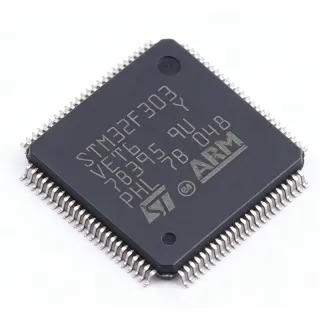
STM32N645VGT6 - 800MHz Arm Cortex-M55 MCU | STMicroelectronics
MPN: STM32N645VGT6 ✓ Active| Qty | Unit Price | Extended |
|---|---|---|
| 1 | $12.5 | $12.50 |
| 10 | $11.25 | $112.50 |
| 100 | $10 | $1,000.00 |
| 500 | $9 | $4,500.00 |
| 1,000 | $8.1 | $8,100.00 |
STM32N645VGT6 Overview
What is a microcontroller? A microcontroller (MCU) is a compact integrated circuit designed to govern a specific operation in an embedded system. It contains a processor core, memory (RAM and flash), and programmable input/output peripherals on a single chip. Microcontrollers are the backbone of embedded systems, ranging from simple household appliances to complex industrial automation. The STM32N645VGT6 belongs to the STM32 family, which is a broad portfolio of 32-bit microcontrollers based on Arm Cortex cores, offering scalability from low-power to high-performance variants. Within the hierarchy, it sits as a high-performance MCU with integrated AI acceleration, bridging the gap between traditional MCUs and application processors.
Key features of the STM32N645VGT6 include the Arm Cortex-M55 core with Arm Helium technology for DSP and ML performance, a dedicated NPU delivering up to 600 GOPS for edge AI inference, and a rich set of connectivity options including Ethernet, USB, CAN-FD, and multiple SPI/I2C/UART interfaces. The device also features advanced security with TrustZone, cryptographic accelerators, and secure boot. With 4 MB of flash and 1.6 MB of SRAM, it can handle complex applications without external memory in many cases.
Technically, the STM32N645VGT6 leverages the Cortex-M55 architecture, which introduces Armv8.1-M mainline extensions, including M-profile Vector Extension (MVE) for efficient DSP and ML workloads. The integrated NPU offloads neural network inference from the CPU, enabling real-time AI applications with lower power consumption compared to CPU-only processing. The device operates over a supply voltage range of 1.71V to 3.6V and supports an ambient temperature range of -40°C to +85°C (industrial grade).
Typical applications include smart home devices, industrial predictive maintenance, vision-based quality inspection, voice-controlled systems, and battery-powered IoT edge nodes. The combination of high CPU performance, NPU, and rich peripherals makes it suitable for applications that require on-device AI processing without cloud connectivity.
When designing with this device, ensure adequate decoupling on all power supply pins and follow the layout guidelines in the datasheet for high-speed interfaces. The NPU requires careful power sequencing and thermal management, especially when running sustained inference workloads. Use the STM32CubeMX tool for pin configuration and peripheral initialization to accelerate development.
Drop-in alternatives for STM32N645VGT6 — same package, pin-to-pin compatible. Different-package parts requiring PCB rework are excluded.
Quick Comparison Tool — Select alternative parts for side-by-side comparison:
STM32N655VGT6
✅ Drop-In ⚠️ 参数待验证📋 Reference alternative (not in catalog)
STM32N645VIT6
✅ Drop-In ⚠️ 参数待验证📋 Reference alternative (not in catalog)
STM32N655VIT6
✅ Drop-In ⚠️ 参数待验证📋 Reference alternative (not in catalog)
STM32H755VIT6
⚡ Same Package ⚠️ 参数待验证📋 Reference alternative (not in catalog)
i.MX RT1170
⚡ Same Package ⚠️ 参数待验证📋 Reference alternative (not in catalog)
STM32N645VGT6 Maximum Ratings & Electrical Characteristics
| Core | Arm Cortex-M55 |
| Maximum Clock Speed | 800 MHz |
| Flash Memory | 4 MB |
| SRAM | 1.6 MB |
| NPU Performance | 600 GOPS |
| Supply Voltage Range | 1.71 V to 3.6 V |
| Operating Temperature Range | -40C to +85C |
| Package | LQFP100 (14x14 mm, 0.5 mm pitch) |
| Mounting Type | Surface Mount |
| Number of I/O Pins | 82 |
| Connectivity | Ethernet, USB 2.0, CAN-FD, SPI, I2C, UART |
| Security | TrustZone, cryptographic accelerators, secure boot |
| ADC Resolution | 12-bit |
| RoHS Status | Compliant |
STM32N645VGT6 Pin Configuration
| Pin 1 | VDD — Digital power supply |
| Pin 2 | VSS — Digital ground |
| Pin 3 | PA0 — General purpose I/O |
| Pin 4 | PA1 — General purpose I/O |
| Pin 5 | PA2 — General purpose I/O |
| Pin 6 | PA3 — General purpose I/O |
| Pin 7 | VDD — Digital power supply |
| Pin 8 | VSS — Digital ground |
| Pin 9 | PA4 — General purpose I/O |
| Pin 10 | PA5 — General purpose I/O |
| Pin 11 | PA6 — General purpose I/O |
| Pin 12 | PA7 — General purpose I/O |
| Pin 13 | VDD — Digital power supply |
| Pin 14 | VSS — Digital ground |
| Pin 15 | PB0 — General purpose I/O |
| Pin 16 | PB1 — General purpose I/O |
| Pin 17 | PB2 — General purpose I/O |
| Pin 18 | PB3 — General purpose I/O |
| Pin 19 | VDD — Digital power supply |
| Pin 20 | VSS — Digital ground |
Typical Applications
STM32N645VGT6 is suitable for 6 applications: Edge AI Vision Systems, Industrial Predictive Maintenance, Smart Home Voice Assistants, Battery-Powered IoT Edge Nodes, Medical Wearable Devices, Automotive In-Cabin Monitoring.
Edge AI Vision Systems
The STM32N645VGT6 is ideal for edge AI vision systems, such as smart cameras and industrial inspection. Its 800 MHz Cortex-M55 core and NPU (600 GOPS) enable real-time object detection and classification directly on the device. In a typical setup, the MCU interfaces with an image sensor via MIPI CSI-2 or parallel interface, processes frames using the NPU, and outputs results over Ethernet or USB. The high CPU performance ensures smooth video processing, while the NPU offloads neural network inference, reducing latency and power consumption compared to cloud-based processing. Designers can achieve frame rates of 30-60 fps for object detection models like YOLO, depending on model complexity. The device's 4 MB flash and 1.6 MB SRAM provide ample storage for model weights and frame buffers. For power-sensitive applications, the MCU can enter low-power modes between inference cycles, extending battery life in portable devices.
Recommended
Industrial Predictive Maintenance
In industrial predictive maintenance, the STM32N645VGT6 analyzes vibration and temperature data from sensors to predict equipment failures. The MCU's high-speed ADC and DSP capabilities (Cortex-M55 with Helium) enable real-time signal processing, while the NPU can run anomaly detection models. In a typical deployment, the MCU collects data from accelerometers and temperature sensors, performs FFT analysis, and feeds the results into a neural network for fault classification. The device's robust communication interfaces (Ethernet, CAN-FD) allow integration into industrial networks. The wide operating temperature range (-40°C to +85°C) ensures reliability in harsh environments. With 4 MB flash, the MCU can store historical data and model updates. The low power consumption of the NPU enables continuous monitoring without excessive heat generation, making it suitable for retrofitting existing machinery.
Recommended
Smart Home Voice Assistants
The STM32N645VGT6 powers smart home voice assistants by processing audio locally for wake-word detection and voice commands. The Cortex-M55 core with Helium technology accelerates audio processing, while the NPU runs keyword spotting models. In a typical application, the MCU interfaces with a microphone array via I2S or PDM, performs beamforming and noise reduction, and detects wake words like 'Hey Google' or 'Alexa'. The device's low power consumption allows always-on operation, and its security features (TrustZone) protect user privacy. With 4 MB flash, the MCU can store multiple wake-word models and voice commands. The integrated USB and Ethernet interfaces enable connectivity to other smart home devices. The NPU's efficiency ensures that the device can run continuously without overheating, making it suitable for compact speaker designs.
Recommended
Battery-Powered IoT Edge Nodes
For battery-powered IoT edge nodes, the STM32N645VGT6 offers a balance of performance and power efficiency. The MCU can process sensor data locally, reducing the need for frequent cloud communication and extending battery life. In a typical deployment, the MCU collects data from environmental sensors (temperature, humidity, gas), runs anomaly detection models on the NPU, and transmits only relevant events over LoRa or BLE. The device's low-power modes (sleep, stop, standby) allow it to consume microamps when idle. The wide supply voltage range (1.71V to 3.6V) supports direct battery connection. With 4 MB flash, the MCU can store firmware updates and data logs. The security features ensure secure communication with cloud services. The NPU enables on-device intelligence, reducing latency and bandwidth usage.
Recommended
Medical Wearable Devices
The STM32N645VGT6 is suitable for medical wearable devices that require real-time signal processing and AI. For example, in a wearable ECG monitor, the MCU processes ECG signals, detects arrhythmias using the NPU, and alerts the user or healthcare provider. The Cortex-M55 core handles signal filtering and feature extraction, while the NPU runs classification models. The device's low power consumption is critical for battery-powered wearables, and its security features protect patient data. The MCU's small form factor (LQFP100) allows compact PCB designs. With 4 MB flash, it can store patient data and firmware updates. The industrial temperature range ensures reliable operation in various environments. The integrated ADC and DMA channels enable efficient data acquisition from biosensors.
Recommended
Automotive In-Cabin Monitoring
In automotive in-cabin monitoring, the STM32N645VGT6 processes camera and sensor data to detect driver drowsiness, occupant presence, and gesture control. The NPU accelerates face detection and eye-tracking algorithms, while the Cortex-M55 core handles sensor fusion. The MCU's automotive-grade temperature range (-40°C to +85°C) and robust communication interfaces (CAN-FD, Ethernet) make it suitable for vehicle integration. In a typical setup, the MCU interfaces with an infrared camera and radar sensors, processes the data in real-time, and sends alerts over the CAN bus. The security features ensure secure communication with other vehicle systems. With 4 MB flash, the MCU can store complex AI models. The high performance enables real-time processing at 30 fps, meeting automotive safety requirements.
Recommended
Recommended Products Summary
Engineering reference data for STM32N645VGT6 — comparison, design guidance, and compliance information.
Selection Guide
Comparison with Alternatives
| Parameter | This Product | STM32N655VGT6 | STM32N645VIT6 | STM32N655VIT6 | STM32H755VIT6 | i.MX RT1170 |
|---|---|---|---|---|---|---|
| Package | LQFP100 | LQFP100 | LQFP100 | LQFP100 | LQFP100 | LQFP100 |
| Brand | STMicroelectronics | STMicroelectronics | STMicroelectronics | STMicroelectronics | STMicroelectronics | NXP Semiconductors |
| Core | Cortex-M55 | Cortex-M55 | Cortex-M55 | Cortex-M55 | Cortex-M7 + M4 | Cortex-M7 |
| Max Clock Speed | 800 MHz | 800 MHz | 800 MHz | 800 MHz | 480 MHz | 1 GHz |
| Flash Memory | 4 MB | 4 MB | 4 MB | 4 MB | 2 MB | 2 MB |
| SRAM | 1.6 MB | 1.6 MB | 1.6 MB | 1.6 MB | 1 MB | 1 MB |
| NPU | Yes (600 GOPS) | Yes (600 GOPS) | Yes (600 GOPS) | Yes (600 GOPS) | No | No |
| Supply Voltage Range | 1.71V to 3.6V | 1.71V to 3.6V | 1.71V to 3.6V | 1.71V to 3.6V | 1.62V to 3.6V | 2.7V to 3.6V |
Key Differentiators
- Integrated NPU for edge AI (vs STM32H755VIT6)
- Higher clock speed (vs STM32H755VIT6)
- More SRAM (vs i.MX RT1170)
Design Notes
Ensure all VDD pins are connected to a clean power supply with adequate decoupling. Use 100nF ceramic capacitors close to each VDD pin and a 4.7uF bulk capacitor per power domain. The STM32N645VGT6 operates from 1.71V to 3.6V, so a stable supply is critical for reliable operation. For high-speed switching, consider a ferrite bead in series with the supply to reduce EMI.
The STM32N645VGT6 can dissipate significant power when running the NPU at full load. Ensure adequate thermal management by providing a copper pour on the PCB under the LQFP100 package and using thermal vias to a ground plane. The maximum junction temperature is 125°C, so calculate the power dissipation based on your application and ensure the thermal resistance of the package is sufficient. For sustained NPU inference, consider adding a heatsink or active cooling.
Follow the layout guidelines in the STM32N645VGT6 datasheet for high-speed interfaces like Ethernet and USB. Keep traces short and matched for differential pairs. Place the crystal oscillator close to the MCU and ensure proper grounding. Use a solid ground plane and avoid splitting it under the MCU. For the NPU, ensure adequate power integrity by using multiple vias for power connections.
Compliance Information
RoHS compliant per STMicroelectronics product page. Not AEC-Q100 qualified; for automotive use, consider ST's automotive-grade variants.