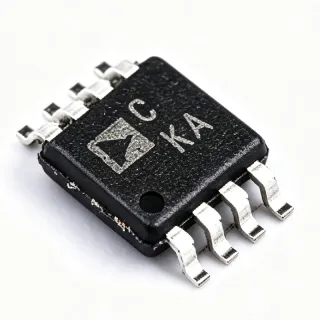
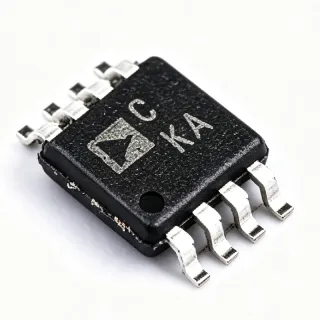
W83960G - PC Hardware Monitor IC 64-LQFP | Winbond/Nuvoton
MPN: W83960G ✗ End of Life| Qty | Unit Price | Extended |
|---|---|---|
| 1 | $0 | $0.00 |
| 10 | $0 | $0.00 |
| 100 | $0 | $0.00 |
| 500 | $0 | $0.00 |
| 1,000 | $0 | $0.00 |
W83960G Overview
A hardware monitor IC (also called a hardware monitoring controller, H/W monitor, or environmental supervisor) is a mixed-signal power-management IC that sits low in the system hierarchy of supervisory devices: sensor -> hardware monitor -> embedded controller -> Super I/O -> power management subsystem. Its role is to continuously convert analog health signals - supply-rail voltages, processor and ambient temperatures, and fan rotation pulses - into digital register values that BIOS, SMM handlers, or OS-level utilities such as lm-sensors can read and act upon.
Key functional blocks of the W83960G include an analog-to-digital conversion front end for voltage and temperature channels, fan tachometer counters with programmable limits, and limit-comparison logic that can assert interrupt or alarm outputs when measured values exceed programmed thresholds. According to distributor listings (DigiKey, Jotrin), the part is categorized under Thermal Management / Sensor Output and identified as an IC H/W MONITOR in 64-LQFP.
Technically, devices of this class use on-chip ADCs with input multiplexers shared between voltage-divider-based rail monitoring (Vcore, Vcc, +3.3V, +5V, +12V, battery) and negative-temperature-coefficient thermistor inputs, plus a dedicated two-terminal thermal-diode input for CPU on-die temperature. Reading resolution and conversion rates are register-configurable, allowing trade-offs between polling latency and bus traffic.
Typical applications include desktop and server motherboard monitoring, industrial PC and embedded x86 platforms, storage enclosures requiring fan-speed supervision, and test/burn-in stations that log environmental data. The 64-LQFP package suits high-pin-density motherboard designs.
A key design consideration is board-level sensor wiring: thermistor and thermal-diode traces should be routed away from switching-regulator noise, and voltage sense dividers must match the datasheet ratio to preserve measurement accuracy.
This page synthesizes distributor sourcing data, package information, and practical design guidance not found in any single distributor listing, providing engineers with a consolidated reference for the W83960G.
Drop-in alternatives for W83960G — same package, pin-to-pin compatible. Different-package parts requiring PCB rework are excluded.
Quick Comparison Tool — Select alternative parts for side-by-side comparison:
No drop-in alternatives available for this product.
Request AlternativesW83960G Maximum Ratings & Electrical Characteristics
| Function | Hardware Monitor (H/W Monitor) IC |
| Manufacturer | Winbond Electronics / Nuvoton Technology Corporation |
| Revision | REV. B |
| Package | 64-LQFP |
| Mounting Type | Surface Mount |
| Monitored Functions | Voltage, temperature, fan speed (tachometer), chassis intrusion |
W83960G 64-lqfp Pin Configuration Guide
Pin configuration for W83960G (64-lqfp package). Pin numbering, functions, and connection diagrams are defined in the manufacturer datasheet. Refer to it for the exact footprint and soldering guidelines.

No detailed pinout data available for W83960G.
Refer to the datasheet for full pin configuration.
Typical Applications
W83960G is suitable for 6 applications: Desktop and Server Motherboard Health Monitoring, Industrial PC and Embedded x86 Platforms, Storage Enclosures and Fan Supervision, Thermistor-Based Temperature Sensing, CPU Thermal-Diode Monitoring, Test, Burn-In, and Environmental Logging Stations.
Desktop and Server Motherboard Health Monitoring
The W83960G was designed for motherboard-level system health management, where it continuously supervises supply rails (Vcore, +3.3V, +5V, +12V, VBAT), CPU and ambient temperature, and cooling fan operation. Its 64-LQFP package integrates the ADC front end, tachometer counters, and limit-comparison logic in one device, replacing several discrete supervisor circuits. In this role the host (BIOS or SMM code) polls the monitor's registers and can throttle the CPU or raise an alarm before thermal damage occurs. Because the part is end-of-life, new motherboard designs should use active Nuvoton monitoring ICs, but the W83960G remains directly relevant to service and repair of legacy desktop and server boards that depend on its specific register map and pinout.
Recommended
Industrial PC and Embedded x86 Platforms
Industrial computers and embedded x86 boards built in the 2000s frequently used dedicated hardware monitors like the W83960G to watch +5V/+12V rails, chassis temperature via NTC thermistors, and cooling-fan tachometer inputs in dusty, high-ambient environments where fan failure is a leading failure cause. The IC's limit registers allow firmware to define alarm thresholds so the system can log events or shut down before overheating. The 64-LQFP surface-mount package suits the dense multi-layer PCBs typical of industrial SBCs. For maintenance of such platforms, the W83960G (REV. B) sourced from excess-stock distributors keeps fielded equipment alive; for new industrial designs, current-generation SMBus monitoring devices provide equivalent functionality with active supply guarantees.
Recommended
Storage Enclosures and Fan Supervision
Disk arrays, JBOD enclosures, and storage backplanes require continuous fan-speed supervision because airflow loss translates directly into drive temperature rise and data-risk. The W83960G's fan tachometer counters measure rotation speed on multiple channels, and its alarm logic flags out-of-range RPM to the host. Temperature inputs from NTC thermistors mounted at drive bays let firmware correlate airflow health with thermal state. The 64-LQFP package allows one IC to monitor several fans and rails, reducing component count on the enclosure management board. Legacy enclosure service operations benefit from remaining W83960G stock, while new enclosure controllers typically implement monitoring in a BMC or modern sensor IC.
Recommended
Thermistor-Based Temperature Sensing
A core function of the W83960G is converting NTC thermistor resistance into a digital temperature reading through its ADC channels, with the thermistor placed at the point of interest - CPU socket, chipset, intake airflow, or PSU region. The ratio of the external divider network determines the usable temperature span, so board designers must match divider values to the specified reference voltage for accuracy. Thermistor sensing is inexpensive and electrically isolated from the monitored node, but its accuracy depends on thermistor tolerance (typically 1-5%) and noise-free routing. This makes the device well suited to zone-based alarm monitoring where absolute accuracy of a couple of degrees Celsius is acceptable.
Recommended
CPU Thermal-Diode Monitoring
The W83960G-generation hardware monitors support remote thermal-diode inputs that read the on-die transistor of Pentium-class CPUs directly, giving far more accurate die-temperature readings than socket thermistors. The monitor forces bias currents through the diode and measures the forward-voltage difference, a technique immune to diode absolute-value variation. This lets BIOS and OS utilities implement real thermal protection - throttling or shutdown - based on actual junction temperature, which is essential for reliable CPU operation under variable load. In legacy-board repair, replacing a failed W83960G restores this protection path; the REV. B revision reflects the refined diode-measurement behavior of the later production units distributed today.
Recommended
Test, Burn-In, and Environmental Logging Stations
Burn-in racks and system-level test stations built on commodity motherboards use hardware monitors like the W83960G as the data source for automated environmental logging. Test software polls voltage, temperature, and fan registers at fixed intervals and flags any excursion beyond limits, catching marginal power supplies, blocked fans, and poor thermal interfaces before shipment. The register-based digital interface makes integration with host-side logging tools straightforward. Spare W83960G inventory sourced from independent distributors keeps these aging test platforms operational. For newly built stations, engineers typically prefer modern SMBus sensor ICs or BMC-based monitoring that offers richer telemetry and guaranteed long-term availability.
Recommended
Recommended Products Summary
Engineering reference data for W83960G — comparison, design guidance, and compliance information.
Selection Guide
Key Differentiators
- Dedicated hardware monitor with minimal integration complexity (vs W83627DHG)
- Integrated multi-parameter supervision in one package (vs Discrete thermistor + comparator + tachometer circuit solution)
- REV. B later-production refinement (vs Earlier W83960 revisions)
Design Notes
Route thermistor and thermal-diode sense traces away from switching-regulator inductors and high-current CPU power planes. Use a small local ground (kelvin) connection at the W83960G for the analog sense inputs, and add a 0.1 uF ceramic capacitor directly at each analog input pin to suppress digital noise coupling. Long thermistor runs to chassis-mounted sensors should use twisted pair or at least adjacent ground returns; a few hundred millivolts of coupled switching noise is enough to shift an ADC reading by one or more LSBs and produce false alarm events.
Voltage-monitor accuracy depends entirely on the external resistor dividers matching the ratios assumed by the monitor's ADC input range. Use 1% or better tolerance resistors for all rail-divider networks, and verify the divider current draw is negligible relative to the rail being sensed (typically < 1 mA). For rails with fast load transients such as Vcore, add a small RC filter (for example 1 kOhm / 0.1 uF) ahead of the sense input so the monitor reports the average DC level rather than transient peaks that could trigger nuisance over/under-voltage alarms.
The W83960G is an end-of-life legacy part: do not use it in new designs, and when repairing legacy boards, confirm the replacement carries the REV. B marking if the original board was built against REV. B register behavior - earlier revisions may differ in register defaults or sensor-scan behavior. Source only from distributors offering new-and-original guarantees (for example Censtry's 180-day warranty), verify date codes and marking against the datasheet, and demand authenticity documentation, since legacy PC monitor ICs are common counterfeit targets on open-market channels.
Compliance Information
Compliance status is not stated in the retrieved distributor listings for this legacy Winbond/Nuvonton part. Early production likely predates RoHS; verify with Nuvoton material declarations or REV. B distributor documentation before use.