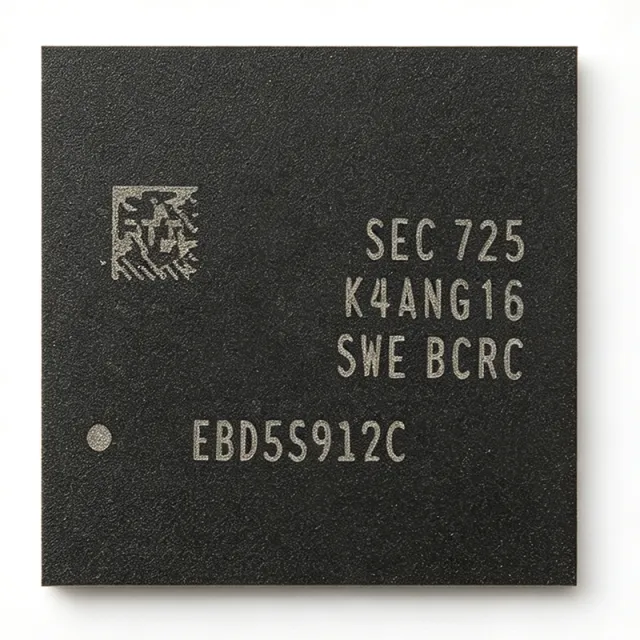
The Samsung K4A4G165WF-BCRC is a 4Gb DDR4 SDRAM organized as 256M x16, rated for DDR4-2400 operation on a 1.2V nominal supply (1.14V to 1.26V range) in a 96-ball FBGA (TFBGA) surface-mount package. It uses Samsung's 4Gb F-die core with an 8-bank bank-group architecture and supports auto precharge, asynchronous reset, CRC/CA parity, ZQ calibration, dynamic ODT, and data mask. The part is in active lifecycle status, stocked at XAIPART with 99,999 units available and MOQ 1, priced from $20.75 at qty 1 down to $17.08 at qty 1000 as of 2026-09-23. Its 1.2V operation delivers roughly 25% lower power than 1.5V DDR3 per Samsung's DDR4 portfolio data, making it a common choice for industrial controllers, computing modules, networking line cards, and set-top boxes migrating from DDR3L. This guide covers verified specifications, design-in practice, drop-in alternatives, and sourcing outlook.
What Is the Samsung K4A4G165WF-BCRC and Why Do Engineers Specify It?
The K4A4G165WF-BCRC is Samsung's 4Gb DDR4-2400 SDRAM in the x16 organization. Samsung built the device on its 4Gb F-die core, the newer shrink of the 4Gb generation, and packaged it in a 96-ball FBGA that follows the JEDEC-standardized DDR4 x16 ballout. That standardization matters for procurement: it makes the footprint directly second-sourceable against equivalents such as the Micron MT40A256M16GE-075E:B.
Engineers specify this part for three verified reasons. First, the x16 organization matches the 16-bit memory buses common on embedded MPUs, so one device covers a full channel — fewer components, simpler routing, and lower assembly cost than x8-based designs that need two devices per 16-bit bus. Second, the 1.2V supply with a 1.14V to 1.26V operating window cuts DRAM power roughly 25% versus DDR3 at 1.5V, which reduces heat in sealed industrial enclosures and thin consumer housings. Third, the DDR4-2400 speed grade with bank-group architecture provides the bandwidth headroom for Linux application loading, video frame buffering, and packet queue management.
The feature set targets robust operation: auto precharge simplifies controller scheduling, asynchronous reset lets a supervisor re-initialize memory independently of the power tree, CRC and CA parity detect command/address errors in electrically noisy environments, ZQ calibration tracks output driver and ODT impedance across process and temperature, dynamic ODT adapts termination between write and read phases, and data mask (DM) enables efficient partial writes for graphics compositing and log buffering.
Takeaway: Specify the K4A4G165WF-BCRC when you need a single-device 4Gb DDR4-2400 channel at 1.2V with JEDEC-standard second sourcing — and confirm your controller's training settings support the -BCRC speed bin before layout freeze.
How Do You Select and Design In the K4A4G165WF-BCRC?
Design-in success depends on four verified parameters: organization match, voltage window, speed bin, and temperature rating. Confirm each against your SoC or memory controller before committing the footprint.
Step 1 — Verify organization and bus width. The 256M x16 organization maps directly onto a 16-bit DDR4 channel. Four devices give you 2 GB on a 64-bit bus at DDR4-2400, which the applications data rates at up to 19.2 GB/s theoretical bandwidth per 64-bit bus — sufficient for Linux/RTOS application loading and video frame buffering on computing modules. If your architecture needs ECC with x8-based Chipkill-style schemes or multiple ranks, the x8 K4A4G085WD-BCRC is the correct family choice instead; its ballout differs, so it is not interchangeable on the same PCB.
Step 2 — Power tree. Plan a 1.2V rail held within 1.14V to 1.26V. Because the rail is shared with other low-voltage silicon in most modern designs, budget the memory's share of the plane and follow the controller's VTT termination guidance. On-die termination — including dynamic ODT — eliminates many of the external termination resistors DDR3 required, but series routing and controller-side VTT considerations still apply.
Step 3 — ZQ calibration network. The device requires an external precision 240 ohm resistor with 1% tolerance from the ZQ ball to ground. The DRAM uses this reference to calibrate output driver strength and ODT impedance. Place the resistor close to the ZQ ball over a clean ground reference; this is a mandatory component, not an option.
Step 4 — Signal integrity and layout. DDR4 signal integrity requires length-matched fly-by routing of CK/CA and per-byte-line DQS strobe tuning. Follow Samsung's layout guidelines for the K4A4G165WF family: fly-by clock/address topology, length-matched DQS per byte lane, and the ZQ resistor placement described above. On dense modules such as COM Express or SOM boards, the F-die's on-die termination reduces external component count versus DDR3, freeing board area.
Step 5 — Initialization and training. Memory controllers must run DDR4 initialization and training at bring-up. When you swap to a drop-in variant later, re-validate controller training data and initialization timing against the replacement's datasheet — this applies even to same-organization cross-brand parts.
Step 6 — Temperature envelope. The -BCRC grade is rated 0C to +95C, a commercial-ambient range. For cold-storage, outdoor, or extended-temperature industrial builds, select the IT-grade variant of the same family, such as the K4A4G085WF-BITD class parts Samsung lists.
Takeaway: Lock the 240 ohm 1% ZQ resistor, the 1.14V–1.26V rail budget, and fly-by/length-matched topology into your design checklist before routing; these three items cause most DDR4 bring-up failures on this class of part.
What Are the Drop-In Alternatives and How Do They Compare?
The verified alternative in the XAIPART database is Samsung's own E-die sibling, the K4A4G165WE-BCRC. The FAQ-verified best drop-in replacement list also includes same-family F-die variants (K4A4G165WF-BCWE, K4A4G165WF-BCTD) and the E-die K4A4G165WE-BCTD, all preserving the same 96-ball FBGA footprint with no PCB redesign required. For cross-brand second sourcing, the Micron MT40A256M16GE-075E:B (4Gb DDR4-2400, CL17, 256M x16, 96-ball FBGA) is electrically drop-in compatible thanks to the JEDEC-standardized DDR4 ballout, but you must re-validate memory-controller training data and initialization timing on your platform per Micron's datasheet.
The table below compares the two variants with full verified specification data:
| Parameter | K4A4G165WF-BCRC | K4A4G165WE-BCRC |
|---|---|---|
| Manufacturer | Samsung Electronics | Samsung Electronics |
| Memory Type | DDR4 SDRAM | DDR4 SDRAM |
| Density | 4 Gb | 4 Gb |
| Organization | 256M x 16 | 256M x 16 |
| Speed Grade | DDR4-2400 | DDR4-2400 |
| Supply Voltage | 1.2 V | 1.2 V |
| Die Type | Samsung 4Gb F-die (newer shrink) | Samsung E-die (earlier core) |
| Package | FBGA-96 (TFBGA) | FBGA-96 (TFBGA) |
| Footprint | Identical — same JEDEC x16 ballout | Identical — drop-in equivalent |
The functional difference is die generation only: WF parts use the newer 4Gb F-die shrink while WE parts use the earlier E-die core. Both are 4Gb 256M x16 DDR4-2400 devices on the same PCB footprint, and Samsung treats them as functional equivalents. For new designs, prefer the F-die WF part; keep WE parts qualified for continuity sourcing. Note that -BCTD speed-bin variants are widely stocked at distributors — LCSC showed 658 units of K4A4G165WF-BCTD and 106 units of the related K4A4G165WE-BCRC at the latest check — so the family offers genuine supply-chain depth. Verify the exact CAS latency bin in the datasheet before interchanging any suffix.
Takeaway: Qualify at least two of the same-footprint variants (WF-BCRC plus WE-BCRC or WF-BCTD) at design time so a single die-generation allocation change never blocks your build.
Where Does This Part Fit in Real Designs? Five Verified Usage Scenarios
Industrial controllers and PLCs. The 1.2V supply (1.14V to 1.26V) cuts DRAM power roughly 25% versus 1.5V DDR3, reducing heat inside sealed control cabinets, while 256M x16 matches the 16-bit buses common on embedded MPUs. The asynchronous reset feature allows re-initialization independent of the power tree, improving fault recovery. Remember the 0C to +95C rating — specify the IT-grade -BITD variant for cold or outdoor installations.
Embedded computing modules (SOM/COM Express). The 96-ball FBGA footprint and JEDEC-standard x16 ballout allow second sourcing with zero PCB change. Four devices provide 2 GB of 64-bit-wide memory at DDR4-2400 — up to 19.2 GB/s theoretical bandwidth per 64-bit bus. CRC and CA parity help detect command/address errors in noisy environments; fly-by CK/CA topology with per-byte DQS length matching is mandatory layout practice.
Networking and communication equipment. Line cards and switches use the bank-group architecture for high random-access throughput in queue management. The 16-bit organization lets designers populate narrow independent channels per port group. Packet-buffer engines typically achieve 60–80% efficiency, so provision one device per 16-bit channel per 1–2 Gbps of sustained traffic as a conservative starting estimate.
Set-top boxes and smart TV platforms. A single device supplies the 4Gb DDR4-2400 channel many consumer SoCs expose — adequate for 4K video buffering. Total DRAM power at moderate utilization stays in the sub-watt range, so no heatsinking is required, and the data mask (DM) function supports efficient partial-frame writes for graphics compositing.
Storage, firmware boot, and data logging. The 4Gb capacity hosts a Linux kernel plus root filesystem loaded at boot, while DDR4-2400 bandwidth accelerates log aggregation before periodic flash commits. The asynchronous reset lets a supervisor MCU recover the DRAM without full power cycling. Size buffering RAM as 2–4x the largest expected single write burst between flash flush cycles to prevent data loss on power faults.
Takeaway: Match the scenario's thermal and temperature constraints first (0C to +95C for -BCRC), then size channel count from bandwidth: one device per 16-bit channel, four devices for a 64-bit 2 GB bank.
What Is the Sourcing and Lifecycle Picture for the K4A4G165WF-BCRC?
Lifecycle status for the K4A4G165WF-BCRC is active in the XAIPART database. XAIPART currently stocks 99,999 units with MOQ 1, at tier pricing of $20.75 (qty 1+), $19.70 (qty 10+), $18.65 (qty 100+), $17.90 (qty 500+), and $17.08 (qty 1000+) as of 2026-09-23 — a 17.7% unit-price reduction from qty 1 to qty 1000. Family stock depth at other distributors supports short lead times: 658 units of K4A4G165WF-BCTD and 106 units of K4A4G165WE-BCRC were in stock at LCSC as of the latest web check. As of 2026-09-04, XAIPART quotes current availability on request; DRAM supply cycles change quarterly, so confirm lead time at order time. The part is RoHS compliant and lead-free per Samsung's standard environmental policy for DRAM products; request formal RoHS/REACH certificates directly from Samsung Semiconductor. The device is also a frequent replacement-sourcing target as DDR3 inventory ages — though DDR4 is not backward compatible with DDR3 controllers, so genuine migrations require a controller redesign.
Takeaway: Availability is strong today, but DRAM pricing and stock move with the market cycle — lock tier pricing at 500+ units ($17.90) or 1000+ units ($17.08) if your build plan spans multiple quarters.
What Should Buyers Watch Next for DDR4 Sourcing?
Three watch items, all anchored to verified data. First, suffix discipline: -BCRC and -BCTD are both DDR4-2400 family parts, but speed-bin and revision coding differ, and the datasheet's exact CAS latency bin must be verified before interchanging — a training-setting mismatch can fail silently at bring-up. Second, die-generation planning: F-die (WF) is the newer shrink and preferred for new designs, while E-die (WE) remains valid for continuity; both share the identical footprint, so dual-qualify now to stay immune to Samsung's die-mix allocation shifts. Third, migration pressure: this part sits at the center of the DDR3-to-DDR4 replacement wave — 1.2V versus 1.5V, roughly 25% lower power, and roughly doubled per-pin bandwidth — which sustains demand for the 96-ball x16 footprint across industrial and consumer segments. Buyers planning longer horizons should also track next-generation memory classes; for context on where the market is heading, see the Samsung M321R8GA0EB2-CWM 64GB DDR5-5600 ECC RDIMM guide and the LPDDR5X analysis on the XAIPART Blog. DDR4 remains the volume workhorse for embedded 16-bit channels today, and the JEDEC-standardized ballout keeps second sourcing practical for the foreseeable life of these platforms.
Takeaway: Dual-qualify F-die and E-die variants, verify the CAS latency bin on every alternate, and revisit DDR4 pricing quarterly against your DDR3 migration roadmap.
Browse the full XAIPART component catalog for companion DRAM, power, and logic parts, or go straight to the K4A4G165WF-BCRC product page for current stock and tier pricing as of 2026-09-23.
Comentários
Seja o primeiro a comentar.
🔐 Por favor entrar para publicar um comentário.
Não tem uma conta? Cadastre-se