Direct answer: The LAN8742A-CZ-TR is a Microchip 10BASE-T/100BASE-TX Ethernet PHY transceiver in a 24-pin SQFN (4x4 mm) package. It supports MII and RMII MAC interfaces, operates from a 1.62V to 3.6V main supply with a variable 1.8V to 3.3V I/O supply, and is IEEE 802.3/802.3u compliant. Verified features include HP Auto-MDIX, auto-negotiation, Wake-On-LAN, cable diagnostics, and flexPWR technology. The part is active, with 32,000 units in XAIPART database stock and a base price of $0.7383 as of 2026-10-14. LCSC separately lists 12,356 units as of 2026-10-08; this stock figure conflicts with the XAIPART database count, so verify real-time inventory before committing to a build schedule.
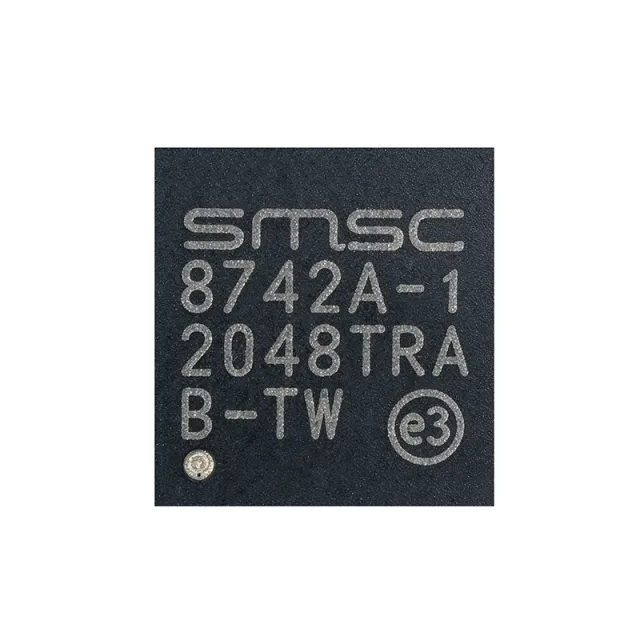
Quick Answers: What is the LAN8742A-CZ-TR and What Does It Cost?
The LAN8742A-CZ-TR is a low-power 10/100 Ethernet PHY for copper twisted-pair networks. It sits between an MCU or MAC controller and the Ethernet magnetics, handling line encoding/decoding, link training, and electrical signaling. The device is IEEE 802.3 and IEEE 802.3u compliant and supports both MII and RMII MAC interfaces via configuration straps. Key verified specifications are summarized below.
- Data rate: 10/100 Mbps
- MAC interface: MII, RMII
- Supply voltage (VDD): 1.62V to 3.6V
- I/O supply voltage: 1.8V to 3.3V (variable)
- Package: 24-SQFN (4x4 mm)
- Operating temperature (commercial): 0C to +70C
- Lifecycle status: Active
- Database stock: 32,000 units
- MOQ: 1
- Base price: $0.7383 as of 2026-10-14
Pricing tiers from the XAIPART database as of 2026-10-14: $1.2656 at qty ≥1, $0.9141 at qty ≥10, $0.8086 at qty ≥100, $0.7734 at qty ≥500, and $0.7383 at qty ≥1000. For full product details, see the LAN8742A-CZ-TR product page. To compare against other interface ICs, browse the component catalog.
Technical Guide: How Do You Design In the LAN8742A-CZ-TR?
Designing with the LAN8742A-CZ-TR starts with the power architecture. The device accepts a main supply (VDD) from 1.62V to 3.6V and a variable I/O supply (VDDIO) from 1.8V to 3.3V. This lets you connect directly to 1.8V or 3.3V MAC controllers without external level shifters, reducing BOM cost and board space. Decouple each power pin — VDDIO (pin 1), VDD (pin 2), and VDDA (pin 22) — with capacitors placed adjacent to the package. The 24-SQFN (4x4 mm) footprint requires a careful thermal and ground layout; the analog ground plane is critical for radiated emissions and signal integrity.
Clock configuration depends on the MAC interface mode. The device has a 25 MHz crystal oscillator input (XI, pin 23) and output (XO, pin 24) for the reference clock. In MII mode, TX_CLK (pin 11) and RX_CLK (pin 12) provide separate transmit and receive clocks. In RMII mode, REF_CLK (pin 11) serves as the single reference clock. Note a data conflict: the XAIPART applications table states that RMII uses a 50 MHz reference, while the FAQ section from the database says the device 'requires a 25 MHz reference.' The 25 MHz figure likely refers to the crystal on XI/XO (pins 23/24); the RMII REF_CLK runs at 50 MHz per the applications table. Confirm the exact clocking scheme in the datasheet before finalizing your clock tree.
The MAC interface uses standard MII or RMII signals. Transmit data runs on TXD0 (pin 3) and TXD1 (pin 4) with TX_EN (pin 5). Receive data uses RXD0/MODE0 (pin 7) through RXD3/MODE3 (pin 10) in MII mode, or RXD0/RXD1 in RMII mode. Pins 7–10 double as mode strap pins (MODE0–MODE3) at reset, so do not drive them strongly during power-up. CRS_DV (pin 6) carries carrier sense and data valid. Management is handled by MDC (pin 13) and MDIO (pin 14) for the Serial Management Interface (SMI). Use INT (pin 15) for interrupt-driven designs and RESETn (pin 16) for hardware reset.
The analog interface connects to the Ethernet magnetics and RJ-45. TX_+ (pin 17) and TX_- (pin 18) form the differential transmit pair; RX_+ (pin 20) and RX_- (pin 21) form the differential receive pair. Route these as 50-ohm impedance-controlled differential pairs per the Microchip LAN8742 QFN Routing Checklist. The magnetics must meet IEEE 802.3 isolation and return-loss specifications. The device integrates a termination network, which simplifies the external component count. HP Auto-MDIX automatically detects and corrects TX/RX pair swaps, so both straight-through and crossover cables work interchangeably. Cable diagnostics detect open or short faults without disconnecting field wiring. Wake-On-LAN supports system sleep modes, and flexPWR technology enables low-power operation.
For industrial environments, the commercial LAN8742A-CZ-TR operates from 0C to +70C. If your design requires -40C to +85C, use the LAN8742AI-CZ-TR industrial variant. Both share the same 24-SQFN package and pinout, so the upgrade is a drop-in change. Additional design details are available on the XAIPART Blog, including interface IC selection guides.
Power sequencing: The datasheet does not specify a required power-up sequence in the verified data set, but standard practice is to bring up VDD and VDDA before or with VDDIO. Use a reset signal on RESETn (pin 16) to hold the PHY in reset until all rails are stable. The strap pins (MODE0–MODE3, pins 7–10) are sampled at reset to configure the MAC interface and other settings; keep them at valid logic levels during power-up. The management interface (MDC/MDIO) lets the MAC configure and read status registers, including link status, speed, and cable diagnostics results.
Alternatives & Comparison: What Are the Drop-In Replacements for LAN8742A-CZ-TR?
The table below compares the LAN8742A-CZ-TR against verified alternatives from the XAIPART database. Only parameters present in the verified data are shown; missing parameters are omitted rather than estimated.
| Parameter | LAN8742A-CZ-TR | LAN8742AI-CZ-TR | LAN8742A-CZ | DP83848QSQ/NOPB |
|---|---|---|---|---|
| Data Rate | 10/100 Mbps | 10/100 Mbps | 10/100 Mbps | 10/100 Mbps |
| MAC Interface | MII, RMII | MII, RMII | MII, RMII | MII, RMII |
| Package | 24-SQFN (4x4 mm) | 24-SQFN (4x4 mm) | 24-SQFN (4x4 mm) | 40-QFN |
The LAN8742AI-CZ-TR is the industrial temperature grade: same die, same pinout, same 24-SQFN package, but rated for -40C to +85C instead of 0C to +70C. This makes it a direct drop-in upgrade for harsh environments. The LAN8742A-CZ is the same die and pinout but supplied in tube packaging instead of tape and reel; it is not a different electrical component. The DP83848QSQ/NOPB is a 10/100 PHY with MII/RMII, but it comes in a 40-QFN package, not a 24-SQFN. That footprint difference means PCB rework is required, so it is not a drop-in replacement without layout changes. No other specifications for the DP83848QSQ/NOPB are included in this verified data set.
For cost-sensitive designs that do not need cable diagnostics or Wake-On-LAN, the earlier LAN8720A family is sometimes considered. The LAN8742A adds cable diagnostics and HP Auto-MDIX over the LAN8720A, while maintaining RMII/MII compatibility. The LAN8742A uses a 24-SQFN package, while the LAN8720A is typically packaged in a smaller QFN. Verify the footprint before substituting. Microchip also offers reel-code variants LAN8742A-CZ-TR/REEL and tube-packaged LAN8742A-CZ, which share the same die and pinout.
Industry Insight: What Is the Market and Supply Situation for LAN8742A-CZ-TR?
The LAN8742A-CZ-TR is in active lifecycle status per the manufacturer product page, with no discontinuation announcements. XAIPART database stock stands at 32,000 units with a minimum order quantity of 1. This stock level supports both prototype and production quantities. However, a stock conflict exists: the database FAQ reports LCSC stock at 12,356 units as of 2026-10-08, which is lower than the XAIPART database figure of 32,000 units. The discrepancy may reflect different snapshot dates or allocation. Check real-time distributor inventory before locking a production schedule.
Pricing from the XAIPART database as of 2026-10-14 is tiered: $1.2656 at quantity 1, $0.9141 at 10, $0.8086 at 100, $0.7734 at 500, and $0.7383 at 1000. The part is available from authorized distributors including DigiKey, Mouser, LCSC, and Win Source according to the database FAQ. DigiKey lists 'ships today' and LCSC holds the aforementioned 12,356 units as of 2026-10-08. Standard lead time for factory-direct orders is typically 4–6 weeks, but distributor stock allows immediate shipment for many quantities. The device ships in tape-and-reel packaging with a 3,000-piece standard reel quantity.
From a market position standpoint, the LAN8742A-CZ-TR competes in the 10/100 Ethernet PHY segment for embedded, consumer, and industrial designs. The verified feature set — HP Auto-MDIX, Wake-On-LAN, cable diagnostics, flexPWR, and 1.8V–3.3V variable I/O — differentiates it from simpler PHYs. No verified market-share data is available in this data set, so buyers should evaluate based on design requirements rather than market claims. Multi-source procurement is straightforward because the part is active and stocked at multiple authorized distributors.
Trends & Outlook: What Should Buyers Watch in 2026?
Buyers should watch the continued demand for low-voltage I/O. The LAN8742A-CZ-TR's 1.8V to 3.3V variable I/O supply lets it connect directly to modern low-power MCUs and SoCs without level shifters. As more embedded designs move to 1.8V cores, this flexibility reduces BOM cost. The 1.62V to 3.6V main supply range also gives designers headroom for different rail architectures. These verified specs make the part attractive for IoT gateways, embedded web servers, and consumer appliances.
Wake-On-LAN remains a key feature for power-sensitive IoT and camera designs. It allows system-level sleep modes and remote wake-up, which is valuable for battery-backed or solar-powered gateways. Cable diagnostics support predictive maintenance in industrial Ethernet nodes and IP cameras, detecting open or short faults without disrupting field wiring. HP Auto-MDIX eliminates cable-orientation issues during installation, reducing commissioning time for building automation controllers and CCTV plants.
The industrial temperature variant, LAN8742AI-CZ-TR, is the drop-in upgrade for -40C to +85C environments. Its same 24-SQFN footprint and pinout mean no layout changes, which simplifies inventory planning: you can design one PCB and populate either grade depending on the deployment environment. Watch for pricing differences between the commercial and industrial grades; the database FAQ notes approximately 15–25% difference due to wider temperature qualification.
From a sourcing perspective, the active lifecycle status and multi-distributor availability reduce supply risk. However, buyers should monitor the stock conflict between the XAIPART database (32,000 units) and LCSC (12,356 units as of 2026-10-08). If you need high volumes, confirm allocation early. The base price of $0.7383 at 1000+ units as of 2026-10-14 provides a cost benchmark. For alternatives that are not drop-in, such as the DP83848QSQ/NOPB in a 40-QFN package, factor in PCB rework costs. For drop-in alternatives, the LAN8742AI-CZ-TR and LAN8742A-CZ are the safest choices from the verified data.
Finally, watch for lifecycle notices from Microchip. The part is currently active, but as with any component, design teams should track product change notifications. No roadmap data is available in this verified data set, so rely on official Microchip communications and distributor alerts.
Comentários
Seja o primeiro a comentar.
🔐 Por favor entrar para publicar um comentário.
Não tem uma conta? Cadastre-se