Áudio e Vídeo
Produtos (4)

NAU8331VG - 8W Class-D Mono Boost Amplifier | Nuvoton
The Nuvoton NAU8331VG is an 8W Class-D mono multi-level boost amplifier with speaker I/V sense, integrating a high-efficiency Class-G boost converter in a compact 35-ball WLCSP package measuring 3.83 x 2.55 mm. A Class-D audio amplifier is a switching amplifier that uses output transistors driven as switches with pulse-width or pulse-density modulation to achieve efficiencies far above Class-AB linear amplifiers. Within the power-management and audio signal-chain hierarchy, an audio amplifier IC takes a low-level analog input and delivers speaker-level output power; a boosted amplifier such as the NAU8331 additionally raises the supply voltage internally, allowing higher output power from a single low-voltage battery rail without an external boost stage. Key features of the NAU8331 include the integrated multi-level Class-G boost converter, which improves efficiency compared with a fixed-rail Class-D amplifier by dynamically adapting the supply rail to the audio signal envelope. The speaker I/V sense function monitors output voltage and current, enabling real-time speaker protection algorithms and aiding acoustic tuning. Mono single-channel output delivers up to 8W, and the tiny WLCSP-35 footprint suits space-constrained portable designs. Technically, the device combines a boost power stage with the Class-D modulator on one die, reducing external component count versus discrete boost-plus-amplifier solutions. Multi-level boosting reduces switching losses and electromagnetic interference relative to two-level topologies, an important consideration in smartphone and tablet layouts where sensitive radios sit nearby. Typical applications include smartphone and tablet loudspeaker drivers, portable Bluetooth speakers, notebook and tablet audio, and smart-home voice-interface devices, where high output power must be extracted from a single-cell lithium-ion battery. The I/V sense capability supports smart-amp speaker protection in these designs. Design consideration: boosted Class-D amplifiers place significant pulsed current demand on the battery rail, so input decoupling capacitance and PCB power-plane layout directly affect output ripple, EMI, and low-frequency stability. Follow the Nuvoton datasheet layout guidance closely. This page synthesizes distributor pricing and availability, package data, and practical design guidance consolidated from multiple sources not found in the manufacturer datasheet alone.

TAS5421QPWPRQ1 - 22W Mono Class-D Automotive Amp | TI
The Texas Instruments TAS5421QPWPRQ1 is an automotive-qualified 22-W mono analog-input Class-D audio amplifier with I2C diagnostics and load-dump protection, housed in a 16-pin HTSSOP (PWP) package with PowerPAD. It delivers up to 22 W into a 4-ohm load at less than 10% THD+N from a 14.4-Vdc automotive battery rail. A Class-D audio amplifier is a switching amplifier that uses output transistors driven as switches with PWM (pulse-width modulation) modulation to achieve very high power-conversion efficiency, typically above 85-90%. Within the power-management and audio signal-chain hierarchy, an audio amplifier IC sits between the preamplifier/DAC stage and the loudspeaker, boosting the low-level analog or digital source signal to speaker drive level. Class-D architectures dominate modern automotive audio because their efficiency minimizes heat, board area, and quiescent battery drain compared with Class-AB designs. Key features of the TAS5421-Q1 include its wide 4.5-V to 18-V supply range, which supports cold-crank, start-stop, and backup-battery operation without the rail collapsing out of regulation; integrated load-dump protection to survive the transient overvoltage events common on automotive power nets; and an I2C diagnostic interface that reports fault status such as short-circuit, thermal, and DC-load-detection conditions, enabling functional-safety-oriented system monitoring in eCall (emergency call) units. Technically, the device is a single-channel (mono) analog-input Class-D amplifier. The closed- or open-loop modulation stage converts the analog input into a switching drive for the integrated H-bridge output stage, which drives the speaker differentially. Integrated protection includes overcurrent, overtemperature shutdown, undervoltage lockout, and output DC protection. Efficiency is high enough that the PowerPAD HTSSOP-16 package can dissipate the loss on a properly designed PCB thermal plane in typical automotive infotainment volumes. Typical applications include automotive emergency call (eCall) audio units, telematics and TCU speaker outputs, instrument cluster warning/chime amplification, and entry-level infotainment head units. The 22-W mono output is well matched to single-speaker alert and voice-prompt systems where availability during start-stop voltage sag is mandatory. Design consideration: dimension the PCB copper under the PowerPAD for the worst-case dissipation at low battery voltage and maximum load, and keep the PVDD loop inductance low with adequate bulk and high-frequency bypass capacitance near the device. This page adds value beyond the datasheet by consolidating distributor sourcing information, drop-in alternative analysis, automotive design notes, and AEO-optimized engineering FAQs in one place.

TAS5760LDDCA - 21W Stereo I2S Class-D Amplifier | TI
The Texas Instruments TAS5760L (orderable as TAS5760LDDCA) is a digital-input Class-D audio amplifier delivering 21 W per channel in stereo or 42 W mono from a 4.5 V to 16.4 V supply, housed in a 48-pin HTSSOP PowerPAD package with exposed die-attach pad. A Class-D audio amplifier switches output power MOSFETs at high frequency to amplify an audio signal with high efficiency, in contrast to Class-AB linear amplifiers that dissipate substantial power as heat. Within the power-management and audio signal-chain hierarchy, the TAS5760L is a closed-loop digital-input speaker amplifier: it accepts an I2S/TDM serial audio stream, performs digital signal processing and PWM modulation on-chip, and drives speakers directly through an external LC filter or filterless output network. Key features include a wide 4.5 V to 16.4 V operating supply range, 21 W stereo / 42 W mono output capability, both hardware and software (I2C) control modes, an integrated digital clipper that protects speakers from overdrive, several selectable gain settings, and integrated headphone/line-output support. Two clock speed modes let designers match a variety of audio master-clock configurations without regenerating the audio stream. Technically, the TAS5760L integrates the full path from digital audio input to power stage: serial-port receiver, audio processing, PWM modulator, gate drive, and power FET H-bridges. The digital clipper acts before the power stage, so clipping artifacts are managed in the digital domain. The entire TAS5760xx family is pin-to-pin compatible in the 48-pin TSSOP package, per TI product documentation. Typical applications include TV soundbars, portable and desktop speakers, LCD TV audio, and docking/foundation systems where an I2S source drives speakers directly without a separate DAC. The wide supply range supports both battery and adapter-powered designs. Design-wise, provide a low-impedance PVDD supply with bulk and local decoupling, and size the LC output filter for the selected PWM switching frequency; thermal design relies on a good PowerPAD solder connection to the PCB copper plane. This page synthesizes verified distributor and TI product data with drop-in alternatives, application guidance, and an FAQ set not found together on the manufacturer datasheet.
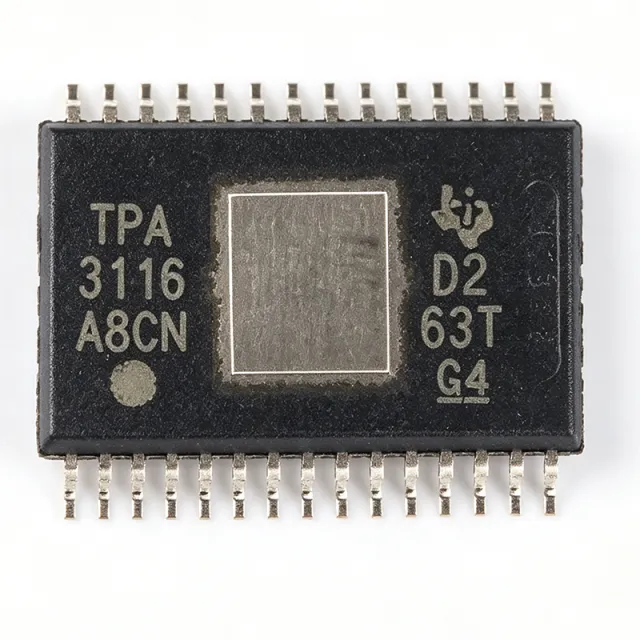
TPA3116D2DADR - 50W Stereo Class-D Audio Amp | Texas Instruments
The Texas Instruments TPA3116D2DADR is a filter-free, analog-input Class-D stereo audio amplifier delivering 2 x 50 W into 4-ohm speakers (or 100 W mono BTL into 2 ohms) from a 4.5 V to 26 V supply, packaged in a 32-pin HTSSOP (DAD) with exposed thermal pad. A Class-D audio amplifier is a switching amplifier whose output transistors operate as switches rather than linear elements, achieving efficiency above 85-90 percent. In the amplifier IC hierarchy, it sits under audio amplifiers, within the broader linear-amplifier IC family, and replaces bulky Class-AB stages plus heat sinks in compact speaker systems. Key features include filter-free operation with an integrated feedback loop that tolerates speaker inductance without an LC output filter, SpeakerGuard amplitude limiting that protects speakers from over-power events, and an AM-avoidance modulation scheme that keeps switching harmonics out of the AM broadcast band. Differential analog inputs improve common-mode noise rejection, and integrated short-circuit and thermal shutdown protection raise system robustness. The device uses an AD modulation topology with 250 kHz-class switching, so high efficiency eliminates heat sinks in most 2 x 50 W designs on a two-layer PCB with adequate copper pour. Fixed internal gain options and a master/slave-capable architecture simplify multi-channel designs; power-supply pumping is managed by the BTL configuration at low frequencies. Typical applications include Bluetooth and active speakers, soundbars, TV audio, portable PA and karaoke systems, and automotive/infotainment speaker drivers where efficiency and small size matter. Design consideration: at 2 x 50 W, PCB copper area under the exposed pad is the primary thermal path - provide a solid ground pour with thermal vias, and place supply decoupling (at least 10 uF bulk plus 0.1 uF ceramic) close to PVCC pins to minimize supply ripple and EMI. This page synthesizes distributor pricing, drop-in alternatives, comparison tables, and practical design notes not found in the manufacturer datasheet. Pricing below as of 2026-08-29.