Produtos (39.000+)

STM32F103R8T7TR - 72MHz 64KB Cortex-M3 MCU | STMicroelectronics (Tape & Reel)
STM32F103R8T7TR

STM32F103R8T7TR - 72MHz 64KB Cortex-M3 MCU | STMicroelectronics (Tape & Reel)

STMicroelectronics STM32F103R8T7TR is an Arm Cortex-M3 32-bit RISC microcontroller operating at 72 MHz, with 64 KB Flash memory and a 64-LQFP 10 mm x 10 mm package. It belongs to the STM32F1 medium-density performance line and integrates USB, CAN, seven 16-bit timers, two ADCs, and nine communication interfaces. Its combination of real-time control capability, extensive peripheral integration, and a 64-pin surface-mount package makes it suitable for embedded control, communications, motor control, sensing, and USB-connected equipment. A microcontroller such as the STM32F103R8T7TR is a programmable semiconductor that combines a processor core, memory, and peripherals on one integrated circuit. The Cortex-M3 core uses a reduced-instruction architecture optimized for embedded systems, while the STM32F103 family adds timers, serial interfaces, analog converters, and communication controllers. Within the hierarchy of MCU, embedded processor, digital controller, and semiconductor, this device provides a practical platform for controlling sensors, actuators, communications, and real-time signal processing. Key features include a maximum 72 MHz operating frequency, 64 KB Flash, two ADCs, USB and CAN connectivity, and seven 16-bit timers. The 64-LQFP package provides external access to the device's GPIO and communication signals, while the integrated analog and timing resources reduce the need for separate components. The verified product listing identifies the device as a 32-bit, 72 MHz, 64 KB Flash MCU in a 64-LQFP package. The STM32F103R8T7TR architecture supports both control-oriented firmware and communication-rich embedded systems. Its seven 16-bit timers support timing, input capture, output compare, PWM, and motor-control workflows. USB and CAN interfaces enable connection to host systems, peripherals, industrial networks, or automotive-style communication equipment. Two ADCs provide analog measurement channels, while the Arm Cortex-M3 core executes control logic efficiently. Typical applications include industrial controllers, USB peripherals, CAN-connected nodes, motor-control boards, instrument interfaces, and compact embedded products. The 72 MHz clock provides processing headroom for protocol handling and real-time tasks, while the analog inputs can be used for sensor conditioning and monitoring. Designers should confirm memory requirements, pin-level connectivity, and peripheral availability against the complete manufacturer documentation before finalizing a system. For PCB design, place the MCU close to its decoupling network and provide a stable clock, reset, and debug implementation according to the manufacturer reference material. Check every exposed and power pin against the package drawing before routing. The device is a digital integrated circuit rather than a power semiconductor, so SOA data is not applicable. Pricing and availability can change, so procurement should rely on current distributor or manufacturer quotes.

Cotação Contato
STM32F103RBH6 - 32-Bit 72MHz 128KB MCU | STMicroelectronics
STM32F103RBH6

STM32F103RBH6 - 32-Bit 72MHz 128KB MCU | STMicroelectronics

The STMicroelectronics STM32F103RBH6 is a 32-bit ARM Cortex-M3 microcontroller operating at 72MHz, with 128KB of Flash memory and a 64-TFBGA package measuring 5mm by 5mm. The device belongs to the STM32F1 series and is positioned for compact embedded systems requiring mixed-signal control, timers, communications, and efficient real-time processing. The verified distributor listing identifies the MCU as a 64-pin TFBGA device, while additional ordering information confirms its 2.5V and 3.3V supply-related positioning. A microcontroller is a programmable semiconductor that integrates a processor core, memory, peripherals, and input/output interfaces onto one package. The STM32F103RBH6 uses an ARM Cortex-M3 core within the broader embedded MCU hierarchy: microcontroller, embedded processor, semiconductor, and electronic component. This family is commonly used where deterministic control, communication connectivity, and broad peripheral integration are needed without a separate external processor. The STM32F103RBH6 provides 128KB of Flash memory, a 72MHz maximum clock indication in the verified listing, and a 32-bit architecture. The STM32F103 family is also identified in the verified material as supporting CAN, LIN, USB, mixed-signal functions, and timer-driven control. These interfaces make it suitable for industrial controllers, communication equipment, motor-control systems, data acquisition modules, and compact consumer products. The device is packaged in a 64-TFBGA, 5mm by 5mm form factor. TFBGA is a surface-mount ball-grid-array package, allowing a compact PCB footprint and short electrical connections when the board layout follows the manufacturer pin and escape-routing requirements. The verified distributor snippet lists 64 pins, while the exact exposed-ball assignments and electrical limits require confirmation from the manufacturer datasheet. A typical design places the MCU beside stable power regulation, decoupling capacitors, oscillator circuitry, reset support, programming access, and application-specific sensors or communication transceivers. Firmware configuration determines whether the available timers, serial interfaces, analog inputs, and communication blocks are used for control, monitoring, or data exchange. Designers should verify package-specific pin multiplexing, power sequencing, clock limits, and peripheral availability against the official datasheet before layout release. The STM32F103RBH6 is best suited to compact embedded-control platforms where 32-bit processing, 128KB Flash, and integrated mixed-signal or communications capability are valuable. Compared with larger LQFP alternatives, its 64-TFBGA package can reduce board area, but it increases assembly and inspection complexity. Compare competitor devices by exact package, pin mapping, memory, peripheral set, clock behavior, and validated firmware support rather than by CPU frequency alone. This page combines verified distributor specifications, package information, pricing references, source links, application guidance, and drop-in alternatives for engineering evaluation. Alternative parts require careful validation of pin compatibility, electrical limits, memory, peripherals, clock behavior, and software support before substitution.

Cotação Contato
STM32F103RBH6TR - 32-Bit 72MHz 128KB MCU | STMicroelectronics (Tape & Reel)
STM32F103RBH6TR

STM32F103RBH6TR - 32-Bit 72MHz 128KB MCU | STMicroelectronics (Tape & Reel)

The STMicroelectronics STM32F103RBH6TR is a 32-bit ARM Cortex-M3 microcontroller operating at 72MHz, with 128KB of Flash memory and a 64-TFBGA package measuring 5mm by 5mm. The device belongs to the STM32F1 series and is positioned for compact embedded systems requiring mixed-signal control, timers, communications, and efficient real-time processing. The verified distributor listing identifies the MCU as a 64-pin TFBGA device, while additional ordering information confirms its 2.5V and 3.3V supply-related positioning. A microcontroller is a programmable semiconductor that integrates a processor core, memory, peripherals, and input/output interfaces onto one package. The STM32F103RBH6TR uses an ARM Cortex-M3 core within the broader embedded MCU hierarchy: microcontroller, embedded processor, semiconductor, and electronic component. This family is commonly used where deterministic control, communication connectivity, and broad peripheral integration are needed without a separate external processor. The STM32F103RBH6TR provides 128KB of Flash memory, a 72MHz maximum clock indication in the verified listing, and a 32-bit architecture. The STM32F103 family is also identified in the verified material as supporting CAN, LIN, USB, mixed-signal functions, and timer-driven control. These interfaces make it suitable for industrial controllers, communication equipment, motor-control systems, data acquisition modules, and compact consumer products. The device is packaged in a 64-TFBGA, 5mm by 5mm form factor. TFBGA is a surface-mount ball-grid-array package, allowing a compact PCB footprint and short electrical connections when the board layout follows the manufacturer pin and escape-routing requirements. The verified distributor snippet lists 64 pins, while the exact exposed-ball assignments and electrical limits require confirmation from the manufacturer datasheet. A typical design places the MCU beside stable power regulation, decoupling capacitors, oscillator circuitry, reset support, programming access, and application-specific sensors or communication transceivers. Firmware configuration determines whether the available timers, serial interfaces, analog inputs, and communication blocks are used for control, monitoring, or data exchange. Designers should verify package-specific pin multiplexing, power sequencing, clock limits, and peripheral availability against the official datasheet before layout release. The STM32F103RBH6TR is best suited to compact embedded-control platforms where 32-bit processing, 128KB Flash, and integrated mixed-signal or communications capability are valuable. Compared with larger LQFP alternatives, its 64-TFBGA package can reduce board area, but it increases assembly and inspection complexity. Compare competitor devices by exact package, pin mapping, memory, peripheral set, clock behavior, and validated firmware support rather than by CPU frequency alone. This page combines verified distributor specifications, package information, pricing references, source links, application guidance, and drop-in alternatives for engineering evaluation. Alternative parts require careful validation of pin compatibility, electrical limits, memory, peripherals, clock behavior, and software support before substitution.

Cotação Contato
STM32F103RBH7 - 72MHz 128KB Cortex-M3 MCU | STMicroelectronics
STM32F103RBH7

STM32F103RBH7 - 72MHz 128KB Cortex-M3 MCU | STMicroelectronics

The STMicroelectronics STM32F103RBH7 is a 32-bit ARM Cortex-M3 microcontroller operating up to 72 MHz, with 128 KB of Flash memory and a 64-pin TFBGA package measuring 5 x 5 mm. It belongs to the STM32F1 performance-line MCU family and combines deterministic embedded control with serial communications and general-purpose I/O in a compact surface-mount package. The verified listing identifies ARM Cortex-M3 architecture, 72 MHz operation, 128 KB Flash, and 64-TFBGA construction. A microcontroller is a programmable system-on-chip that integrates a processor core, memory, peripherals, and I/O into one device. The Cortex-M3 hierarchy places STM32F103RBH7 within ARM-based 32-bit embedded processors, microcontrollers, and the broader semiconductor category. It is suited to systems that require compact firmware execution, real-time control, and multiple serial interfaces without using a larger application processor. The verified part data specifies 32-bit processing, a 72 MHz maximum frequency, and 128 KB organized as 128K x 8 Flash. One distributor result also describes a wide I/O selection and available connectivity including USB, CAN, LIN, I2C, and SPI. These interfaces make the device useful when several peripheral buses must coexist. Exact peripheral counts, voltage ranges, RAM capacity, GPIO count, package dimensions, and electrical limits were not supplied in the provided data and therefore remain unconfirmed here. The STM32F103RBH7 is positioned for embedded control, communication gateways, instrumentation, and compact automation modules. Its 128 KB Flash footprint provides room for boot code, application logic, and communication handlers, while the 72 MHz Cortex-M3 core provides computational headroom for control loops. Firmware planning must nevertheless include the device's actual RAM, interrupt map, peripheral variants, clock limits, and pin multiplexing after those values are confirmed from the manufacturer datasheet. PCB design should provide a regulated supply, decoupling capacitors, ground-plane continuity, and clean routing for external interfaces. Because the verified package is a 64-pin TFBGA, assembly and inspection require a land pattern and via arrangement suitable for fine-pitch BGA construction. Do not substitute a package drawing from an LQFP STM32F103 variant, because the STM32F103RBH7 listing explicitly identifies TFBGA rather than LQFP. This data page consolidates exact distributor listings, availability and pricing references, package information, interface context, and replacement-analysis limits for the STM32F103RBH7. Unverified technical values are deliberately identified as missing rather than inferred. Engineers should use the manufacturer datasheet for final pin assignments, timing, electrical characteristics, memory, errata, and qualification decisions before release to production.

Cotação Contato
STM32F103RBT6 - 72MHz Cortex-M3 MCU 128KB Flash | ST
STM32F103RBT6

STM32F103RBT6 - 72MHz Cortex-M3 MCU 128KB Flash | ST

The STMicroelectronics STM32F103RBT6 is a 32-bit ARM Cortex-M3 microcontroller operating at 72 MHz, integrating 128 KB of single-bank Flash and 20 KB of SRAM in a 64-pin LQFP surface-mount package. It belongs to the ST medium-density STM32F1 performance line and is one of the most widely deployed Cortex-M3 MCUs in industrial control and communication modules. A microcontroller unit (MCU) is a single integrated circuit that combines a processor core, memory, and programmable peripherals into one device, forming the lowest layer of the embedded-system hierarchy: MCU -> microcontroller -> embedded processor -> system-on-chip. The ARM Cortex-M3 is a 32-bit RISC processor core optimized for cost-sensitive and power-conscious embedded control. The STM32F103 family was one of the first mainstream Cortex-M families adopted at scale across industrial electronics, in large part because of its rich peripheral set and pin compatibility across Flash derivatives. Key features include the 72 MHz Cortex-M3 core delivering 1.25 DMIPS/MHz, 128 KB on-chip Flash, 20 KB SRAM, a 2.0 V to 3.6 V supply range with a 3.3 V operating point, two 12-bit ADCs with up to 1 microsecond conversion time and up to 16 input channels, two I2C, two SPI, three USART, one USB 2.0 full-speed interface, one CAN 2.0B active controller, and seven 16-bit timers including PWM-capable channels. An 8 MHz high-speed internal RC oscillator and support for an external 4 to 16 MHz crystal allow flexible clocking without external components. Architecturally, the device uses an ARMv7-M Harvard structure with a three-stage pipeline and a Nested Vectored Interrupt Controller (NVIC) for low-latency interrupt response. An AHB/APB bus matrix allows peripheral DMA and core execution to proceed concurrently, while a Flash interface with prefetch buffer minimizes stalls when the 72 MHz core fetches instructions from Flash. Typical applications include industrial control nodes, motor-control auxiliary boards, USB and CAN communication modules, low-cost development platforms, and legacy 8-bit/16-bit MCU upgrades where the ARM tool ecosystem reduces software cost. Designers also use this device in smart-metering peripherals and low-cost HMIs. Design consideration: pin compatibility across the STM32F1 family means Flash upgrades from 128 KB to 256 KB (e.g., STM32F103RCT6) require no PCB change, but verify RAM sizing, peripheral count, and the 72 MHz maximum frequency when porting between derivative families. This page synthesizes distributor pricing, verified drop-in alternatives including the GD32F103RBT6 cross-brand P2P candidate and STM32F103RCT6 same-family upgrade, plus practical design notes not found in the manufacturer datasheet.

Cotação Contato
STM32F103RBT6TR - 72MHz Cortex-M3, 128KB Flash MCU | STMicroelectronics
STM32F103RBT6TR

STM32F103RBT6TR - 72MHz Cortex-M3, 128KB Flash MCU | STMicroelectronics

The STMicroelectronics STM32F103RBT6TR is a 32-bit ARM Cortex-M3 microcontroller running at 72 MHz (90 DMIPS, 1.25 DMIPS/MHz) with 128 KB Flash and 20 KB SRAM, housed in a 64-pin LQFP surface-mount package (Tape & Reel packaged, indicated by the TR suffix). A microcontroller (MCU) is a single-chip computer that integrates a processor core, program memory, data memory, and peripheral interfaces on one die. Within the embedded-systems hierarchy, the STM32F103RBT6TR belongs to the medium-density performance line of the STM32F1 family: MCU -> 32-bit MCU -> ARM Cortex-M3 MCU -> STM32F1 series -> STM32F103 medium-density performance line. Key features include two 12-bit ADCs with up to 10 external channels and 1 us conversion time, seven 16-bit timers, and nine communication interfaces: two I2C, three USARTs, two SPIs, a full-speed USB 2.0 device controller, and a CAN 2.0B controller. A 7-channel DMA controller offloads data transfers, and a nested vectored interrupt controller (NVIC) with 60 maskable interrupt vectors enables deterministic real-time response. The core supports single-cycle hardware multiply and division for efficient signal processing. Technically, the device operates from a 2.0 V to 3.6 V supply with dedicated VDDA/VSSA analog pins that isolate the ADC and PLL from digital supply noise. Power modes include Sleep, Stop, and Standby with wake-up in microseconds; typical run consumption is low enough for battery-powered designs. Flash supports 10,000 write cycles with embedded erase/write controllers, and true read-while-write operation permits EEPROM emulation. Typical applications include industrial control and PLC I/O modules, motor control and inverter boards using the advanced TIM1 timer, USB and CAN field devices, medical handheld instruments, and consumer appliances. Design consideration: keep VDDA well-decoupled (10 nF plus 1 uF) and provide a clean 3.3 V rail with 100 nF on every VDD pin pair; BOOT0 must be strapped to ground for flash boot. This page adds value beyond the datasheet by synthesizing distributor pricing, verified pin-compatible alternatives such as GigaDevice GD32F103, and practical design notes for second-sourcing and migration.

Cotação Contato
STM32F103RBT7 - 72MHz Cortex-M3 128KB MCU | STMicroelectronics
STM32F103RBT7

STM32F103RBT7 - 72MHz Cortex-M3 128KB MCU | STMicroelectronics

The STMicroelectronics STM32F103RBT7 is a 32-bit Arm Cortex-M3 microcontroller operating at 72 MHz, with 128 KB of Flash memory, USB, CAN, seven timers, two ADCs, and nine communication interfaces, packaged in a 64-LQFP 10 x 10 mm package. A microcontroller is a programmable embedded-system component that combines a processor core, memory, peripherals, and communication interfaces on one semiconductor device. The STM32F103 belongs to STMicroelectronics’ medium-density performance line and is used to control motors, industrial equipment, communications, sensors, and consumer products. Its Cortex-M3 architecture provides a 32-bit RISC platform while retaining low system complexity for embedded designs. The verified product information identifies a maximum operating frequency of 72 MHz, 128 KB Flash memory, USB, CAN, seven 16-bit timers, two ADCs, and nine communication interfaces. These peripherals support applications requiring analog measurement, timing, serial communications, motor-control feedback, USB connectivity, or CAN-based distributed control. The 64-LQFP package provides a conventional surface-mount footprint suitable for automated PCB assembly. The STM32F103RBT7 is positioned for designs that need more processing performance and peripheral integration than a basic 8-bit or low-density microcontroller, while remaining within the STM32F103 family ecosystem. Its USB and CAN interfaces make it useful for connected embedded equipment, and its dual ADC capability supports analog sensor acquisition. The exact RAM size, supply-voltage limits, pin assignments, and detailed electrical characteristics are not included in the supplied verified data and must be confirmed in the manufacturer datasheet. Typical implementations include industrial motor controllers, USB-connected data-acquisition devices, CAN network nodes, instrumentation, communications equipment, and compact control platforms. Designers should preserve the package footprint, verify every alternate-function pin, confirm memory-map and peripheral compatibility, and review the official STM32F103RB documentation before transferring firmware between MCU variants. A key sourcing consideration is that an electrically similar MCU may not be a true drop-in replacement. Package dimensions, pin multiplexing, peripheral behavior, clock requirements, memory organization, firmware support, and lifecycle expectations must all be checked. This page distinguishes verified product facts from unresolved specifications and avoids inventing values that were not present in the supplied data.

Cotação Contato
STM32F103RBT7TR - 72MHz Cortex-M3 128KB MCU | STMicroelectronics (Tape & Reel)
STM32F103RBT7TR

STM32F103RBT7TR - 72MHz Cortex-M3 128KB MCU | STMicroelectronics (Tape & Reel)

The STMicroelectronics STM32F103RBT7TR is a 32-bit Arm Cortex-M3 microcontroller operating at 72 MHz, with 128 KB of Flash memory, USB, CAN, seven timers, two ADCs, and nine communication interfaces, packaged in a 64-LQFP 10 x 10 mm package. A microcontroller is a programmable embedded-system component that combines a processor core, memory, peripherals, and communication interfaces on one semiconductor device. The STM32F103 belongs to STMicroelectronics’ medium-density performance line and is used to control motors, industrial equipment, communications, sensors, and consumer products. Its Cortex-M3 architecture provides a 32-bit RISC platform while retaining low system complexity for embedded designs. The verified product information identifies a maximum operating frequency of 72 MHz, 128 KB Flash memory, USB, CAN, seven 16-bit timers, two ADCs, and nine communication interfaces. These peripherals support applications requiring analog measurement, timing, serial communications, motor-control feedback, USB connectivity, or CAN-based distributed control. The 64-LQFP package provides a conventional surface-mount footprint suitable for automated PCB assembly. The STM32F103RBT7TR is positioned for designs that need more processing performance and peripheral integration than a basic 8-bit or low-density microcontroller, while remaining within the STM32F103 family ecosystem. Its USB and CAN interfaces make it useful for connected embedded equipment, and its dual ADC capability supports analog sensor acquisition. The exact RAM size, supply-voltage limits, pin assignments, and detailed electrical characteristics are not included in the supplied verified data and must be confirmed in the manufacturer datasheet. Typical implementations include industrial motor controllers, USB-connected data-acquisition devices, CAN network nodes, instrumentation, communications equipment, and compact control platforms. Designers should preserve the package footprint, verify every alternate-function pin, confirm memory-map and peripheral compatibility, and review the official STM32F103RB documentation before transferring firmware between MCU variants. A key sourcing consideration is that an electrically similar MCU may not be a true drop-in replacement. Package dimensions, pin multiplexing, peripheral behavior, clock requirements, memory organization, firmware support, and lifecycle expectations must all be checked. This page distinguishes verified product facts from unresolved specifications and avoids inventing values that were not present in the supplied data.

Cotação Contato
STM32F103RCT6 - 72MHz Cortex-M3 MCU, 256KB Flash | ST
STM32F103RCT6

STM32F103RCT6 - 72MHz Cortex-M3 MCU, 256KB Flash | ST

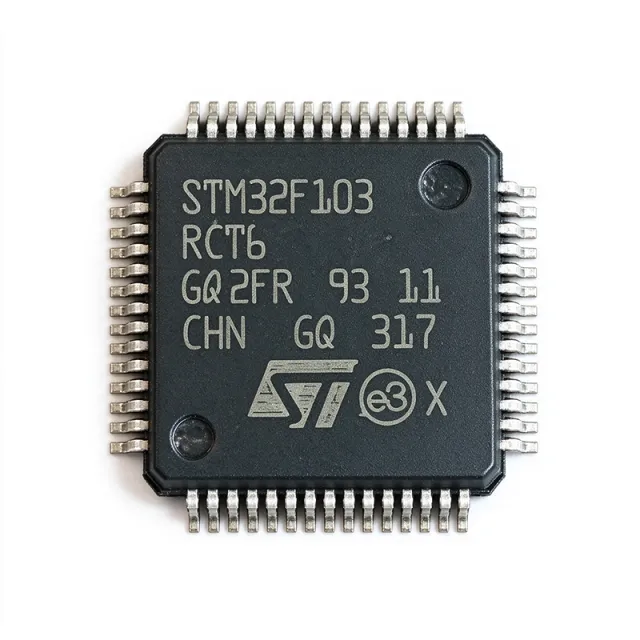
The STMicroelectronics STM32F103RCT6 is a high-density performance line ARM Cortex-M3 32-bit microcontroller operating at up to 72MHz with 256KB of Flash memory and 48KB of SRAM, housed in an LQFP64 (10x10 mm) surface-mount package with 51 GPIO pins. A microcontroller (MCU) is a compact integrated circuit that combines a processor core, memory, and programmable peripherals on a single chip, forming the central control element of embedded systems. The STM32F103RCT6 sits within the STM32 family hierarchy: STM32F1 series -> STM32 MCU portfolio -> ARM Cortex-M based microcontrollers -> semiconductor ICs. The Cortex-M3 core, with its nested vectored interrupt controller (NVIC) and memory protection unit (MPU), delivers deterministic real-time performance at 1.25 DMIPS/MHz. Key features include a wide 2.0V to 3.6V supply range, -40C to +85C industrial temperature operation, Sleep/Stop/Standby low-power modes, a real-time clock (RTC), multiple PWM-capable timers, and 5V-tolerant GPIOs. The 256KB high-density Flash accommodates complex firmware such as RTOS-based applications, while rich peripheral integration reduces external BOM cost and board area. Architecturally, the device uses an AMBA AHB/APB bus matrix connecting the 72MHz core to SRAM and peripherals, with single-cycle hardware multiply for efficient control-loop mathematics. Three 12-bit ADCs run at up to 1 MSPS (2 MSPS in interleaved dual mode), and two 12-bit DACs support analog output. Connectivity includes USB 2.0 Full Speed, CAN 2.0B, three USARTs, SPI, and I2C interfaces. Typical applications include industrial motor control, PLCs, medical devices, IoT gateways, USB/CAN communication bridges, and HMI panels. Design tip: decouple every VDD pin with 100nF close to the pin plus a 4.7uF bulk capacitor, filter VDDA through a ferrite bead, and strap BOOT0 correctly for the intended boot mode. This page synthesizes distributor pricing, drop-in alternatives including the GigaDevice GD32F103RCT6, pinout guidance, and practical design notes not found in the manufacturer datasheet.

USD $1,64 Em estoque
STM32F103RCT6TR - 72MHz Cortex-M3 MCU, 256KB Flash | ST (Tape & Reel)
STM32F103RCT6TR

STM32F103RCT6TR - 72MHz Cortex-M3 MCU, 256KB Flash | ST (Tape & Reel)

The STMicroelectronics STM32F103RCT6TR is a high-density performance line ARM Cortex-M3 32-bit microcontroller operating at up to 72MHz with 256KB of Flash memory and 48KB of SRAM, housed in an LQFP64 (10x10 mm) surface-mount package with 51 GPIO pins. A microcontroller (MCU) is a compact integrated circuit that combines a processor core, memory, and programmable peripherals on a single chip, forming the central control element of embedded systems. The STM32F103RCT6TR sits within the STM32 family hierarchy: STM32F1 series -> STM32 MCU portfolio -> ARM Cortex-M based microcontrollers -> semiconductor ICs. The Cortex-M3 core, with its nested vectored interrupt controller (NVIC) and memory protection unit (MPU), delivers deterministic real-time performance at 1.25 DMIPS/MHz. Key features include a wide 2.0V to 3.6V supply range, -40C to +85C industrial temperature operation, Sleep/Stop/Standby low-power modes, a real-time clock (RTC), multiple PWM-capable timers, and 5V-tolerant GPIOs. The 256KB high-density Flash accommodates complex firmware such as RTOS-based applications, while rich peripheral integration reduces external BOM cost and board area. Architecturally, the device uses an AMBA AHB/APB bus matrix connecting the 72MHz core to SRAM and peripherals, with single-cycle hardware multiply for efficient control-loop mathematics. Three 12-bit ADCs run at up to 1 MSPS (2 MSPS in interleaved dual mode), and two 12-bit DACs support analog output. Connectivity includes USB 2.0 Full Speed, CAN 2.0B, three USARTs, SPI, and I2C interfaces. Typical applications include industrial motor control, PLCs, medical devices, IoT gateways, USB/CAN communication bridges, and HMI panels. Design tip: decouple every VDD pin with 100nF close to the pin plus a 4.7uF bulk capacitor, filter VDDA through a ferrite bead, and strap BOOT0 correctly for the intended boot mode. This page synthesizes distributor pricing, drop-in alternatives including the GigaDevice GD32F103RCT6, pinout guidance, and practical design notes not found in the manufacturer datasheet.

USD $1,64 Em estoque
STM32F103RCT7 - 72MHz ARM Cortex-M3 MCU | STMicroelectronics
STM32F103RCT7

STM32F103RCT7 - 72MHz ARM Cortex-M3 MCU | STMicroelectronics

The STMicroelectronics STM32F103RCT7 is a 32-bit ARM Cortex-M3 microcontroller with a 72 MHz maximum clock frequency, 256 KB of Flash memory, and a 64-LQFP package measuring 10 mm by 10 mm. It belongs to STMicroelectronics' STM32F1 high-density performance line and combines an embedded MCU with USB and CAN connectivity for compact embedded control systems. The device operates from 2 V to 3.6 V according to the verified product data and provides 37 I/O ports for external peripherals and board-level interfaces. A microcontroller is a programmable semiconductor that integrates a processor core, memory, peripheral interfaces, and I/O in one device. The STM32F103RCT7 is specifically an ARM Cortex-M3 MCU, a member of the ARM Cortex-M product family designed for embedded control. Within the device hierarchy, it is a microcontroller within the broader semiconductor category, with the STM32F1 series providing a practical platform for industrial controls, motor-control systems, communication equipment, and connected products. Key features include a 72 MHz Cortex-M3 core, 256 K × 8 Flash organization, 37 I/O ports, USB, CAN, and a 2 V to 3.6 V supply range. The 256 KB of embedded Flash supports firmware, boot code, configuration data, and application logic without requiring external program memory. Its 37 I/O pins provide parallel digital connectivity for sensors, actuators, displays, status indicators, and external communication transceivers. The device uses the high-performance 32-bit ARM Cortex-M3 RISC architecture rather than an 8-bit controller, allowing it to process control algorithms, protocol stacks, and human-machine-interface logic efficiently. The 64-LQFP package exposes a larger pin count than smaller MCU packages, supporting broad peripheral connectivity while remaining compatible with automated board assembly. Its 0.5 mm lead pitch and 10 mm × 10 mm body size balance routing density and inspection accessibility. Typical applications include industrial motor controllers, USB-connected data-acquisition equipment, CAN network nodes, USB-to-serial or protocol-conversion products, programmable logic controllers, and compact automation controllers. In each case, the combination of Cortex-M3 processing capability, embedded Flash, USB or CAN connectivity, and 37 I/O ports reduces the number of external devices required around the MCU. Designers should reserve clean supply paths, connect decoupling capacitors close to the power pins, and assign all 64 LQFP leads according to the manufacturer pinout before layout release. Firmware and peripheral assignments should be checked against the STM32F103 device documentation, especially when debugging, bootloader use, or USB and CAN functions are required. The 3.6 V maximum supply also requires careful protection from industrial transients and overvoltage conditions. This product record combines verified distributor specifications, lifecycle information, package details, and documented cross-reference options with practical design guidance. It helps engineers evaluate the STM32F103RCT7 against same-manufacture and cross-brand Cortex-M3 alternatives without overlooking firmware, clock, memory, or package validation requirements.

Cotação Contato
STM32F103RCT7TR - 72MHz ARM Cortex-M3 MCU | STMicroelectronics (Tape & Reel)
STM32F103RCT7TR

STM32F103RCT7TR - 72MHz ARM Cortex-M3 MCU | STMicroelectronics (Tape & Reel)

The STMicroelectronics STM32F103RCT7TR is a 32-bit ARM Cortex-M3 microcontroller with a 72 MHz maximum clock frequency, 256 KB of Flash memory, and a 64-LQFP package measuring 10 mm by 10 mm. It belongs to STMicroelectronics' STM32F1 high-density performance line and combines an embedded MCU with USB and CAN connectivity for compact embedded control systems. The device operates from 2 V to 3.6 V according to the verified product data and provides 37 I/O ports for external peripherals and board-level interfaces. A microcontroller is a programmable semiconductor that integrates a processor core, memory, peripheral interfaces, and I/O in one device. The STM32F103RCT7TR is specifically an ARM Cortex-M3 MCU, a member of the ARM Cortex-M product family designed for embedded control. Within the device hierarchy, it is a microcontroller within the broader semiconductor category, with the STM32F1 series providing a practical platform for industrial controls, motor-control systems, communication equipment, and connected products. Key features include a 72 MHz Cortex-M3 core, 256 K × 8 Flash organization, 37 I/O ports, USB, CAN, and a 2 V to 3.6 V supply range. The 256 KB of embedded Flash supports firmware, boot code, configuration data, and application logic without requiring external program memory. Its 37 I/O pins provide parallel digital connectivity for sensors, actuators, displays, status indicators, and external communication transceivers. The device uses the high-performance 32-bit ARM Cortex-M3 RISC architecture rather than an 8-bit controller, allowing it to process control algorithms, protocol stacks, and human-machine-interface logic efficiently. The 64-LQFP package exposes a larger pin count than smaller MCU packages, supporting broad peripheral connectivity while remaining compatible with automated board assembly. Its 0.5 mm lead pitch and 10 mm × 10 mm body size balance routing density and inspection accessibility. Typical applications include industrial motor controllers, USB-connected data-acquisition equipment, CAN network nodes, USB-to-serial or protocol-conversion products, programmable logic controllers, and compact automation controllers. In each case, the combination of Cortex-M3 processing capability, embedded Flash, USB or CAN connectivity, and 37 I/O ports reduces the number of external devices required around the MCU. Designers should reserve clean supply paths, connect decoupling capacitors close to the power pins, and assign all 64 LQFP leads according to the manufacturer pinout before layout release. Firmware and peripheral assignments should be checked against the STM32F103 device documentation, especially when debugging, bootloader use, or USB and CAN functions are required. The 3.6 V maximum supply also requires careful protection from industrial transients and overvoltage conditions. This product record combines verified distributor specifications, lifecycle information, package details, and documented cross-reference options with practical design guidance. It helps engineers evaluate the STM32F103RCT7TR against same-manufacture and cross-brand Cortex-M3 alternatives without overlooking firmware, clock, memory, or package validation requirements.

Cotação Contato
STM32F103RCY6CTR - 256KB Cortex-M3 MCU | STMicroelectronics
STM32F103RCY6CTR

STM32F103RCY6CTR - 256KB Cortex-M3 MCU | STMicroelectronics

STMicroelectronics STM32F103RCY6CTR is a 32-bit ARM Cortex-M3 microcontroller with 256 KB of Flash memory in a 64-UFBGA/WLCSP package. The high-density STM32F103 device combines USB, CAN, 11 timers, 3 ADCs, and 13 communication interfaces for compact embedded-control, industrial automation, metering, motor-control, and connected-device designs. Its 64-lead wafer-level chip-scale package supports space-constrained boards requiring substantial peripheral integration without a large leaded footprint. An ARM Cortex-M3 microcontroller is a 32-bit embedded processor that combines a CPU core, memory, interrupt control, and peripherals on one integrated circuit. It belongs to the microcontroller hierarchy and executes firmware directly from embedded Flash. Compared with a general-purpose processor, the STM32F103 architecture is designed for real-time control, low-power operation, deterministic peripheral access, and compact industrial or commercial products. The STM32F103RCY6CTR provides 256 KB of Flash for program storage, 3 ADC channels, and a peripheral set covering USB, CAN, timers, and multiple serial communication interfaces. USB and CAN support respectively removable data exchange and robust controller-area-network communications. The 11 timers support periodic timing, input capture, output compare, encoder-related measurement, and motor-control sequencing, while the 3 ADC channels provide analog-to-digital conversion for sensing and feedback applications. The STM32F103 series is positioned by STMicroelectronics as its mainstream value line of high-density ARM-based microcontrollers. Its combination of Cortex-M3 processing, extensive timers, analog conversion, and communication peripherals allows a single device to consolidate functions that might otherwise require several discrete components. Software design should still account for the exact peripheral assignments and alternate-function settings listed in the manufacturer pin and reference documents. Typical applications include industrial control boards, IoT gateways, USB-connected instruments, CAN-based monitoring equipment, electronic meters, compact motor controllers, and low-power embedded products. The 64-UFBGA/WLCSP format is especially useful for space-sensitive products, but its fine pitch requires careful PCB layout, solder-paste control, X-ray inspection, and assembly-process qualification. Designers should review the package drawing, land pattern, exposed-pad or thermal requirements, and recommended PCB stack-up before layout. Firmware and peripheral configurations should be validated against the STM32F103 reference manual, especially for alternate-function pins, clock configuration, USB suspend behavior, and CAN timing. Because this package has a fine ball-grid pitch, assembly yield is as important as electrical performance. This product page consolidates the identified electrical characteristics, package information, sourcing guidance, alternative-device caveats, and practical implementation considerations into one engineering-focused resource. It also distinguishes true pin-compatible substitution from broader MCU equivalence, helping teams evaluate second sourcing without overlooking memory, firmware, timing, qualification, or PCB-change risks.

Cotação Contato
STM32F103RCY6TR - 72MHz Cortex-M3 256KB MCU | STMicroelectronics
STM32F103RCY6TR

STM32F103RCY6TR - 72MHz Cortex-M3 256KB MCU | STMicroelectronics

The STMicroelectronics STM32F103RCY6TR is a 32-bit ARM Cortex-M3 microcontroller with a maximum clock frequency of 72 MHz, 256 KB of Flash memory, 64 KB of RAM, and a 64-pin LQFP package. It combines USB and CAN connectivity, three ADCs, 11 timers, and 13 communication interfaces for compact industrial, communications, and control systems. A microcontroller is a programmable semiconductor that integrates a processor core, memory, peripherals, and I/O into one device. The STM32F103 belongs to the STM32F1 family of 32-bit ARM Cortex-M3 microcontrollers. Within the broader hierarchy, it combines a general-purpose embedded processor with real-time control peripherals, serial communications, analog conversion, and timing resources, making it suitable for applications that require deterministic control without a separate external processor. The STM32F103RCY6TR provides 72 MHz single-cycle multiplication, hardware division, and 1.25 DMIPS/MHz performance at zero-wait-state memory access. Its 256 KB Flash supports firmware and application code, while 64 KB of SRAM supports working data, buffers, and peripheral state. USB, CAN, 11 timers, three ADCs, and 13 communication interfaces reduce the need for external interface components in connected embedded equipment. The device operates from a 2.0 V to 3.6 V supply and includes 37 I/O ports according to the device listing information. Its high-density STM32F1 architecture is intended for motor control, communications gateways, industrial modules, USB peripherals, data acquisition, and consumer equipment. The 72 MHz Cortex-M3 core provides additional compute headroom for protocol handling, control loops, and supervisory logic when compared with lower-clock general-purpose alternatives. For new designs, choose the STM32F103RCY6TR when firmware size, peripheral breadth, USB or CAN support, and a 64-pin surface-mount footprint are priorities. Confirm the device variant, package drawing, pin assignments, clock configuration, and temperature grade against the manufacturer datasheet before releasing production artwork or starting PCB layout. This page combines the key device characteristics, commercial sourcing guidance, package considerations, and engineering-focused comparisons for teams evaluating the STM32F103RCY6TR as the central controller in a new embedded platform.

Cotação Contato
STM32F103RDT6 - 384KB Flash Cortex-M3 MCU 64-LQFP | STMicroelectronics
STM32F103RDT6

STM32F103RDT6 - 384KB Flash Cortex-M3 MCU 64-LQFP | STMicroelectronics

The STMicroelectronics STM32F103RDT6 is a 32-bit ARM Cortex-M3 microcontroller in the high-density STM32F1 performance line, operating at up to 72 MHz with 384 KB of embedded Flash and 64 KB of SRAM, housed in a 64-pin LQFP (10x10 mm) package. It integrates USB 2.0 Full-Speed, CAN 2.0B, two I2C, three USART plus two UART, two SPI, and one I2S interface, giving engineers 11 timers, 3 ADCs (12-bit, 1 us), 2 DACs (12-bit), and 51 GPIO pins for mixed-signal motor control and industrial networking designs. Background: An ARM Cortex-M3 microcontroller is a 32-bit RISC core with Thumb-2 instruction set, hardware divide, NVIC interrupt controller, and tightly coupled memory interfaces, designed for deterministic real-time embedded control. Within the broader taxonomy, the Cortex-M3 belongs to the ARM Cortex-M family -> 32-bit RISC microcontrollers -> embedded microcontrollers -> microprocessors -> semiconductors. The STM32F1 series is ST's mainstream Cortex-M3 line spanning low-, medium-, high-, and XL-density sub-families with progressively richer peripheral sets. Key specifications include a 2.0-3.6 V single supply range, 4-16 MHz crystal driver with internal 8 MHz RC and 40 kHz LSI for RTC, 12-bit ADC with up to 16 channels, two 12-bit DACs, an FS USB PHY, and a CAN 2.0B controller. The device also features a 7-channel DMA, an SDIO interface for SD/MMC cards, and a CRC engine for embedded communication stacks. Performance is rated up to 90 DMIPS at 72 MHz, with single-cycle multiply and hardware divide. Architecturally, the STM32F103RDT6 uses a multi-AHB bus matrix connecting the Cortex-M3 core, DMA engines, and on-chip peripherals, allowing simultaneous memory and peripheral access without contention. Standard peripherals include three general-purpose 16-bit timers, one PWM timer for motor control, two watchdog timers (independent and window), and a SysTick timer. Embedded Flash is zero-wait state up to 24 MHz; above that, a prefetch buffer maintains 72 MHz operation without software wait states. Typical applications include three-phase motor drives (BLDC, PMSM, induction), industrial control PLCs, USB-CAN bridges, HVAC controllers, low-cost data loggers, biometric instrumentation, and handheld POS equipment. The combination of CAN, USB, and 12-bit ADC resolution in a 64-LQFP package makes the STM32F103RDT6 especially common in automotive aftermarket and 24 V industrial designs where USB diagnostics and CAN fieldbus must coexist. Design consideration: At 72 MHz and 1.8 V core, idle current is roughly 27 mA; selecting sleep or stop modes with RTC wake-up can drop this to the tens-of-microamp range for battery-backed nodes. The 64-LQFP 10x10 mm footprint with 0.5 mm pitch can be hand-soldered, but a 4-layer PCB with continuous ground pour under the exposed pad is recommended for stable ADC performance. This page synthesizes distributor inventory, drop-in alternatives including pin-compatible GD32F103RDT6, application-specific design notes, and verification cross-references not present on any single distributor or manufacturer page.

Cotação Contato
STM32F103RDT6TR - 384KB Flash Cortex-M3 MCU 64-LQFP | STMicroelectronics (Tape & Reel)
STM32F103RDT6TR

STM32F103RDT6TR - 384KB Flash Cortex-M3 MCU 64-LQFP | STMicroelectronics (Tape & Reel)

The STMicroelectronics STM32F103RDT6TR is a 32-bit ARM Cortex-M3 microcontroller in the high-density STM32F1 performance line, operating at up to 72 MHz with 384 KB of embedded Flash and 64 KB of SRAM, housed in a 64-pin LQFP (10x10 mm) package. It integrates USB 2.0 Full-Speed, CAN 2.0B, two I2C, three USART plus two UART, two SPI, and one I2S interface, giving engineers 11 timers, 3 ADCs (12-bit, 1 us), 2 DACs (12-bit), and 51 GPIO pins for mixed-signal motor control and industrial networking designs. Background: An ARM Cortex-M3 microcontroller is a 32-bit RISC core with Thumb-2 instruction set, hardware divide, NVIC interrupt controller, and tightly coupled memory interfaces, designed for deterministic real-time embedded control. Within the broader taxonomy, the Cortex-M3 belongs to the ARM Cortex-M family -> 32-bit RISC microcontrollers -> embedded microcontrollers -> microprocessors -> semiconductors. The STM32F1 series is ST's mainstream Cortex-M3 line spanning low-, medium-, high-, and XL-density sub-families with progressively richer peripheral sets. Key specifications include a 2.0-3.6 V single supply range, 4-16 MHz crystal driver with internal 8 MHz RC and 40 kHz LSI for RTC, 12-bit ADC with up to 16 channels, two 12-bit DACs, an FS USB PHY, and a CAN 2.0B controller. The device also features a 7-channel DMA, an SDIO interface for SD/MMC cards, and a CRC engine for embedded communication stacks. Performance is rated up to 90 DMIPS at 72 MHz, with single-cycle multiply and hardware divide. Architecturally, the STM32F103RDT6TR uses a multi-AHB bus matrix connecting the Cortex-M3 core, DMA engines, and on-chip peripherals, allowing simultaneous memory and peripheral access without contention. Standard peripherals include three general-purpose 16-bit timers, one PWM timer for motor control, two watchdog timers (independent and window), and a SysTick timer. Embedded Flash is zero-wait state up to 24 MHz; above that, a prefetch buffer maintains 72 MHz operation without software wait states. Typical applications include three-phase motor drives (BLDC, PMSM, induction), industrial control PLCs, USB-CAN bridges, HVAC controllers, low-cost data loggers, biometric instrumentation, and handheld POS equipment. The combination of CAN, USB, and 12-bit ADC resolution in a 64-LQFP package makes the STM32F103RDT6TR especially common in automotive aftermarket and 24 V industrial designs where USB diagnostics and CAN fieldbus must coexist. Design consideration: At 72 MHz and 1.8 V core, idle current is roughly 27 mA; selecting sleep or stop modes with RTC wake-up can drop this to the tens-of-microamp range for battery-backed nodes. The 64-LQFP 10x10 mm footprint with 0.5 mm pitch can be hand-soldered, but a 4-layer PCB with continuous ground pour under the exposed pad is recommended for stable ADC performance. This page synthesizes distributor inventory, drop-in alternatives including pin-compatible GD32F103RDT6, application-specific design notes, and verification cross-references not present on any single distributor or manufacturer page.

Cotação Contato
STM32F103RDY6TR - 72MHz 384KB MCU | STMicroelectronics
STM32F103RDY6TR

STM32F103RDY6TR - 72MHz 384KB MCU | STMicroelectronics

STMicroelectronics STM32F103RDY6TR is a 32-bit ARM Cortex-M3 microcontroller with a maximum clock frequency of 72 MHz, 384 KB of Flash memory, and a 64-pin WLCSP package. It belongs to the high-density STM32F1 performance line and provides 11 timers, three ADCs, and 13 communication interfaces for embedded control, communications, and industrial applications. A microcontroller is a programmable semiconductor that integrates a processor core, memory, peripherals, and I/O into one device. The STM32F103RDY6TR follows the hierarchy from ARM Cortex-M3 core to 32-bit embedded microcontroller, then to the STM32F1 family and the broader power management and semiconductor ecosystem. Its combination of substantial Flash storage and numerous peripherals allows control firmware, protocol handling, signal acquisition, and timing functions to operate within one compact device. Principal features include a 72 MHz Cortex-M3 core with 1.25 DMIPS/MHz performance, single-cycle multiplication, hardware division, 384 KB of Flash, USB, CAN, 11 timers, three ADCs, and 13 communication interfaces. The 384 KB Flash capacity accommodates larger embedded applications than low-density STM32F1 devices, while the timer and ADC resources support motor control, signal monitoring, and data acquisition. The 64-pin package also provides 37 I/O ports. The STM32F1 architecture combines a deterministic general-purpose control core with dedicated peripheral blocks for timers, serial communications, analog conversion, USB, and CAN. Single-cycle multiplication and hardware division accelerate common control-loop operations without requiring separate arithmetic accelerators. Operation from a 2.0 V to 3.6 V supply range supports conventional embedded power systems, while the maximum 72 MHz clock provides a higher processing ceiling than the 16 MHz entry-level clock stated in one distributor record. Typical applications include industrial automation equipment, CAN-connected controllers, USB data-acquisition systems, motor-control boards, instrumentation, and compact embedded platforms. Three ADCs support analog sensor monitoring, eleven timers improve periodic task and motor-control capability, and the collection of communication peripherals enables mixed industrial and communications designs. The WLCSP package also supports space-constrained products where a large quad flat package would be unsuitable. Designers should verify the exact exposed-pad, pad, and ball layout against the manufacturer pin description before PCB release. Firmware must also account for clock configuration, peripheral remapping, electrical timing, and the 2.0 V to 3.6 V operating range. For drop-in planning, any substitute must match not only the 64-pin package but also the peripheral mapping, electrical limits, clock behavior, and programming requirements. This page consolidates the principal electrical, memory, interface, environmental, package, and sourcing characteristics of the STM32F103RDY6TR. It also identifies the limits of available substitution data, compares practical selection criteria, and provides actionable guidance for schematic capture, PCB layout, firmware migration, and second-source qualification without treating pin-compatible candidates as automatically interchangeable.

Cotação Contato
STM32F103RET6 - 72MHz Cortex-M3, 512KB Flash MCU | STMicroelectronics
STM32F103RET6

STM32F103RET6 - 72MHz Cortex-M3, 512KB Flash MCU | STMicroelectronics

The STMicroelectronics STM32F103RET6 is a 32-bit ARM Cortex-M3 microcontroller running at up to 72 MHz, with 512 KB of Flash memory and 64 KB of SRAM, housed in a 64-pin LQFP package. The device operates from a 2.0V to 3.6V supply across an industrial -40C to +85C temperature range, exposing 51 general-purpose I/O pins and integrating three 12-bit ADCs, four general-purpose 16-bit timers plus two advanced PWM timers. What is an ARM Cortex-M3 microcontroller? An MCU (microcontroller unit) integrates a processor core, program memory, data memory, and programmable peripherals on a single die, enabling standalone embedded operation. The Cortex-M3 is a 32-bit RISC core within the ARM Cortex-M family (Cortex-M0, M3, M4, M7), widely adopted for industrial control, medical instruments, and consumer electronics because of its deterministic interrupt latency, nested vectored interrupt controller (NVIC), and rich peripheral ecosystem. Within STMicroelectronics' portfolio, the STM32F1 series sits in the general-purpose performance class between entry-level STM32F0 and mainstream STM32F4 devices. Key features of the STM32F103RET6 include 512 KB of Flash organized in 128-bit wide banks for fast code execution, 64 KB of SRAM, two I2C buses, three SPIs, two I2S, one SDIO, five USARTs, a USB 2.0 full-speed device interface, and a CAN 2.0B controller. The high-density Flash architecture supports both in-system programming (ISP) and in-application programming (IAP), and the JTAG/SWD debug interface enables serviceable designs in the field. Technically, the Cortex-M3 core uses a 3-stage pipeline with single-cycle multiply and hardware divide. The optional memory protection unit (MPU) and 7-channel DMA controller offload data movement from the CPU, while the 16-bit timers can be cascaded into complex PWM and quadrature encoder chains for motor and power conversion. Typical applications include motor drives and three-phase inverters, PLC I/O modules, medical devices such as blood-glucose meters, industrial communication gateways using CAN or USB, and consumer human-machine interface panels. When designing with this device, connect VDDA to a clean filtered analog supply and configure BOOT0 correctly at reset, because boot-mode selection directly affects programming and startup behavior. The HSE crystal range (4-16 MHz) and LSE 32.768 kHz crystal must be laid out following ST AN2586 PCB guidelines to avoid radio-frequency interference. This page synthesizes distributor availability, drop-in second sources such as GD32F103RET6, and practical design notes not found in the manufacturer datasheet, providing engineers a one-stop selection resource.

USD $2,21 Em estoque
STM32F103RET6TR - 72MHz Cortex-M3, 512KB Flash MCU | STMicroelectronics (Tape & Reel)
STM32F103RET6TR

STM32F103RET6TR - 72MHz Cortex-M3, 512KB Flash MCU | STMicroelectronics (Tape & Reel)

The STMicroelectronics STM32F103RET6TR is a 32-bit ARM Cortex-M3 microcontroller running at up to 72 MHz, with 512 KB of Flash memory and 64 KB of SRAM, housed in a 64-pin LQFP package. The device operates from a 2.0V to 3.6V supply across an industrial -40C to +85C temperature range, exposing 51 general-purpose I/O pins and integrating three 12-bit ADCs, four general-purpose 16-bit timers plus two advanced PWM timers. What is an ARM Cortex-M3 microcontroller? An MCU (microcontroller unit) integrates a processor core, program memory, data memory, and programmable peripherals on a single die, enabling standalone embedded operation. The Cortex-M3 is a 32-bit RISC core within the ARM Cortex-M family (Cortex-M0, M3, M4, M7), widely adopted for industrial control, medical instruments, and consumer electronics because of its deterministic interrupt latency, nested vectored interrupt controller (NVIC), and rich peripheral ecosystem. Within STMicroelectronics' portfolio, the STM32F1 series sits in the general-purpose performance class between entry-level STM32F0 and mainstream STM32F4 devices. Key features of the STM32F103RET6TR include 512 KB of Flash organized in 128-bit wide banks for fast code execution, 64 KB of SRAM, two I2C buses, three SPIs, two I2S, one SDIO, five USARTs, a USB 2.0 full-speed device interface, and a CAN 2.0B controller. The high-density Flash architecture supports both in-system programming (ISP) and in-application programming (IAP), and the JTAG/SWD debug interface enables serviceable designs in the field. Technically, the Cortex-M3 core uses a 3-stage pipeline with single-cycle multiply and hardware divide. The optional memory protection unit (MPU) and 7-channel DMA controller offload data movement from the CPU, while the 16-bit timers can be cascaded into complex PWM and quadrature encoder chains for motor and power conversion. Typical applications include motor drives and three-phase inverters, PLC I/O modules, medical devices such as blood-glucose meters, industrial communication gateways using CAN or USB, and consumer human-machine interface panels. When designing with this device, connect VDDA to a clean filtered analog supply and configure BOOT0 correctly at reset, because boot-mode selection directly affects programming and startup behavior. The HSE crystal range (4-16 MHz) and LSE 32.768 kHz crystal must be laid out following ST AN2586 PCB guidelines to avoid radio-frequency interference. This page synthesizes distributor availability, drop-in second sources such as GD32F103RET6, and practical design notes not found in the manufacturer datasheet, providing engineers a one-stop selection resource.

Cotação Contato
STM32F103RET7 - 72MHz Cortex-M3 512KB MCU | STMicroelectronics
STM32F103RET7

STM32F103RET7 - 72MHz Cortex-M3 512KB MCU | STMicroelectronics

The STMicroelectronics STM32F103RET7 is an ARM Cortex-M3 32-bit microcontroller operating at 72 MHz, with 512 KB of Flash memory and a 64-LQFP package measuring 10 mm by 10 mm. It belongs to STMicroelectronics’ STM32F1 high-density performance line and integrates communication peripherals including USB, CAN, 11 timers, 3 ADCs, and 13 communication interfaces. These headline resources make it suitable for embedded control, motor-control, industrial communication, and data-acquisition systems requiring broad peripheral integration in a conventional surface-mount package. A microcontroller is an integrated circuit that executes firmware, reads inputs, controls outputs, and manages communication and timing functions. The STM32F103RET7 combines a 32-bit ARM Cortex-M3 processor with embedded Flash and SRAM resources, forming an MCU within the broader embedded-systems and semiconductor hierarchy. Its high peripheral count reduces the need for external interface chips while supporting multiple communication protocols and mixed-signal measurements. The verified product listing identifies a 72 MHz ARM Cortex-M3 core, 512 KB Flash organized as 512K by 8 bits, 64 pins, and a 10 mm by 10 mm LQFP package. The related manufacturer-description excerpt also identifies USB, CAN, 11 timers, 3 ADCs, and 13 communication interfaces. These features support applications that combine real-time control with serial networking, analog measurement, and programmable timing. Compared with simpler 8-bit or low-pin-count MCUs, the STM32F103RET7 offers substantially more processing capacity, memory, and peripheral connectivity while remaining in a 64-pin LQFP package. The 72 MHz Cortex-M3 architecture is suited to control loops, protocol stacks, and human-machine-interface logic. Its three ADC channels and communication interfaces can consolidate measurement and communications onto one controller, although final design suitability depends on electrical ratings and peripheral details not supplied in the verified data. Typical uses include industrial automation controllers, USB- or CAN-connected embedded equipment, motor-control subsystems, and multi-channel data-acquisition systems. Design teams should verify power-supply requirements, exact I/O ratings, memory organization, peripheral multiplexing, clock-tree settings, and package pin assignments against the official STMicroelectronics datasheet before schematic capture or PCB release. A key implementation consideration is that MCU replacement requires validation at firmware, electrical, timing, and peripheral levels. Pin compatibility alone does not guarantee identical behavior, especially when changing manufacturers or clock rates. This page combines verified distributor identity data, same-package alternative research, application guidance, and selection criteria rather than treating all functional equivalents as automatic drop-ins.

Cotação Contato
STM32F103REY6TR - 72MHz 512KB MCU | Embedded Control
STM32F103REY6TR

STM32F103REY6TR - 72MHz 512KB MCU | Embedded Control

The STMicroelectronics STM32F103REY6TR is a 32-bit ARM Cortex-M3 microcontroller with a 72 MHz clock, 512 KB of Flash memory, and 64 pins in a surface-mount package. It combines three 12-bit ADCs, general-purpose and PWM timers, USB, CAN, and multiple serial communication interfaces for embedded control, industrial automation, communications, and motor-control systems. Its high-density STM32F1 architecture provides a capable balance of processing performance, peripheral integration, and compact board area. An ARM Cortex-M3 microcontroller is a reduced-instruction-set processor designed for embedded control. Within the hierarchy of semiconductor devices, the Cortex-M3 MCU operates below a microprocessor and above a basic controller, providing interrupt handling, deterministic peripherals, and compact code execution for battery-powered, industrial, communications, and real-time products. The STM32F103 family is designed around a common peripheral architecture and extensive software-tool support. Three headline capabilities define the STM32F103REY6TR: a maximum 72 MHz operating frequency, 512 KB of programmable Flash, and three 12-bit analog-to-digital converters. The listed 37 I/O ports support digital control and communication interfaces, while the analog section enables analog measurements from sensor and control circuits. The device also includes 11 timers and 13 communication interfaces according to the manufacturer datasheet, reducing the need for external peripheral components in mixed analog, digital, and communications designs. The STM32F103REY6TR uses an ARM Cortex-M3 core and supports the STM32F1 high-density product family. Its communication resources include USB and CAN, while serial peripherals support embedded networking and data acquisition. Three ADCs and dedicated timer blocks are useful for motor control, power conversion, industrial sensing, and real-time feedback systems. The 72 MHz clock provides additional performance margin for protocol processing, control loops, and supervisory firmware. Typical applications include industrial automation controllers, CAN-connected equipment, USB data loggers, motor-control boards, instrumentation platforms, and compact embedded gateways. The combination of three ADCs, multiple timers, CAN, USB, and 37 I/O positions allows designers to consolidate peripheral functions onto one microcontroller while retaining a broad range of communication options. Designers should verify the exact land pattern and pin assignments against the manufacturer package drawing before layout release. Because the public product information describes the ordered part as a 64-pin device while one distributor listing labels its physical format as 64-WLCSP, engineers should confirm the shipping package and exposed-pad details for the production ordering code before committing to a PCB footprint. This product page combines the ordered part identity, 72 MHz performance class, 512 KB Flash configuration, peripheral resources, lifecycle status, and practical footprint checks into a concise engineering reference. It also highlights where firmware compatibility and package verification remain necessary when evaluating second-source candidates for an STM32F103-based design.

Cotação Contato
STM32F103RFT6 - 32-Bit 72MHz Cortex-M3 MCU | STMicroelectronics
STM32F103RFT6

STM32F103RFT6 - 32-Bit 72MHz Cortex-M3 MCU | STMicroelectronics

The STMicroelectronics STM32F103RFT6 is a 32-bit ARM Cortex-M3 microcontroller operating at up to 72 MHz, with 768 KB of Flash memory, 96 KB of RAM, 51 I/O pins, and a 64-pin LQFP package measuring 10 mm by 10 mm. It is an XL-density performance-line STM32F1 series MCU designed for embedded systems requiring substantial memory, extensive connectivity, and multiple peripheral functions. An STM32F1 microcontroller is a 32-bit embedded-control component combining a processor core, program Flash, static RAM, GPIO, timers, analog converters, and communication interfaces. STM32F1 devices belong to the microcontroller hierarchy, where they sit between a general-purpose microprocessor and simpler fixed-function embedded controllers. The Cortex-M3 core uses a reduced-instruction architecture optimized for control workloads, interrupt handling, and real-time embedded applications. The supplied specifications identify the STM32F103RFT6 with 768 KB program Flash, 96 KB RAM, 51 I/O pins, a 72 MHz operating frequency, and a 64-LQFP package. The device also belongs to the STM32F103 XL-density family and is associated with USB, CAN, timers, ADCs, and communication interfaces. These features support designs requiring multiple serial peripherals, control-loop timing, data acquisition, and external connectivity rather than a simple GPIO-only control node. The STM32F103RFT6 is suitable for industrial automation, motor control, communications, USB-enabled embedded products, CAN-connected equipment, and general-purpose control boards. Its 51 available I/O pins provide connectivity for sensors, actuators, displays, memory, transceivers, and status indicators. The 768 KB Flash capacity offers room for a larger application, bootloader, protocol stack, or logging subsystem than lower-density STM32F1 variants, while 96 KB RAM supports buffered communications and control data. The 64-LQFP package is mechanically suited to leaded PCB assembly and provides a documented alternative to smaller fine-pitch packages when inspection, rework, or hand assembly matters. Designers should confirm the exact pinout, electrical limits, clock configuration, startup behavior, and peripheral assignments from the manufacturer datasheet before finalizing a board. STM32F103RFT6 is supplied in tray packaging according to the verified distributor data. This product page combines distributor specifications, manufacturer-related sourcing information, and engineering-oriented application guidance. It also records the verified availability of same-footprint alternatives without treating a pin-compatible candidate as automatically equivalent in firmware, timing, or analog behavior. The STM32F103RFT6 is therefore best understood as a high-memory STM32F1 MCU platform selected when its documented resources and package match the system requirements.

Cotação Contato
STM32F103RFT6JTR - 72MHz Cortex-M3 768KB MCU | STMicroelectronics
STM32F103RFT6JTR

STM32F103RFT6JTR - 72MHz Cortex-M3 768KB MCU | STMicroelectronics

The STMicroelectronics STM32F103RFT6JTR is a 32-bit ARM Cortex-M3 microcontroller operating at 72 MHz, with 768 KB of Flash program memory, 96 KB of RAM, and a 64-pin LQFP package. It is designed for embedded systems requiring substantial code storage and moderate real-time processing performance. The device also integrates 12-bit analog conversion resources, including 16 ADC channels and 2 DAC channels. A microcontroller is a programmable semiconductor that integrates a processor core, memory, peripheral interfaces, and control logic on one package. The STM32F1 series occupies the microcontroller level within the embedded-device hierarchy: an MCU combines general-purpose computing with embedded resources such as timers, serial interfaces, GPIO, and analog converters. The Cortex-M3 architecture provides a compact instruction set and deterministic control behavior suitable for industrial, communications, and consumer equipment. The STM32F103RFT6JTR's headline configuration combines a 72 MHz core with 768 KB of Flash, 96 KB of SRAM, and 16-channel 12-bit ADC conversion. Its 2-channel 12-bit DAC provides a useful output for waveform generation, control signals, or audio-oriented system functions. A 64-LQFP package offers 64 externally accessible positions and is suitable for automated assembly, multilayer PCB layouts, and designs requiring more I/O than smaller 48-pin STM32F103 packages. This MCU belongs to STMicroelectronics' STM32F103 performance line, where general-purpose embedded processing is combined with a broad set of on-chip peripherals. The 768 KB Flash region provides substantially more code space than entry-level STM32F103 variants, supporting protocol stacks, graphical interfaces, logging, and application firmware within one device. The 96 KB RAM allows real-time working data and peripheral buffers to remain on-chip, reducing external memory requirements in compact designs. Typical applications include industrial control modules, motor and motion controllers, communication gateways, data acquisition equipment, industrial networking, and embedded user-interface systems. Its ADC resources suit analog sensor monitoring, while the DAC can support excitation, reference, or signal-generation functions. Firmware development normally uses the STM32 ecosystem, including the STM32CubeMX configuration tool, C/C++ toolchains, debugger probes, and ST-LINK programming and debug hardware. For PCB implementation, use the manufacturer's pinout and package drawing to assign power, ground, clock, reset, boot, and peripheral signals. Place decoupling capacitors close to the supply pins, provide a correctly designed clock and reset network, and preserve access to all programming and debug signals. Confirm the complete pin map against the manufacturer datasheet before routing a production board. This page combines the exact device configuration, verified manufacturer and distributor resources, drop-in candidate analysis, application guidance, and design-focused comparisons to support component selection, schematic review, PCB planning, and sourcing without reducing the STM32F103RFT6JTR to a basic catalog description.

Cotação Contato
STM32F103RFT6TR - 32-Bit 72MHz Cortex-M3 MCU | STMicroelectronics (Tape & Reel)
STM32F103RFT6TR

STM32F103RFT6TR - 32-Bit 72MHz Cortex-M3 MCU | STMicroelectronics (Tape & Reel)

The STMicroelectronics STM32F103RFT6TR is a 32-bit ARM Cortex-M3 microcontroller operating at up to 72 MHz, with 768 KB of Flash memory, 96 KB of RAM, 51 I/O pins, and a 64-pin LQFP package measuring 10 mm by 10 mm. It is an XL-density performance-line STM32F1 series MCU designed for embedded systems requiring substantial memory, extensive connectivity, and multiple peripheral functions. An STM32F1 microcontroller is a 32-bit embedded-control component combining a processor core, program Flash, static RAM, GPIO, timers, analog converters, and communication interfaces. STM32F1 devices belong to the microcontroller hierarchy, where they sit between a general-purpose microprocessor and simpler fixed-function embedded controllers. The Cortex-M3 core uses a reduced-instruction architecture optimized for control workloads, interrupt handling, and real-time embedded applications. The supplied specifications identify the STM32F103RFT6TR with 768 KB program Flash, 96 KB RAM, 51 I/O pins, a 72 MHz operating frequency, and a 64-LQFP package. The device also belongs to the STM32F103 XL-density family and is associated with USB, CAN, timers, ADCs, and communication interfaces. These features support designs requiring multiple serial peripherals, control-loop timing, data acquisition, and external connectivity rather than a simple GPIO-only control node. The STM32F103RFT6TR is suitable for industrial automation, motor control, communications, USB-enabled embedded products, CAN-connected equipment, and general-purpose control boards. Its 51 available I/O pins provide connectivity for sensors, actuators, displays, memory, transceivers, and status indicators. The 768 KB Flash capacity offers room for a larger application, bootloader, protocol stack, or logging subsystem than lower-density STM32F1 variants, while 96 KB RAM supports buffered communications and control data. The 64-LQFP package is mechanically suited to leaded PCB assembly and provides a documented alternative to smaller fine-pitch packages when inspection, rework, or hand assembly matters. Designers should confirm the exact pinout, electrical limits, clock configuration, startup behavior, and peripheral assignments from the manufacturer datasheet before finalizing a board. STM32F103RFT6TR is supplied in tray packaging according to the verified distributor data. This product page combines distributor specifications, manufacturer-related sourcing information, and engineering-oriented application guidance. It also records the verified availability of same-footprint alternatives without treating a pin-compatible candidate as automatically equivalent in firmware, timing, or analog behavior. The STM32F103RFT6TR is therefore best understood as a high-memory STM32F1 MCU platform selected when its documented resources and package match the system requirements.

Cotação Contato