Produtos (39.000+)

LM2416CT - Triple 35MHz Video Amplifier | Texas Instruments
LM2416CT

LM2416CT - Triple 35MHz Video Amplifier | Texas Instruments

Texas Instruments LM2416CT is a triple-channel video amplifier and CRT driver with a bandwidth of 35 MHz, output-current capability of 22 mA per channel, and an 11-terminal TO-220 through-hole package. The device is intended for driving analog video signals in CRT-based display equipment and related low-impedance video interfaces. A video amplifier is a specialized amplifier category designed to preserve amplitude and timing relationships across a wide frequency range. Within the signal-chain hierarchy, the LM2416CT combines three video amplifier channels in one package, reducing component count in multi-channel display systems. Its TO-220-11 construction also provides a substantial thermal path compared with small-outline surface-mount packages. The principal feature of the LM2416CT is its three-channel architecture. Each channel can deliver up to 22 mA, allowing it to support video-cathode drive requirements rather than serving only as a low-current signal-conditioning amplifier. Its 35 MHz bandwidth provides adequate margin for conventional analog CRT video signals while keeping the circuit manageable in legacy display designs. The LM2416C family is described as a triple 50 MHz CRT driver in the National Semiconductor documentation, while current distributor records identify the LM2416CT as a 35 MHz triple video-amplifier device. These descriptions should be checked against the applicable revision of the manufacturer datasheet when designing new equipment, particularly when bandwidth, gain, settling behavior, or output-stage limits are critical. Typical applications include CRT monitor video-output boards, multi-channel analog video distribution, laboratory display equipment, and legacy industrial or medical visualization systems. The 11-lead formed TO-220 package makes the LM2416CT most practical in through-hole and repair-oriented assemblies where a robust heat-dissipation path is more important than compactness. Designers should preserve adequate copper area around the device, provide a clean bypass supply, and follow the manufacturer pin configuration when routing the three channels. Because it is a legacy video-output component, verify connector standards, video bandwidth requirements, thermal conditions, and replacement availability before beginning a new production design. This page organizes the LM2416CT’s known channel count, bandwidth, current capability, package, sourcing information, comparison candidates, and application guidance into one engineering-focused reference for evaluating legacy analog video drive designs.

Cotação Contato
LM2416T - Triple 50 MHz CRT Video Driver | National Semiconductor
LM2416T

LM2416T - Triple 50 MHz CRT Video Driver | National Semiconductor

National Semiconductor LM2416T is a triple 50 MHz CRT video driver integrated circuit packaged in an 11-lead TO-220 configuration. The device provides three video output channels for driving analog CRT displays, combining video amplification and output drive functions in one package. Its 50 MHz bandwidth class is suited to legacy graphics systems operating with conventional CRT monitors, including VGA-class video outputs and other analog display interfaces. A CRT video driver is an amplifier IC that converts a low-level video signal into the higher-level drive voltage required by a cathode-ray tube. In the product hierarchy, the LM2416T is a video amplifier within the broader amplifier IC and integrated-circuit categories. It belongs to a class of devices designed specifically for analog display outputs rather than modern flat-panel interfaces such as HDMI, DisplayPort, or LVDS. The principal documented features include three video output channels and a maximum video bandwidth of 50 MHz. The three-channel arrangement allows one driver to serve all three primary CRT color channels, reducing the number of external amplification and drive stages required in a multi-channel display circuit. Its 11-lead TO-220 package is intended for through-hole mounting and provides a mechanically substantial package for CRT display equipment. Operationally, the LM2416T is designed around the analog video signals used by legacy computer monitors. The 50 MHz figure describes the device's video bandwidth capability rather than a digital clock rate. PCB design should account for the analog input sensitivity of CRT video stages, the need for clean grounding, and the voltage and current requirements of the downstream CRT circuitry. The manufacturer datasheet should be used for exact DC bias, gain, output swing, supply requirements, and pin functions before schematic capture. Typical applications include VGA and other multi-channel analog graphics systems, CRT monitor refresh and video-output boards, industrial legacy display controllers, and repair or modernization platforms that retain CRT display hardware. The device can simplify a three-color CRT drive section because all three channels are integrated, but it does not provide digital display timing, synchronization generation, deflection processing, or CRT flyback control. Design consideration: the TO-220 outline requires unobstructed through-hole clearance and adequate spacing from surrounding high-voltage CRT circuitry. Confirm the appropriate heatsinking and PCB hole pattern against the manufacturer package drawing, and treat video and ground return paths as sensitive analog nets. A legacy CRT system also requires high-voltage interlocks and protective circuitry outside this low-power signal-driver function. This page consolidates the available manufacturer and distributor information, organizes verified LM2416T specifications, maps the three-channel 50 MHz CRT-driver role into practical applications, and distinguishes documented facts from electrical data that must be confirmed directly in the LM24166 datasheet and package drawing before layout release.

Cotação Contato
LM246J - Quad Programmable Bipolar Op Amp | STMicroelectronics
LM246J

LM246J - Quad Programmable Bipolar Op Amp | STMicroelectronics

The STMicroelectronics LM246J is a programmable quad bipolar operational-amplifier IC containing four amplifier circuits in a 16-pin CDIP package. The verified product data identifies it as a CDIP16 device with a listed maximum offset voltage of 7500 uV and a bipolar process implementation. Its four-circuit architecture allows one package to serve several precision or general-purpose signal-conditioning stages while keeping the inter-amplifier circuitry localized. An operational amplifier is an analog integrated circuit that uses high open-loop gain to amplify the difference between its differential inputs. Within the broader hierarchy, the LM246J belongs to the linear amplifier, operational amplifier, analog IC, and semiconductor categories. This quad device consolidates four amplifiers into one through-hole package, which can reduce external component count and simplify routing in circuits requiring several matched functional channels. The verified LM246 family description identifies the product as programmable, quad, and bipolar. Programmability means external or board-level configuration is used to set an operating condition or trim a parameter rather than relying entirely on fixed internal programming. The specified offset maximum of 7500 uV gives designers an initial accuracy boundary to account for when the amplifier operates inside a precision feedback network. DC bias, input bias current, supply limits, gain bandwidth, slew rate, common-mode range, and noise figures were not supplied in the verified dataset. The LM246J is packaged as a 16-CDIP, also described by the distributor result as 16-CDIP in a 0.300-inch, 7.62 mm package. A ceramic-DIP through-hole format is useful for legacy industrial, instrumentation, test, control, or educational assemblies where leaded components are preferred. Because no complete manufacturer pin table was included in the supplied data, the exact individual pin functions cannot be reconstructed safely. The exposed-pad package key selected for the known 16-pin outline is dip-16. Potential uses include four-channel sensor conditioning, programmable gain stages, analog summing networks, active filters, data-acquisition front ends, and legacy control-system modules. For precision applications, the 7500 uV maximum offset should be evaluated against the signal amplitude and calibration budget. For new designs, engineers should obtain the official LM246 datasheet, verify supply voltage, compensation requirements, pin assignments, input common-mode behavior, output swing, and stability before releasing a PCB. The key layout consideration is lead spacing: the CDIP16 footprint matches a standard 16-lead through-hole outline, but mechanical compatibility does not by itself prove electrical interchangeability with another quad amplifier. Verify the pinout, gain configuration, compensation, supply range, and signal limits for every substitute. This page combines the verified product classification, sourcing references, package details, and engineering cautions without inventing unprovided electrical values.

Cotação Contato
LM246N - Programmable Quad Op Amp, 16-DIP | STMicroelectronics
LM246N

LM246N - Programmable Quad Op Amp, 16-DIP | STMicroelectronics

The STMicroelectronics LM246N is a programmable quad bipolar operational amplifier containing four independent, high-gain, internally compensated amplifiers in a 16-pin DIP package. The verified source data identifies a gain-bandwidth product of 1 MHz, low-noise voltage of 28 nV/Hz, low DC voltage gain of 120 dB, low supply current of 250 µA per amplifier, and a wide ±22 V power-supply range. External RSET resistors program gain bandwidth, slew rate, supply current, and other electrical characteristics. An operational amplifier is an analog signal-conditioning semiconductor that uses high open-loop gain and negative feedback to amplify voltage differences. The LM246N belongs to the broader operational-amplifier hierarchy and is designed for instrumentation, buffering, active filtering, and programmable analog signal paths. Its four independent amplifiers can support several channels within one package while preserving consistent programmable operating characteristics. The main technical feature is external programmability through two RSET resistors. This allows the circuit designer to tune bandwidth and dynamic behavior rather than relying only on fixed internal compensation. The device is internally compensated and uses a bipolar process. Verified data also identifies a Class AB output stage, which is useful when driving moderate external loads while maintaining an appropriate output operating point. The LM246N is intended for general-purpose instrumentation rather than low-voltage modern mixed-signal systems. Its wide supply range allows operation from dual supplies up to ±22 V according to the verified source data. However, the exact input common-mode range, output swing, slew-rate range, input bias current, operating temperature, package dimensions, and absolute maximum ratings were not supplied in the verified data and must be confirmed in the manufacturer datasheet before production design. Typical uses include four-channel signal conditioning, programmable gain stages, active filters, sensor interfaces, laboratory instrumentation, and analog control systems. Because the amplifiers are programmable, the external resistor values and the required bandwidth should be selected together. The DIP package also favors through-hole prototyping and educational or legacy industrial equipment rather than compact high-density PCB assemblies. For PCB design, keep each RSET connection short and place compensation or bypass capacitors close to their relevant pins where the manufacturer circuit recommends them. Confirm the pinout and pin numbering against the selected DIP footprint before assembly. This page consolidates verified distributor information, programming characteristics, sourcing links, and design cautions; unavailable electrical limits are explicitly identified rather than inferred.

Cotação Contato
LM248D - 36V Quad 1MHz Op Amp | STMicroelectronics
LM248D

LM248D - 36V Quad 1MHz Op Amp | STMicroelectronics

The STMicroelectronics LM248D is a quad, general-purpose operational amplifier with four independent, high-gain, internally compensated amplifiers, a 36 V maximum supply, 1 MHz gain-bandwidth product, and a 14-SO package. It is designed for instrumentation, analog signal conditioning, and general amplification. An operational amplifier is a voltage-feedback amplifier used in the amplifier-IC hierarchy. Its high open-loop gain, differential input, and feedback network enable accurate gain, buffering, summation, filtering, and impedance conversion. The LM248D follows the familiar UA741-style architecture, making it suitable where conventional, low-cost general-purpose amplification is preferred over precision or high-speed alternatives. The main feature set includes four amplifiers per package, internal compensation, operation from dual or single supplies within a 36 V limit, and a 1 MHz gain-bandwidth product. The STMicroelectronics product description identifies the device as a standard general-purpose four-circuit amplifier in a 14-SO package. The TI page identifies the LM248 family as a quad, 36 V, 1 MHz operational amplifier with -25°C to +85°C operation. Because the four amplifiers are independent, a single package can implement multiple stages or channels in analog systems. Internal compensation removes the need for an external compensation network in standard closed-loop applications. The device is best suited to moderate-frequency, moderate-precision signal paths rather than precision measurement or high-speed communication circuits. Typical applications include audio preamplification, sensor signal conditioning, instrumentation, industrial control interfaces, and general-purpose analog buffers. Designers should verify the exact supply, input common-mode, output swing, slew, and offset limits against the manufacturer datasheet before finalizing a circuit. For PCB implementation, maintain short analog traces, provide stable supply bypassing, and observe the datasheet's input and output common-mode limits. This page combines verified manufacturer and distributor information with selection guidance, alternatives, and practical design considerations.

Cotação Contato
LM248DR - 36V Quad 1MHz Op Amp | STMicroelectronics (Tape & Reel)
LM248DR

LM248DR - 36V Quad 1MHz Op Amp | STMicroelectronics (Tape & Reel)

The STMicroelectronics LM248DR is a quad, general-purpose operational amplifier with four independent, high-gain, internally compensated amplifiers, a 36 V maximum supply, 1 MHz gain-bandwidth product, and a 14-SO package. It is designed for instrumentation, analog signal conditioning, and general amplification. An operational amplifier is a voltage-feedback amplifier used in the amplifier-IC hierarchy. Its high open-loop gain, differential input, and feedback network enable accurate gain, buffering, summation, filtering, and impedance conversion. The LM248DR follows the familiar UA741-style architecture, making it suitable where conventional, low-cost general-purpose amplification is preferred over precision or high-speed alternatives. The main feature set includes four amplifiers per package, internal compensation, operation from dual or single supplies within a 36 V limit, and a 1 MHz gain-bandwidth product. The STMicroelectronics product description identifies the device as a standard general-purpose four-circuit amplifier in a 14-SO package. The TI page identifies the LM248 family as a quad, 36 V, 1 MHz operational amplifier with -25°C to +85°C operation. Because the four amplifiers are independent, a single package can implement multiple stages or channels in analog systems. Internal compensation removes the need for an external compensation network in standard closed-loop applications. The device is best suited to moderate-frequency, moderate-precision signal paths rather than precision measurement or high-speed communication circuits. Typical applications include audio preamplification, sensor signal conditioning, instrumentation, industrial control interfaces, and general-purpose analog buffers. Designers should verify the exact supply, input common-mode, output swing, slew, and offset limits against the manufacturer datasheet before finalizing a circuit. For PCB implementation, maintain short analog traces, provide stable supply bypassing, and observe the datasheet's input and output common-mode limits. This page combines verified manufacturer and distributor information with selection guidance, alternatives, and practical design considerations.

Cotação Contato
LM248DT - Quad 1.3 MHz UA741 Op Amp | STMicroelectronics
LM248DT

LM248DT - Quad 1.3 MHz UA741 Op Amp | STMicroelectronics

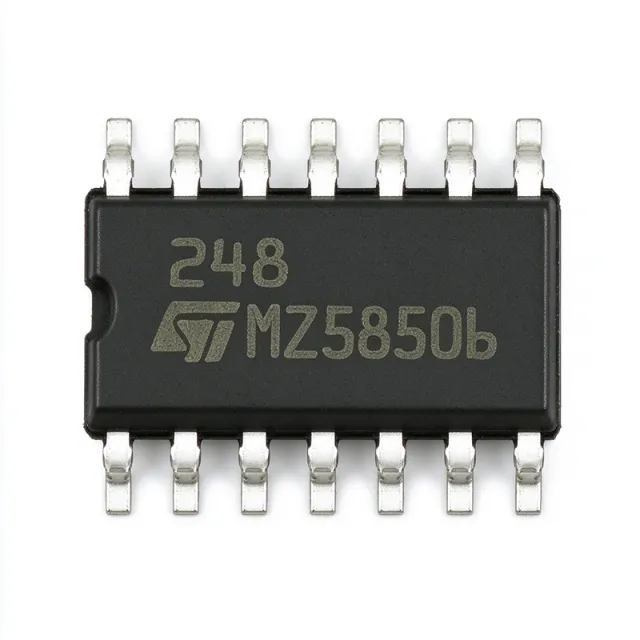
The STMicroelectronics LM248DT is a quad bipolar operational amplifier in a 14-pin SOIC package, providing four independent, high-gain, internally compensated amplifiers with characteristics similar to the UA741. The verified data identifies a 1.3 MHz gain-bandwidth product, 0.5 V/µs slew rate, 1 mV input offset voltage, 2 nA input offset current, 30 nA input bias current, and approximately 0.53 mA supply current per amplifier. The LM248DT is pin-compatible with the LM224 and LM324 families according to the manufacturer datasheet. An operational amplifier is an analog integrated circuit that uses high open-loop gain and negative feedback to amplify small voltage signals. A quad operational-amplifier package contains four amplifiers, allowing a design to implement four independent signal-processing channels while reducing board area and package count. Within the product hierarchy, the LM248DT is a bipolar operational amplifier, a general-purpose analog IC, and a member of the broader amplifier and signal-conditioning category. The LM248DT's Class AB output stage avoids crossover distortion, making it useful where low distortion is preferred over the lower output-current capability associated with CMOS amplifiers. Its internally compensated architecture simplifies closed-loop design without external compensation networks. Low input offset voltage supports precision-feedback applications, while the low input bias and offset currents reduce error in source impedances that are not extremely low. The four amplifiers operate independently, providing internal isolation between channels and allowing simultaneous use in unrelated circuit blocks. The 1.3 MHz gain-bandwidth product supports moderate-bandwidth signal amplification and active filtering, while the 0.5 V/µs slew rate is suitable for general-purpose waveform and feedback tasks. Because bipolar inputs can require more input-bias current than CMOS input amplifiers, source impedance and input-common-mode headroom should be checked against the manufacturer datasheet. Typical uses include industrial process-control loops, instrumentation amplifiers, sensor conditioning, active filters, transducers, and general-purpose analog signal chains. Four amplifiers in one package can be allocated to instrumentation stages, filters, and buffer functions. In designs requiring rail-to-rail input or output behavior, very low supply voltage, or rail-to-rail output drive, a modern precision CMOS amplifier may be more appropriate. When designing around the LM248DT, verify the supply-voltage range, input common-mode range, output swing, operating-temperature grade, and package pinout against the manufacturer datasheet. Decoupling capacitors should be placed close to the supply pins, and unused amplifier channels should be configured according to the datasheet rather than left floating. A common-mode input beyond the specified range can cause input-stage saturation and loss of normal operation. This page combines verified manufacturer and distributor information with pin-compatible alternatives, practical selection guidance, application analysis, and engineering design notes. It is intended to help engineers identify whether the LM248DT fits a legacy or new analog circuit without relying on undocumented assumptions about electrical limits, stock, or cross-references.

USD $0,95 Em estoque
LM248N - Quad 36V 1MHz Op Amp | Texas Instruments
LM248N

LM248N - Quad 36V 1MHz Op Amp | Texas Instruments

The Texas Instruments LM248N is a quad, general-purpose operational amplifier with four independent high-gain amplifiers, a 36 V maximum supply rating, 1 MHz gain-bandwidth product, and a 14-pin PDIP package. The device operates from -25°C to 85°C and is designed for instrumentation, buffering, signal conditioning, and general-purpose analog applications. Its quad organization allows multiple amplifier sections to share one package while retaining independent operation. An operational amplifier is an analog integrated circuit that uses high open-loop gain to amplify the difference between its input voltages. The LM248 belongs to the broader hierarchy of operational amplifier, analog amplifier, and semiconductor devices. Unlike a comparator, the LM248 is intended for linear signal amplification, while its overload protection and internally compensated design support practical feedback-based circuit implementation. The LM248N combines a 1 MHz gain-bandwidth product with a slew rate of 0.5 V/µs, according to the verified product search results. Its input and output overload protection make it suitable for conventional op-amp stages connected to external resistors and feedback networks. The four independent circuits in the package can be assigned separately to instrumentation buffers, active filters, sensor interfaces, or voltage-feedback stages when circuit conditions meet the device requirements. The LM248N is identified by the verified search data as a standard general-purpose amplifier in a 14-PDIP package. The product family is also described as designed to be interchangeable with industry-standard LM148, LM248, and LM348 devices. The verified distributor listing identifies the part as a four-circuit amplifier, confirming the quad-channel architecture and through-hole package format. Typical applications include low-frequency analog signal conditioning, buffered sensor interfaces, audio and communications support circuits, general instrumentation, and multiple-channel analog systems. Because it is a bipolar-style general-purpose amplifier family, designers should verify supply voltage, input common-mode range, output swing, stability, and load conditions against the manufacturer datasheet before finalizing a design. The primary design consideration is to follow the manufacturer’s recommended supply, biasing, feedback, and decoupling arrangements. Because no complete electrical characteristic table or application-specific circuit constraints were included in the verified data, unsupported values are marked for engineering follow-up rather than inferred. This page summarizes verified product identity, architecture, package, and application context alongside sourcing and replacement guidance. This page synthesizes verified manufacturer and distributor information, drop-in replacement considerations, comparison fields, and practical engineering guidance for LM248N selection and PCB integration.

Cotação Contato
LM258AD - Dual 30V 700kHz Op Amp | Texas Instruments
LM258AD

LM258AD - Dual 30V 700kHz Op Amp | Texas Instruments

The Texas Instruments LM258AD is a dual, internally frequency-compensated operational amplifier designed for low-power operation from a single supply. It combines a 30 V maximum supply rating, 700 kHz gain-bandwidth product, 1.1 MHz unity-gain bandwidth, and approximately 500 uA supply current per amplifier in an 8-pin SOIC package. The device provides two independent amplifiers in one package and operates over the -25°C to 85°C temperature range. An operational amplifier is an analog signal-conditioning IC that uses high open-loop gain to amplify the difference between voltages applied to its inverting and non-inverting inputs. The LM258AD belongs to the operational-amplifier family within the broader linear-amplifier and analog-signal-processing hierarchy. Its internally frequency-compensated architecture eliminates the need for an external compensation capacitor in typical closed-loop configurations. Key features include a large DC voltage gain of 100 dB, a 1.1 MHz unity-gain bandwidth, low input bias current of 20 nA, and supply current that remains essentially independent of supply-voltage magnitude. The two amplifiers can be used in non-inverting, inverting, comparator, summing, difference, and general feedback configurations. The single-supply capability also supports battery-powered and industrial signal-conditioning equipment. Each amplifier is intended for operation over a wide supply range, with the verified manufacturer description identifying a 30 V maximum supply voltage and a -25°C to 85°C operating-temperature range. Internal frequency compensation makes the device suitable for straightforward fixed-gain implementations without an additional compensation network. Engineers should still account for input common-mode limits, output swing, stability, input offset, and output-current limitations according to the manufacturer datasheet. Typical applications include transducer and sensor-signal conditioning, low-current industrial control, audio preamplification, bridge-amplifier interfaces, and power-supply feedback networks. The dual configuration saves board area when two low-frequency analog channels are required. Compared with a switching regulator or a modern rail-to-rail amplifier, the LM258AD prioritizes low quiescent current, wide supply-voltage headroom, and straightforward single-supply operation. When laying out the circuit, keep input and feedback paths short and place compensation or filtering capacitors close to their associated pins when required by the selected topology. Check output-current demand and input common-mode range against the actual supply voltage. Do not assume rail-to-rail input or output behavior; the available headroom and output swing are important constraints in low-voltage designs. This page consolidates the verified manufacturer specifications, distributor availability information, package details, and practical selection guidance. It also distinguishes pin-compatible alternatives from merely similar amplifiers and highlights missing electrical data explicitly rather than estimating values that are not established by the supplied sources.

Cotação Contato
LM258ADR - Dual 30V 700kHz Op Amp | Texas Instruments (Tape & Reel)
LM258ADR

LM258ADR - Dual 30V 700kHz Op Amp | Texas Instruments (Tape & Reel)

The Texas Instruments LM258ADR is a dual, internally frequency-compensated operational amplifier designed for low-power operation from a single supply. It combines a 30 V maximum supply rating, 700 kHz gain-bandwidth product, 1.1 MHz unity-gain bandwidth, and approximately 500 uA supply current per amplifier in an 8-pin SOIC package. The device provides two independent amplifiers in one package and operates over the -25°C to 85°C temperature range. An operational amplifier is an analog signal-conditioning IC that uses high open-loop gain to amplify the difference between voltages applied to its inverting and non-inverting inputs. The LM258ADR belongs to the operational-amplifier family within the broader linear-amplifier and analog-signal-processing hierarchy. Its internally frequency-compensated architecture eliminates the need for an external compensation capacitor in typical closed-loop configurations. Key features include a large DC voltage gain of 100 dB, a 1.1 MHz unity-gain bandwidth, low input bias current of 20 nA, and supply current that remains essentially independent of supply-voltage magnitude. The two amplifiers can be used in non-inverting, inverting, comparator, summing, difference, and general feedback configurations. The single-supply capability also supports battery-powered and industrial signal-conditioning equipment. Each amplifier is intended for operation over a wide supply range, with the verified manufacturer description identifying a 30 V maximum supply voltage and a -25°C to 85°C operating-temperature range. Internal frequency compensation makes the device suitable for straightforward fixed-gain implementations without an additional compensation network. Engineers should still account for input common-mode limits, output swing, stability, input offset, and output-current limitations according to the manufacturer datasheet. Typical applications include transducer and sensor-signal conditioning, low-current industrial control, audio preamplification, bridge-amplifier interfaces, and power-supply feedback networks. The dual configuration saves board area when two low-frequency analog channels are required. Compared with a switching regulator or a modern rail-to-rail amplifier, the LM258ADR prioritizes low quiescent current, wide supply-voltage headroom, and straightforward single-supply operation. When laying out the circuit, keep input and feedback paths short and place compensation or filtering capacitors close to their associated pins when required by the selected topology. Check output-current demand and input common-mode range against the actual supply voltage. Do not assume rail-to-rail input or output behavior; the available headroom and output swing are important constraints in low-voltage designs. This page consolidates the verified manufacturer specifications, distributor availability information, package details, and practical selection guidance. It also distinguishes pin-compatible alternatives from merely similar amplifiers and highlights missing electrical data explicitly rather than estimating values that are not established by the supplied sources.

Cotação Contato
LM258AH - Dual 30V Low-Power Op Amp | STMicroelectronics
LM258AH

LM258AH - Dual 30V Low-Power Op Amp | STMicroelectronics

STMicroelectronics LM258AH is a dual, low-power operational amplifier designed for single-supply operation over a wide voltage range, with two independent, internally frequency-compensated amplifiers in an 8-lead TO-99-8 metal package. The LM258 family supports input voltages up to 30 V, operating frequency up to 700 kHz, and an industrial ambient-temperature range of -25 °C to +85 °C. The LM258AH ordering suffix identifies the wire-lead TO-99-8 industrial-temperature configuration. An operational amplifier, or op amp, is a high-gain analog building block used to amplify small voltage signals. Within the wider semiconductor hierarchy, the LM258AH is an analog integrated circuit and a dual operational amplifier. Its two independent channels can support signal conditioning, feedback control, voltage comparison, and general-purpose analog amplification without requiring a split-supply arrangement. The key features of the LM258AH include two amplifiers in one package, internal frequency compensation, and a maximum input voltage of 30 V. The LM258 family is designed around a 700 kHz gain-bandwidth characteristic, while the LM258A version has an input offset voltage specified as 3 mV by the cited manufacturer information. The low-power architecture is intended for applications that require wider supply-voltage tolerance than conventional low-voltage single-supply op amps. The internally compensated architecture simplifies closed-loop amplifier design because it avoids the external compensation components normally required by higher-gain parts. Independent channels may also be used for unrelated signal paths, although common supply pins mean both channels share the same operating rail and thermal environment. Designers should still verify output swing, input common-mode range, output-current capability, and stability against their actual source and load impedances. Typical uses include industrial process-control loops, sensor-signal conditioning, low-frequency filter stages, comparators, and general analog signal chains. The wide operating-voltage capability can simplify legacy and industrial designs that operate from higher single rails. The 700 kHz bandwidth is appropriate for low-frequency precision and control tasks, but it is generally not the preferred choice for high-speed video, RF, or wideband data-acquisition requirements. The principal design considerations are supply decoupling, input common-mode limits, output swing, and thermal behavior. Place the supply bypass capacitor close to the device and avoid driving outputs into hard clamps except where the application intentionally requires saturation. Verify the complete circuit against the STMicroelectronics LM258 datasheet, particularly for AC output current, noise, offset voltage, and load-capacitance stability. This product page consolidates the verified manufacturer and distributor information for the LM258AH and distinguishes the TO-99-8 metal-package option from surface-mount and other package variants. It also provides compatibility-focused replacement guidance, practical circuit considerations, and a specification comparison structured around engineers evaluating an existing TO-99-8 dual-op-amp design.

Cotação Contato
LM258AM - Dual 30V 700kHz Operational Amplifier | onsemi
LM258AM

LM258AM - Dual 30V 700kHz Operational Amplifier | onsemi

onsemi LM258AM is a dual general-purpose operational amplifier designed for single-supply operation, with two independent, internally frequency-compensated amplifiers in an 8-pin SOIC package. The device supports input voltages up to 30 V, operates across the -25°C to +85°C temperature range, and features a 700 kHz gain-bandwidth product. Its dual-channel configuration allows one package to implement two amplification, filtering, comparison, or signal-conditioning functions. An operational amplifier is a high-gain analog signal-processing IC that compares its inverting and non-inverting inputs and drives its output according to the voltage difference between them. The LM258 family belongs to the operational-amplifier category within analog amplifiers and linear integrated circuits. It is intended for general-purpose designs rather than precision, low-noise, or high-speed instrumentation, providing a practical balance of supply range, gain, common-mode capability, and output swing. Key features include two independent channels, large DC voltage gain of 100 dB, and internal frequency compensation that supports unity-gain operation without an external compensation network. The input common-mode voltage range includes ground, supporting single-supply signal conditioning where the signal is referenced to 0 V. These characteristics make the LM258AM suitable for transducers, industrial controls, audio and communication interfaces, sensor amplification, and general feedback-control circuits. The architecture is based on two independent high-gain amplifier sections with internal compensation. Internal compensation simplifies PCB design and improves usability at unity gain, while the wide supply range permits operation from lower-voltage single supplies through industrial supplies up to 30 V. Because this is a general-purpose bipolar-style amplifier family, engineers should verify input common-mode limits, output swing, load capability, stability, and supply-current requirements against the manufacturer datasheet for the exact operating conditions. Typical applications include current-loop and voltage-feedback control, low-side sensing, sensor signal conditioning, audio preamplification, active filtering, threshold detection, and general industrial interface circuits. The dual arrangement is especially useful when a design needs two related functions, such as an error amplifier paired with a buffer or a comparator paired with a gain stage. When laying out an LM258AM circuit, keep input and feedback connections compact to minimize parasitic pickup, provide adequate supply bypassing near the device, and verify that source and load impedances remain within the stability requirements of the internal compensation. The SOIC-8 package also allows a smaller footprint than a traditional through-hole dual operational amplifier. This page consolidates the LM258AM electrical characteristics, package information, verified source links, replacement considerations, comparison parameters, and practical design guidance into one engineering-focused resource for part selection and PCB implementation.

Cotação Contato
LM258AN - Dual Low-Power Op Amp | STMicroelectronics
LM258AN

LM258AN - Dual Low-Power Op Amp | STMicroelectronics

STMicroelectronics LM258AN is a low-power dual operational amplifier containing two independent, high-gain, internally frequency-compensated amplifiers. It is packaged in an 8-pin Mini DIP and is designed for single-supply operation over a wide voltage range. Each channel is internally compensated for unity-gain stability, allowing operation without an external frequency-compensation network. An operational amplifier, or op amp, is a voltage-gain amplifier that compares an inverting input with a non-inverting input and drives its output toward the difference between them. The LM258 belongs to the broader linear-IC hierarchy: operational amplifier, analog amplifier, voltage amplifier, and semiconductor. Internally compensated dual op amps are useful when a board needs two independent amplifier channels while limiting component count and keeping the two channels in one package. The LM258AN provides two amplifier circuits with a large DC voltage gain of 100 dB and unity-gain frequency compensation. Its input common-mode voltage range includes ground, an important characteristic for circuits powered from a single positive supply and biased near the lower supply rail. The low-power architecture is designed to maintain low supply drain independently of the magnitude of the supply voltage, according to the manufacturer family documentation. Each amplifier channel has separate input and output pins, while the two channels share the power supply connections. This arrangement supports conventional non-inverting, inverting, voltage follower, summing, and differential signal-conditioning circuits. Because the amplifiers are internally compensated, stable unity-gain operation can be implemented with a minimum external feedback network, reducing design effort in general-purpose analog equipment. Typical LM258AN applications include sensor-signal conditioning, industrial control loops, low-frequency active filters, relay-driver interfaces, audio preamplifier stages, and buffered measurement systems. The dual configuration is especially useful when a circuit requires two related analog channels, such as an instrumentation amplifier input stage, motor-control feedback network, or dual-channel sensor interface. When designing around the LM258AN, verify the exact input common-mode range, output swing, supply-current limits, and operating-temperature limits for the LM258 variant against the STMicroelectronics datasheet. Decoupling capacitors should be placed close to the supply pins, and the feedback network should preserve stable operation at the intended signal frequency. This product page combines the LM258AN family characteristics, package information, sourcing guidance, comparison parameters, and practical circuit-planning notes. It is intended to help engineers evaluate the device for single-supply analog designs and identify same-package alternatives without overlooking package or qualification differences.

Cotação Contato
LM258AP - Dual 30V 700kHz Op Amp | Texas Instruments
LM258AP

LM258AP - Dual 30V 700kHz Op Amp | Texas Instruments

Texas Instruments LM258AP is a dual, general-purpose operational amplifier supplied in an 8-pin PDIP package. It supports operation from a single supply or split supply over a wide voltage range, with a maximum total supply voltage of 32 V. The LM258 family provides 700 kHz gain-bandwidth product, 0.3 V/µs slew rate, and approximately 3 mV input offset voltage for the LM258A version, making it suitable for conventional analog signal conditioning. An operational amplifier is an analog semiconductor that amplifies the voltage difference between its two inputs. Its applications include voltage buffers, current-to-voltage conversion, active filters, comparators, instrumentation circuits, and low-frequency closed-loop control. The dual LM258 architecture provides two amplifiers in one package, reducing board area in designs that need independent or complementary analog channels. The LM258A operating-temperature range extends from -25°C to 85°C. The principal characteristics are a 700 kHz typical gain-bandwidth product, 0.3 V/µs slew rate, and 3 mV offset voltage for LM258A. The device operates with total supply voltages from 3 V to 32 V, including single-supply configurations near 3 V and split supplies up to approximately ±16 V. Its 8-pin PDIP package also facilitates prototyping and through-hole assembly where leaded components are preferred. LM258 devices are internally frequency-compensated dual operational amplifiers. Internal compensation allows operation as unity-gain voltage followers without external compensation components, which simplifies many basic amplifier layouts. Users must still observe input common-mode and output-swing limits, maintain the specified supply voltage, and use adequate bypassing to prevent oscillation or unexpected analog noise. The dual configuration also permits one channel to perform signal amplification while the other handles a separate task. Typical uses include low-frequency active filters, DC sensor amplification, industrial control-signal conditioning, audio preamplifier stages, comparators, and general instrumentation. In a basic non-inverting stage, the closed-loop gain is established by the feedback network, while the amplifier provides high input impedance and low output impedance. In a transimpedance stage, the feedback resistor converts input current into a voltage, making the LM258 suitable for photodiode and detector interfaces when operating within its bandwidth and dynamic-range limits. A critical design consideration is to place the specified bypass capacitor close to the supply pins and route feedback components to minimize parasitic capacitance and oscillation risk. Check common-mode input range, output swing, load capability, and thermal dissipation at the actual supply voltage. Keep sensitive input nodes away from switching-current paths and use a stable ground reference to reduce offset and noise pickup. This product page combines manufacturer specifications, package details, drop-in alternatives, application guidance, and design considerations for engineers evaluating the LM258AP. It also distinguishes verified electrical parameters from parameters that require design confirmation, helping teams plan analog prototypes, production PCB layouts, and replacement decisions with fewer assumption-driven errors.

Cotação Contato
LM258D - Dual 30V Operational Amplifier | STMicroelectronics
LM258D

LM258D - Dual 30V Operational Amplifier | STMicroelectronics

The STMicroelectronics LM258D is a dual, internally frequency-compensated operational-amplifier IC with two independent amplifiers, a 30 V maximum supply rating and a 700 kHz gain-bandwidth product. Each amplifier is designed for general-purpose signal conditioning from single or split supplies. The device is packaged for surface mounting in an 8-pin SOIC and is identified by the DigiKey listing as a standard, general-purpose, two-circuit amplifier. The supplied source data confirms the 30 V and 700 kHz headline ratings through Texas Instruments’ LM258 family page, but it does not provide a complete STMicroelectronics parameter table. An operational amplifier is a voltage-gain element that uses external feedback to control closed-loop behavior. The LM258D belongs to the dual operational-amplifier hierarchy and contains two independent amplifiers in one package. Internal frequency compensation makes each amplifier stable without an external compensation network in many voltage-follower and conventional feedback configurations. Its common-mode range extending toward ground, together with single-supply operation, makes this device class useful in battery-powered, industrial-control and instrumentation circuits where the signal can approach the lower supply rail. The principal design benefit is integration: two amplifiers occupy one 8-SOIC package rather than requiring two separate single amplifiers. Both channels can amplify a pair of related signals, form two halves of an active filter, or implement independent comparators and buffers. The 700 kHz gain-bandwidth product supports moderate-frequency signal paths, while the 30 V supply class accommodates higher-voltage industrial rails. Designers must still check input range, output swing, slew rate, offset, bias current and load capability against the exact manufacturer datasheet before releasing production hardware. Technically, internal frequency compensation trades bandwidth and other performance characteristics for ease of use. Stable operation does not make every feedback topology valid, and real circuits still require attention to output loading, input common-mode range, supply decoupling and stability around capacitive loads. Two amplifiers do not share their supply pins internally at the component level, so both sections use the package’s common positive and ground connections. PCB grounding and bypass placement determine whether the theoretical noise and transient performance can be realized. Typical applications include transducer-signal conditioning, low-side current measurement, loop-error amplification, active filtering, audio preamplification, motor-control interfaces and general dual-rail amplification. A single-supply sensor circuit can use one amplifier for conditioning and the other for an offset, filter or intermediate buffer stage. Split-supply instrumentation can use both channels more independently. Compared with modern low-voltage rail-to-rail amplifiers, the LM258D trades compactness and precision for its wide-supply capability and straightforward general-purpose use. When designing around the LM258D, place the supply bypass capacitor close to the IC and route each amplifier’s inputs and outputs to minimize leakage and feedback-loop pickup. Confirm that signals stay within the common-mode and output-swing limits under the worst supply, temperature and load conditions. Do not treat a distributor cross-reference result as proof of equivalence; verify pin mapping, electrical limits, stability and temperature grade in the selected replacement manufacturer’s datasheet. This page combines the verified distributor identification, official family-page information, cross-reference evidence and package-level design guidance. It distinguishes confirmed facts from parameters that were not supplied, avoiding invented precision while helping engineers evaluate LM258D procurement, replacement and circuit-integration decisions.

Cotação Contato
LM258DG - Dual 1 MHz Op Amp, 3-32 V | onsemi Industrial
LM258DG

LM258DG - Dual 1 MHz Op Amp, 3-32 V | onsemi Industrial

The onsemi LM258DG is a dual general-purpose operational amplifier with two amplifier circuits, a 1 MHz gain-bandwidth product, a 0.6 V/µs slew rate, and an operating supply range of 3 V to 32 V. The device is supplied in an 8-pin SOIC package. Its low-power design, common-mode input range extending toward ground or VEE, and support for single-supply or split-supply operation make it suitable for industrial control, instrumentation, sensor conditioning, and low-frequency signal-processing systems. An operational amplifier, or op amp, is a voltage-gain building block within analog and mixed-signal electronics. A dual op amp contains two amplifiers in one package, allowing one device to implement two independent signal paths or a differential stage. The LM258DG belongs to the operational-amplifier hierarchy: dual operational amplifier, general-purpose amplifier, analog IC, and ultimately semiconductor. Its broad supply range accommodates conventional industrial rails, while its ground-referenced input capability simplifies designs powered from a single supply. Key verified characteristics include two amplifier circuits, 1 MHz gain-bandwidth product, 0.6 V/µs slew rate, and operation from 3 V to 32 V. The listed operating temperature range is -25 °C to 85 °C. Because the gain-bandwidth product is 1 MHz, the device is best suited to low-frequency amplification, buffering, comparators, and general feedback-control loops rather than high-speed signal processing. The LM258 architecture derives from the circuit designs used in quad operational amplifiers. This dual configuration provides functional flexibility while limiting package count and board area. Single-supply operation allows the input and output signals to remain near the lower supply rail, and split-supply operation permits bipolar-style signal paths. The verified operating range supports both 3 V minimum-supply designs and higher-voltage industrial systems. Typical applications include sensor signal conditioning, transducer amplification, current-loop interfaces, low-frequency active filters, and general-purpose analog buffers. Its two channels can also be used together as a differential amplifier when the circuit requires matched amplifier functions in one package. Applications should account for the 1 MHz bandwidth and 0.6 V/µs slew rate when setting gain, bandwidth, and expected output slew behavior. A key design consideration is verifying input and output voltage excursions for the selected single- or split-supply configuration. Decoupling and stability should be implemented around the circuit required by the ON Semiconductor LM258 datasheet and the particular feedback network. Because detailed pin names, offset voltage, input bias current, and noise figures were not supplied in the verified data, those values must be confirmed before production release. This page consolidates verified distributor specifications, sourcing information, same-package replacement candidates, and practical selection guidance. It adds engineering context for supply-range, bandwidth, packaging, and replacement decisions while clearly separating verified facts from unavailable parameters.

Cotação Contato
LM258DR - Dual 30V Operational Amplifier | STMicroelectronics (Tape & Reel)
LM258DR

LM258DR - Dual 30V Operational Amplifier | STMicroelectronics (Tape & Reel)

The STMicroelectronics LM258DR is a dual, internally frequency-compensated operational-amplifier IC with two independent amplifiers, a 30 V maximum supply rating and a 700 kHz gain-bandwidth product. Each amplifier is designed for general-purpose signal conditioning from single or split supplies. The device is packaged for surface mounting in an 8-pin SOIC and is identified by the DigiKey listing as a standard, general-purpose, two-circuit amplifier. The supplied source data confirms the 30 V and 700 kHz headline ratings through Texas Instruments’ LM258 family page, but it does not provide a complete STMicroelectronics parameter table. An operational amplifier is a voltage-gain element that uses external feedback to control closed-loop behavior. The LM258DR belongs to the dual operational-amplifier hierarchy and contains two independent amplifiers in one package. Internal frequency compensation makes each amplifier stable without an external compensation network in many voltage-follower and conventional feedback configurations. Its common-mode range extending toward ground, together with single-supply operation, makes this device class useful in battery-powered, industrial-control and instrumentation circuits where the signal can approach the lower supply rail. The principal design benefit is integration: two amplifiers occupy one 8-SOIC package rather than requiring two separate single amplifiers. Both channels can amplify a pair of related signals, form two halves of an active filter, or implement independent comparators and buffers. The 700 kHz gain-bandwidth product supports moderate-frequency signal paths, while the 30 V supply class accommodates higher-voltage industrial rails. Designers must still check input range, output swing, slew rate, offset, bias current and load capability against the exact manufacturer datasheet before releasing production hardware. Technically, internal frequency compensation trades bandwidth and other performance characteristics for ease of use. Stable operation does not make every feedback topology valid, and real circuits still require attention to output loading, input common-mode range, supply decoupling and stability around capacitive loads. Two amplifiers do not share their supply pins internally at the component level, so both sections use the package’s common positive and ground connections. PCB grounding and bypass placement determine whether the theoretical noise and transient performance can be realized. Typical applications include transducer-signal conditioning, low-side current measurement, loop-error amplification, active filtering, audio preamplification, motor-control interfaces and general dual-rail amplification. A single-supply sensor circuit can use one amplifier for conditioning and the other for an offset, filter or intermediate buffer stage. Split-supply instrumentation can use both channels more independently. Compared with modern low-voltage rail-to-rail amplifiers, the LM258DR trades compactness and precision for its wide-supply capability and straightforward general-purpose use. When designing around the LM258DR, place the supply bypass capacitor close to the IC and route each amplifier’s inputs and outputs to minimize leakage and feedback-loop pickup. Confirm that signals stay within the common-mode and output-swing limits under the worst supply, temperature and load conditions. Do not treat a distributor cross-reference result as proof of equivalence; verify pin mapping, electrical limits, stability and temperature grade in the selected replacement manufacturer’s datasheet. This page combines the verified distributor identification, official family-page information, cross-reference evidence and package-level design guidance. It distinguishes confirmed facts from parameters that were not supplied, avoiding invented precision while helping engineers evaluate LM258DR procurement, replacement and circuit-integration decisions.

Cotação Contato
LM258DT - Dual 30V Low-Power Op Amp | STMicroelectronics
LM258DT

LM258DT - Dual 30V Low-Power Op Amp | STMicroelectronics

The STMicroelectronics LM258DT is a low-power, dual, internally frequency-compensated operational amplifier with two independent amplifiers, a 3 V to 30 V single-supply operating range, and an 8-pin SOIC package. Its unity-gain bandwidth is 1.1 MHz, while its slew rate is 0.6 V/us. The device is designed for single-supply operation over a wide voltage range and provides large DC voltage gain of 100 dB. An operational amplifier is an analog signal-conditioning IC that uses high open-loop gain and negative feedback to amplify, buffer, filter, or compare voltages. The LM258DT belongs to the bipolar operational-amplifier family and combines two amplifiers in one package, reducing board area when a circuit needs matched general-purpose gain stages. Its internally frequency-compensated architecture simplifies closed-loop design because the compensation network is integrated rather than added externally. Each amplifier offers a unity-gain bandwidth of 1.1 MHz and a slew rate of 0.6 V/us, making the device suitable for audio-frequency signal paths, sensor conditioning, active filtering, voltage amplification, and general feedback-control blocks. The low-power supply drain is approximately 500 uA per amplifier and is essentially independent of supply-voltage magnitude. The low input bias current of approximately 20 nA also helps minimize source-loading errors in high-impedance sensing circuits. The dual architecture supports independent signal paths, including two noninverting stages, two inverting stages, mixed gain stages, or a buffer paired with an active filter. Both amplifiers share the same supply pins but operate independently. Their common supply range allows them to use a single rail in portable instrumentation, industrial control, sensor interfaces, and low-voltage embedded systems. The 8-SOIC package is suitable for conventional surface-mount PCB assembly and temperature-controlled lead-free manufacturing processes. Designers should account for input and output voltage limitations when using a single positive supply. The LM258DT is not a rail-to-rail input or output device, so the usable signal range must remain inside the common-mode and output-swing limits stated in the manufacturer datasheet. Place bypassing capacitors close to the supply pins and maintain adequate PCB copper for heat dissipation. Stable operation also depends on selecting appropriate feedback components and avoiding capacitive loading directly at the amplifier output. This product page combines the LM258DT electrical characteristics, package and pin information, application guidance, comparison criteria, and practical design considerations into a compact engineering reference for initial design decisions.

Cotação Contato
LM258H - Dual 30V 700kHz Op Amp | Texas Instruments
LM258H

LM258H - Dual 30V 700kHz Op Amp | Texas Instruments

The Texas Instruments LM258H is a dual general-purpose operational amplifier with a 30 V supply rating, 700 kHz gain-bandwidth product, and operation from -25°C to 85°C. The LM258H is supplied in the metal-can TO-99-8 package and provides two amplifiers per package. Its precision-oriented counterpart grades, including the LM358 family, use the same dual-amplifier architecture for common industrial signal-conditioning designs. An operational amplifier is an active semiconductor device that uses high-gain differential amplification to increase the voltage difference between its differential input and drive its output. Operational amplifiers belong to the amplifier IC hierarchy and are commonly used in sensor interfaces, buffer stages, integrators, comparators, and control loops. The LM258 family is positioned as a general-purpose bipolar amplifier rather than a high-speed, low-noise, or precision-specific device. The manufacturer identifies the LM258 family as dual, 30 V, 700 kHz operational amplifiers. The LM258H ordering variant is associated with the TO-99-8 metal-can package, while the broader LM258 family also includes other package and temperature options. The verified distributor listing describes LM258H as a two-circuit amplifier in a TO-99-8 package. The H suffix is used in the manufacturer ordering information, but individual suffix-specific electrical values must be confirmed against the ordering table in the manufacturer datasheet. The 700 kHz gain-bandwidth product is the principal verified speed parameter. It describes the approximate closed-loop bandwidth available for unity-gain operation under the stated test conditions, subject to the manufacturer datasheet's load and test assumptions. The 30 V rating identifies the device as suitable for higher-voltage analog signal chains than basic low-voltage single-supply amplifiers, provided the selected grade and supply arrangement meet the complete datasheet limits. Operating temperature is specified from -25°C to 85°C for the LM258 family. Typical uses include buffered sensor signals, low-frequency active filters, analog summing and difference amplifiers, current-loop buffering, audio and communications signal conditioning, and general industrial control interfaces. Because the verified data does not provide output-current, input-offset, noise, slew-rate, load-current, common-mode, or package-dimension values, those parameters should not be inferred for design calculations. Engineers should use the manufacturer datasheet for the exact LM258H grade limits and test conditions. The main design consideration is ensuring that the selected dual amplifier's pinout, supply voltages, input common-mode range, output swing, and load conditions match the completed analog design. TO-99-8 is a through-hole metal-can package, so PCB footprint selection and mechanical clearance require the package drawing rather than a modern SMD assumption. Decoupling, grounding, and stable feedback compensation remain necessary even when using a general-purpose amplifier. This page combines the verified manufacturer product identity, distributor package information, ordering context, and design-oriented interpretation. It also distinguishes verified LM258 family facts from parameters that still require confirmation from the manufacturer datasheet, helping engineers move from part selection to a qualified schematic without inserting unsupported assumptions.

Cotação Contato
LM258N - Dual 32 V 700 kHz Op Amp | Amplifier IC
LM258N

LM258N - Dual 32 V 700 kHz Op Amp | Amplifier IC

The LM258N is a dual, general-purpose operational amplifier designed for single-supply operation over a 3 V to 30 V range, with a stated 32 V maximum supply rating in the verified product data. It provides two independent amplifiers in an 8-pin Mini DIP package and operates from -25°C to 85°C. Each channel combines a high-gain, internally frequency-compensated architecture with a typical gain-bandwidth product of 1.1 MHz and a typical slew rate of 0.6 V/µs. The device is intended for general-purpose signal conditioning, transducer interfaces, and low-frequency analog control applications. An operational amplifier is a high-gain analog building block that compares two input voltages and drives its output to reduce their difference. A differential input amplifier, voltage follower, comparator-style interface, or control loop can be built around the LM258N when the required bandwidth, slew rate, supply voltage, and input/output range fit the device. The LM358-family architecture also allows operation from a single supply or split supply, making it useful in systems whose signal is referenced near ground. Verified product information identifies the LM258-N as a dual 32 V, 700 kHz operational amplifier with -25°C to 85°C operation. The related LM258N distributor listings identify an 8-pin Mini DIP package and a general-purpose dual amplifier configuration. The device is therefore suited to industrial and instrumentation circuits where a through-hole package and wide supply range are useful, provided the circuit designer checks the exact manufacturer datasheet for input common-mode limits, output swing, supply current, offset voltage, and thermal limits. The internally compensated amplifiers simplify implementation of unity-gain and conventional inverting or non-inverting stages because no external compensation network is required for ordinary closed-loop use. The 1.1 MHz gain-bandwidth product supports many low-frequency signal paths, while the 0.6 V/µs slew rate limits large-signal response. These characteristics make the LM258N more appropriate for instrumentation, buffering, and control than for high-speed signal chains. Typical uses include sensor signal conditioning, low-frequency active filters, audio and communications interface stages, analog control loops, and general dual-amplifier boards. In a single-supply circuit, the input and output signal ranges must remain inside the device's allowable common-mode and output-swing limits. The 8-pin DIP package also favors through-hole prototyping and repairable industrial assemblies. For PCB layout, keep input and feedback paths short, provide a solid ground reference, and place decoupling capacitors close to the supply pins. Avoid placing noisy switching nodes beside high-impedance input traces. Because the verified data does not provide every electrical limit, exact compliance status, pricing, or an official pin mapping for the generic LM258N ordering code, those details remain marked as data needed rather than inferred.

Cotação Contato
LM258NG - Dual 1MHz Operational Amplifier | onsemi
LM258NG

LM258NG - Dual 1MHz Operational Amplifier | onsemi

onsemi LM258NG is a dual, general-purpose operational amplifier with a 1 MHz gain-bandwidth product, 0.6 V/µs slew rate, and operation from 3 V to 32 V in an 8-pin PDIP package. The device provides two amplifier circuits in one through-hole package and supports single-supply or split-supply operation. Its common-mode input voltage range extends toward ground or VEE, making it suitable for industrial, instrumentation, control, and signal-conditioning systems where single-rail operation is advantageous. An operational amplifier is a high-gain differential amplifier used to amplify, buffer, compare, or integrate signals. The LM258NG belongs to the dual general-purpose operational-amplifier class and within the broader hierarchy of analog ICs, analog signal-chain components, and semiconductor devices. Unlike rail-to-rail precision amplifiers, its practical input and output ranges depend on its supply voltage and circuit configuration. Designers should therefore evaluate common-mode range, output swing, input bias current, and load capability against their signal levels. The principal verified characteristics are a 1 MHz gain-bandwidth product, 0.6 V/µs slew rate, dual-circuit construction, and a 3 V to 32 V operating supply range. The low-power-drain architecture is useful in battery-powered or space-constrained equipment, while the common-mode range extending to ground or VEE improves usefulness in systems powered from one positive rail. The 8-pin PDIP package also supports conventional through-hole assembly and socket-level serviceability. The LM258NG architecture is suited to general-purpose feedback stages rather than high-speed signal chains. A 1 MHz gain-bandwidth product provides usable bandwidth at modest closed-loop gains, while the 0.6 V/µs slew rate limits how quickly output voltage can follow a changing input. In gain configurations with substantial noise gain, the available closed-loop bandwidth is lower. Stable feedback-network design and appropriate output loading are therefore necessary to avoid oscillation or slew-limited operation. Typical uses include low-frequency sensor signal conditioning, industrial control-loop amplifiers, audio preamplification, comparators with external hysteresis, and buffered instrumentation inputs. The dual configuration can implement two independent amplifier sections on one PCB. In a single-supply circuit, input and output grounding must be referenced carefully because the common-mode range reaches ground or VEE but is not necessarily a rail-to-rail input specification. A key design consideration is power-supply decoupling: place a suitable bypass capacitor close to each supply pin and route return currents without splitting analog ground paths. Check output swing and load current at the lowest supply voltage, and use output isolation when driving capacitive loads. These checks are especially important because the available verified data does not specify detailed offset, bias-current, thermal, or output-drive limits. This page consolidates verified distributor specifications, package information, practical application guidance, and verified web-data drop-in candidates. It also distinguishes confirmed facts from parameters that still require confirmation from the manufacturer datasheet, helping engineers identify the LM258NG quickly while avoiding unsupported assumptions.

Cotação Contato
LM258P - Dual 30 V 700 kHz Op Amp | Texas Instruments
LM258P

LM258P - Dual 30 V 700 kHz Op Amp | Texas Instruments

The Texas Instruments LM258P is a dual, internally frequency-compensated operational amplifier with a 30 V supply rating, 700 kHz gain-bandwidth product, and operation from -25°C to 85°C, housed in an 8-pin PDIP package. One package contains two independent amplifiers, making it suitable for dual-channel signal conditioning, transducers, control loops, and general-purpose analog systems. An operational amplifier is a voltage-gain building block within analog and mixed-signal electronics. The LM258P belongs to the bipolar operational-amplifier family, combining differential inputs, high voltage gain, internal frequency compensation, and common operation from a single or split supply. Its two independent channels allow simultaneous amplification, filtering, buffering, or feedback control without requiring two separate amplifier packages. The verified source data identifies a wide supply-voltage operating range, high DC voltage gain, unity-gain bandwidth, low supply current, and low input-bias current. The search results specifically identify 100 dB large DC voltage gain, 1.1 MHz unity-gain bandwidth, approximately 500 µA supply current per amplifier, and approximately 20 nA input-bias current. These characteristics make the device relevant to instrumentation where useful closed-loop accuracy is more important than very high speed. Each amplifier is independently compensated, allowing normal operation without external frequency-compensation components. Input and output-device choices support practical single-supply and split-supply arrangements, while the dual configuration can reduce board area in paired channels. Nevertheless, output-current capability, common-mode limits, input-offset behavior, noise, and stability should be checked against the complete manufacturer datasheet before precision or load-heavy use. Typical uses include transducer signal conditioning, low-frequency active filters, sensor amplification, instrumentation amplifiers, sample-and-hold interfaces, and industrial control loops. The 8-pin PDIP package is appropriate for through-hole assembly and prototypes, and its wide temperature coverage supports equipment operating across industrial temperature ranges. PCB design should keep input and feedback paths short, provide adequate supply bypassing, and maintain a stable reference or mid-supply point when the output must remain biased above ground in single-supply operation. Avoid relying on the verified snippets for load-current or saturation limits; those values require the complete LM258 manufacturer datasheet. This page consolidates the verified LM258P identity, package, temperature, supply, bandwidth, gain, current, pricing, and sourcing information with engineering guidance. It also distinguishes verified facts from parameters that still require full-datasheet confirmation, providing a practical basis for initial design and procurement review.

Cotação Contato
LM258PT - Dual 1.1 MHz Low-Power Op Amp | STMicroelectronics
LM258PT

LM258PT - Dual 1.1 MHz Low-Power Op Amp | STMicroelectronics

The STMicroelectronics LM258PT is a dual low-power bipolar operational amplifier packaged in an 8-pin TSSOP. Each of its two independent, internally frequency-compensated amplifiers provides a 100 dB large-signal voltage gain, a 1.1 MHz unity-gain bandwidth, and approximately 500 uA of supply current per amplifier. The device is designed for single-supply operation across a wide voltage range and supports general-purpose signal conditioning. An operational amplifier, or op amp, is a high-gain differential-input amplifier whose inverting and non-inverting inputs produce a single-ended output. Internally frequency-compensated op amps such as the LM258PT are internally stabilized for unity-gain operation without an external compensation network. This makes them suitable for amplifier, buffer, comparator, transducer, and feedback-control circuits where simplicity and low quiescent current are more important than very high bandwidth. Key characteristics include two amplifier circuits in one package, a large DC voltage gain of 100 dB, a 1.1 MHz unity-gain bandwidth, approximately 500 uA of supply current per amplifier, and a typical input bias current of 20 nA. Because the two channels are independent, engineers can use them for cascaded gain stages, differential signal conditioning, active filtering, or separate control and monitoring functions. The internal frequency compensation eliminates the need for external dominant-pole components in most unity-gain applications. The LM258PT is a bipolar-input general-purpose amplifier rather than a rail-to-rail CMOS op amp. Its design is appropriate when a single supply rail is available, input-referred offset is not the dominant system requirement, and operation from a non-rail-to-rail output range is acceptable. Designers must still account for the output-swing limits, common-mode input range, stability requirements, and load capability described by the manufacturer datasheet. Typical uses include low-frequency transducer amplification, sensor signal conditioning, audio preamplification, battery-powered instrumentation, feedback amplifiers in control loops, and general dual-amplifier boards. Its 8-pin TSSOP footprint permits compact surface-mount layouts, while the low 500 uA-per-amplifier supply current helps preserve battery life in portable systems. The main design consideration is stability around the op amp. Place input and output components close to their associated pins, verify capacitive loading against the datasheet stability limits, and avoid driving the output into hard clipping when the input signal exceeds the available output swing. Using the device as a unity-gain buffer requires particular care with capacitive loads because the internal compensation is optimized for a specified load range. This page consolidates manufacturer and distributor information, package details, verified pricing, drop-in alternatives, application guidance, and design notes. It is intended to complement the manufacturer datasheet with selection and implementation context that is not normally presented on a distributor listing page.

Cotação Contato
LM258QT - Dual 1.1MHz Op Amp | STMicroelectronics
LM258QT

LM258QT - Dual 1.1MHz Op Amp | STMicroelectronics

The STMicroelectronics LM258QT is a low-power dual operational amplifier with two independent, internally frequency-compensated amplifiers, a 1.1 MHz unity-gain bandwidth, 100 dB large-signal voltage gain, and an 85 dB common-mode rejection ratio. The device is supplied in an 8-pin DFN package measuring 2 x 2 mm and operates from 3 V to 30 V on a single supply or from ±1.5 V to ±15 V on dual supplies. An operational amplifier is a high-gain analog signal-conditioning IC that compares differential input voltages and amplifies the result. The LM258QT belongs to the operational amplifier hierarchy, where it combines amplifier signal gain, input protection, frequency compensation, and output-current capability in one package. Its two independent channels make it useful for dual-channel signal paths, instrumentation, transducer amplification, and general-purpose analog control. Key features include a 1.1 MHz gain-bandwidth product, 0.6 V/µs slew rate, 2 mV input offset voltage, approximately 20 nA input bias current, and 100 dB DC voltage gain. The low-power architecture is intended for operation across a broad supply-voltage range, while internal frequency compensation avoids the need for external compensation components in standard closed-loop configurations. The two amplifiers are independent, allowing them to amplify different signals or drive separate analog stages. Its 85 dB CMRR helps reject common-mode interference, while its 0.6 V/µs slew rate supports moderate signal slewing requirements. The 1.1 MHz bandwidth is appropriate for low-to-moderate-frequency precision and control circuits rather than high-speed video or RF signal chains. Typical applications include sensor and transducer signal conditioning, industrial control loops, low-frequency measurement instrumentation, audio preamplification, and general-purpose dual-channel amplification. The two-amplifier configuration can reduce component count when a board needs two related analog functions, provided both channels have compatible signal ranges and grounding requirements. Designers should preserve the datasheet-recommended bypass capacitance, verify output swing and load-current limits, and account for input common-mode range near the supply rails. The DFN-8 package also requires careful PCB layout, exposed-pad thermal management, and short feedback and input paths to preserve stability and reduce parasitic effects. This page consolidates verified distributor pricing, package and electrical details, practical application guidance, and pin-compatible replacement information. It also highlights the LM258QT's key engineering trade-offs so purchasing and design decisions can be made against verified source data rather than generic operational-amplifier assumptions.

Cotação Contato