Produtos (20.000+)

MSP430G2553IPW20 - 16MHz 16KB MCU | Texas Instruments
MSP430G2553IPW20

MSP430G2553IPW20 - 16MHz 16KB MCU | Texas Instruments

The Texas Instruments MSP430G2553IPW20 is a 16-bit mixed-signal microcontroller operating at up to 16 MHz, with 16 KB of Flash memory, 512 bytes of SRAM, and a 20-pin TSSOP (PW) package. According to the Texas Instruments product page, the device includes comparator, UART, SPI, I2C, and timer resources for compact embedded control designs. A microcontroller is a programmable semiconductor that integrates a CPU core, memory, input/output ports, and peripherals into one device. The MSP430 belongs to the mixed-signal MCU family, combining digital control with analog comparison capability and low-power operating modes. This makes it useful for embedded products that must measure a signal, control peripherals, communicate with external systems, or operate from limited power budgets. The MSP430G2553IPW20 provides 16 KB of Flash for firmware, 512 bytes of SRAM for working data, and a maximum clock frequency of 16 MHz. Its listed peripherals include a comparator, UART, SPI, I2C, and timer. The supplied distributor and manufacturer snippets identify the industrial temperature range as -40 °C to +85 °C and the package as 20-pin TSSOP (PW). The verified source data does not provide the complete pin-level electrical table, so individual pin functions and several operating-current values remain unverified. The MSP430G2553 platform is suited to low-power embedded control, sensor conditioning, communication bridges, and small control nodes. The comparator can support threshold-based analog supervision, while the serial interfaces allow connection to displays, sensors, transceivers, or storage devices. The 16 MHz CPU class is appropriate for event handling, protocol management, and control logic where deterministic behavior is more important than workstation-class processing. When designing a board around this MCU, verify the device pinout and the detailed electrical limits in the manufacturer datasheet before routing power, programming signals, communication interfaces, and analog inputs. Pay particular attention to decoupling, oscillator configuration, unused pins, programming access, and the selected supply voltage. Firmware and peripheral assignments should also be checked against the exact device variant and package. This page combines the verified Texas Instruments product information with distributor references, application guidance, and procurement considerations. It is intended to help engineers identify the correct MSP430G2553IPW20 for low-power embedded systems while clearly separating confirmed specifications from parameters that still require datasheet confirmation.

Cotação Contato
MSP430G2553IPW20R - 16MHz 16KB MCU | Texas Instruments (Tape & Reel)
MSP430G2553IPW20R

MSP430G2553IPW20R - 16MHz 16KB MCU | Texas Instruments (Tape & Reel)

The Texas Instruments MSP430G2553IPW20R is a 16-bit mixed-signal microcontroller operating at up to 16 MHz, with 16 KB of Flash memory, 512 bytes of SRAM, and a 20-pin TSSOP (PW) package. According to the Texas Instruments product page, the device includes comparator, UART, SPI, I2C, and timer resources for compact embedded control designs. A microcontroller is a programmable semiconductor that integrates a CPU core, memory, input/output ports, and peripherals into one device. The MSP430 belongs to the mixed-signal MCU family, combining digital control with analog comparison capability and low-power operating modes. This makes it useful for embedded products that must measure a signal, control peripherals, communicate with external systems, or operate from limited power budgets. The MSP430G2553IPW20R provides 16 KB of Flash for firmware, 512 bytes of SRAM for working data, and a maximum clock frequency of 16 MHz. Its listed peripherals include a comparator, UART, SPI, I2C, and timer. The supplied distributor and manufacturer snippets identify the industrial temperature range as -40 °C to +85 °C and the package as 20-pin TSSOP (PW). The verified source data does not provide the complete pin-level electrical table, so individual pin functions and several operating-current values remain unverified. The MSP430G2553 platform is suited to low-power embedded control, sensor conditioning, communication bridges, and small control nodes. The comparator can support threshold-based analog supervision, while the serial interfaces allow connection to displays, sensors, transceivers, or storage devices. The 16 MHz CPU class is appropriate for event handling, protocol management, and control logic where deterministic behavior is more important than workstation-class processing. When designing a board around this MCU, verify the device pinout and the detailed electrical limits in the manufacturer datasheet before routing power, programming signals, communication interfaces, and analog inputs. Pay particular attention to decoupling, oscillator configuration, unused pins, programming access, and the selected supply voltage. Firmware and peripheral assignments should also be checked against the exact device variant and package. This page combines the verified Texas Instruments product information with distributor references, application guidance, and procurement considerations. It is intended to help engineers identify the correct MSP430G2553IPW20R for low-power embedded systems while clearly separating confirmed specifications from parameters that still require datasheet confirmation.

Cotação Contato
MSP430G2553IPW28 - 16MHz 16KB Flash MCU | Texas Instruments (Tape & Reel)
MSP430G2553IPW28

MSP430G2553IPW28 - 16MHz 16KB Flash MCU | Texas Instruments (Tape & Reel)

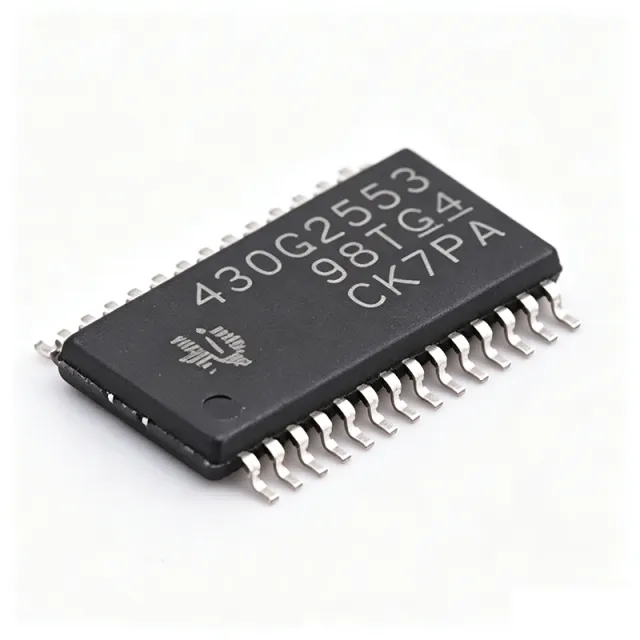
The Texas Instruments MSP430G2553IPW28 is a 16-bit ultra-low-power mixed-signal microcontroller from the MSP430 Value Line series, featuring a 16MHz CPU, 16KB Flash, 512B SRAM, and a rich set of integrated peripherals. Housed in a 28-pin TSSOP (PW) package, it operates from 1.8V to 3.6V over the industrial temperature range of -40 to +85 C. A microcontroller (MCU) is a compact integrated circuit that governs a specific operation in an embedded system, containing a processor core, memory (Flash and SRAM), and programmable I/O peripherals. The MSP430 family sits within the broader hierarchy of 16-bit RISC microcontrollers under power-management-conscious embedded processing, and is renowned for five low-power modes (LPM0 to LPM4) that reduce current to as low as 0.1 uA in standby mode with RAM retention. Key features include a 10-bit ADC, an analog comparator, two 16-bit timers, and a universal serial communication interface (USCI) supporting UART, SPI, and I2C. The device integrates a temperature sensor, brownout reset, and capacitive-touch-enabled I/O. Its internal DCO is factory-calibrated to 16 MHz with approximately 1% accuracy, often eliminating external crystals. Architecturally, the MSP430G2553 uses a 16-bit RISC CPU with a von-Neumann memory map, enabling efficient code density and rapid wake-up from low-power modes. Firmware can be updated in-system via the two-wire Spy-Bi-Wire interface, simplifying production programming. Typical applications include portable medical devices, wireless sensor nodes, smart meters, remote controls, and battery-powered consumer electronics. The 16KB Flash accommodates substantial application code, while 512B SRAM supports moderate buffering. The integrated comparator and ADC enable direct sensor interfacing, and the multiple communication interfaces allow easy connectivity to radios, displays, and other peripherals. Design tip: place a 0.1 uF capacitor close to DVCC and 1 uF at the power entry; configure unused I/O as outputs to avoid floating-input leakage. This mature, widely available part has extensive community support for both prototyping and production. The MSP430G2553IPW28 is a popular choice for cost-sensitive, power-critical designs where performance and low energy consumption are paramount.

USD $0,72 Contato
MSP430G2553IPW28R - 16MHz 16KB Flash MCU | Texas Instruments
MSP430G2553IPW28R

MSP430G2553IPW28R - 16MHz 16KB Flash MCU | Texas Instruments

The Texas Instruments MSP430G2553IPW28R is a 16-bit ultra-low-power mixed-signal microcontroller from the MSP430 Value Line series, featuring a 16MHz CPU, 16KB Flash, 512B SRAM, and a rich set of integrated peripherals. Housed in a 28-pin TSSOP (PW) package, it operates from 1.8V to 3.6V over the industrial temperature range of -40 to +85 C. A microcontroller (MCU) is a compact integrated circuit that governs a specific operation in an embedded system, containing a processor core, memory (Flash and SRAM), and programmable I/O peripherals. The MSP430 family sits within the broader hierarchy of 16-bit RISC microcontrollers under power-management-conscious embedded processing, and is renowned for five low-power modes (LPM0 to LPM4) that reduce current to as low as 0.1 uA in standby mode with RAM retention. Key features include a 10-bit ADC, an analog comparator, two 16-bit timers, and a universal serial communication interface (USCI) supporting UART, SPI, and I2C. The device integrates a temperature sensor, brownout reset, and capacitive-touch-enabled I/O. Its internal DCO is factory-calibrated to 16 MHz with approximately 1% accuracy, often eliminating external crystals. Architecturally, the MSP430G2553 uses a 16-bit RISC CPU with a von-Neumann memory map, enabling efficient code density and rapid wake-up from low-power modes. Firmware can be updated in-system via the two-wire Spy-Bi-Wire interface, simplifying production programming. Typical applications include portable medical devices, wireless sensor nodes, smart meters, remote controls, and battery-powered consumer electronics. The 16KB Flash accommodates substantial application code, while 512B SRAM supports moderate buffering. The integrated comparator and ADC enable direct sensor interfacing, and the multiple communication interfaces allow easy connectivity to radios, displays, and other peripherals. Design tip: place a 0.1 uF capacitor close to DVCC and 1 uF at the power entry; configure unused I/O as outputs to avoid floating-input leakage. This mature, widely available part has extensive community support for both prototyping and production. The MSP430G2553IPW28R is a popular choice for cost-sensitive, power-critical designs where performance and low energy consumption are paramount.

Cotação Contato
MSP430G2553IPW8RQ1 - 16MHz Automotive MCU | Texas Instruments
MSP430G2553IPW8RQ1

MSP430G2553IPW8RQ1 - 16MHz Automotive MCU | Texas Instruments

The Texas Instruments MSP430G2553IPW8RQ1 is an automotive ultra-low-power 16-bit microcontroller with a 16 MHz clock, 16 KB of Flash memory, 512 bytes of SRAM, and a 28-pin TSSOP package. It integrates a 10-bit ADC, comparator, UART, SPI, I2C, and timer peripherals for compact control systems. An ultra-low-power microcontroller is a semiconductor device optimized to minimize energy consumption during active operation and standby. The MSP430 belongs to the embedded-controller hierarchy: microcontroller > mixed-signal MCU > ultra-low-power MCU. Its architecture combines a 16-bit RISC core with integrated analog and serial interfaces, reducing the component count required for embedded measurement, monitoring, and control designs. The verified product information identifies a 16 MHz maximum clock, 16 KB Flash, 512 B SRAM, and 10-bit ADC. These resources suit applications that require periodic sensing, local control, and low-rate serial communication without adopting a higher-power application processor. Integrated UART, SPI, and I2C peripherals support sensor, actuator, display, and external peripheral connectivity while preserving a compact embedded design. The MSP430G2553-Q1 product family targets automotive applications and is available in the specified 28-pin TSSOP configuration. Its MSP430 CPU16 architecture processes the ADC, comparator, timer, and communication resources in a compact package. The family-level information confirms the combination of 16 KB Flash and 512 B SRAM, making it suitable for firmware that coordinates mixed-signal sensing and embedded control rather than computationally intensive workloads. Typical uses include automotive body-control modules, low-duty-cycle sensor nodes, battery-operated instrumentation, industrial condition-monitoring equipment, and compact communication controllers. The integrated serial interfaces allow a design to connect sensors over I2C or SPI, use UART for a local link, and employ the ADC for analog measurements while retaining the modest memory footprint of the MSP430 architecture. Designers should verify the exact pin multiplexing, operating-voltage limits, clock configuration, and automotive qualification requirements in the manufacturer datasheet before layout release. The 28-pin TSSOP footprint also requires adequate spacing between fine-pitch leads, careful decoupling near the supply pins, and programming access consistent with the device configuration. This page consolidates verified manufacturer and distributor information, automotive ordering details, practical application guidance, and honest replacement analysis. It distinguishes confirmed drop-in information from package-code or cross-family parts that cannot be treated as true pin-compatible substitutes.

Cotação Contato
MSP430G2553IRHB32R - 16MHz, 16KB Mixed-Signal MCU | TI
MSP430G2553IRHB32R

MSP430G2553IRHB32R - 16MHz, 16KB Mixed-Signal MCU | TI

The Texas Instruments MSP430G2553IRHB32R is a 16 MHz mixed-signal microcontroller with 16 KB Flash memory, 512 bytes of SRAM, a 10-bit ADC, an analog comparator, UART, SPI, and I2C in a 32-pin VQFN package. It is intended for low-power embedded systems that require compact digital control alongside limited analog measurement capability. The industrial-temperature ordering option is specified for operation from -40°C to +85°C. An ultra-low-power microcontroller is a semiconductor controller designed to minimize energy consumption while executing control, measurement, and communications tasks. The MSP430 family belongs to the mixed-signal MCU hierarchy, combining a 16-bit RISC core with analog and digital peripherals. MSP430 devices use multiple low-power operating modes, making them especially useful in battery-powered instrumentation, portable sensing, and embedded industrial products. The MSP430G2553 operates at up to 16 MHz and provides 16 KB of Flash for program storage plus 512 bytes of SRAM for working memory. Its integrated 10-bit ADC and comparator support analog front ends, while the universal serial communication interface provides UART, SPI, and I2C connectivity. Up to 24 I/O pins can support capacitive-touch functions according to the manufacturer product information. Power efficiency is central to the device architecture. Verified manufacturer information lists active-mode consumption of 230 μA at 1 MHz and 2.2 V, standby current of 0.5 μA, and off-mode current with RAM retention of 0.1 μA. Five power-saving modes allow firmware to match current consumption to workload, although exact standby time and wake-up behavior should be checked in the datasheet for the selected clock configuration. Typical uses include compact environmental sensors, industrial condition-monitoring nodes, low-power data loggers, capacitive-touch controls, wearable measurement devices, and embedded communications modules. The combination of 16 MHz processing speed, serial-interface flexibility, and small memory makes the MCU suitable for coordinating sensors and communicating results through UART, SPI, or I2C. Designers should account for the limited 512-byte SRAM when planning buffers and must place input and output decoupling close to the supply pins. The exposed-pad VQFN package also requires a properly designed thermal and ground layout. Firmware should use the device's low-power modes and avoid blocking delays when battery life is important. This product data combines manufacturer specifications, distributor availability information, and explicit cross-reference findings. It also distinguishes verified technical parameters from values that still require confirmation, providing a practical basis for schematic design, PCB layout, firmware planning, sourcing, and component selection.

Cotação Contato
MSP430G2553IRHB32T - 16MHz Mixed-Signal MCU | Texas Instruments
MSP430G2553IRHB32T

MSP430G2553IRHB32T - 16MHz Mixed-Signal MCU | Texas Instruments

The Texas Instruments MSP430G2553IRHB32T is a 16-bit mixed-signal microcontroller with a 16 MHz CPU, 16 KB Flash memory, 512 B SRAM, and a 32-pin VQFN package with an exposed thermal pad. It integrates a 10-bit ADC, analog comparator, 16-bit timers, and UART, SPI, and I2C communication capability in an ultra-low-power design optimized for portable measurement and embedded control systems. A mixed-signal microcontroller combines digital processing and analog measurement functions on one semiconductor device. The MSP430 belongs to the ultra-low-power MCU hierarchy, where a 16-bit RISC core and architecture-specific low-power modes reduce energy consumption in battery-powered or intermittently powered equipment. The G2553 device family provides 16-bit registers and constant generators that support efficient execution of compact embedded control algorithms. Verified device features include a maximum clock speed of 16 MHz, 16 KB of programmable Flash, 512 B of SRAM, a 10-bit analog-to-digital converter, a versatile analog comparator, and communication peripherals supporting UART, SPI, and I2C. Up to 24 I/O pins are described as capacitive-touch capable, enabling compact user interfaces and low-cost sensing arrangements without requiring separate switch devices. The MSP430G2553 is based on the MSP430 CPU16 architecture and combines digital control with analog signal acquisition. Its low-power operating modes make it useful for portable instruments, sensor nodes, energy meters, and embedded products that spend substantial time waiting for measurements or user input. The mixed-signal peripherals reduce the component count of designs that otherwise require separate ADC and communication circuitry. Typical uses include low-power data loggers, industrial sensor interfaces, battery-powered monitoring equipment, simple motor-control systems, and connected measurement instruments. UART, SPI, and I2C support allows the controller to communicate with display controllers, external analog or digital sensors, transceivers, and data-storage components. The 16 MHz processing rate is suitable for responsive sampling, control-loop calculation, and peripheral coordination without adopting a higher-power application processor. Designers should use the exposed-pad land pattern correctly for thermal dissipation and should preserve the device's recommended supply and decoupling arrangement. Because firmware size, interrupt configuration, peripheral mapping, and exposed-pad construction affect interchangeability, an alternative should not be treated as a drop-in replacement unless its complete ordering information and pinout have been verified. The verified 32-VQFN construction makes the RHB package especially relevant to compact, surface-mounted industrial designs. This page consolidates the verified manufacturer and distributor information for MSP430G2553IRHB32T and separates confirmed specifications from parameters that still require datasheet confirmation. It also provides application guidance, procurement context, and a conservative replacement assessment that avoids presenting unrelated MSP430 devices as verified pin-compatible substitutes.

Cotação Contato
MSP430I2031TPWR - 16MHz Metering AFE MCU 32KB Flash | TI
MSP430I2031TPWR

MSP430I2031TPWR - 16MHz Metering AFE MCU 32KB Flash | TI

The Texas Instruments MSP430I2031TPWR is a 16-bit metering analog front end (AFE) microcontroller with a 16.384 MHz 16-bit RISC CPU, three 24-bit sigma-delta ADCs, 32KB Flash, and 2KB RAM, housed in a 28-pin TSSOP (PW) package rated from -40C to +105C. A metering AFE MCU is a mixed-signal microcontroller that combines an MCU core with high-resolution analog-to-digital conversion on the same die. In the power management hierarchy it sits between generic MCUs and dedicated metrology ASICs, integrating sigma-delta conversion, timing, and computation for energy measurement without external ADCs. The MSP430i20xx family belongs to TI's MSP430 Metrology and Monitoring portfolio. Key features include the 16-bit RISC CPU with a DCO-based clock system generating up to 16.384 MHz, three independent 24-bit sigma-delta (SD24) converters ideal for simultaneous voltage and current sampling in poly-phase metering, two 16-bit timers, and five low-power modes optimized for extended battery life. The integrated flash-based memory supports field firmware updates for metering products. Architecturally, the device pairs the CPU16 core with a power management module (PMM) and a flexible clock subsystem, allowing the sigma-delta ADCs to run concurrently with computation for RMS power, energy accumulation, and tariff processing. The 24-bit ADC resolution supports wide dynamic range current sensing via shunt or CT inputs, reducing external component count and calibration effort. Typical applications include single-phase and poly-phase electricity meters, current-voltage monitoring in industrial equipment, battery-powered measurement instruments, and building automation energy sub-metering, where simultaneous multi-channel sampling and low power consumption are decisive. Design consideration: budget the sigma-delta ADC sampling rate against CPU headroom at 16.384 MHz, and place the analog inputs away from switching noise; the 2KB RAM constrains buffering depth for multi-channel DSP algorithms. This page synthesizes distributor pricing, drop-in family alternatives, and practical design notes not found in the manufacturer datasheet.

Cotação Contato
MSP430L092SPW - 4MHz 16-Bit MCU | Texas Instruments
MSP430L092SPW

MSP430L092SPW - 4MHz 16-Bit MCU | Texas Instruments

Texas Instruments MSP430L092SPW is a 4 MHz, 16-bit mixed-signal microcontroller with 2 KB ROM, 2 KB SRAM, an 8-bit ADC, an 8-bit DAC, a comparator, and a timer, packaged in a 14-pin TSSOP (PW). The device combines the MSP430 RISC core with embedded analog conversion and comparison functions in a compact surface-mount package. A mixed-signal microcontroller is an integrated circuit that places programmable digital control with analog measurement or output functions on one device. In the MSP430 product hierarchy, the MSP430L092 belongs to the family of ultra-low-power 16-bit RISC microcontrollers within the broader embedded-control and semiconductor categories. Its combination of digital processing and analog peripherals reduces the component count in compact control systems while keeping software development within the MSP430 ecosystem. The principal operating characteristics include a 4 MHz clock, 2 KB of ROM, 2 KB of SRAM, and 8-bit ADC and DAC resolution. The ADC and DAC support direct acquisition and generation of analog quantities, while the comparator can monitor a voltage against a programmable threshold. A dedicated timer supports periodic timing, elapsed-time measurement, and event-generation tasks, making the MCU suitable for deterministic embedded-control sequences. The MSP430L092 uses 16-bit registers and a reduced-instruction-set architecture designed for efficient control operations. Its small 14-pin TSSOP package is appropriate for space-constrained instruments, sensor nodes, and compact control boards. Because the device combines digital processing with an ADC, DAC, comparator, and timer, peripheral sharing can reduce external circuitry and simplify firmware scheduling when the application does not require simultaneous high-rate conversion. Typical applications include low-power sensor acquisition, compact industrial control modules, battery-operated instruments, programmable signal-generation products, and threshold-based monitoring systems. The 8-bit ADC suits slower measurements where higher-resolution conversion is unnecessary, while the DAC supports controllable analog outputs. The timer provides a deterministic time base for sampling, control-loop updates, or periodic actuator commands. Designers should verify the complete electrical limits and pin assignments in the MSP430L092 manufacturer datasheet before layout or firmware release. Decoupling, analog grounding, and regulator selection should follow the device recommendations. Firmware should also account for the 2 KB ROM and 2 KB SRAM limits by controlling library size and avoiding unbounded buffer allocation. This product page consolidates verified manufacturer and distributor information, organizes the mixed-signal feature set, identifies application fit, and clearly documents pricing and pinout data that were not supplied by the retrieved sources.

Cotação Contato
MSP430L092SPWR - 4MHz 16-Bit MCU | Texas Instruments (Tape & Reel)
MSP430L092SPWR

MSP430L092SPWR - 4MHz 16-Bit MCU | Texas Instruments (Tape & Reel)

Texas Instruments MSP430L092SPWR is a 4 MHz, 16-bit mixed-signal microcontroller with 2 KB ROM, 2 KB SRAM, an 8-bit ADC, an 8-bit DAC, a comparator, and a timer, packaged in a 14-pin TSSOP (PW). The device combines the MSP430 RISC core with embedded analog conversion and comparison functions in a compact surface-mount package. A mixed-signal microcontroller is an integrated circuit that places programmable digital control with analog measurement or output functions on one device. In the MSP430 product hierarchy, the MSP430L092 belongs to the family of ultra-low-power 16-bit RISC microcontrollers within the broader embedded-control and semiconductor categories. Its combination of digital processing and analog peripherals reduces the component count in compact control systems while keeping software development within the MSP430 ecosystem. The principal operating characteristics include a 4 MHz clock, 2 KB of ROM, 2 KB of SRAM, and 8-bit ADC and DAC resolution. The ADC and DAC support direct acquisition and generation of analog quantities, while the comparator can monitor a voltage against a programmable threshold. A dedicated timer supports periodic timing, elapsed-time measurement, and event-generation tasks, making the MCU suitable for deterministic embedded-control sequences. The MSP430L092 uses 16-bit registers and a reduced-instruction-set architecture designed for efficient control operations. Its small 14-pin TSSOP package is appropriate for space-constrained instruments, sensor nodes, and compact control boards. Because the device combines digital processing with an ADC, DAC, comparator, and timer, peripheral sharing can reduce external circuitry and simplify firmware scheduling when the application does not require simultaneous high-rate conversion. Typical applications include low-power sensor acquisition, compact industrial control modules, battery-operated instruments, programmable signal-generation products, and threshold-based monitoring systems. The 8-bit ADC suits slower measurements where higher-resolution conversion is unnecessary, while the DAC supports controllable analog outputs. The timer provides a deterministic time base for sampling, control-loop updates, or periodic actuator commands. Designers should verify the complete electrical limits and pin assignments in the MSP430L092 manufacturer datasheet before layout or firmware release. Decoupling, analog grounding, and regulator selection should follow the device recommendations. Firmware should also account for the 2 KB ROM and 2 KB SRAM limits by controlling library size and avoiding unbounded buffer allocation. This product page consolidates verified manufacturer and distributor information, organizes the mixed-signal feature set, identifies application fit, and clearly documents pricing and pinout data that were not supplied by the retrieved sources.

Cotação Contato
MSP430P112IDW - 16-Bit 8MHz Ultra-Low-Power MCU | Texas Instruments
MSP430P112IDW

MSP430P112IDW - 16-Bit 8MHz Ultra-Low-Power MCU | Texas Instruments

The Texas Instruments MSP430P112IDW is an ultra-low-power 16-bit RISC mixed-signal microcontroller with an 8 MHz maximum clock, 4 KB of one-time-programmable flash memory, 256 bytes of RAM, and a 20-pin SOIC package. According to the distributor-verified product data, its low 5.5 V supply range and 200 ns minimum instruction-cycle time suit compact embedded control and battery-powered sensing designs. What is an ultra-low-power mixed-signal microcontroller? It is a semiconductor that combines a low-power digital CPU with resources for interacting with analog signals. In the MSP430 family, the MSP430 core belongs to the broader RISC microcontroller hierarchy and is selected when energy efficiency, fast interrupt handling, and compact embedded control matter more than a large memory map or high peripheral integration. Key verified features include a 16-bit RISC architecture, 4 KB OTP, 256 B RAM, and operation up to 8 MHz. The available datasheet search data also identifies a maximum supply voltage of 5.5 V, standby wake-up within 6 microseconds, and off-mode RAM-retention current as low as 0.1 microampere. These figures make the device applicable where the controller spends substantial time waiting for an event and must resume quickly. The MSP430 architecture provides a compact instruction set and deterministic timing useful for embedded measurement, control, and low-duty-cycle monitoring. Its 4 KB program memory is modest, so firmware must be sized carefully, while 256 B of RAM supports local variables and short data buffers. The 20-SOIC format also simplifies assembly and inspection compared with very small packages, although it is larger than modern QFN options. Typical uses include battery-operated sensor nodes, simple industrial controls, compact instrumentation, meter-reading products, and portable measurement devices. Because the supplied data does not enumerate the target device's individual I/O assignments or peripheral set, the complete pinout and peripheral requirements should be checked in the manufacturer datasheet before PCB release. The principal design consideration is supply and power management. Designers should use a regulated supply within the 5.5 V maximum, confirm clock requirements against the selected operating mode, and avoid treating every SOIC-20 MCU as pin-compatible. Programming, reset, and unused-pin handling must follow the MSP430P112 datasheet exactly. This page consolidates the verified distributor specifications, sourcing context, and design cautions for MSP430P112IDW. It also distinguishes factual data from fields that require confirmation, helping engineers evaluate the MCU without introducing unverified electrical, timing, or compliance claims.

Cotação Contato
MSP430P315CY - 16-Bit 8MHz 16KB OTP MCU | Texas Instruments
MSP430P315CY

MSP430P315CY - 16-Bit 8MHz 16KB OTP MCU | Texas Instruments

The Texas Instruments MSP430P315CY is a 16-bit mixed-signal microcontroller with an 8 MHz MSP430 CPU16 core, 16 KB of one-time-programmable memory, 512 bytes of RAM, and integrated LCD segment support in a low-power system-on-chip design. Its wide 3.3 V to 5.5 V operating capability and five power-saving modes suit compact instruments, meters, industrial controls, and battery-powered products. A mixed-signal microcontroller combines a digital processor, analog and timing resources, memory, and communication peripherals on one chip. Within the MSP430 family, the device belongs to the mixed-signal MCU hierarchy rather than the flash-memory general-purpose MSP430X line. One-time-programmable memory permits a finished device to be programmed once, which can simplify production control when field updates are unnecessary. The verified source information identifies a 16-bit RISC architecture, 16 KB OTP memory, 512 B RAM, up to 92 LCD segments, and operation at 8 MHz. It also reports low-current operation at 1 MHz and 3 V, five power-saving modes, 1.3 uA standby current, 0.1 uA RAM-retention/off current, and a maximum 6 us wakeup from standby. These figures make the MCU appropriate for designs where most of the time is spent waiting for an input or measurement event. The LCD integration is particularly useful for segment-driven meters because external display multiplexing is reduced. The CPU16 architecture supports efficient control of sensor inputs, timers, and LCD segments while retaining state in low-power modes. Firmware and board design must still confirm the required LCD segment map, pin assignments, timing, and voltage limits before layout release. Typical uses include compact utility meters, temperature controllers, industrial panel instruments, portable monitors, and low-cost embedded sensing systems. For battery-powered products, use the standby and RAM-retention modes only when the application can tolerate the stated 1.3 uA and 0.1 uA conditions, respectively. Wakeup latency also affects whether the MCU can meet a short measurement or response interval. The principal design trade-off is OTP memory: it supports a compact, controlled programming process but cannot be updated like flash. Confirm final code size before programming, reserve pins for the exact display and peripherals, and follow the manufacturer’s absolute maximum and recommended operating conditions. This page combines distributor availability, verified family specifications, application guidance, and replacement considerations beyond a raw catalog entry.

Cotação Contato
MSP430P315IDL - 16-Bit, 8MHz Mixed-Signal MCU | Texas Instruments
MSP430P315IDL

MSP430P315IDL - 16-Bit, 8MHz Mixed-Signal MCU | Texas Instruments

Texas Instruments MSP430P315IDL is a 16-bit RISC mixed-signal microcontroller operating at up to 8 MHz, with 16 KB of one-time-programmable memory, 512 B of RAM, and a 92-segment LCD driver in a 56-pin SSOP package. Designed around the MSP430 family hierarchy of embedded mixed-signal controllers, the device combines low-power operation with dedicated LCD segment support, making it suitable for compact, display-oriented industrial and instrumentation products. A mixed-signal microcontroller is an embedded controller that integrates digital processing with analog-capable peripherals for sensing, timing, communication, and control. Within the semiconductor hierarchy, the MSP430P315IDL belongs to the MSP430x3xx family of 16-bit RISC microcontrollers and combines a power-management-aware design with LCD-driving resources. This family architecture targets applications that need deterministic control, compact display output, and low standby consumption without the complexity of a larger system. Verified product information identifies a maximum clock frequency of 8 MHz, 16 KB of OTP memory, 512 B of RAM, and support for up to 92 LCD segments. The device operates from low-voltage supply rails, with 3.3 V and 5 V operation identified in the distributor records and a maximum supply voltage of 5.5 V. Its 16-bit RISC architecture supports efficient control workloads while the integrated display capability reduces the need for an external LCD controller in segmented-meter designs. Power-management characteristics include standby current of 1.3 µA and off-mode current with RAM retention of 0.1 µA, as stated in the retrieved technical description. Wake-up from standby is specified at up to 6 µs. These figures make the MSP430P315IDL relevant to battery-operated meters, portable instrumentation, and industrial panel devices where idle-current demand is important. The available operating-current value at 1 MHz and 3 V could not be confirmed from the supplied excerpts. Typical uses include multifunction utility meters, industrial measurement panels, temperature controllers, portable test equipment, and compact display instruments. The 92-segment LCD capability is particularly useful when the user interface consists of numeric digits, status indicators, or a matrix of fixed segments. The device can reduce external display-driver circuitry, provided the selected LCD panel and segment mapping are compatible with its multiplexing and pin assignments. The primary design considerations are power-budget verification, LCD bias and segment mapping, oscillator configuration, firmware timing, and decoupling of the supply pins. Designers should use the manufacturer datasheet for the complete pinout, recommended operating conditions, LCD timing, and electrical limits because the verified excerpts do not provide a complete public pin-assignment table. Industrial-grade marking is reported by the distributor data, but detailed temperature limits are not included in the supplied records. This page consolidates verified distributor specifications, lifecycle-relevant sourcing information, package constraints, and a drop-in replacement assessment for the MSP430P315IDL. It also distinguishes confirmed engineering facts from fields that still require datasheet or quotation confirmation, helping engineers avoid treating uncertain parameters as production-ready data.

Cotação Contato
MSP430TCH5EPW - 16-Bit Haptics MCU | Texas Instruments
MSP430TCH5EPW

MSP430TCH5EPW - 16-Bit Haptics MCU | Texas Instruments

The Texas Instruments MSP430TCH5EPW is a haptics-enabled mixed-signal 16-bit microcontroller with 16 kB of flash memory, 512 bytes of RAM, an 8-channel 10-bit ADC, and two PWM channels, housed in a 28-pin TSSOP package measuring 4.40 mm in width. A mixed-signal microcontroller combines a low-power digital processor with analog measurement and control functions on one integrated circuit. The MSP430 family belongs to the embedded-controller hierarchy of microcontrollers, embedded processors, and semiconductor devices. It is intended for compact products in which touch sensing, haptic feedback, analog monitoring, and embedded control must operate within a small package and a constrained power budget. The MSP430TCH5EPW is differentiated by its dedicated capacitive-touch and haptics capability. Its 10-bit ADC provides eight analog input channels, while two PWM outputs support timed control functions. The 16-bit processor architecture and 16 kB flash capacity provide space for touch configuration, haptic drive control, system state machines, and application firmware. The 512-byte RAM supports working variables and buffered data without requiring a large external memory device. The 28-pin TSSOP package is suitable for conventional surface-mounted PCB assembly and provides a practical alternative to larger leaded packages when product dimensions are constrained. Signal integrity around touch electrodes, ADC inputs, and haptics-drive outputs requires careful partitioning of sensitive analog paths from switching nodes and high-current drive returns. The manufacturer datasheet should be used for exact pin assignments, recommended external components, electrical limits, and initialization procedures. Typical applications include capacitive-touch control panels, haptic feedback interfaces, industrial control panels, appliance user interfaces, compact sensor-hub products, and embedded human-interface systems. In a touch-control design, the MCU can acquire electrode measurements through its mixed-signal resources, evaluate touch conditions, and generate a controlled haptic response through its PWM-capable output architecture. When designing the PCB, place the MCU decoupling capacitors close to their specified supply pins and keep the analog ground and signal paths compact. Confirm input-voltage, output-current, ADC, and haptics-drive constraints against the device limits before connecting external loads. Firmware should also include startup defaults, electrode calibration, and a defined haptics-drive shutdown state to prevent unintended actuator activation. This product page combines the manufacturer device identity, package information, core mixed-signal specifications, application guidance, engineering notes, and verified sourcing links. It also identifies the distinction between a true pin-compatible replacement and a merely similar MCU so engineers can avoid accepting a footprint-level match without checking peripheral functionality.

Cotação Contato
MSP430U183IPG - 16-Bit RISC Ultra-Low-Power Mixed-Signal MCU | Texas Instruments
MSP430U183IPG

MSP430U183IPG - 16-Bit RISC Ultra-Low-Power Mixed-Signal MCU | Texas Instruments

The Texas Instruments MSP430U183IPG is a 16-bit RISC mixed-signal microcontroller from the MSP430U1xx family, packaged in an 80-pin TQFP (IPG) surface-mount package. It combines an ultra-low-power CPU core with on-chip analog conversion resources and a 16-bit RISC architecture optimized for battery-operated and energy-harvesting systems. A microcontroller (MCU) is a single integrated circuit containing a processor core, non-volatile program memory, data memory, and peripherals such as analog-to-digital converters, timers, and serial interfaces. The MSP430 family belongs to the broader embedded-processor hierarchy: MCU -> embedded processor -> mixed-signal semiconductor. Devices in this line are engineered around a 16-bit RISC core with a highly regular instruction set, 16-bit register file, and hardware designed for very low standby current, making the family a common choice for metering, sensing, and portable control nodes. Key characteristics of this device include its 16-bit RISC instruction set, mixed-signal analog front end integrated on the same die, and a low-leakage design intended for always-on operation. The MSP430U1xx family targets cost-sensitive, low-power designs where a few milliwatts of active power or microamps of standby current determine whether a product is viable. The part is supplied in a surface-mount TQFP-80 (IPG) package, which supports automated assembly and provides ample I/O for external sensing and actuation. Because the part integrates analog signal acquisition alongside digital control, one device can replace a discrete sensor front end plus a small microcontroller. This reduces board area, lowers total component count, and simplifies firmware by keeping the measurement path on the same silicon as the control logic, which minimizes conversion latency and analog routing issues. Typical applications include battery-powered flow and energy meters, portable gas and air quality monitors, industrial sensor nodes, smart home sensing modules, handheld instrumentation, and low-leakage tamper-detection or security peripherals. When designing with the MSP430U183IPG, budget for bypass capacitors on the supply pins, keep analog inputs away from fast switching traces, and consult the pin-description table in the manufacturer datasheet when assigning PCB tracks and test points. Confirm operating voltage limits and current consumption for your specific clock and duty cycle before committing to a power budget. This page consolidates device characteristics, family-level drop-in alternatives, a parameter-by-parameter comparison table, and practical layout and power-design guidance into a single engineering reference that goes beyond the raw datasheet ordering information.

Cotação Contato
MSP430U275IPM - 64-LQFP 16-Bit Microcontroller | Texas Instruments
MSP430U275IPM

MSP430U275IPM - 64-LQFP 16-Bit Microcontroller | Texas Instruments

Texas Instruments MSP430U275IPM is a 16-bit microcontroller IC identified by distributor listings as an ASIC for the Dolphin chipset, supplied in a 64-LQFP surface-mount package measuring 10 mm by 10 mm. Its defining orderable features are the MSP430 microcontroller category, 16-bit architecture, ASIC implementation, 64-lead LQFP package, and 10 mm by 10 mm body size. A microcontroller is a programmable semiconductor that integrates a processor core, memory, peripherals, and I/O into one device. The MSP430 family belongs to the embedded-controller hierarchy: microcontroller, embedded processor, semiconductor, and integrated circuit. It is used where a compact control system must execute firmware, read inputs, operate timing functions, and control external circuitry within a defined board-level design. The verified distributor information identifies MSP430U275IPM as an MSP430 Microcontroller IC and an ASIC for the Dolphin chipset. The same sources consistently identify the package as 64-LQFP (10x10), while DigChip specifies tray packaging. Detailed information such as flash memory, RAM, I/O count, clock speed, operating-temperature range, and detailed peripheral assignments was not present in the supplied excerpts and therefore remains unverified on this page. Because the supplied source refers to the U275 as a Dolphin chipset ASIC rather than providing a conventional general-purpose MCU feature summary, engineers should evaluate the device from the complete manufacturer documentation for the specific embedded design. The 64-LQFP footprint also requires a PCB land pattern and pin assignment matching the exact ordering code; a 64-pin package alone does not prove function-level compatibility with another MSP430 device. Typical design contexts for a 16-bit embedded controller include embedded system control, peripheral control, data acquisition, instrumentation, and compact industrial products. The 10 mm by 10 mm LQFP package provides a moderate-size surface-mount option for multilayer PCBs, while tray packaging is identified by the verified product listings. Exact suitability still depends on the unavailable memory, clock, I/O, and electrical specifications. For new layouts, preserve the manufacturer-specified decoupling, programming interface, clock arrangement, and exposed or routed ground-network requirements from the complete datasheet. Also verify programming, debug, and supply-voltage compatibility before substituting this device into an existing design, especially when replacing a microcontroller with a superficially similar 64-LQFP part. This page combines verified package, classification, packaging, inventory, and pricing information with explicit uncertainty notes, helping engineers separate confirmed data from fields that still require the full MSP430U275IPM datasheet for memory capacity, pinout, electrical limits, and lifecycle confirmation.

Cotação Contato
MSP430U283IPM - 16-Bit MCU | Texas Instruments | Embedded
MSP430U283IPM

MSP430U283IPM - 16-Bit MCU | Texas Instruments | Embedded

The Texas Instruments MSP430U283IPM is a 16-bit embedded microcontroller in the MSP430 U-series family, supplied in the IPM package. The verified source data identifies the device as “IC MCU 16BIT U283,” but does not provide verified values for CPU frequency, flash memory, RAM, I/O count, timers, communication peripherals, voltage range, or temperature range. Those specifications remain to be confirmed in the manufacturer documentation before schematic, firmware, or production qualification. A microcontroller is a programmable semiconductor that integrates a processor core, memory, and peripherals into one device. The MSP430 family is associated with embedded control and low-power applications, while the U-series name identifies this device within Texas Instruments’ product taxonomy. A 16-bit MCU can represent values and perform arithmetic across a wider numeric range than an 8-bit MCU, making it useful for control logic, sensor acquisition, communications, and compact embedded products when its verified peripherals match the application. The principal confirmed feature of the MSP430U283IPM is its 16-bit U283 architecture designation. The “IPM” suffix identifies the ordered package variant, but the supplied sources do not provide a package drawing, pin count, pin names, exposed-pad details, dimensions, or soldering information. Consequently, engineers should not assume a board footprint solely from the MPN. The package drawing and pin table must be checked against the official Texas Instruments documentation for the exact ordering code before layout release. The verified distributor results include DigiKey Marketplace, Octopart, Hotenda, Kynix, ampheo, Jotrin Electronics, ABC Semiconductor, Suntsu Electronics, and a third-party PDF mirror. Their snippets support the product identity and market availability search, but do not expose a complete manufacturer specification table. The official manufacturer datasheet was not included in the provided web results, so claims about memory, clock speed, interfaces, operating voltage, and environmental limits are intentionally not asserted here. Potential design uses include low-power sensor nodes, industrial monitoring, compact instrumentation, embedded control, and portable equipment. These are application directions rather than confirmed manufacturer application listings. Firmware portability, peripheral compatibility, timing, brownout behavior, and low-power performance must be evaluated using verified device documentation. The MSP430U283IPM is best treated as a component-identification and sourcing entry until the missing technical data is obtained. A critical design practice is to avoid substituting a similarly named MSP430 device solely because the distributor title appears similar. Confirm the exact package, pin mapping, memory resources, clock configuration, supply limits, and peripheral set from the manufacturer datasheet. This page distinguishes verified identity information from engineering data that still requires confirmation, reducing the risk of an invalid PCB or firmware choice. This page provides a structured sourcing record for MSP430U283IPM, including verified distributor links, explicit data gaps, procurement questions, and design cautions. It does not convert distributor snippets into unverified specifications; all missing values are marked for follow-up before engineering release.

Cotação Contato
MSP430V138TDA Flash Embedded MCU | Texas Instruments
MSP430V138TDA

MSP430V138TDA Flash Embedded MCU | Texas Instruments

The Texas Instruments MSP430V138TDA is an active, flash-programmed embedded microcontroller intended for mixed-signal, low-power, and connected embedded systems. It belongs to the MSP430 family of 16-bit RISC microcontrollers, combining a microcontroller core, on-chip program and data memory, analog measurement resources, timers, communication interfaces, and low-power operating modes in one integrated device. The exact electrical ratings, memory organization, clock architecture, peripheral configuration, pin assignments, and package dimensions should be confirmed in the manufacturer datasheet before schematic capture or PCB layout begins. What is an embedded microcontroller? An embedded microcontroller is a semiconductor that combines a processor core with memory, input/output ports, and dedicated peripherals in one package. The processor executes application firmware, while the peripherals handle measurements, timing, data exchange, and control functions. Within the product hierarchy, the MSP430V138TDA is a microcontroller, which is a type of integrated circuit and embedded processor. It can serve as the central controller in instrumentation, industrial monitoring, building automation, portable measurement equipment, and connected sensor systems. The MSP430V138TDA is identified as a flash-programmed MCU, allowing operating firmware to be programmed and updated in the device rather than relying on mask-programmed ROM. That architecture is useful for products that require configurable control logic, field diagnostics, calibration support, or firmware revision management. Designers should map each firmware function to the specific peripherals and interrupt resources listed in the datasheet, then verify clock, memory, and interface requirements against the product specification. Its mixed-signal capability makes the MCU relevant to designs that measure analog quantities and perform digital control in the same enclosure. Common implementation choices include sensor signal acquisition, digital control of power converters, metering, low-level communications, and autonomous data collection. For each of these applications, correct sensor conditioning, reference selection, input protection, and isolation remain essential; the microcontroller does not replace front-end analog design. Low-power operation is a defining consideration in MSP430-based products. The MSP430 architecture is commonly used with duty-cycled control loops, sleep modes, and wake-up events to reduce energy use in battery-operated equipment. Actual active and standby current must be checked at the selected voltage, temperature, clock configuration, and peripheral state. Peripheral gating and firmware execution patterns can materially change system energy consumption, so a datasheet current value should not be treated as an end-to-end application result. The MSP430V138TDA is offered in a package identified by the TDA ordering suffix. Use the package drawings, land pattern, pin-description table, and recommended PCB layout guidance in the manufacturer documentation rather than inferring dimensions from the suffix. The exposed-pad arrangement, if present, must be connected according to the datasheet and thermal requirements. This product page combines the verified manufacturer identity, active lifecycle status, flash-programmed MCU classification, source links, application guidance, and a strict drop-in alternative review. Because the available material does not establish pin-compatible substitutes, unverified candidates are excluded. Use the Request a Quote form for current commercial availability, and request the complete manufacturer documentation before committing the part to a production design.

Cotação Contato
MSP432E401Y - 120MHz Cortex-M4F Ethernet MCU, 1MB Flash | TI
MSP432E401Y

MSP432E401Y - 120MHz Cortex-M4F Ethernet MCU, 1MB Flash | TI

The Texas Instruments MSP432E401Y is a SimpleLink 32-bit Arm Cortex-M4F Ethernet microcontroller running at 120 MHz, with 1 MB (1M x 8) of on-chip flash and 256 kB of SRAM, housed in a 128-TQFP (14 x 14 mm) surface-mount package. A microcontroller (MCU) is a single-chip computer that integrates a processor core, memory, and peripherals into one package. It sits at the heart of the embedded hierarchy: microcontroller unit -> embedded processor -> semiconductor device. The MSP432E401Y belongs to the SimpleLink MCU platform, which spans Wi-Fi, Bluetooth low energy, Sub-1 GHz, Ethernet, Zigbee, Thread, and host MCUs - all sharing a common, easy-to-use development environment with a single core software development kit (SDK) and rich tool set. Key features include the 120 MHz Cortex-M4F core with a hardware floating point unit (FPU) and DSP instructions, 1 MB flash for code storage, 256 kB SRAM for buffers and stacks, and an integrated 10/100 Ethernet MAC and PHY that enables a single-chip networked node without an external PHY. CAN 2.0 support addresses industrial fieldbus requirements. Technically, the MSP432E401Y uses the Arm Cortex-M4F architecture with an advanced interrupt architecture, and its peripheral memory map is shared across the MSP432E4 family as documented in the MSP432E4 Technical Reference Manual (Rev. A). This simplifies software porting between family members and from the legacy TM4C129 series, which is confirmed as pin-to-pin compatible on the TQFP packages per TI E2E forum guidance. Typical applications include industrial Ethernet gateways and IoT nodes, IEEE 1588 PTP precision timing masters, building automation and remote monitoring nodes, and CAN-based industrial control - anywhere cost-sensitive control processing plus wired connectivity is required. The MSP-EXP432E401Y LaunchPad kit provides a fast evaluation path. Design consideration: when migrating from TM4C129x devices, the pinout is pin-to-pin compatible, but software must move to the SimpleLink SDK; TM4C129 MCUs are not part of the SimpleLink family and do not offer its connectivity ecosystem. This page synthesizes distributor pricing, drop-in alternatives, and practical design notes not found in the manufacturer datasheet.

Cotação Contato
MSP432E411YTZADR - 120MHz Cortex-M4F MCU 1MB Flash | Texas Instruments
MSP432E411YTZADR

MSP432E411YTZADR - 120MHz Cortex-M4F MCU 1MB Flash | Texas Instruments

The Texas Instruments MSP432E411YTZADR is a SimpleLink™ 32-bit Arm Cortex-M4F microcontroller (MCU) with floating-point unit, integrating 1MB Flash and 256kB SRAM in a 212-ball NFBGA (ZAD) 10x10mm package. It operates at up to 120MHz and includes an integrated Ethernet MAC+PHY, dual CAN controllers, USB Host/Device, and a TFT LCD interface for graphics-capable applications. Per TI's product page, the device is qualified for an industrial operating temperature range of -40C to +105C. A microcontroller (MCU) is a single-chip computer that integrates a CPU core, program and data memory, and a rich set of peripherals such as timers, ADCs, and communication interfaces. The MSP432E411Y belongs to the SimpleLink MCU family (32-bit MCU -> Arm Cortex-M -> embedded microcontroller -> microcontroller/system-on-chip hierarchy), positioned as a deterministic, real-time control + connectivity platform for industrial, IoT, and human-machine interface (HMI) products. Key features highlighted by the verified data include: 120MHz Cortex-M4F core with single-precision FPU, 1MB on-chip Flash (1M x 8), 256kB SRAM, integrated 10/100 Ethernet MAC+PHY with MII/RMII, two CAN 2.0 A/B controllers, USB 2.0 OTG (Host/Device), 8/16/32-bit external peripheral interface (EPI) for SDRAM/SRAM/FPGA connection, and a TFT LCD controller with dedicated DMA. The 212-NFBGA package provides 212 balls at 0.65mm pitch within a compact 10x10mm outline, suitable for space-constrained designs that demand maximum peripheral integration. Architecturally, the device pairs the Cortex-M4F core with a deterministic interrupt controller, configurable GPIO, four 32-bit timers, dual 12-bit ADCs up to 2 MSPS, and an Hibernation module with RTC and backup battery support for ultra-low-power sleep. The integrated Ethernet MAC+PHY, hardware crypto accelerator (AES/SHA/MD5/CRC), and ECC-protected memory make it a strong choice for secure, connected embedded systems. Typical applications include industrial Ethernet gateways, programmable logic controllers (PLCs), building automation controllers, HMI panels with TFT displays, barcode scanners, point-of-sale (POS) terminals, and connected IoT edge nodes. The combination of Ethernet, CAN, USB and TFT LCD interfaces removes the need for most external bridge chips. When designing with this device, allocate PCB area for the 212-ball NFBGA land pattern with 0.65mm ball pitch - this requires laser-cut solder stencils and careful reflow profiling. Bypass the 12 V-tolerant analog and digital supply pins with 100 nF + 10 uF ceramic capacitors placed as close as possible to the balls. This page synthesizes distributor pricing, drop-in alternative references, and practical application guidance that the manufacturer datasheet alone does not present, enabling faster BOM selection for industrial and connected designs.

Cotação Contato
MSP432P401MIRGCR - 48MHz ARM Cortex-M4F MCU 128KB Flash | Texas Instruments
MSP432P401MIRGCR

MSP432P401MIRGCR - 48MHz ARM Cortex-M4F MCU 128KB Flash | Texas Instruments

The Texas Instruments MSP432P401MIRGCR is a SimpleLink ultra-low-power 32-bit ARM Cortex-M4F microcontroller with FPU, operating at up to 48 MHz, integrating 128 KB of Flash and 32 KB of SRAM in a 64-pin VQFN (RGC) 9x9 mm package. The device is built on a precision-mixed-signal architecture that includes a 14-bit 1 MSPS SAR ADC with internal voltage reference, multiple serial interfaces (UART/SPI/I2S), and up to 48 GPIO pins. The Cortex-M4F core delivers DSP instructions and a single-precision floating-point unit for signal-processing workloads while the MSP432 platform achieves 80 µA/MHz active power consumption. The 'I' industrial temperature grade operates from -40 °C to +85 °C at a supply voltage of 1.62 V to 3.7 V. A SimpleLink MSP432P401x microcontroller is an ultra-low-power ARM Cortex-M4F MCU designed for battery-powered and energy-harvesting applications. The platform combines Cortex-M4 DSP performance with MSP430-class power efficiency, featuring seven low-power modes (LPM0-LPM4.5) that draw sub-µA standby current. The MSP432 family occupies the tier between 16-bit MSP430 devices and higher-power Cortex-M4 parts, and is positioned within the SimpleLink ecosystem of compatible wireless host MCUs that share drivers, RTOS support (TI-RTOS, FreeRTOS), and the CCS development environment. Key features include 128 KB single-cycle Flash with 4-bank partitioning for in-field updates, 32 KB SRAM with parity, four 16-bit timers, two 32-bit timers, a 14-bit 1 MSPS SAR ADC with 16 channels and internal 1.2 V or 1.45 V reference, plus two comparators. The RGC package integrates a 9 mm × 9 mm VQFN with exposed thermal pad. Hardware cryptography acceleration and AES are absent on the M-class part (these are reserved for MSP432P401R higher-tier SKUs). The MSP432P401M uses a Cortex-M4F core with MPU and FPU, supported by an integrated 8-channel DMA engine, SysTick timer, and a flexible clock tree with 48 MHz DCO, 32.768 kHz LFXT, and an internal REFO. On-chip peripherals include RTC, watchdog, and supply-voltage supervisor. The 14-bit ADC achieves 1 MSPS throughput with 16 single-ended or differential channels. The architecture nests balanced supplies with deep-sleep LPM3.5 current under 1 µA typical. Typical applications include industrial sensor transmitters, smart metering endpoints, IoT edge nodes, building automation controllers, HVAC sensor interfaces, battery-powered medical monitors, and consumer wearables. The integrated precision ADC removes the need for an external converter in many sensor-conditioning designs. Designers should budget for the 9 mm × 9 mm VQFN PCB footprint with a thermal pad for ground stitching and a 32.768 kHz crystal if RTC accuracy is required. The CCS IDE with XDS110 or XDS200 debug probe is recommended for development. This page synthesizes distributor pricing, drop-in same-family alternatives, and practical design notes not aggregated in the manufacturer datasheet, giving you a single source for sourcing, replacement, and design decisions.

Cotação Contato
MSPM0C1104 - 24MHz Cortex-M0+ MCU, 16KB Flash | TI
MSPM0C1104

MSPM0C1104 - 24MHz Cortex-M0+ MCU, 16KB Flash | TI

The Texas Instruments MSPM0C1104 is a 32-bit entry-level microcontroller based on an enhanced Arm Cortex-M0+ core operating at up to 24 MHz, integrating 16 KB of flash memory, 1 KB of SRAM, and a 12-bit ADC, housed in an ultra-compact 8-pin WSON (2 mm x 2 mm) package. A microcontroller unit (MCU) is a single-chip computer that combines a processor core, program memory, data memory, and peripherals such as ADCs, timers, and serial interfaces on one die. MCUs sit at the lowest level of the embedded-systems hierarchy - above discrete logic but below application processors - and the MSPM0C1104 belongs to the MSPM0 family, TI's highly-integrated ultra-low-power 32-bit MCU platform descended from the decades-proven MSP430 legacy of low-power mixed-signal control. Key features of the MSPM0C1104 include the 24 MHz Cortex-M0+ core with its two-stage pipeline and low interrupt latency, 16 KB of on-chip flash supporting in-system reprogramming, a 12-bit ADC enabling direct analog sensor capture without an external converter, and an 8-pin WSON footprint of just 2 mm x 2 mm. According to TI, this part is engineered to replace legacy 8-bit MCUs in cost- and space-constrained designs while retaining a modern 32-bit instruction set. Technically, the MSPM0C110x family is documented in the TI datasheet 'MSPM0C110x, MSPS003 Mixed-Signal Microcontrollers' (Rev. D, 77 pages), which details the mixed-signal integration, low-power operating modes, and peripheral set. The enhanced Cortex-M0+ platform gives developers access to the broad Arm ecosystem, including Keil, IAR, GCC, and TI Code Composer Studio, plus the MSPM0 software development kit and LaunchPad hardware (LP-MSPM0C1104) for rapid evaluation. Typical applications include analog sensor interfacing and signal conditioning, small appliance and consumer electronics control, LED lighting and power-supply supervision, and ultra-small IoT sensor nodes where board area is at a premium. The 12-bit ADC plus 32-bit processing in an 8-pin footprint makes the MSPM0C1104 especially compelling for direct replacement of 8-bit MCUs with external ADCs. A key design consideration is the small 1 KB SRAM allocation: developers must budget stack and buffer usage carefully, and the tiny WSON package requires attention to thermal pad soldering and PCB land-pattern design per the datasheet layout guidance. This page synthesizes distributor pricing, same-family drop-in alternatives, design notes, and application guidance not found in the manufacturer datasheet alone.

Cotação Contato
MSPM0G3218-Q1 - 80MHz Cortex-M0+ MCU with CAN-FD | TI
MSPM0G3218-Q1

MSPM0G3218-Q1 - 80MHz Cortex-M0+ MCU with CAN-FD | TI

The MSPM0G3218-Q1 is an automotive-grade mixed-signal microcontroller from Texas Instruments, featuring an Arm Cortex-M0+ core running at up to 80 MHz. It is part of the MSPM0G321X family and is designed for automotive applications requiring a CAN-FD interface. According to the TI datasheet, the device integrates a rich set of peripherals suitable for body control, powertrain, and battery management systems. The MSPM0G3218-Q1 is a 32-bit MCU built on the enhanced Arm Cortex-M0+ platform, offering cost-optimized performance with ultra-low power consumption. It operates at up to 80 MHz, providing sufficient processing power for real-time control tasks while maintaining low power sleep modes. The CAN-FD interface enables high-speed data transmission in automotive networks, supporting both classic CAN and CAN-FD protocols. The MCU is supported by the MSPM0 SDK and a hardware ecosystem including LaunchPad development kits, reference designs, and code examples. This ecosystem accelerates development, reducing time-to-market for automotive projects. The device is qualified for automotive applications with AEC-Q100 Grade 1 certification, ensuring robust operation in challenging environments. Key features include the 80 MHz Cortex-M0+ core, CAN-FD interface, and automotive-grade qualification. The MSPM0G3218-Q1 is intended for applications such as body control modules, battery management units, motor control, and sensor interfaces. It provides a flexible GPIO configuration, multiple communication peripherals, and analog signal processing capabilities, making it suitable for mixed-signal control tasks. For design, the MSPM0G3218-Q1 requires careful consideration of power supply decoupling and thermal management. An integrated analog-to-digital converter (ADC) and comparator enable direct interfacing with sensors and actuators. The device supports a wide operating voltage range and includes various low-power modes to extend battery life in automotive systems. The MSPM0G3218-Q1 is a reliable choice for automotive electronics, offering a balance of performance, cost, and low power. Its ecosystem and automotive qualification make it an attractive option for engineers seeking a robust MCU with CAN-FD capability. [DATA_NEEDED: Flash size, RAM size, GPIO count, ADC channels, operating voltage, temperature range]

Cotação Contato
MSPM0G3507 - 80MHz Cortex-M0+ 128KB MCU CAN-FD | TI
MSPM0G3507

MSPM0G3507 - 80MHz Cortex-M0+ 128KB MCU CAN-FD | TI

The Texas Instruments MSPM0G3507 is a 32-bit mixed-signal microcontroller based on the enhanced Arm Cortex-M0+ core running at up to 80 MHz, with 128KB flash memory, 32KB SRAM, and an operating supply range of 1.62V to 3.6V across -40C to +125C. It is available in a 48-pin LQFP (7x7 mm) package, with 64-pin LQFP and 32-pin VQFN (5x5 mm, SRHB) options in the same family. A microcontroller (MCU) is a single-chip computer that integrates a processor core, memory, and programmable peripherals such as timers, ADCs, and communication interfaces. Within the semiconductor hierarchy, the MSPM0G3507 belongs to the MSP 32-bit MCU portfolio: MCU -> embedded processor -> integrated circuit. It is a member of the MSPM0G350x performance sub-family, TI's cost-optimized, analog-rich Cortex-M0+ line. Key differentiating features include dual 12-bit ADCs sampling at 4 Msps - unusually fast for the Cortex-M0+ class - a 12-bit DAC, three comparators, and two operational amplifiers that can eliminate external analog front-end components. The MATHACL hardware math accelerator accelerates trigonometric and division operations common in PID and motor-control loops, and the integrated CAN-FD controller supports industrial and automotive networking. Architecturally, the enhanced Cortex-M0+ platform pairs the low-power core with TI's analog peripheral integration and an extended temperature range from -40C to +125C, positioning the MSPM0G3507 between TI's entry-level MSPM0L devices and higher-performance C2000 real-time MCUs. Typical applications include motor control and digital power conversion, industrial sensing and signal-conditioning nodes, CAN-FD networked modules in factory and automotive systems, and medical alarm designs demonstrated in TI's IEC 60601-1-8 reference design using the MSPM0G3507. Design tip: program and debug through the SWDIO/SWCLK pins using an XDS110-based LaunchPad debugger, and use TI SysConfig to configure pins and peripherals graphically. This page synthesizes distributor pricing data, drop-in alternatives within the MSPM0G350x family, and practical design notes not consolidated in the manufacturer datasheet.

Cotação Contato