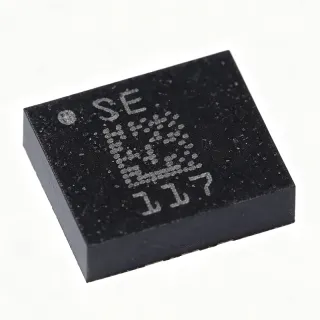
MMA3201D - ±45g Dual-Axis Micromachined Accelerometer | NXP
N.º da peça: MMA3201D ✗ Fim de vida| Qtd. | Preço unitário | Total |
|---|---|---|
| 1 | $8.62 | $8,62 |
| 10 | $7.84 | $78,40 |
| 100 | $6.91 | $691,00 |
| 500 | $6.12 | $3.060,00 |
| 1.000 | $5.44 | $5.440,00 |
MMA3201D Visão geral
A MEMS accelerometer (Micro-Electro-Mechanical Systems accelerometer) is a sensor that measures the rate of change of velocity (acceleration) along one or more axes by detecting the displacement of a proof mass etched into a silicon structure. Within the sensor taxonomy, the MMA3201D sits at: MEMS accelerometer -> capacitive accelerometer -> inertial sensor -> motion sensor -> semiconductor device. Capacitive MEMS accelerometers use the differential capacitance change between interdigitated combs to convert mechanical deflection into an electrical signal that is then conditioned and filtered on-die.
Key features of the MMA3201D include ±45 g full-scale range on both axes, factory-calibrated zero-g offset and full-scale span that require no external trimming, a 4-pole low-pass filter for anti-aliasing, self-test capability for system-level diagnostics, and integrated temperature compensation across the automotive -40 °C to +125 °C range. The 20-pin SOIC surface-mount package simplifies PCB assembly and provides robust mechanical handling compared to smaller QFN/LGA packages used in later Freescale/NXP parts.
The device uses a silicon capacitive sensing cell whose capacitance changes proportionally to applied acceleration. An on-chip ASIC performs charge-to-voltage conversion, gain calibration, offset trimming, and 4-pole Butterworth filtering before presenting a ratiometric analog output per axis on dedicated XOUT and YOUT pins. The self-test function exercises the proof mass electrostatically to verify both the mechanical structure and the signal chain in a single command.
Typical applications include automotive airbag crash detection, electronic stability control (ESC) sensor inputs, rollover detection, active suspension systems, vehicle dynamic control (VDC) units, industrial vibration monitoring, and platform stabilization. The dual-axis configuration is particularly valuable when both lateral and longitudinal crash signatures must be captured simultaneously.
When designing with this device, allocate adequate PCB area for the 20-pin SOIC footprint and follow NXP's recommended decoupling scheme (typically a 0.1 µF ceramic close to VDD). Because the part is RoHS-non-compliant per its datasheet marking, RoHS-restricted end products must select a newer NXP/Freescale successor such as the MMA3202D or MMA26XX family instead.
Alternativas drop-in para MMA3201D — mesmo encapsulamento, compatível pino a pino. Peças de encapsulamento diferente que exigem retrabalho na PCB são excluídas.
Variantes desta série
Modelos da mesma série compatíveis como drop-in com MMA3201D (mesmo formato e footprint) — diferindo em Acceleration Range, Bandwidth, Operating Temperature, Output Type, Package.
Ferramenta de comparação rápida — selecione peças alternativas para comparação lado a lado:
MMA3202D
✅ Drop-In📋 Alternativa de referência (fora do catálogo)
MMA3201DR2
✅ Drop-In📋 Alternativa de referência (fora do catálogo)
MMA3201EG
✅ Drop-In📋 Alternativa de referência (fora do catálogo)
MMA3201EGR2
✅ Drop-In📋 Alternativa de referência (fora do catálogo)
MMA3200
✅ Drop-In📋 Alternativa de referência (fora do catálogo)
MMA3201D Classificações máximas e características elétricas
| Tipo de sensor | Accelerometer, Dual-Axis (X, Y) |
| Sensing Technology | Capacitive MEMS (silicon micromachined) |
| Acceleration Range | ±45 g |
| Bandwidth | 400 Hz (4-pole low-pass filter) |
| Tipo de saída | Analog, separate X and Y outputs |
| Supply Voltage (VDD) | 4.75 V to 5.25 V |
| Zero-g Offset | Factory trimmed (no external adjustment required) |
| Self-Test | Yes (logic-level command on dedicated pin) |
| Temperature Compensation | On-chip |
| Temperatura de operação | -40 °C to +125 °C (automotive grade) |
| Encapsulamento | 20-pin SOIC (SOP-20), surface mount |
| Tipo de montagem | Surface Mount |
| Status RoHS | Non-Compliant (contains lead, per datasheet) |
Configuração de pinos do MMA3201D
| Pino 1 | VDD — Supply voltage (4.75 V to 5.25 V) |
| Pino 2 | NC — Not connected (per datasheet) |
| Pino 3 | NC — Not connected (per datasheet) |
| Pino 4 | GND — Ground |
| Pino 5 | NC — Not connected (per datasheet) |
| Pino 6 | NC — Not connected (per datasheet) |
| Pino 7 | ST — Self-test input (logic-level command) |
| Pino 8 | NC — Not connected (per datasheet) |
| Pino 9 | YOUT — Y-axis analog output (ratiometric to VDD) |
| Pino 10 | NC — Not connected (per datasheet) |
| Pino 11 | NC — Not connected (per datasheet) |
| Pino 12 | NC — Not connected (per datasheet) |
| Pino 13 | NC — Not connected (per datasheet) |
| Pino 14 | XOUT — X-axis analog output (ratiometric to VDD) |
| Pino 15 | NC — Not connected (per datasheet) |
| Pino 16 | NC — Not connected (per datasheet) |
| Pino 17 | NC — Not connected (per datasheet) |
| Pino 18 | NC — Not connected (per datasheet) |
| Pino 19 | NC — Not connected (per datasheet) |
| Pino 20 | GND — Ground |
Aplicações típicas
MMA3201D é adequado para 6 aplicaçãos: Automotive Airbag Crash Detection, Electronic Stability Control (ESC) Sensor Input, Rollover Detection Systems, Active Suspension Systems, Industrial Vibration Monitoring, Vehicle Dynamic Control (VDC) Units.
Automotive Airbag Crash Detection
The MMA3201D's ±45 g dual-axis range, 400 Hz bandwidth, and automotive -40 °C to +125 °C qualification made it a workhorse for front and side airbag crash sensors. Its separate XOUT and YOUT ratiometric analog signals feed the airbag control unit's dual-channel ADC, capturing both lateral and longitudinal crash signatures in a single IC. The on-chip 4-pole low-pass filter prevents high-frequency mechanical noise from aliasing into the crash decision algorithm. The integrated self-test lets the ECU verify the sensor chain at every ignition-on, satisfying ASIL-rated system-level diagnostics. Designers should follow NXP's reference layout for automotive ECU and place 0.1 µF VDD decoupling close to the IC.
Recomendado
Electronic Stability Control (ESC) Sensor Input
The MMA3201D's 400 Hz analog bandwidth and dual-axis response align with the dynamic range needed for electronic stability control sensors that track chassis acceleration during aggressive cornering and braking. By emitting separate X and Y analog voltages, the part feeds the ESC controller's accelerometer channel alongside the vehicle's yaw-rate gyroscope. The factory-calibrated zero-g offset eliminates the per-unit mechanical trim step, lowering ESC module end-of-line test cost. The part's -40 °C to +125 °C automotive grade tolerates underhood thermal stress on production programs.
Recomendado
Rollover Detection Systems
Rollover detection modules use dual-axis accelerometers to sense the lateral g-forces generated when a vehicle begins to tip, in combination with a yaw-rate sensor. The MMA3201D's ±45 g range and separate Y-axis signal give the rollover algorithm a clean lateral channel that can detect the onset of a tip-over event. The on-chip temperature compensation keeps the lateral zero-g drift within the rollover algorithm's safe window across the full automotive temperature grade. RoHS-compliant successors should be selected for new Rollover designs per OEM regulations.
Recomendado
Active Suspension Systems
Active suspension controllers sample chassis vertical and lateral acceleration at high bandwidth to command each damper actuator in real time. The MMA3201D's 400 Hz analog bandwidth and dual-axis topology let one IC capture both the vertical ride-motion channel and a secondary lateral channel, simplifying the suspension ECU BOM. The on-chip 4-pole low-pass filter rejects suspension-pump vibration above 400 Hz that would otherwise alias into the damper controller. Integrated self-test enables a periodic in-Field health verification of the suspension sensor chain.
Recomendado
Industrial Vibration Monitoring
Industrial vibration monitoring systems mount accelerometers on motors, gearboxes, and pumps to detect bearing wear, imbalance, and cavitation before catastrophic failure. The MMA3201D's ±45 g range covers the high-vibration spectra found on industrial machinery, and its dual-axis output lets one IC monitor both axial and radial vibration channels. The automotive-grade -40 °C to +125 °C specification also tolerates harsh factory-floor thermal environments. The part's SOIC package provides robust PCB retention under high-vibration industrial mounting conditions.
Recomendado
Vehicle Dynamic Control (VDC) Units
Vehicle dynamic control units integrate accelerometer, gyroscope, and steering-angle data to maintain vehicle stability in extreme maneuvers. The MMA3201D's separate XOUT and YOUT analog channels provide a low-latency feed to the VDC's main microcontroller ADC, with 4-pole low-pass filtering already applied on-chip. The factory-calibrated zero-g offset and full-scale span shorten the VDC end-of-line calibration step. Designers should pair the part with a complementary yaw-rate gyroscope for full 6-degree-of-freedom dynamic sensing.
Recomendado
Resumo dos produtos recomendados
Dados de referência de engenharia para MMA3201D — comparação, orientação de projeto e informações de conformidade.
Guia de seleção
Comparação com alternativas
| Parâmetro | Este produto | MMA3202D | MMA3201DR2 | MMA3201EG | MMA3201EGR2 | MMA3200 |
|---|---|---|---|---|---|---|
| Package | 20-SOIC | 20-SOIC - same | 20-SOIC - same | 20-SOIC - same | 20-SOIC - same | 20-SOIC - same |
| Brand | NXP Semiconductors | NXP Semiconductors | NXP Semiconductors | NXP Semiconductors | NXP Semiconductors | NXP Semiconductors |
| Acceleration Range | ±45 g | ±45 g | ±45 g | ±45 g | ±45 g | ±20 g |
| Bandwidth | 400 Hz | 400 Hz | 400 Hz | 400 Hz | 400 Hz | 400 Hz |
| Supply Voltage | 4.75 V to 5.25 V | 4.75 V to 5.25 V | 4.75 V to 5.25 V | 4.75 V to 5.25 V | 4.75 V to 5.25 V | 4.75 V to 5.25 V |
| Output Type | Analog X/Y separate | Analog X/Y separate | Analog X/Y separate | Analog X/Y separate | Analog X/Y separate | Analog X/Y separate |
| Self-Test | Yes | Yes | Yes | Yes | Yes | Yes |
| RoHS Status | Non-Compliant | Compliant | Non-Compliant | Non-Compliant | Non-Compliant | Non-Compliant |
| Lifecycle Status | NRND | Active | NRND | NRND | NRND | Obsolete |
Principais diferenciais
- RoHS/Pb-free compliance on a 20-SOIC drop-in footprint (vs MMA3201D vs MMA3202D)
- Higher full-scale range for severe crash capture (vs MMA3201D vs MMA3200)
- Automotive-grade temperature qualification (vs MMA3201D vs industrial-only MEMS accelerometers)
Notas de projeto
Place a 0.1 µF ceramic decoupling capacitor as close as possible to the VDD pin (pin 1) and ensure a low-impedance ground return to the GND pins (4 and 20). The analog dual-axis input range is ratiometric to VDD, so any noise on the supply directly couples into the XOUT/YOUT signals and degrades the ECU's crash-decision algorithm. A bulk 10 µF tantalum or ceramic on the ECU supply rail is also recommended.
Route the XOUT and YOUT analog traces as differential-style guarded pairs away from switching regulator, CAN, and motor-driver traces. The 4-pole low-pass filter on the IC cuts off at 400 Hz but does NOT protect against in-band conducted or radiated noise below 400 Hz; keeping the trace short and guarding it with GND copper improves in-band noise rejection on automotive ECU boards.
The MMA3201D is RoHS-non-compliant (contains lead) and is NRND as of 2026-10-15, per NXP/Mouser product pages. For new automotive or industrial programs with RoHS requirements, select the pin-compatible RoHS-compliant successor MMA3202D instead. Mixing Pb-free and non-Pb-free parts on the same automotive ECU will fail the customer's end-product RoHS declaration.
Informações de conformidade
RoHS non-compliant per MMA3201D datasheet marking (contains lead). AEC-Q100 status not explicitly listed in the provided datasheet excerpt; qualified to automotive temperature grade -40 °C to +125 °C. Reach and conflict minerals compliance inferred from NXP corporate statements; verify per lot via the NXP compliance portal.