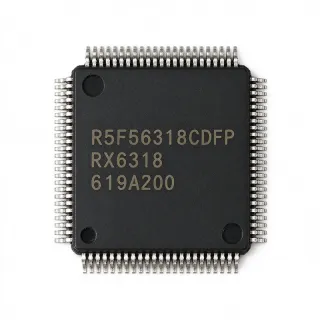
R5F51308ADFP#30 - RX130 32MHz 512KB Flash MCU | Renesas
N.º da peça: R5F51308ADFP#30 ✓ Ativo| Qtd. | Preço unitário | Total |
|---|---|---|
| 1 | $6.4 | $6,40 |
| 10 | $5.8 | $58,00 |
| 100 | $5.1 | $510,00 |
| 500 | $4.4 | $2.200,00 |
| 1.000 | $3.75 | $3.750,00 |
R5F51308ADFP#30 Visão geral
A microcontroller (MCU) is a single-chip computer containing a CPU core, program memory (Flash), data memory (SRAM), and on-chip peripherals such as timers, communication interfaces, ADCs, and touch sensing. MCUs form the lowest tier of the embedded computing hierarchy: embedded processor -> microcontroller -> 32-bit MCU -> RX130 family. They sit beneath microprocessors (MPUs) in capability but above discrete logic in integration, enabling compact, low-power designs for appliance, industrial, and human-machine-interface (HMI) products.
Key features of the R5F51308ADFP#30 include 88 I/O pins (per JLCPCB listing), a 12-bit A/D converter with up to 36 capacitive touch sensing channels, an 8-bit D/A converter, 6 communication channels (including SCI, I2C, and SPI variants), an RTC, IEC60730 compliance support for household appliance safety standards, and a wide 1.8 V to 5.5 V single-supply operating range. The device uses the proprietary RXv1 CPU core with single-precision FPU.
The RX130 architecture combines deterministic interrupt response with low-power operation, making it well suited for white goods, sensor HMI, and battery-friendly IoT edge nodes. The integrated touch sensing unit uses an improved mutual-capacitance detection method providing better noise immunity, sensitivity, and water resistance versus earlier Renesas touch MCUs.
Typical applications include washing machine and refrigerator control boards, induction cooktop user interfaces, smart thermostat keypads, industrial sensor HMI panels, and small IoT sensor hubs. The wide 5 V tolerance simplifies interfacing with legacy analog front-ends and white-goods actuator drivers.
When designing with this part, remember that the R5F51308ADFP#30 is the 100-pin / 512 KB / -40C to +85C industrial-grade variant. For lower pin counts, smaller flash, or extended temperature (-40C to +105C) refer to other RX130 group members listed in the family datasheet (R01DS0243EU0300).
This page synthesizes distributor pricing, drop-in same-package alternatives, and practical design notes not found in the manufacturer datasheet, with cross-references verified against the Renesas RX130 group datasheet and authorized distributor data as of 2026-10-10.
Alternativas drop-in para R5F51308ADFP#30 — mesmo encapsulamento, compatível pino a pino. Peças de encapsulamento diferente que exigem retrabalho na PCB são excluídas.
Variantes desta série
Modelos da mesma série compatíveis como drop-in com R5F51308ADFP#30 (mesmo formato e footprint) — diferindo em I/O Pins, Operating Temperature, Package, RoHS Status.
Ferramenta de comparação rápida — selecione peças alternativas para comparação lado a lado:
R5F51307ADFP#30
✅ Drop-In📋 Alternativa de referência (fora do catálogo)
R5F51305ADFP#30
✅ Drop-In📋 Alternativa de referência (fora do catálogo)
R5F51308ADFP#10
✅ Drop-In📋 Alternativa de referência (fora do catálogo)
R5F51306ADFP#30
✅ Drop-In📋 Alternativa de referência (fora do catálogo)
PIC32MX575F512H-80I/MR
✅ Drop-In✓ Em estoque
$6.72 / unidade
Ver ficha técnica →R5F51308ADFP#30 Classificações máximas e características elétricas
| Core | RXv1 32-bit |
| Operating Frequency | 32 MHz |
| DMIPS | 50 DMIPS |
| Program Memory (Flash) | 512 KB |
| Data Memory (SRAM) | 48 KB |
| Encapsulamento | 100-LFQFP (14x14 mm) |
| Tipo de montagem | Surface Mount |
| Tensão de alimentação | 1.8 V to 5.5 V |
| Temperatura de operação | -40C to +85C |
| I/O Pins | 88 |
| A/D Converter | 12-bit |
| D/A Converter | 8-bit |
| Capacitive Touch Channels | Up to 36 |
| Communication Channels | Up to 6 |
| RTC | Yes (on-chip) |
| IEC60730 Compliance Support | Yes |
| Status RoHS | Compliant (per JLCPCB listing) |
Configuração de pinos do R5F51308ADFP#30
| Pino 1 | VREFH — ADC reference voltage high |
| Pino 2 | VREFL — ADC reference voltage low |
| Pino 3 | AVCC — Analog supply voltage |
| Pino 4 | P40/IRQ0 — Port 4 / external interrupt 0 |
| Pino 5 | P41/IRQ1 — Port 4 / external interrupt 1 |
| Pino 6 | P42/IRQ2 — Port 4 / external interrupt 2 |
| Pino 7 | P43 — Port 4 general I/O |
| Pino 8 | P44 — Port 4 general I/O |
| Pino 9 | P45 — Port 4 general I/O |
| Pino 10 | P46 — Port 4 general I/O |
| Pino 11 | P47 — Port 4 general I/O |
| Pino 12 | VSS — Ground |
| Pino 13 | P50 — Port 5 general I/O |
| Pino 14 | P51 — Port 5 general I/O |
| Pino 15 | P52 — Port 5 general I/O |
| Pino 16 | P53 — Port 5 general I/O |
| Pino 17 | P54 — Port 5 general I/O |
| Pino 18 | P55 — Port 5 general I/O |
| Pino 19 | P56 — Port 5 general I/O |
| Pino 20 | P57 — Port 5 general I/O |
| Pino 21 | VCL — Decoupling pin for internal regulator |
| Pino 22 | MD — Mode select (boot mode) |
| Pino 23 | XCIN — Sub-clock oscillator input (32.768 kHz) |
| Pino 24 | XCOUT — Sub-clock oscillator output |
| Pino 25 | RES# — Reset input (active low) |
| Pino 26 | XTAL/P37 — Main oscillator / Port 3 |
| Pino 27 | EXTAL/P36 — Main oscillator / Port 3 |
| Pino 28 | P35/NMI — Port 3 / non-maskable interrupt |
| Pino 29 | P34/IRQ4 — Port 3 / external interrupt 4 |
| Pino 30 | P33/IRQ3 — Port 3 / external interrupt 3 |
| Pino 31 | P32 — Port 3 general I/O |
| Pino 32 | P31 — Port 3 general I/O |
| Pino 33 | P30 — Port 3 general I/O |
| Pino 34 | VCC — Digital supply voltage |
| Pino 35 | P17 — Port 1 general I/O |
| Pino 36 | P16 — Port 1 general I/O |
| Pino 37 | P15 — Port 1 general I/O |
| Pino 38 | P14 — Port 1 general I/O |
| Pino 39 | P13 — Port 1 general I/O |
| Pino 40 | P12 — Port 1 general I/O |
| Pino 41 | P11 — Port 1 general I/O |
| Pino 42 | P10 — Port 1 general I/O |
| Pino 43 | P07 — Port 0 general I/O |
| Pino 44 | P06 — Port 0 general I/O |
| Pino 45 | P05 — Port 0 general I/O |
| Pino 46 | P04 — Port 0 general I/O |
| Pino 47 | P03 — Port 0 general I/O |
| Pino 48 | P02 — Port 0 general I/O |
| Pino 49 | P01 — Port 0 general I/O |
| Pino 50 | P00 — Port 0 general I/O |
| Pino 51 | VSS — Ground |
| Pino 52 | P97 — Port 9 general I/O |
| Pino 53 | P96 — Port 9 general I/O |
| Pino 54 | P95 — Port 9 general I/O |
| Pino 55 | P94 — Port 9 general I/O |
| Pino 56 | P93 — Port 9 general I/O |
| Pino 57 | P92 — Port 9 general I/O |
| Pino 58 | P91 — Port 9 general I/O |
| Pino 59 | P90 — Port 9 general I/O |
| Pino 60 | P87 — Port 8 general I/O |
| Pino 61 | P86 — Port 8 general I/O |
| Pino 62 | P85 — Port 8 general I/O |
| Pino 63 | P84 — Port 8 general I/O |
| Pino 64 | P83 — Port 8 general I/O |
| Pino 65 | P82 — Port 8 general I/O |
| Pino 66 | P81 — Port 8 general I/O |
| Pino 67 | P80 — Port 8 general I/O |
| Pino 68 | VCC — Digital supply voltage |
| Pino 69 | P77 — Port 7 general I/O |
| Pino 70 | P76 — Port 7 general I/O |
| Pino 71 | P75 — Port 7 general I/O |
| Pino 72 | P74 — Port 7 general I/O |
| Pino 73 | P73 — Port 7 general I/O |
| Pino 74 | P72 — Port 7 general I/O |
| Pino 75 | P71 — Port 7 general I/O |
| Pino 76 | P70 — Port 7 general I/O |
| Pino 77 | P67 — Port 6 general I/O |
| Pino 78 | P66 — Port 6 general I/O |
| Pino 79 | P65 — Port 6 general I/O |
| Pino 80 | P64 — Port 6 general I/O |
| Pino 81 | P63 — Port 6 general I/O |
| Pino 82 | P62 — Port 6 general I/O |
| Pino 83 | P61 — Port 6 general I/O |
| Pino 84 | P60 — Port 6 general I/O |
| Pino 85 | VSS — Ground |
| Pino 86 | P27 — Port 2 general I/O |
| Pino 87 | P26 — Port 2 general I/O |
| Pino 88 | P25 — Port 2 general I/O |
| Pino 89 | P24 — Port 2 general I/O |
| Pino 90 | P23 — Port 2 general I/O |
| Pino 91 | P22 — Port 2 general I/O |
| Pino 92 | P21 — Port 2 general I/O |
| Pino 93 | P20 — Port 2 general I/O |
| Pino 94 | P13 — Port 1 general I/O |
| Pino 95 | P12 — Port 1 general I/O |
| Pino 96 | P11 — Port 1 general I/O |
| Pino 97 | P10 — Port 1 general I/O |
| Pino 98 | AVSS — Analog ground |
| Pino 99 | AVCC — Analog supply voltage |
| Pino 100 | VREFH — ADC reference voltage high |
Aplicações típicas
R5F51308ADFP#30 é adequado para 6 aplicaçãos: Washing Machine Control Board, Induction Cooktop Touch Interface, Refrigerator Temperature & Door HMI, Smart Thermostat Wall Module, Industrial Sensor HMI Panel, Small IoT Sensor Hub / Appliance Gateway.
Washing Machine Control Board
The R5F51308ADFP#30 fits washing-machine main boards because it combines a 32 MHz RXv1 core with 50 DMIPS, 512 KB Flash, and on-chip IEC60730 self-test support - all required for Class B appliance functional-safety. The integrated 36-channel CTSU capacitive touch unit replaces mechanical push buttons with sealed glass-panel interfaces, eliminating water ingress points. The 1.8 V-5.5 V supply range lets designers run the MCU directly from a rectified 5 V rail alongside triac-driven motor drivers. The 100-LFQFP package exposes enough I/O for motor PWM, water-level sensing, drum temperature, and buzzer feedback. Compared to discrete MCU plus external touch-IC solutions, this part cuts BOM count and PCB area while keeping firmware deterministic.
Recomendado
Induction Cooktop Touch Interface
The R5F51308ADFP#30 drives induction-cooktop slider-and-key HMIs thanks to its 36-channel CTSU with improved water resistance and noise immunity over earlier Renesas touch MCUs. A 32 MHz core is fast enough to scan the full slider array at 8 ms per cycle while still running the IEC60730 self-test and the user-interface graphics state machine. The 512 KB Flash stores the touch library, slider gesture recognition, and fault-detection firmware without external memory. The 88 available I/Os allow direct connection to IGBT gate drivers, fan PWM, and pan-presence comparator logic, simplifying the BOM. Its 5 V tolerance eliminates level shifters on legacy analog front-ends.
Recomendado
Refrigerator Temperature & Door HMI
The R5F51308ADFP#30 is well suited for refrigerator main boards that need to combine a multi-zone temperature-control loop, a capacitive-touch door panel, and an LCD segment driver. The 12-bit ADC samples NTC thermistors with 0.25 C resolution for compressor defrost cycles, while the on-chip RTC enables adaptive energy-saving modes. The wide -40C to +85C operating range covers unheated garage and freezer-cabinet environments. 48 KB SRAM holds the touch-sensing buffer plus a small TCP/IP fragment for smart-fridge connectivity modules. Compared with external touch controllers, integrating CTSU into the main MCU reduces quiescent current and removes an SPI bus from the design.
Recomendado
Smart Thermostat Wall Module
Wall-mounted smart thermostats benefit from the R5F51308ADFP#30's capacitive touch sensing, 5 V tolerance, and 32 MHz RXv1 performance at modest power consumption. The 36 CTSU channels support slider-setpoint, mode buttons, and proximity wake-up - all with the noise immunity needed near switched-mode HVAC relays. 512 KB Flash accommodates a real-time OS, a Matter-over-Wi-Fi or BLE bridge, and OTA bootloader. The 88 I/Os interface directly to a triac for fan control and to a 0-10 V dimmer for backlight, simplifying PCB routing. Compared with ARM Cortex-M0+ alternatives at the same frequency, RXv1 offers stronger deterministic interrupt latency for HVAC safety routines.
Recomendado
Industrial Sensor HMI Panel
Factory-floor sensor HMI panels use the R5F51308ADFP#30 for its rugged -40C to +85C rating, integrated IEC60730 class-B support, and ability to drive up to 6 communication channels (SCI, I2C, SPI) for multi-sensor aggregation. The 32 MHz core runs a CAN-style industrial protocol stack plus a 4-line LCD user interface without DMA stalls. CTSU enables sealed front-panel designs where the sensor enclosure is IP65-rated and free of mechanical key switches. Compared to NXP LPC or STM32 alternatives, RX130 provides comparable flash density with a tighter latency profile for safety shutdown routines.
Recomendado
Small IoT Sensor Hub / Appliance Gateway
Connected appliances and small IoT hubs use the R5F51308ADFP#30 as a local sensor-aggregation MCU, leveraging its 6 communication channels to bridge UART sensors, I2C peripherals, and an SPI radio module. 512 KB Flash holds an lwIP TCP/IP stack or a private RF protocol alongside the main application, and 48 KB SRAM keeps packet buffers in-chip without external SRAM. The 5 V tolerance simplifies integration with analog 4-20 mA loops and legacy actuator drivers, while the RXv1 core's fast interrupt response ensures deterministic sensor polling. Compared to a separate touch MCU plus a Wi-Fi SoC, integrating CTSU and a host-side MCU into one part saves board space and reduces total BOM cost.
Recomendado
Resumo dos produtos recomendados
Dados de referência de engenharia para R5F51308ADFP#30 — comparação, orientação de projeto e informações de conformidade.
Guia de seleção
Comparação com alternativas
| Parâmetro | Este produto | R5F51307ADFP#30 | R5F51305ADFP#30 | R5F51308ADFP#10 | R5F51306ADFP#30 | PIC32MX575F512H-80I/MR |
|---|---|---|---|---|---|---|
| Package | 100-LFQFP (14x14) | 100-LFQFP (14x14) - same | 100-LFQFP (14x14) - same | 100-LFQFP (14x14) - same | 100-LFQFP (14x14) - same | 100-LQFP (LQFP-100) - same |
| Brand | Renesas Electronics | Renesas Electronics | Renesas Electronics | Renesas Electronics | Renesas Electronics | Microchip Technology |
| Core / Architecture | RXv1 32-bit | RXv1 32-bit | RXv1 32-bit | RXv1 32-bit | RXv1 32-bit | MIPS M4K 32-bit |
| Operating Frequency | 32 MHz | 32 MHz | 32 MHz | 32 MHz | 32 MHz | 80 MHz |
| Flash | 512 KB | 384 KB | 256 KB | 512 KB | 256 KB | 512 KB |
| SRAM | 48 KB | 48 KB | 48 KB | 48 KB | 48 KB | 64 KB |
| Capacitive Touch Channels | Up to 36 | Up to 36 | Up to 36 | Up to 36 | Up to 36 | 0 (external CTMU required) |
| Operating Temperature | -40C to +85C (industrial) | -40C to +85C (industrial) | -40C to +85C (industrial) | -20C to +85C (consumer) | -40C to +85C (industrial) | -40C to +85C (industrial) |
| Supply Voltage | 1.8 V to 5.5 V | 1.8 V to 5.5 V | 1.8 V to 5.5 V | 1.8 V to 5.5 V | 1.8 V to 5.5 V | 2.3 V to 3.6 V |
| IEC60730 Compliance | Yes (on-chip library support) | Yes | Yes | Yes | Yes | Yes (via MPLAB XC32 Class B library) |
Principais diferenciais
- Integrated 36-channel CTSU with improved water resistance (vs PIC32MX575F512H-80I/MR)
- Native 5 V operation (1.8 V to 5.5 V) (vs PIC32MX575F512H-80I/MR)
- RXv1 deterministic 32-bit performance at 32 MHz (vs R5F51305ADFP#30 (256 KB Flash))
- Industrial -40C to +85C temperature grade (vs R5F51308ADFP#10)
Notas de projeto
The R5F51308ADFP#30 operates from 1.8 V to 5.5 V single supply, so a single 3.3 V LDO (e.g. NCV4274ADS50R4G with 5 V variant) is sufficient for the digital rail. Place a 4.7 uF bulk capacitor plus 0.1 uF decoupling close to each VCC pin, and a 1 uF + 0.01 uF pair on AVCC. The VCL pin MUST have a 0.47 uF decoupling capacitor to ground; omitting it causes unstable internal regulator behavior and Flash programming failures. Estimated: total MCU supply current at 32 MHz active is approximately 15 mA, well below typical 100 mA LDO ratings.
Keep the 32 MHz main oscillator traces (XTAL/EXTAL) and the 32.768 kHz sub-oscillator traces (XCIN/XCOUT) as short as possible and away from switching nodes such as triac drivers and IGBT gate lines. The 100-LFQFP exposes 88 I/Os - route CTSU touch channels with guard traces (grounded pour) to keep capacitive loading consistent across channels. Estimated: typical CTSU trace impedance of 50 ohm with 10 pF load benefits from a 5 mm trace-width-to-ground spacing ratio. A solid 4-layer ground pour under the MCU is recommended to minimize radiated emissions from the high-speed RXv1 core.
Three common pitfalls when designing with R5F51308ADFP#30: (1) selecting '#10' instead of '#30' for outdoor appliances - the consumer temperature grade bottoms out at -20C and will fail cold-start tests; (2) forgetting to enable the on-chip IEC60730 self-test library before Flash programming - the library must be linked into the firmware image, not bolted on later; (3) sharing the analog AVCC with the digital VCC rail without an inductor bead, which couples MCU switching noise into the 12-bit ADC readings. Always boot the device through the Renesas e2 studio or Renesas Flash Programmer with the correct algorithm file for the 512 KB variant.
Informações de conformidade
RoHS compliance confirmed via JLCPCB listing; AEC-Q100 not applicable - this is a consumer/industrial MCU, not an automotive-grade part. IEC60730 functional-safety compliance is supported via on-chip self-test library but requires firmware-level certification by the appliance maker.