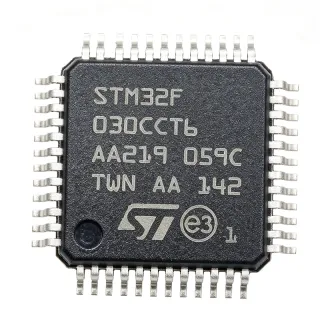
STM8S207K8T3CTR - 24MHz 8-Bit 64KB Flash MCU | STMicroelectronics
N.º da peça: STM8S207K8T3CTR ✓ AtivoSTM8S207K8T3CTR Visão geral
An STM8S performance-line microcontroller is an 8-bit embedded controller used to combine flash-programmable logic, peripheral interfaces, and real-time control in a compact package. Its hierarchy extends from embedded microcontroller to 8-bit MCU and then to the broader semiconductor category. The STM8S207K8T3CTR is intended for cost-sensitive appliance control, industrial equipment, consumer products, and compact automation modules that benefit from a deterministic 8-bit architecture and extensive peripheral integration.
Key features include a 24 MHz maximum clock, 64 KB of Flash program memory, and support for both 3.3 V and 5 V operation. The 32-lead LQFP package provides a conventional gull-wing footprint that remains practical for prototypes, moderate-density control boards, and production assemblies requiring leaded-package inspection. Its part suffix identifies a tape-and-reel ordering configuration, while the T3 temperature designation is associated with the automotive-grade ordering family identified for this exact device.
The STM8S207K8 architecture uses a high-performance 8-bit core and integrates communication and control peripherals for embedded designs. At 24 MHz, it provides substantially more instruction throughput than standard 8 MHz STM8 devices, allowing designers to combine protocol handling, timing, and control tasks on one microcontroller. The 64 KB Flash configuration offers twice the program capacity of a comparable 32 KB member while maintaining the same 32-lead package family.
Typical applications include appliance controllers, motor-control modules, sensor-hub boards, LED-control systems, compact industrial interfaces, and low-cost connected products. Its 3.3 V and 5 V operating options also make it suitable for legacy 5 V control platforms and modern 3.3 V peripheral systems. Engineers should verify the exact peripheral mix, pin multiplexing, electrical limits, and programming requirements against the manufacturer datasheet before releasing a PCB.
For a new layout, route the MCU power pins with short, symmetrical paths and place the required bypass capacitors close to their associated supply pins. Keep oscillator and reset traces away from switching nodes and high-current outputs. Because firmware, bootloader behavior, and peripheral availability depend on the exact STM8S207K8 device revision, confirm the device identifier and programming configuration during design validation.
This product page consolidates the verified 24 MHz, 64 KB Flash, 32-LQFP, supply-voltage, packaging, and ordering information with pin-compatible STM8 family options, application guidance, and design cautions. It is intended to accelerate initial part selection while directing detailed engineering decisions to the manufacturer datasheet and product documentation.
Alternativas drop-in para STM8S207K8T3CTR — mesmo encapsulamento, compatível pino a pino. Peças de encapsulamento diferente que exigem retrabalho na PCB são excluídas.
Variantes desta série
Modelos da mesma série compatíveis como drop-in com STM8S207K8T3CTR (mesmo formato e footprint) — diferindo em Flash Program Memory, Package, ADC Resolution, CAN Interface, Core Architecture.
STM8S207K6T3CTR
✅ Drop-In ⚠️ Especificações não verificadasConsulte o preço
Ver ficha técnica →STM8S207K6T6CTR
✅ Drop-In ⚠️ Especificações não verificadasConsulte o preço
Ver ficha técnica →STM8S207K8T3CTR Classificações máximas e características elétricas
| Product Type | 8-bit flash microcontroller |
| Product Line | STM8S20xxx performance line |
| Frequência máxima de clock | 24 MHz |
| Flash Program Memory | 64 KB (64K x 8) |
| Tensão de alimentação | 3.3 V or 5 V |
| Encapsulamento | 32-lead LQFP, 7 x 7 mm |
| Number of Terminals | 32 |
| Core Architecture | 8-bit CISC |
| Temperature Grade | Automotive |
| Tipo de montagem | Surface mount |
| Terminal Form | Gull wing |
| Package Shape | Square |
| Order Configuration | Tape and reel |
Guia de Configuração de Pinos do STM8S207K8T3CTR square
Configuração de pinos para STM8S207K8T3CTR (pacote square). Este CI digital inclui GPIO, interfaces de comunicação (UART, SPI, I2C) e pinos de alimentação. Consulte o datasheet do fabricante para funções alternativas dos pinos e opções de configuração. Essencial para projeto de sistemas embarcados e layout de PCB.

Nenhum dado detalhado de pinagem disponível para STM8S207K8T3CTR.
Consulte a ficha técnica para a configuração completa dos pinos.
Aplicações típicas
STM8S207K8T3CTR é adequado para 6 aplicaçãos: Appliance Control, Industrial Sensor Interface, Compact Motor Controller, LED Lighting Controller, Cost-Sensitive Consumer Product, Communication Gateway Module.
Appliance Control
The STM8S207K8T3CTR fits appliance-control boards that combine several timed functions, user-interface inputs, and communication tasks within a 64 KB Flash budget. Its 24 MHz operating speed provides useful execution margin for motor sequencing, sensor filtering, and state-machine logic. The 3.3 V or 5 V operating capability supports both modern low-voltage logic and established appliance architectures. Use the device between the power-control stage and the main logic rails, while preserving the separation between switching signals and sensitive sensor paths. The 32-lead LQFP package is easier to inspect than a fine-pitch QFP and remains compatible with conventional gull-wave assembly capability.
Recomendado
Industrial Sensor Interface
The STM8S207K8T3CTR is appropriate for compact industrial sensor interfaces that must acquire measurements, apply filtering, report status, and manage digital I/O locally. The 64 KB of Flash provides room for protocol handlers and calibration logic, while the 24 MHz clock supports time-critical sampling and control tasks. Its 3.3 V or 5 V compatibility enables integration with both legacy sensors and newer industrial peripherals. Place the MCU close to the sensor-conditioning circuitry, route analog and digital grounds according to the system grounding strategy, and isolate switching-regulator nodes from precision measurement paths. Confirm ADC characteristics and peripheral availability in the manufacturer documentation before finalizing the signal chain.
Recomendado
Compact Motor Controller
The STM8S207K8T3CTR can manage compact motor-control subsystems where a dedicated motor controller is unnecessary and deterministic 8-bit control is sufficient. Its 24 MHz processing capability supports commutation logic, speed measurement, fault handling, and communication tasks, while 64 KB of Flash accommodates application code beyond the basic control loop. The controller should operate at a 3.3 V or 5 V logic level, with power transistors and drivers positioned separately on the board. Keep motor current paths away from oscillator, reset, and communication traces, and include hardware protection independent of firmware. Verify timer outputs, encoder inputs, and electrical limits before assigning motor-control functions to specific pins.
Recomendado
LED Lighting Controller
The STM8S207K8T3CTR suits LED-lighting controllers that require timed effects, status indication, user adjustment, and communication in one controller. The 64 KB Flash capacity supports longer effect tables and multi-light sequences, and the 24 MHz clock allows responsive updates without tying up a more complex processor. Its 3.3 V or 5 V operating range supports different LED-driver interface levels. Use PWM-capable pins for dimming or channel selection, connect the MCU ground to a stable quiet reference in the power tree, and separate LED switching returns from sensitive signal paths. Validate PWM resolution, timer channel allocation, and maximum pin toggle requirements against the actual lighting architecture.
Recomendado
Cost-Sensitive Consumer Product
The STM8S207K8T3CTR is well suited to cost-sensitive consumer products that require flash-based programmability, moderate real-time performance, and a straightforward package. The 24 MHz 8-bit core can manage button logic, display functions, simple actuators, and communication without imposing the cost or power budget of a higher-complexity MCU. Sixty-four kilobytes of Flash provides useful application headroom without requiring external memory, while 3.3 V and 5 V operation accommodates multiple platform generations. The 32-LQFP package is suitable for moderate production volumes where leaded gull-wing assemblies simplify inspection and rework. Confirm programming-cycle requirements, active standby behavior, and peripheral demand before locking the bill of materials.
Recomendado
Communication Gateway Module
The STM8S207K8T3CTR can serve as a local protocol-conversion and gateway controller for compact equipment that must bridge serial interfaces and manage auxiliary I/O. The 24 MHz clock supports timely protocol parsing, buffering, and diagnostics, while 64 KB of Flash accommodates firmware for several communication modes. Operation from 3.3 V or 5 V allows the controller to fit established industrial and consumer interface circuits. Keep transceiver interfaces away from oscillator and supply-return paths, provide local decoupling at each supply entry, and use controlled ground routing between external interfaces. Because peripheral assignments vary within the family, verify the required USART, SPI, I2C, and timer resources in the device documentation before assigning connector signals.
Recomendado
Resumo dos produtos recomendados
Dados de referência de engenharia para STM8S207K8T3CTR — comparação, orientação de projeto e informações de conformidade.
Guia de seleção
Comparação com alternativas
| Parâmetro | Este produto | STM8S207K6T3CTR | STM8S207K6T6CTR |
|---|---|---|---|
| Brand | STMicroelectronics | STMicroelectronics | STMicroelectronics |
| Package | 32-LQFP (7x7) | 32-LQFP (7x7) | 32-LQFP (7x7) |
| Flash Program Memory | 64 KB | 32 KB | 32 KB |
| Architecture | 8-bit CISC | 8-bit CISC | 8-bit CISC |
| Number of Terminals | 32 | 32 | 32 |
| Temperature Designation | T3 | T3 | T6 |
| Mounting Type | Surface mount | Surface mount | Surface mount |
| Order Packaging | Tape and reel | Tape and reel | Tape and reel |
Principais diferenciais
- Double the program memory of the K6 alternatives (vs STM8S207K6T3CTR)
- Retains the same 32-LQFP footprint as the K6 alternatives (vs STM8S207K6T6CTR)
- Higher identified operating frequency than the K6 family configuration (vs STM8S207K6T6CTR)
Notas de projeto
Place all required bypass capacitors directly beside the STM8S207K8T3CTR power pins, using the manufacturer-recommended capacitance and voltage rating. Keep the return path through the capacitor ground terminal short and pair it with a nearby ground-plane connection. Route oscillator traces away from motor, relay, LED-driver, and switching-regulator nodes to reduce injected noise and prevent unstable clock operation.
Design the 3.3 V or 5 V supply path so the MCU experiences the required voltage during startup, reset, and maximum peripheral activity. Validate minimum operating voltage at the device pins rather than relying only on the nominal source voltage. Keep high-current loads on separate branches and use local filtering where their transients could otherwise appear across the MCU supply.
Do not treat the STM8S207K6T3CTR or STM8S207K6T6CTR as unconditional replacements for STM8S207K8T3CTR. Each alternative has 32 KB of Flash rather than 64 KB, so the existing firmware may no longer fit. Check code size, bootloader interaction, peripheral availability, temperature requirements, and device identification during prototype qualification.
Assign communication, timer, and general-purpose functions only after reviewing the STM8S207K8 pin-description table and alternate-function matrix. Several signals can have multiple peripheral roles, and choosing the wrong mapping can prevent a timer output or serial channel from operating as expected. Leave programming and debug access reachable in the production layout and preserve the manufacturer's recommended reset arrangement.
Informações de conformidade
The ordering information identifies an automotive temperature grade, but AEC-Q100 qualification and material-compliance declarations must be confirmed from the manufacturer product documentation.