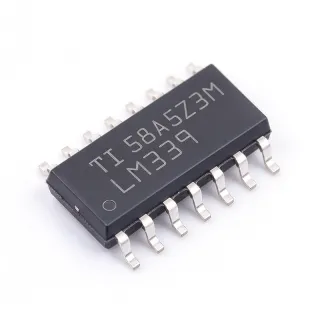
TS924IYDT - Quad R-R Op Amp, 4MHz, 12V | STMicroelectronics
N.º da peça: TS924IYDT ✓ AtivoTS924IYDT Visão geral
An operational amplifier is an analog signal-processing IC that uses differential feedback to amplify the voltage difference between its inverting and non-inverting inputs. The TS924IYDT belongs to the operational-amplifier hierarchy, which includes rail-to-rail amplifiers, general-purpose amplifiers, analog ICs, and semiconductors. Its rail-to-rail input stage accepts signals near either supply rail, while its rail-to-rail output stage can swing close to both rails when sufficient output-current and load conditions are met.
The four amplifiers share a common package while operating independently. Each channel combines a 4 MHz gain-bandwidth product with a 1.3 V/us slew rate, allowing moderate-bandwidth signal conditioning without the switching noise associated with a digital potentiometer or multiplexed converter. Low input bias current of 15 nA is useful for high-impedance sources, while the specified 80 mA output current allows low-impedance loads to be driven more effectively than a standard low-current amplifier.
Noise and distortion are important benefits in audio, sensor, and instrumentation paths. The published noise density of 9 nV/Hz supports low-noise amplification, and the device is characterized for low distortion. Because the common-mode input range extends across the supply rails, the device can process signals close to ground or to the positive supply without requiring a separate mid-supply reference in many single-supply designs.
Typical uses include low-level sensor amplification, active filtering, audio signal conditioning, industrial instrumentation, data-acquisition front ends, and general-purpose buffer stages. Each amplifier can also be configured as a voltage follower, non-inverting amplifier, or inverting amplifier. Decoupling close to the supply pins remains important because simultaneous switching and wide input bandwidth can couple supply noise and board activity into the output.
For stable operation, confirm the output voltage, load, input common-mode range, and required closed-loop bandwidth against the operating conditions. The 14-pin SOIC footprint supports conventional surface-mount assembly, while the exposed thermal considerations are less demanding than those of high-power components because the TS924IYDT is primarily an analog signal amplifier.
This page combines manufacturer-device characteristics, package and sourcing details, same-family replacement guidance, and practical design guidance to support faster component selection, footprint verification, and robust analog-circuit implementation.
Alternativas drop-in para TS924IYDT — mesmo encapsulamento, compatível pino a pino. Peças de encapsulamento diferente que exigem retrabalho na PCB são excluídas.
Variantes desta série
Modelos da mesma série compatíveis como drop-in com TS924IYDT (mesmo formato e footprint) — diferindo em Amplifier Type, Package, Supply Voltage Range, RoHS Status, Slew Rate.
TS924AIDT
✅ Drop-In ⚠️ Especificações não verificadasConsulte o preço
Ver ficha técnica →TS924AIYDT
✅ Drop-In ⚠️ Especificações não verificadas📋 Alternativa de referência (fora do catálogo)
TS924IDT
✅ Drop-In ⚠️ Especificações não verificadasConsulte o preço
Ver ficha técnica →TS924IYDT
✅ Drop-In ⚠️ Especificações não verificadasConsulte o preço
Ver ficha técnica →TS925IDT
✅ Drop-InConsulte o preço
Ver ficha técnica →TS924IYDT Classificações máximas e características elétricas
| Number of Amplifiers | 4 circuits |
| Amplifier Type | General-purpose rail-to-rail operational amplifier |
| Process Technology | BiCMOS |
| Supply Voltage Operation | 3 V to 5 V optimized |
| Maximum Supply Voltage | 12 V |
| Input Common-Mode Range | Rail-to-rail |
| Output Swing | Rail-to-rail |
| Gain-Bandwidth Product | 4 MHz |
| Slew Rate | 1.3 V/us |
| Voltage Noise Density | 9 nV/Hz |
| Output Current | 80 mA |
| Input Bias Current | 15 nA |
| Offset Voltage | 3 mV maximum |
| Número de pinos | 14 pins |
| Encapsulamento | SOIC-14 |
| Tipo de montagem | Surface mount |
| Shipping Form | Tape and reel |
Guia de Configuração de Pinos do TS924IYDT soic-14
Configuração de pinos para TS924IYDT (pacote soic-14). Este componente analógico possui pinos de entrada, saída e alimentação. Consulte o datasheet do fabricante para configurações de offset null, compensação e pino de enable. Ideal para circuitos de condicionamento de sinal e amplificadores.
Nenhum dado detalhado de pinagem disponível para TS924IYDT.
Consulte a ficha técnica para a configuração completa dos pinos.
Aplicações típicas
TS924IYDT é adequado para 6 aplicaçãos: Low-Level Sensor Signal Conditioning, Audio Preamplifier and Output Buffer, Industrial Instrumentation Amplifier, Active Filter and Equalization Network, Data-Acquisition Input Conditioning, Portable Low-Voltage Analog Interface.
Low-Level Sensor Signal Conditioning
The TS924IYDT fits low-level sensor front ends because its rail-to-rail input range accepts signals near the supply rails, while its 15 nA input bias current limits loading on high-impedance sources. The 9 nV/Hz noise density also supports low-amplitude measurement signals that would otherwise be buried in amplifier noise. Each of the four channels can amplify a sensor output, buffer a reference, or form an active filter. Place the selected channel close to the sensor connector and use short feedback paths to minimize parasitic pickup. Verify the common-mode range at the actual signal and supply voltages because rail-to-rail operation does not remove all input overvoltage or output-swing restrictions.
Recomendado
Audio Preamplifier and Output Buffer
The TS924IYDT is appropriate for audio preamplifier and buffer stages that operate from 3 V or 5 V. Its 4 MHz gain-bandwidth product supports audio-band signals, its low distortion supports signal fidelity, and its 80 mA output-current rating provides more drive than a conventional low-power amplifier. The rail-to-rail output can be useful with single-supply audio circuitry, although crossover distortion, load capacitance, and the actual output swing should be evaluated in the finished network. Use one channel for input amplification and another for output buffering when additional drive is required. Keep the feedback loop compact and isolate the amplifier from digital switching paths.
Recomendado
Industrial Instrumentation Amplifier
The TS924IYDT can serve in industrial instrumentation circuits that combine low-frequency sensor signals with moderate bandwidth requirements. Its 4 MHz gain-bandwidth product supports closed-loop gains where adequate phase margin is retained, and its 1.3 V/us slew rate allows reasonably fast settling for data-acquisition channels. The quad topology can implement differential gain, active filtering, and output buffering without requiring four separate packages. For long sensor cables, place protection and filtering ahead of the amplifier and keep high-impedance nodes away from humid or contaminated board areas. Verify operating temperature, supply tolerance, and electrical limits against the industrial environment in which the equipment will operate.
Recomendado
Active Filter and Equalization Network
The TS924IYDT is well suited to active filtering because it combines four amplifiers in one package with a 4 MHz gain-bandwidth product and 1.3 V/us slew rate. Multiple Sallen-Key or state-variable sections can be implemented for anti-alias, smoothing, audio equalization, or sensor-band shaping. Rail-to-rail input and output behavior increases the usable signal range in low-voltage systems, while the specified output drive can support moderate loading. Keep component values and feedback loops stable with realistic tolerances, and check the closed-loop gain against the amplifier's gain-bandwidth limit. Decouple the supply pins and avoid routing filter nodes adjacent to switching converter nodes.
Recomendado
Data-Acquisition Input Conditioning
The TS924IYDT can condition inputs for data-acquisition systems by combining four channels of amplification, filtering, and buffering in a single 14-pin SOIC package. The 15 nA input bias current is useful when sensors present high output resistance, while rail-to-rail input operation allows signals near the supply boundaries. At higher frequencies, the 4 MHz gain-bandwidth product and 1.3 V/us slew rate help preserve amplitude and settling performance. Anti-alias filters, input clamps, and the ADC's acquisition requirements should be evaluated together. Maintain a return path from the input reference to the ADC ground plane to prevent common-mode currents from creating acquisition errors.
Recomendado
Portable Low-Voltage Analog Interface
The TS924IYDT suits portable and compact low-voltage interfaces that need more than one analog function without allocating four separate packages. Its 3 V and 5 V optimization, rail-to-rail signal handling, and SOIC-14 footprint make it suitable for portable measurement, wearable-adjacent sensor interfaces, and compact control boards. The 80 mA output rating can drive moderate loads, although battery efficiency remains a system-level consideration when multiple channels operate continuously. Use local bypass capacitors, control leakage around high-impedance inputs, and avoid placing sensitive inputs next to display or wireless circuitry. Confirm whether the application can tolerate the SOIC footprint and board area compared with a smaller package.
Recomendado
Resumo dos produtos recomendados
Dados de referência de engenharia para TS924IYDT — comparação, orientação de projeto e informações de conformidade.
Guia de seleção
Comparação com alternativas
| Parâmetro | Este produto | TS924AIDT | TS924AIYDT | TS924IDT | TS924IYDT | TS925IDT |
|---|---|---|---|---|---|---|
| Package | SOIC-14 | SOIC-14 | SOIC-14 | SOIC-14 | SOIC-14 | SOIC-14 |
| Brand | STMicroelectronics | STMicroelectronics | STMicroelectronics | STMicroelectronics | STMicroelectronics | STMicroelectronics |
| Number of Amplifiers | 4 circuits | 4 circuits | 4 circuits | 4 circuits | 4 circuits | 4 circuits |
| Architecture | BiCMOS quad operational amplifier | BiCMOS quad operational amplifier | BiCMOS quad operational amplifier | BiCMOS quad operational amplifier | BiCMOS quad operational amplifier | BiCMOS quad operational amplifier with phantom ground |
| Supply Optimization | 3 V and 5 V | 3 V and 5 V | 3 V and 5 V | 3 V and 5 V | 3 V and 5 V | 3 V and 5 V |
| Input and Output Swing | Rail-to-rail | Rail-to-rail | Rail-to-rail | Rail-to-rail | Rail-to-rail | Rail-to-rail |
| Gain-Bandwidth Product | 4 MHz | 4 MHz | 4 MHz | 4 MHz | 4 MHz | 4 MHz |
| Slew Rate | 1.3 V/us | 1.3 V/us | 1.3 V/us | 1.3 V/us | 1.3 V/us | 1.3 V/us |
| Output Current | 80 mA | 80 mA | 80 mA | 80 mA | 80 mA | 80 mA |
| Internal Phantom Ground | No | No | No | No | No | Yes |
Principais diferenciais
- Four high-drive amplifiers in one SOIC-14 package (vs TS925IDT)
- Rail-to-rail input and output operation at low supply voltage (vs TS924IDT)
- Low 15 nA input bias current for higher-impedance sources (vs TS925IDT)
Notas de projeto
Place the manufacturer-recommended bypass capacitors directly beside the positive supply and ground pins, and keep the supply current return close to the device. The TS924IYDT supports 3 V and 5 V operation, but the complete datasheet electrical limits must be respected at the actual supply voltage. Because its output-current capability is 80 mA, transient load current can couple into supply impedance and create output errors; use an appropriately low-impedance local rail and avoid sharing a narrow return path with switching circuitry.
Keep inverting-input and feedback nodes short, especially for high-gain configurations, and route sensitive inputs away from clock, display, switching-converter, and digital-return paths. The 4 MHz bandwidth can pick up board-level interference even when the intended signal occupies a much lower frequency. Use a continuous ground plane where practical and provide a quiet analog return to the supply bypass capacitor. For high-impedance sensors, use guarding techniques and keep connector and PCB contamination away from input pins.
Do not treat rail-to-rail input and output operation as unlimited input-voltage tolerance. Inputs must remain within the device's permitted common-mode and absolute-maximum limits, and outputs must remain compatible with the connected load. When substituting a same-footprint amplifier, verify channel-by-channel pin mapping, supply range, input bias current, output swing, load stability, and whether the circuit relies on a standard midpoint reference or a phantom-ground arrangement.
For filters and instrumentation stages, calculate the closed-loop bandwidth from the intended noise gain rather than relying only on the 4 MHz gain-bandwidth product. A 1.3 V/us slew rate limits large-signal output movement, while the 80 mA rating addresses drive capability rather than guaranteeing stability into every capacitive load. Simulate the actual source impedance, load, feedback network, and supply decoupling, and add isolation resistors or compensation when driving long cables or unusually capacitive loads.
Informações de conformidade
The TS924 is a general-purpose industrial operational amplifier, not an automotive-qualified device. Explicit RoHS, REACH, lead-free, halogen-free, and conflict-minerals declarations were not identified for the exact ordering code.