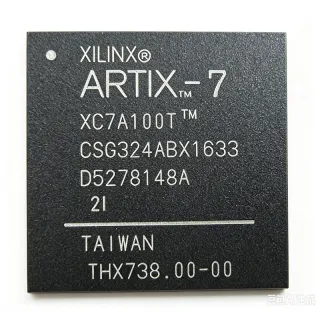
XA3S250E-4FTG256Q 250K-Gate Automotive FPGA | AMD
N.º da peça: XA3S250E-4FTG256Q ⚠ Última compraXA3S250E-4FTG256Q Visão geral
A field-programmable gate array is a semiconductor whose digital logic, interconnect, memory, and input/output resources can be configured after manufacture. The XA Spartan-3E family occupies the FPGA level of the broader programmable-logic hierarchy, combining configurable logic blocks, block RAM, dedicated multipliers, digital clock managers, and programmable I/O. Its XA designation identifies devices intended for cost-sensitive automotive electronics requiring enhanced qualification.
Key capabilities include 612 configurable logic blocks, a reported internal frequency of 572 MHz, 221,184 on-chip RAM bits, and 172 user I/O pins. The -4 suffix identifies the device speed grade, while the Q suffix denotes the extended-temperature automotive configuration. These resources support parallel control, data acquisition, protocol bridging, image processing, and general-purpose programmable-logic functions within one integrated device.
The CMOS Spartan-3E architecture provides deterministic programmable resources rather than the fixed instruction sequence of a microcontroller. Its internal logic blocks can implement Boolean functions, arithmetic, state machines, and datapath logic, while dedicated block RAM and DSP resources reduce the amount of external logic required. The FTG256 package concentrates this processing capacity into a surface-mount ball-grid array intended for multilayer PCB assembly.
Typical automotive uses include body-control modules, infotainment controllers, sensor-fusion front ends, motor and pump controllers, gateway communication equipment, and driver-assistance subsystems. The extended-temperature grade and AEC-Q100 qualification make the device appropriate for environments where temperature cycling, production traceability, and automotive-quality processes are required.
When designing around this FPGA, validate the complete power architecture, decoupling strategy, clocking topology, I/O standards, and programming interface against the manufacturer datasheet. The 256-LBGA footprint demands careful escape-routing and thermal design, while legacy-device availability and end-of-life planning must be addressed before committing to new production volumes.
This page combines the device’s automotive qualification, logic and memory resources, package constraints, lifecycle information, practical automotive use cases, and same-footprint replacement guidance. It also distinguishes the XA automotive Spartan-3E from standard Spartan-3E variants so engineers can assess qualification, temperature grade, and sourcing risk before redesigning an existing 256-ball PCB.
Alternativas drop-in para XA3S250E-4FTG256Q — mesmo encapsulamento, compatível pino a pino. Peças de encapsulamento diferente que exigem retrabalho na PCB são excluídas.
XA3S250E-4FTG256I
✅ Drop-In ⚠️ Especificações não verificadas📋 Alternativa de referência (fora do catálogo)
XA3S250E-4FTG256C
✅ Drop-In ⚠️ Especificações não verificadas📋 Alternativa de referência (fora do catálogo)
XC3S250E-4FTG256C
✅ Drop-In ⚠️ Especificações não verificadas📋 Alternativa de referência (fora do catálogo)
XC3S250E-4FTG256I
✅ Drop-In ⚠️ Especificações não verificadas📋 Alternativa de referência (fora do catálogo)
XA3S250E-4FTG256Q Classificações máximas e características elétricas
| Device Type | Spartan-3E XA automotive FPGA |
| System Gates | 250,000 gates |
| Logic Cells | 5,508 logic cells |
| Configurable Logic Blocks | 612 logic blocks |
| Embedded RAM | 221,184 bits |
| User I/O Pins | 172 pins |
| Nominal Core Supply Voltage | 1.2 V |
| Reported Internal Frequency | 572 MHz |
| Maximum Combinatorial CLB Delay | 4.88 ns |
| Speed Grade | -4 |
| Process Technology | CMOS |
| Faixa de temperatura de operação | -40°C to +125°C |
| Automotive Qualification | AEC-Q100 qualified |
| Encapsulamento | 21 mm × 21 mm lead-free 256-LBGA |
| Status RoHS | RoHS3 compliant |
| Packaging | Tray |
| Manufacturer Lead Time | 12 weeks |
| Product Status | Last Time Buy |
Guia de Configuração de Pinos do XA3S250E-4FTG256Q 21 mm × 21 mm lead-free 256-lbga
Configuração de pinos para XA3S250E-4FTG256Q (pacote 21 mm × 21 mm lead-free 256-lbga). Este CI digital inclui GPIO, interfaces de comunicação (UART, SPI, I2C) e pinos de alimentação. Consulte o datasheet do fabricante para funções alternativas dos pinos e opções de configuração. Essencial para projeto de sistemas embarcados e layout de PCB.

Nenhum dado detalhado de pinagem disponível para XA3S250E-4FTG256Q.
Consulte a ficha técnica para a configuração completa dos pinos.
Aplicações típicas
XA3S250E-4FTG256Q é adequado para 6 aplicaçãos: Automotive Body Control, Vehicle Sensor Fusion, Motor and Pump Control, Automotive Communication Gateway, Driver Assistance Image Processing, Diagnostics and Programmable Logic.
Automotive Body Control
The XA3S250E-4FTG256Q fits body-control and vehicle-auxiliary logic where multiple discrete controllers would otherwise be required. Its 5,508 logic cells and 612 configurable logic blocks can support door, lighting, wiper, and switch-state logic, while 172 user I/O pins provide broad peripheral connectivity. The Q-grade device operates from -40°C to +125°C and carries AEC-Q100 qualification for automotive programs. Designers should partition deterministic control functions into FPGA logic and connect external relays, sensors, and communication transceivers through appropriately protected interfaces. The 256-LBGA footprint also requires careful escape routing, multilayer power distribution, and thermal validation under worst-case switching activity.
Recomendado
Vehicle Sensor Fusion
The XA3S250E-4FTG256Q is suitable for combining outputs from radar, camera, pressure, temperature, and position sensors before they reach higher-level vehicle networks. Its 221,184 bits of embedded RAM support buffering and time alignment, while 5,508 programmable logic cells can implement filtering, thresholding, fault detection, and data-format conversion. The extended -40°C to +125°C range supports automotive environments where commercial FPGA grades may not provide adequate margin. Signal-chain implementation still requires suitable analog front ends, isolation where specified, sensor diagnostics, and CAN or Ethernet transceivers. The complete design should verify timing closure, electromagnetic compatibility, and fault-containment requirements independently of the FPGA qualification.
Recomendado
Motor and Pump Control
The XA3S250E-4FTG256Q can implement deterministic field-oriented motor control, pump sequencing, and actuator-management functions in a programmable-logic architecture. Its 612 configurable logic blocks provide parallel arithmetic, control-state, and interface resources, while dedicated I/O and embedded RAM can support pulse measurement, PWM generation, and supervisory functions. Compared with a microcontroller-only implementation, the FPGA can place safety-critical timing and fault-detection logic in parallel hardware. Power-stage isolation, gate-driver protection, current sensing, and shutdown behavior remain external design obligations. Engineers must also complete worst-case timing, thermal, and functional-safety analysis before using the device in a safety-related control path.
Recomendado
Automotive Communication Gateway
The XA3S250E-4FTG256Q can bridge multiple vehicle communication formats by terminating one interface in FPGA logic and translating frames into another. The 172 user I/O pins, 5,508 logic cells, and 221,184 RAM bits allow concurrent protocol engines, buffers, and diagnostic routines to share one programmable device. This makes the FPGA useful for CAN-family, LIN, automotive Ethernet, or proprietary links when selected transceivers and physical layers are added. The design must account for protocol timing, bus fault recovery, watchdog behavior, and diagnostic coverage. Automotive qualification of the FPGA does not automatically qualify the complete gateway, so EMC, transient immunity, network security, and functional-safety requirements must be validated at system level.
Recomendado
Driver Assistance Image Processing
The XA3S250E-4FTG256Q can implement fixed-function image processing for driver-assistance subsystems that require predictable parallel logic rather than a general-purpose processor. Its 612 configurable logic blocks and 221,184 embedded RAM bits can support pixel formatting, windowing, thresholding, lane balancing, and object-detection preprocessing. The 172 user I/O pins provide substantial connectivity to image sensors and automotive network interfaces, although external serializers, deserializers, and transceivers are still required. For production use, the design team must evaluate sensor timing, video latency, error detection, and recovery behavior. Automotive qualification and the -40°C to +125°C operating range make the device appropriate for harsh vehicle locations, subject to complete system-level verification.
Recomendado
Diagnostics and Programmable Logic
The XA3S250E-4FTG256Q is suitable for centralized diagnostics, production test, and programmable interface modules in automotive electronics. Parallel logic resources can execute boundary scans, sensor-loop tests, pattern generation, fault injection, and production configuration checks while supporting data logging in embedded RAM. The -4 speed grade and 5,508 logic cells make the device useful when several deterministic test paths must operate concurrently. A practical implementation should include secure configuration handling, boot monitoring, clock and reset supervision, and access protection for diagnostic commands. The last-time-buy lifecycle status means maintenance, calibration, and test-equipment plans should reserve sufficient devices for long product lifecycles.
Recomendado
Resumo dos produtos recomendados
Dados de referência de engenharia para XA3S250E-4FTG256Q — comparação, orientação de projeto e informações de conformidade.
Guia de seleção
Comparação com alternativas
| Parâmetro | Este produto | XA3S250E-4FTG256I | XA3S250E-4FTG256C | XC3S250E-4FTG256C | XC3S250E-4FTG256I |
|---|---|---|---|---|---|
| Brand | AMD | AMD | AMD | AMD | AMD |
| Package | 256-LBGA | 256-LBGA - same | 256-LBGA - same | 256-LBGA - same | 256-LBGA - same |
| Product Family | Spartan-3E XA | Spartan-3E XA | Spartan-3E XA | Spartan-3E | Spartan-3E |
| System Gates | 250,000 gates | 250,000 gates | 250,000 gates | 250,000 gates | 250,000 gates |
| Logic Cells | 5,508 logic cells | 5,508 logic cells | 5,508 logic cells | 5,508 logic cells | 5,508 logic cells |
| Embedded RAM | 221,184 bits | 221,184 bits | 221,184 bits | 221,184 bits | 221,184 bits |
| User I/O Pins | 172 pins | 172 pins | 172 pins | 172 pins | 172 pins |
| Maximum Operating Temperature | 125°C | 85°C | 70°C | 85°C | 100°C |
| Automotive Qualification | AEC-Q100 qualified | XA automotive family; temperature grade differs | XA automotive family; commercial temperature grade | Not the XA automotive qualification line | Not the XA automotive qualification line |
| Speed Grade | -4 | -4 | -4 | -4 | -4 |
Principais diferenciais
- Automotive temperature coverage (vs XC3S250E-4FTG256I)
- AEC-Q100-qualified XA product line (vs XC3S250E-4FTG256C)
- Automotive family retention with the target footprint (vs XC3S250E-4FTG256C)
- Programmable-logic capacity for consolidated automotive functions (vs XC3S250E-4FTG256C)
Notas de projeto
Perform a board-level thermal analysis using the manufacturer’s worst-case core and I/O power tables, the FTG256 package thermal data, and the actual PCB stack-up. Estimated: without the complete timing, utilization, and ambient information, junction temperature and copper-area requirements cannot be calculated responsibly. Validate the design at maximum vehicle ambient temperature, highest I/O switching activity, and worst-case supply condition, then add thermal test points near the device and retain margin for automotive temperature cycling.
Route the 256-LBGA power, ground, configuration, clock, and high-speed I/O networks directly from the manufacturer’s package and pinout tables. Place decoupling capacitors in accordance with the recommended power architecture, use short ground-return paths, and provide independent filtering for external interfaces. The BGA escape-routing channels and thermal-via field should be designed together because adding dense signal escape wiring can restrict copper placement and reduce heat spreading.
Do not treat a same-package FPGA as an automatic automotive replacement. Before substituting any listed variant, compare the complete ball map, supported I/O standards, configuration interface, core-voltage requirements, speed grade, temperature range, AEC-Q100 documentation, and production-change notifications. A PCB that fits XC3S250E-4FTG256C may compile for XA3S250E-4FTG256Q, but that does not establish qualification equivalence or prove that the substitute is an acceptable production source.
Budget the complete FPGA power tree rather than the 1.2 V core rail alone. Estimated: use the manufacturer’s maximum power value for the selected clock, resource utilization, I/O state, and temperature, then apply the design’s measured or calculated efficiency from source to load. Include regulator tolerance, transient response, sequencing, inrush, and capacitor derating. Do not use the nominal 1.2 V core voltage as a substitute for the complete recommended operating and absolute-maximum limits.
Assign clock, configuration, and high-speed I/O standards only after checking the complete FTG256 ball map and device constraints. Keep configuration pins away from noisy routing where the architecture permits, follow clock-input topology, and isolate external transceiver interfaces according to the automotive EMC and isolation plan. Use the manufacturer’s IBIS or board-simulation models when available and verify edge rate, loading, crosstalk, and return-path continuity before release.
Informações de conformidade
The device is identified as RoHS3 compliant, lead-free, and AEC-Q100 qualified. No product-specific REACH, halogen-free, or conflict-minerals declaration was identified in the referenced catalog information.