Товары (32771)

STM8AF5288TCY - 8-bit Automotive MCU, 64KB Flash, 24MHz | STMicroelectronics
STM8AF5288TCY

STM8AF5288TCY - 8-bit Automotive MCU, 64KB Flash, 24MHz | STMicroelectronics

The STM8AF5288TCY is an 8-bit automotive-grade microcontroller from STMicroelectronics, based on the high-performance STM8A core. It operates at a maximum frequency of 24 MHz and provides 64 KB of Flash program memory, 6 KB of RAM, and 2 KB of EEPROM. The device is housed in a 48-pin LQFP package (7x7 mm) and is designed for a wide range of automotive body and chassis applications. An 8-bit microcontroller (MCU) is a single-chip computer with an 8-bit data bus, integrating a CPU, memory, and peripherals. In the automotive domain, 8-bit MCUs like the STM8AF5288TCY are widely used for cost-sensitive, real-time control tasks such as window lift, wiper control, and lighting modules. They offer a balance of performance, power efficiency, and deterministic behavior, making them ideal for safety-critical and time-constrained applications. Key features of the STM8AF5288TCY include a 24 MHz CPU clock, 64 KB Flash with read-while-write capability, 6 KB SRAM, and 2 KB true data EEPROM with up to 300k write/erase cycles. It integrates a 10-bit ADC with up to 16 channels, multiple timers (including a 16-bit advanced control timer), and standard communication interfaces such as SPI, I2C, and UART. The device also features a CAN 2.0B controller, making it suitable for in-vehicle networking. The STM8A core is based on a Harvard architecture with a 3-stage pipeline, achieving up to 20 MIPS at 24 MHz. It includes an extended instruction set with hardware multiply and divide, and supports a wide operating voltage range of 3.0V to 5.5V. The MCU is AEC-Q100 qualified (Grade 1, -40°C to +125°C), ensuring reliable operation in harsh automotive environments. Typical applications include body control modules, door modules, seat control, HVAC control, and lighting systems. The integrated CAN interface enables communication with other ECUs in the vehicle network, while the rich timer and ADC peripherals support motor control and sensor interfacing. When designing with this MCU, ensure proper decoupling of the power supply pins and a clean ground plane. The EEPROM endurance of 300k cycles allows frequent data logging, but careful management of write operations is recommended to maximize lifetime. For safety-critical applications, the built-in watchdog timer and clock security system should be enabled.

Запрос цены Контакты
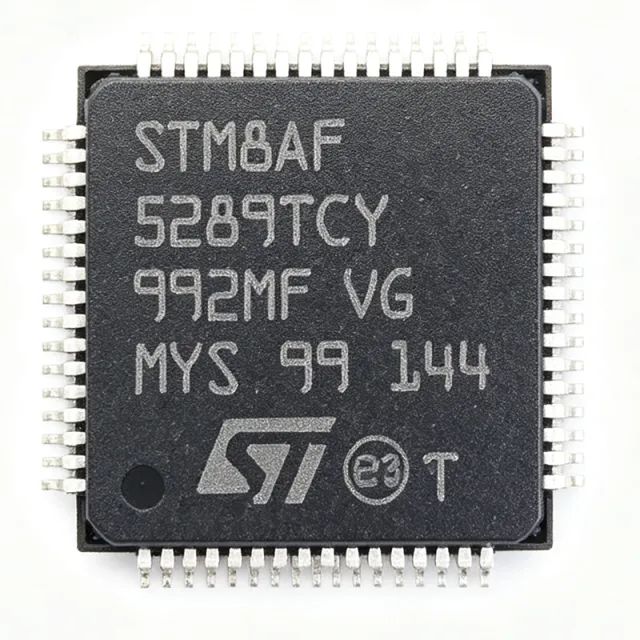
STM8AF5289TCY - 8-bit Automotive MCU, 128KB Flash | STMicroelectronics
STM8AF5289TCY

STM8AF5289TCY - 8-bit Automotive MCU, 128KB Flash | STMicroelectronics

The STM8AF5289TCY is an 8-bit automotive-grade microcontroller from STMicroelectronics, featuring a high-performance STM8A core running at up to 24 MHz. It integrates 128 KB of Flash program memory, 6 KB of RAM, and 2 KB of EEPROM, making it suitable for body control modules, motor control, and other automotive applications. The device operates over a supply voltage range of 3.0V to 5.5V and is available in a 64-pin LQFP package. An 8-bit microcontroller (MCU) is a single-chip computer with an 8-bit data bus, typically used for embedded control applications. It integrates a CPU, memory (Flash, RAM, EEPROM), and peripherals such as timers, ADCs, and communication interfaces. In the automotive domain, 8-bit MCUs like the STM8AF series provide a cost-effective solution for real-time control tasks, bridging the gap between simple logic ICs and more complex 32-bit processors. They are part of the broader microcontroller hierarchy: 8-bit MCU -> microcontroller -> embedded processor -> integrated circuit. Key features of the STM8AF5289TCY include a 24 MHz maximum CPU frequency, 128 KB Flash with read-while-write capability, 6 KB SRAM, and 2 KB true EEPROM with up to 300k write/erase cycles. It offers a rich set of peripherals: two 16-bit timers, one 8-bit timer, a 12-bit ADC with up to 16 channels, and multiple communication interfaces including SPI, I2C, UART, and LIN. The device is AEC-Q100 qualified, ensuring reliability for automotive environments, and operates over a temperature range of -40°C to +150°C. Technically, the STM8A core is based on a Harvard architecture with a 3-stage pipeline, achieving up to 20 MIPS at 24 MHz. The Flash memory supports in-application programming (IAP) and in-circuit programming (ICP), enabling firmware updates in the field. The EEPROM is separate from Flash, allowing data storage without affecting program memory. The device includes a comprehensive set of safety features, such as a watchdog timer, clock security system, and low-voltage detection, which are essential for automotive safety-critical applications. Typical applications include automotive body control modules (BCM), window lift and mirror control, HVAC control, and motor control for pumps and fans. The STM8AF5289TCY's robust communication interfaces (LIN, SPI, I2C, UART) make it ideal for in-vehicle networking, while its high-temperature rating and AEC-Q100 qualification ensure reliable operation under harsh conditions. When designing with this MCU, ensure proper decoupling of the VDD and VDDA pins with 100nF capacitors placed close to the pins. The NRST pin requires a 100nF capacitor to ground for reliable reset. For automotive applications, consider using the internal watchdog and clock security system to enhance system reliability. The device supports low-power modes (Wait, Active-Halt, Halt) to reduce current consumption in standby conditions.

Запрос цены Контакты
STM8AF52AATCY - 8-bit Automotive MCU, 128KB Flash, LQFP64 | STMicroelectronics
STM8AF52AATCY

STM8AF52AATCY - 8-bit Automotive MCU, 128KB Flash, LQFP64 | STMicroelectronics

The STMicroelectronics STM8AF52AATCY is an 8-bit automotive-grade microcontroller based on the STM8A core, operating at up to 24 MHz. It features 128 KB of Flash program memory, 6 KB of RAM, and 2 KB of EEPROM, all in a 64-pin LQFP package. This device is designed for automotive body electronics, motor control, and safety-critical applications, offering a robust set of peripherals including CAN, LIN, SPI, I2C, UART, and a 10-bit ADC. An 8-bit microcontroller (MCU) is a single-chip computer with an 8-bit data bus, typically used for embedded control applications where cost, power, and simplicity are prioritized over raw processing power. The STM8A core is an enhanced 8-bit architecture with a three-stage pipeline, allowing most instructions to execute in a single clock cycle. This places the STM8AF52AATCY in the hierarchy: 8-bit MCU -> microcontroller -> embedded processor -> semiconductor, and it competes with other 8-bit automotive MCUs like the Renesas RL78 and Microchip PIC18 families. Key features include a wide operating voltage range of 3.0V to 5.5V, an operating temperature range of -40°C to +150°C (AEC-Q100 Grade 0), and a rich set of communication interfaces. The integrated CAN 2.0B controller and LIN support make it ideal for automotive networking. The 10-bit ADC with up to 16 channels enables precise sensor monitoring, while the advanced timer peripherals support PWM generation for motor control. The device also includes a true EEPROM with up to 300k write/erase cycles, eliminating the need for external EEPROM in many designs. Architecturally, the STM8AF52AATCY uses a Harvard architecture with separate program and data memory buses, allowing simultaneous instruction fetch and data access. The core includes a 24-bit program counter, 16-bit stack pointer, and a rich instruction set optimized for control applications. The Flash memory is organized into 128 KB with read-while-write capability, enabling firmware updates without halting the system. The device also features a flexible clock system with internal and external oscillators, including a low-power RC oscillator for standby modes. Typical applications include automotive body control modules (BCM), power window and seat control, HVAC systems, and motor control for pumps and fans. The CAN interface allows seamless integration into vehicle networks, while the LIN interface supports low-cost sub-networks. The wide temperature range and AEC-Q100 qualification ensure reliable operation in harsh automotive environments. When designing with this MCU, pay attention to the power supply decoupling: place a 100nF capacitor close to each VDD pin and a 4.7uF bulk capacitor on the main supply. The STM8A core is 5V tolerant, but ensure the ADC reference voltage is stable for accurate conversions. Also, configure the option bytes correctly for the desired clock source and watchdog settings before production.

Запрос цены Контакты
STM8AF6166 - 8-bit Automotive MCU, 32KB Flash | STMicroelectronics
STM8AF6166

STM8AF6166 - 8-bit Automotive MCU, 32KB Flash | STMicroelectronics

The STMicroelectronics STM8AF6166 is an 8-bit automotive-grade microcontroller based on the STM8A core, operating at up to 16 MHz with 32 KB of Flash memory and 2 KB of RAM. It is housed in a 48-pin LQFP package and is designed for body electronics, motor control, and other automotive applications requiring robust performance and reliability. An 8-bit microcontroller (MCU) is a single-chip computer with an 8-bit data bus, integrating a CPU, memory, and peripherals. The STM8A family is optimized for automotive environments, offering a wide operating temperature range (-40°C to +150°C) and compliance with AEC-Q100 standards. As a member of the STM8A series, it provides a cost-effective solution for real-time control tasks in vehicles. Key features include a 16 MHz CPU clock, 32 KB of program Flash, 2 KB of RAM, and 1 KB of EEPROM with error correction code (ECC). It integrates a 10-bit analog-to-digital converter (ADC) with up to 10 channels, two 16-bit timers, one 8-bit timer, and a UART, SPI, and I2C interface. The device operates from a 3.0V to 5.5V supply, making it suitable for direct battery connection in automotive systems. The STM8AF6166 uses a Harvard architecture with a pipeline, achieving up to 16 MIPS at 16 MHz. It includes an embedded boot ROM for in-application programming (IAP) and supports single-wire debug (SWIM) for programming and debugging. The MCU features a low-power mode with a typical current consumption of 10 µA in halt mode, extending battery life in always-on applications. Typical applications include automotive body control modules (BCM), window lift control, seat control, and motor control for pumps and fans. Its robust EMC performance and wide temperature range make it ideal for under-hood and in-cabin electronics. The integrated EEPROM allows for storing calibration data and fault codes without external memory. When designing with this MCU, ensure proper decoupling of the VDD and VDDA pins with 100 nF capacitors placed close to the device. The SWIM pin should be pulled up with a 10 kΩ resistor for reliable programming. For automotive applications, consider using the internal watchdog timer to enhance system reliability.

Запрос цены Контакты
STM8AF6226TCY - 8-bit Automotive MCU, 8KB Flash, 16MHz | STMicroelectronics
STM8AF6226TCY

STM8AF6226TCY - 8-bit Automotive MCU, 8KB Flash, 16MHz | STMicroelectronics

The STM8AF6226TCY is an 8-bit automotive-grade microcontroller from STMicroelectronics, featuring an STM8A core running at up to 16 MHz. It integrates 8 KB of Flash memory, 1 KB of RAM, and 128 bytes of EEPROM, making it suitable for cost-sensitive automotive body and lighting applications. The device is offered in a 32-pin LQFP package (7x7 mm) and operates over a wide temperature range of -40°C to +150°C, meeting AEC-Q100 Grade 0 requirements. An 8-bit microcontroller (MCU) is a single-chip computer with an 8-bit central processing unit (CPU), memory, and programmable input/output peripherals. It is a subset of the broader microcontroller family, which includes 16-bit and 32-bit devices. In the hierarchy of embedded systems, an 8-bit MCU sits below 16-bit and 32-bit parts, offering lower cost and power consumption while still providing sufficient performance for control-oriented tasks such as reading sensors, driving actuators, and managing communication protocols. The STM8A core is an enhanced 8-bit architecture with a three-stage pipeline, enabling most instructions to execute in a single clock cycle. Key features of the STM8AF6226TCY include a 16 MHz maximum CPU frequency, 8 KB of Flash with read-while-write capability, 1 KB of SRAM, and 128 bytes of true EEPROM. It also integrates a 10-bit analog-to-digital converter (ADC) with up to 7 channels, two 16-bit timers, one 8-bit timer, and a UART, SPI, and I2C interface. The device supports a supply voltage range of 3.0V to 5.5V, making it compatible with standard automotive battery systems. Its low-power modes, including Active-Halt and Halt, help reduce current consumption to as low as 1.5 µA in Halt mode. From a technical architecture perspective, the STM8AF6226TCY is built on a high-density Flash process, providing robust data retention and endurance. The embedded EEPROM supports up to 300,000 write/erase cycles, which is critical for storing calibration data and fault codes in automotive applications. The device also includes a clock security system (CSS) that detects clock failures and automatically switches to an internal oscillator, enhancing system reliability. The ADC offers a conversion time of 3 µs at 4 MHz, enabling real-time monitoring of analog signals such as battery voltage and temperature. Typical applications include automotive body control modules, lighting control (LED and halogen), seat control, window lift, and sensor interfaces. The wide temperature range and AEC-Q100 qualification make it ideal for under-hood and in-cabin environments where reliability is paramount. The device's rich peripheral set allows designers to consolidate multiple discrete components into a single MCU, reducing BOM cost and board space. When designing with the STM8AF6226TCY, ensure proper decoupling of the VDD and VDDA pins with 100 nF ceramic capacitors placed close to the device. The NRST pin should be connected to a 100 nF capacitor to ground for reliable reset operation. For automotive applications, consider using the internal watchdog timer (IWDG) to prevent software lockups, and implement a brown-out reset (BOR) to handle voltage dips during cranking.

Запрос цены Контакты
STM8AF6246TCY - Automotive 8-bit MCU, 32KB Flash | STMicroelectronics
STM8AF6246TCY

STM8AF6246TCY - Automotive 8-bit MCU, 32KB Flash | STMicroelectronics

The STM8AF6246TCY is an automotive-grade 8-bit microcontroller from STMicroelectronics, featuring a high-performance STM8A core with Harvard architecture and a 3-stage pipeline. Operating at a maximum CPU frequency of 16 MHz, it delivers up to 10 MIPS for industry-standard benchmarks, making it suitable for real-time automotive control applications. The device integrates 32 Kbytes of Flash program memory and true data EEPROM, along with a 10-bit ADC, multiple timers, and communication interfaces including LIN, SPI, and I2C. An 8-bit microcontroller (MCU) is a single-chip computer with an 8-bit data bus, designed for embedded control tasks. It integrates a processor core, memory (Flash, RAM, EEPROM), and peripherals (timers, ADC, communication interfaces) on a single die. In the system hierarchy, an 8-bit MCU sits below 16-bit and 32-bit MCUs in processing power but offers cost-effectiveness, low power consumption, and ease of use for dedicated control functions. The STM8A core is specifically optimized for automotive applications, balancing performance with deterministic real-time behavior. Key features of the STM8AF6246TCY include AEC-Q10x qualification for automotive reliability, a wide supply voltage range of 3V to 5.5V, and an operating temperature range of -40°C to 125°C. The device provides 25 I/O ports, 2048 bytes of RAM, and 7 ADC channels in the LQFP-32 package. The integrated true data EEPROM allows for non-volatile data storage without external components, simplifying system design and reducing BOM cost. The STM8A core's Harvard architecture enables simultaneous instruction and data access, improving throughput compared to Von Neumann designs. The 3-stage pipeline further enhances execution efficiency, achieving an average of 1.6 cycles per instruction. This architectural efficiency, combined with the 16 MHz clock, delivers 10 MIPS performance, sufficient for closed-loop control algorithms, sensor processing, and communication protocol handling in automotive systems. Typical applications include body control modules, automotive lighting control, window lift and mirror control, and sensor interfaces. The LIN interface makes it ideal for low-cost automotive sub-networks, while the 10-bit ADC enables direct connection to analog sensors such as temperature and position sensors. The wide operating temperature range and AEC-Q10x qualification ensure reliable operation in harsh automotive environments. When designing with this MCU, consider the power supply decoupling: place a 100nF ceramic capacitor close to each VDD pin and a 4.7uF bulk capacitor near the power input. The STM8A core requires a stable clock source; use the internal RC oscillator for cost-sensitive designs or an external crystal for precision timing applications. Proper layout of the ADC input pins is critical to minimize noise and maintain conversion accuracy.

Запрос цены Контакты
STM8AF6266TCY - 8-bit Automotive MCU, 32KB Flash, LQFP-32 | STMicroelectronics
STM8AF6266TCY

STM8AF6266TCY - 8-bit Automotive MCU, 32KB Flash, LQFP-32 | STMicroelectronics

The STMicroelectronics STM8AF6266TCY is an 8-bit automotive-grade microcontroller based on the STM8A core, operating at up to 16 MHz. It features 32 KB of Flash program memory, 2 KB of RAM, and 1 KB of EEPROM, all in a 32-pin LQFP package. This device is designed for body electronics, motor control, and sensor applications in automotive environments, with an extended temperature range of -40°C to +150°C and AEC-Q100 qualification. An 8-bit microcontroller (MCU) is a single-chip computer with an 8-bit central processing unit (CPU), memory, and peripherals integrated onto one integrated circuit. It is a type of embedded controller that executes instructions sequentially, processing data in 8-bit chunks. In the system hierarchy, an 8-bit MCU is a subset of microcontrollers, which are a type of embedded processor, which in turn falls under the broader category of integrated circuits (ICs) used in electronic systems. The STM8A core is an enhanced 8-bit architecture with a three-stage pipeline, delivering up to 16 MIPS at 16 MHz, making it suitable for real-time control tasks. Key features include a 16 MHz maximum CPU frequency, 32 KB Flash with read-while-write capability, 2 KB SRAM, and 1 KB true data EEPROM with up to 300k write/erase cycles. The device integrates a 10-bit ADC with up to 10 channels, two 16-bit timers, one 8-bit timer, a UART, SPI, and I2C interfaces. It also includes a CAN 2.0B controller, making it ideal for automotive networking. The LQFP-32 package offers a compact footprint with 25 general-purpose I/O pins, and the device operates from a 2.95V to 5.5V supply voltage. Technically, the STM8AF6266TCY uses a Harvard architecture with separate program and data buses, allowing simultaneous instruction fetch and data access. The embedded EEPROM supports byte-level programming and erasing, which is critical for storing calibration data and fault codes in automotive applications. The device also features a robust clock system with an internal 16 MHz RC oscillator, an external crystal oscillator, and a phase-locked loop (PLL) for clock multiplication. The CAN controller supports both 2.0A and 2.0B protocols, with message filtering and a 3-message mailbox. Typical applications include automotive body control modules (BCM), window lift and mirror control, HVAC control, and sensor interfaces. The CAN interface enables communication with the vehicle's main network, while the high-temperature rating and AEC-Q100 qualification ensure reliability in harsh under-hood environments. The low-power modes (Wait, Active-Halt, Halt) help reduce current consumption in battery-powered or always-on systems. When designing with this MCU, ensure proper decoupling of the VDD and VDDA pins with 100 nF capacitors placed close to the device. The VCAP pin requires a 470 nF capacitor for internal regulator stability. For CAN communication, a CAN transceiver such as the TJA1050 is needed to interface with the physical bus. The device supports in-application programming (IAP) via the UART or CAN, enabling firmware updates in the field.

Запрос цены Контакты
STM8AF6286TCY - 8-bit Automotive MCU, 64KB Flash, 24MHz | STMicroelectronics
STM8AF6286TCY

STM8AF6286TCY - 8-bit Automotive MCU, 64KB Flash, 24MHz | STMicroelectronics

The STM8AF6286TCY is an 8-bit automotive-grade microcontroller from STMicroelectronics, featuring a high-performance STM8 core running at up to 24 MHz. It integrates 64 KB of Flash memory, 6 KB of RAM, and 2 KB of EEPROM, making it suitable for a wide range of automotive body and safety applications. The device is offered in a 32-pin LQFP package, providing a compact footprint for space-constrained designs. An 8-bit microcontroller (MCU) is a single-chip computer with an 8-bit data bus, typically used for embedded control applications. It integrates a processor core, memory, and peripherals on one chip, enabling cost-effective and efficient control of electronic systems. In the automotive domain, 8-bit MCUs are widely used for body control modules, lighting control, and sensor interfacing, where moderate processing power and low power consumption are essential. Key features of the STM8AF6286TCY include a 24 MHz CPU clock, 64 KB of Flash memory with read-while-write capability, 6 KB of RAM, and 2 KB of true data EEPROM with up to 300k write/erase cycles. It also offers a rich set of peripherals: two UARTs, one SPI, one I2C, a 10-bit ADC with up to 10 channels, and multiple 16-bit timers. The device operates over a supply voltage range of 3.0V to 5.5V and is specified for the automotive temperature range of -40°C to +150°C, meeting AEC-Q100 Grade 0 requirements. The STM8 core is based on a Harvard architecture with a 3-stage pipeline, achieving up to 20 MIPS at 24 MHz. It includes an extended instruction set with hardware multiply and divide, and supports a wide range of addressing modes. The Flash memory is organized with error correction code (ECC) for enhanced reliability, and the EEPROM is designed for high endurance, making it ideal for storing calibration data and fault codes in automotive systems. Typical applications include automotive body control modules (BCM), lighting control (LED and HID), seat control, window lift, and sensor interfaces. The device's robust ESD protection and wide operating temperature range make it well-suited for harsh automotive environments. Additionally, its low power modes (Active-Halt, Halt) help reduce battery drain in always-on systems. When designing with the STM8AF6286TCY, ensure proper decoupling of the VDD and VDDA pins with 100nF capacitors placed close to the pins. The device supports in-application programming (IAP) via the bootloader, allowing firmware updates in the field. For EMI-sensitive applications, use the internal clock divider and enable the clock security system to monitor the external crystal.

Запрос цены Контакты
STM8AF6366 - Automotive 8-bit MCU, 32KB Flash, 16MHz | STMicroelectronics
STM8AF6366

STM8AF6366 - Automotive 8-bit MCU, 32KB Flash, 16MHz | STMicroelectronics

The STM8AF6366 is an automotive-grade 8-bit microcontroller from STMicroelectronics, featuring an advanced STM8A core with Harvard architecture and a 3-stage pipeline. It operates at a maximum CPU frequency of 16 MHz, delivering up to 10 MIPS for industry-standard benchmarks. The device offers from 16 to 32 Kbyte of Flash program memory and integrated true data EEPROM, making it suitable for a wide range of automotive body electronics, lighting, and motor control applications. It is available in a 32-pin LQFP (7x7 mm) package, which is compact and suitable for space-constrained PCB designs. An 8-bit microcontroller (MCU) is a single-chip computer with an 8-bit central processing unit (CPU), memory, and programmable input/output peripherals. It is a type of embedded processor designed for control-oriented applications, often used in automotive, industrial, and consumer electronics. The STM8A family is part of the broader STM8 series, which is known for its cost-effectiveness, robustness, and ease of use. The STM8AF6366 sits in the medium-density segment of the STM8A product line, providing a balance of memory, performance, and peripheral integration for automotive systems. Key features of the STM8AF6366 include a 10-bit analog-to-digital converter (ADC) with up to 16 multiplexed channels, multiple communication interfaces (UART, SPI, I2C), and a variety of timers including a 16-bit advanced control timer for PWM generation. The device is AEC-Q10x qualified, ensuring reliability for automotive environments. It also features low-power modes, an integrated watchdog timer, and a clock security system for enhanced system robustness. From a technical perspective, the STM8A core is based on a Harvard architecture with separate instruction and data buses, enabling efficient execution. The 3-stage pipeline allows for an average of 1.6 cycles per instruction, resulting in high performance at a modest clock frequency. The integrated true data EEPROM provides non-volatile storage for calibration data or parameters, which is critical in automotive applications where data retention is essential. The device operates over a supply voltage range of 3.0V to 5.5V, making it compatible with standard automotive power rails. Typical applications include automotive body control modules, lighting control (e.g., LED and HID), motor control for fans and pumps, and sensor interfaces. The STM8AF6366 is also used in aftermarket automotive electronics and industrial control systems where its automotive qualification and robust feature set are advantageous. Its wide operating temperature range (-40°C to +150°C) ensures reliable operation in harsh environments. When designing with the STM8AF6366, it is important to consider proper decoupling of the power supply pins and careful layout of the crystal oscillator circuit to minimize noise and ensure stable clock operation. The device's low-power modes should be utilized to meet energy efficiency requirements in battery-powered or energy-conscious applications.

Запрос цены Контакты
STM8AF6388 - 8-bit Automotive MCU, 64KB Flash | STMicroelectronics
STM8AF6388

STM8AF6388 - 8-bit Automotive MCU, 64KB Flash | STMicroelectronics

The STMicroelectronics STM8AF6388 is an 8-bit automotive-grade microcontroller based on the STM8A core, offering up to 64KB of Flash memory and 6KB of RAM in a 48-pin LQFP package. It operates over a supply voltage range of 3.0V to 5.5V and is designed for harsh automotive environments with an extended temperature range of -40°C to +150°C. An 8-bit microcontroller (MCU) is a single-chip computer with an 8-bit central processing unit (CPU), memory, and programmable input/output peripherals. It is a subset of the broader microcontroller family, which falls under embedded systems and integrated circuits. The STM8A core is an enhanced 8-bit architecture with a three-stage pipeline, delivering up to 16 MIPS at 24 MHz, making it suitable for real-time control applications. Key features include 64KB of Flash memory with read-while-write capability, 6KB of SRAM, and 2KB of EEPROM with true data EEPROM. It integrates a 10-bit ADC with up to 16 channels, two 16-bit timers, one 8-bit timer, and a CAN 2.0B controller for automotive networking. The device also includes an SPI, I2C, and two UARTs for communication, along with a LIN interface for local interconnect networking. The STM8AF6388 is built on a high-density Flash technology, providing robust data retention and endurance. The automotive qualification (AEC-Q100) ensures reliability under extreme temperature and vibration conditions. The CAN controller supports both standard and extended frame formats, enabling seamless integration into vehicle networks. Typical applications include body control modules, automotive lighting control, sensor interfaces, and power window control. The device's low power consumption and wide voltage range make it ideal for battery-powered automotive systems. Its robust communication interfaces allow it to serve as a central node in distributed automotive networks. When designing with this MCU, ensure proper decoupling of the power supply pins and use the internal RC oscillator for cost-sensitive designs, or an external crystal for higher accuracy. The CAN bus requires proper termination resistors and common-mode chokes for EMC compliance.

Запрос цены Контакты
STM8AL3146TAY - 8-bit Ultra-Low-Power MCU, 16KB Flash | STMicroelectronics
STM8AL3146TAY

STM8AL3146TAY - 8-bit Ultra-Low-Power MCU, 16KB Flash | STMicroelectronics

The STM8AL3146TAY is an 8-bit ultra-low-power microcontroller from STMicroelectronics, featuring an STM8A core running at up to 16 MHz. It integrates 16 KB of Flash memory, 2 KB of RAM, and 1 KB of EEPROM, making it suitable for battery-powered and energy-harvesting applications. The device operates from a 1.8V to 3.6V supply and is available in a 32-pin LQFP (7x7) package. An 8-bit microcontroller (MCU) is a single-chip computer with an 8-bit central processing unit (CPU), memory, and programmable input/output peripherals. It is a type of embedded processor used to control electronic systems, forming the core of many smart devices. In the hierarchy of computing devices, an 8-bit MCU is a subset of microcontrollers, which are a subset of embedded systems, which are a subset of electronic systems. The STM8AL3146TAY belongs to the STM8A family, which is designed for automotive and industrial applications requiring low power consumption and high reliability. Key features include multiple low-power modes (Wait, Active-Halt, Halt) with current consumption as low as 0.6 µA in Halt mode, a 12-bit ADC with up to 16 channels, two comparators, and a real-time clock (RTC). It also integrates a variety of communication interfaces: SPI, I2C, and UART, enabling flexible connectivity. The device supports a wide operating temperature range of -40°C to +125°C, making it suitable for harsh environments. The STM8AL3146TAY is built on a low-power 8-bit core with a Harvard architecture, featuring an extended instruction set and a single-wire debug interface (SWIM). It includes a 16-bit timer, a 16-bit low-power timer, and a watchdog timer for robust operation. The EEPROM allows data storage without external components, and the Flash memory supports in-application programming (IAP) for firmware updates. Typical applications include automotive body electronics (e.g., window lift, lighting control), industrial sensors, smart meters, and portable medical devices. Its ultra-low-power consumption extends battery life in remote monitoring systems, while the wide temperature range ensures reliable operation in automotive under-hood environments. When designing with this MCU, pay attention to the power supply decoupling: place a 100 nF capacitor close to each VDD pin and a 1 µF capacitor at the main supply. Use the low-power modes effectively to minimize average current consumption, and ensure the SWIM debug interface is accessible for programming and debugging.

Запрос цены Контакты
STM8AL3166TA - Automotive 8-bit MCU, 32KB Flash, LQFP-32 | ST
STM8AL3166TA

STM8AL3166TA - Automotive 8-bit MCU, 32KB Flash, LQFP-32 | ST

The STMicroelectronics STM8AL3166TA is an automotive-grade 8-bit ultra-low-power microcontroller from the STM8AL medium-density family, featuring a 16 MHz STM8 core, 32 KB of Flash, 32-LQFP (7x7) package, and operating across the -40C to +125C automotive temperature range. According to the manufacturer datasheet, this part integrates 12-bit ADC, DAC, two comparators, three 16-bit timers, one 8-bit timer, RTC, and standard communication peripherals including SPI, I2C, and USART. An 8-bit microcontroller (MCU) is a compact integrated circuit combining a low-power 8-bit CPU, program memory (Flash/ROM), data memory (RAM), and on-chip peripherals such as timers, ADC, and GPIO into a single package. The MCU sits at the hierarchy of microcontroller -> embedded processor -> semiconductor IC, serving as the brain of an embedded system for deterministic control tasks. The STM8AL medium-density line occupies the ultra-low-power, automotive-qualified tier of ST's 8-bit portfolio, designed for body electronics, sensor conditioning, and battery-powered ECUs. Key features of the STM8AL3166TA include the proprietary STM8 core running at 16 MHz, AES-128 hardware encryption on most L variants, integrated LCD driver (on L3xxx derivatives), ultra-low-power modes with sub-microamp standby current, AEC-Q100 qualification for automotive deployment, and 32 KB of single-voltage Flash with in-application programming. The device supports 1.65 V to 3.6 V supply and provides robust ESD immunity specified in the family datasheet. Architecturally, the STM8AL3166TA uses a Harvard-style architecture with separate program and data buses, a 16-bit stack pointer, and a 24-bit program counter that together enable linear 16 MB address space. The integrated voltage regulator, brown-out reset, and low-power real-time clock allow the part to operate for years from a single coin cell or automotive battery while still meeting strict quiescent-current budgets. Typical applications include automotive body controllers, sensor nodes, remote keyless entry, instrument cluster sub-modules, HVAC control, and industrial low-power wireless sensor platforms. The wide operating temperature and AEC-Q100 grade make the device suitable for under-hood and chassis-mounted ECUs. When designing with this MCU, allocate Flash for a robust bootloader to enable field firmware updates and leave at least one USART free for diagnostics. Use the brown-out reset and watchdog together to recover from corrupted supply or firmware states - this is essential for unattended automotive deployments. This page synthesizes distributor pricing, drop-in alternatives from the same STM8AL family, and practical application guidance not found in the manufacturer datasheet alone, helping procurement and engineering teams make an informed component selection.

Запрос цены Контакты
STM8AL3166TAY - 8-bit Ultra-Low-Power MCU, 32KB Flash | STMicroelectronics
STM8AL3166TAY

STM8AL3166TAY - 8-bit Ultra-Low-Power MCU, 32KB Flash | STMicroelectronics

The STM8AL3166TAY is an 8-bit ultra-low-power microcontroller from STMicroelectronics, based on the STM8A core. It operates at a maximum frequency of 16 MHz and features 32 KB of Flash memory, 2 KB of RAM, and 1 KB of EEPROM. The device is housed in a 32-pin LQFP package (7x7 mm) and is designed for automotive and industrial applications requiring low power consumption and high reliability. An 8-bit microcontroller (MCU) is a single-chip computer with an 8-bit central processing unit (CPU), memory, and programmable input/output peripherals. It is a subset of the broader microcontroller family, which falls under embedded systems and integrated circuits. The STM8A core is an enhanced 8-bit architecture that provides efficient code density and low power operation, making it suitable for battery-powered and energy-harvesting applications. Key features of the STM8AL3166TAY include multiple low-power modes (Wait, Active-Halt, Halt) with typical current consumption as low as 0.6 µA in Halt mode, a 12-bit ADC with up to 16 channels, two comparators, and a real-time clock (RTC). It also integrates a variety of communication interfaces including SPI, I2C, and UART, along with a 16-bit timer and a 12-bit timer for precise timing control. The STM8AL3166TAY is built on a low-power process technology that enables a wide operating voltage range of 1.8V to 3.6V, with an extended temperature range of -40°C to +125°C for automotive-grade reliability. The device includes a brown-out reset (BOR) and a programmable voltage detector (PVD) for robust power management. Its EEPROM with write protection and read-out protection enhances data security in critical applications. Typical applications include automotive body control modules, battery management systems, industrial sensors, and portable medical devices. The ultra-low-power modes and rich analog peripherals make it ideal for applications that require long battery life and precise analog signal processing. When designing with this MCU, careful attention should be paid to decoupling the power supply with a 100nF capacitor close to each VDD pin and a 4.7µF bulk capacitor. The RTC requires a 32.768 kHz crystal for accurate timekeeping, and the ADC reference voltage should be filtered to minimize noise. Proper layout of the crystal and analog ground planes is essential for reliable operation.

Запрос цены Контакты
STM8AL3166TC - 32KB Flash Automotive 8-bit MCU LQFP-32 | STMicroelectronics
STM8AL3166TC

STM8AL3166TC - 32KB Flash Automotive 8-bit MCU LQFP-32 | STMicroelectronics

The STMicroelectronics STM8AL3166TC is an automotive-grade 8-bit ultra-low-power microcontroller in the STM8AL3 medium-density family, offering 32 Kbytes of Flash, 2 Kbytes of RAM, and 32 Kbytes of EEPROM-equivalent data storage in a 32-pin LQFP (7x7 mm) package. It integrates a 16 MHz STM8 core with a 12-bit ADC, DAC, two comparators, three 16-bit timers, an 8-bit timer, and standard interfaces including SPI, I²C, and USART, plus a real-time clock and LIN support. An 8-bit microcontroller (MCU) is a programmable processor with an 8-bit data bus, optimized for cost-sensitive embedded control tasks. The STM8AL series in particular targets ultra-low-power applications where automotive AEC-Q100 qualification, long battery life, and high peripheral integration matter more than raw computational throughput. In the broader taxonomy, the STM8AL3166TC sits under microcontroller -> 8-bit MCU -> ultra-low-power MCU -> automotive MCU -> semiconductor IC. Its architected sleep modes and run-time current draw make it a frequent choice where the system-level power budget is dominated by standby drain rather than active compute. Key headline specs include 32 KB Flash program memory, 2 KB SRAM, 1024-byte data EEPROM, 16 MHz maximum fCPU, an operating temperature range of -40°C to +125°C (automotive Grade 1), 12-bit SAR ADC, and a wide supply range of 1.65 V to 3.6 V. The integrated RTC and LIN connectivity pair with on-chip peripherals to minimize external component count. Architecturally, the STM8AL3166TC uses ST's proprietary STM8 8-bit Harvard-style core with a three-stage pipeline and a Harvard bus providing separate code and data paths. The ultra-low-power design uses multiple STOP modes (WAIT, HALT, ACTIVE-HALT) with selectable RTC-driven wakeup, supporting sub-µA standby current figures typical of this family. Bor-level brownout and a programmable voltage detector ensure safe operation under automotive load-dump and cold-crank conditions. Typical applications include automotive body controllers, sensor interfaces, tire-pressure monitoring (TPMS) sensor nodes (when paired with an external RF transceiver), instrument-cluster small displays, LIN slaves, and HVAC control sub-modules. Its AEC-Q100 grade makes it suitable for underhood or in-cabin systems. Design with this part requires attention to decoupling: place 100 nF and 4.7 µF ceramics close to VDD/VSS pins. The LQFP-32 footprint offers good thermal performance for the part's typical dissipation class. Keep RESET pin routing short and avoid long traces through noisy zones to preserve EMC margin in automotive environments. This page integrates distributor pricing, drop-in alternatives, and pin-compatibility notes not found directly in the manufacturer datasheet. Where datasheet revision specifics are unavailable, parameters derived from the family manual are flagged and cross-referenced for traceability.

Запрос цены Контакты
STM8AL3166UAY - 8-Bit 16MHz 32KB Flash Auto MCU | STMicroelectronics
STM8AL3166UAY

STM8AL3166UAY - 8-Bit 16MHz 32KB Flash Auto MCU | STMicroelectronics

The STMicroelectronics STM8AL3166UAY is an automotive-grade 8-bit ultra-low-power microcontroller from the STM8AL family, featuring a 16MHz STM8 core with 32KB of embedded Flash, 32-VFQFPN (5x5 mm) package, and AEC-Q100 qualification. It integrates 32KB Flash, 2KB SRAM, and 1KB true data EEPROM, plus a rich set of peripherals including LIN, RTC, USARTs, I2C, SPIs, ADC, DAC, and comparators. The wide 1.65V to 5.5V operating range and ultra-low-power modes target automotive body, sensor, and battery-backed applications. An automotive 8-bit ultra-low-power MCU is a microcontroller designed for the harsh electrical and thermal environment of vehicles, emphasizing low quiescent current, extended voltage range, and AEC-Q100 reliability qualification. The STM8AL sits in the broader 8-bit microcontroller hierarchy (8-bit MCU -> microcontroller -> embedded processor -> semiconductor IC) and is optimized for direct sensor interfacing, LIN/CAN connectivity, and standby current budgets measured in microamperes. Compared with 32-bit Cortex-M alternatives, STM8AL devices offer smaller code footprint, deterministic interrupt latency, and substantially lower cost per node for body-electronics applications. Key features of the STM8AL3166UAY include: 32KB single-voltage Flash with in-application programming, 1KB true EEPROM for parameter storage, hardware RTC with calendar and alarm, two USARTs (one LIN-capable), two SPIs, one I2C, a 12-bit ADC, a 12-bit DAC, two ultra-low-power comparators, and a 4-channel DMA. The integrated LIN 2.1 compliant USART simplifies in-vehicle networking nodes. The BxCAN interface is not present on this density device, but USART-LIN combined with the RTC and EEPROM provides a complete body-controller-on-a-chip. The device uses the STM8 Harvard-architecture core with a 3-stage pipeline and 16-bit instructions for code density. Its embedded voltage regulator supports single-supply operation down to 1.65V, enabling direct connection to a 3.3V or 5V rail. Run-mode current is approximately 200 uA/MHz, while Halt with RTC consumes only 0.9 uA typical, allowing automotive electronic control units to meet strict quiescent-current budgets (typically <100 uA) on the battery rail when the ignition is off. Typical applications include automotive body control modules, LIN slave nodes for seat and mirror control, sensor interface ECUs for temperature and pressure, lighting controllers, RKE receivers, dashboard clusters, and HVAC control panels. The on-chip 12-bit ADC and DAC pair support analog sensor signal chains without external converters. The 32-VFQFPN (5x5 mm) package footprint with exposed pad gives good thermal performance and suits space-constrained under-hood and behind-cluster layouts. When designing with this device, ensure the exposed pad is soldered to a contiguous ground copper pour for thermal dissipation and signal integrity. The EEPROM write endurance is 300k cycles minimum at 85C - budget write frequency accordingly for non-volatile parameter storage. The LIN master/slave mode requires an external LIN transceiver such as the TLE7259-3GE for physical bus compliance. This page synthesizes distributor pricing, drop-in alternatives, and comparison data not found on the manufacturer product page alone - enabling faster sourcing decisions.

Запрос цены Контакты
STM8AL3188TCY - 8-bit Ultra-Low-Power MCU 64KB Flash | STMicroelectronics
STM8AL3188TCY

STM8AL3188TCY - 8-bit Ultra-Low-Power MCU 64KB Flash | STMicroelectronics

The STM8AL3188TCY is an 8-bit ultra-low-power microcontroller from STMicroelectronics, part of the STM8AL series designed for battery-powered and energy-harvesting applications. It features a 16 MHz STM8 core with 64 KB of Flash memory, 4 KB of RAM, and 2 KB of EEPROM, packaged in a 48-pin LQFP (TCY) package. The device operates over a supply voltage range of 1.8V to 3.6V and is optimized for low power consumption with multiple low-power modes including Halt, Active-Halt, and Wait modes. An 8-bit microcontroller (MCU) is a single-chip computer containing a processor core, memory, and programmable input/output peripherals. The STM8AL3188TCY belongs to the STM8 family, which is a line of 8-bit MCUs known for their cost-effectiveness and low power consumption. In the hierarchy of embedded systems, an MCU is a type of integrated circuit that serves as the brain of a device, executing firmware to control sensors, actuators, and communication interfaces. The STM8AL series specifically targets applications requiring long battery life, such as portable medical devices, smart meters, and wireless sensor nodes. Key features of the STM8AL3188TCY include an ultra-low-power RTC with automatic wake-up, a 12-bit ADC with up to 25 channels, two comparators, and multiple communication interfaces (SPI, I2C, UART). It also integrates a low-power LCD driver supporting up to 8x40 segments, making it suitable for display-equipped portable devices. The MCU operates at up to 16 MHz, providing a balance between processing power and energy efficiency. Technically, the STM8AL3188TCY is built on a high-density Flash process, offering 64 KB of program memory and 2 KB of true EEPROM for data storage. The core is an 8-bit CISC architecture with a 3-stage pipeline, achieving 16 MIPS at 16 MHz. The device includes a flexible clock management system with internal and external oscillators, and a low-power mode that reduces current consumption to as low as 0.35 µA in Halt mode with RTC running. This makes it ideal for applications where power efficiency is critical. Typical applications include smart meters (gas, water, and electricity), portable medical devices like glucose meters and pulse oximeters, wireless sensor networks, and industrial monitoring systems. The ultra-low-power RTC and LCD driver make it particularly suitable for battery-powered devices that require timekeeping and display functionality. When designing with this MCU, careful attention should be paid to the power supply decoupling and the selection of low-power modes to maximize battery life. The device supports a wide operating temperature range of -40°C to +85°C, ensuring reliability in harsh environments.

Запрос цены Контакты
STM8AL3L46TCY - 8-Bit 16MHz Automotive MCU, 16KB Flash | STMicroelectronics
STM8AL3L46TCY

STM8AL3L46TCY - 8-Bit 16MHz Automotive MCU, 16KB Flash | STMicroelectronics

The STM8AL3L46TCY is an automotive-grade, ultra-low-power 8-bit microcontroller from STMicroelectronics, part of the STM8AL3L4x/6x family. It features a 16MHz STM8A CPU core, 16KB of Flash memory, 2KB of RAM, and 1KB of EEPROM, all housed in a compact 32-pin LQFP (7x7mm) package. This device is designed for battery-powered and energy-efficient automotive applications, offering a wide operating voltage range of 1.8V to 3.6V and an extended temperature range of -40°C to +125°C. An 8-bit microcontroller (MCU) is a single-chip computer containing a processor core, memory, and programmable input/output peripherals. The STM8A core is an 8-bit CISC architecture optimized for low power consumption and high code density, making it ideal for cost-sensitive embedded control applications. In the hierarchy of embedded systems, an MCU sits between simple logic ICs and complex application processors, providing a self-contained computing platform for real-time control tasks. The STM8AL3L46TCY belongs to the STM8A family, which is specifically designed for automotive body electronics, sensor interfaces, and battery management systems. Key features of the STM8AL3L46TCY include an integrated LCD driver supporting up to 4x28 segments, a 12-bit analog-to-digital converter (ADC) with up to 16 channels, and multiple communication interfaces including I2C, SPI, and UART. The device also incorporates a low-power RTC, a watchdog timer, and a brown-out reset circuit. Its ultra-low-power modes, including Halt, Active-Halt, and Wait modes, enable significant battery life extension in portable and automotive applications. The 32-pin LQFP package provides a compact footprint while offering sufficient I/O pins for peripheral integration. From a technical architecture perspective, the STM8AL3L46TCY utilizes a Harvard architecture with separate instruction and data buses, allowing simultaneous instruction fetch and data access. The CPU core operates at up to 16MHz, delivering 16 MIPS throughput. The Flash memory is programmable in-system via the SWIM (Single Wire Interface Module) debug interface, facilitating firmware updates in the field. The integrated EEPROM provides non-volatile data storage for calibration parameters and system configuration, with endurance of up to 300k write/erase cycles. Typical applications for the STM8AL3L46TCY include automotive body control modules, smart sensors, battery management systems, and dashboard displays. Its combination of low power consumption, integrated LCD driver, and automotive qualification (AEC-Q100) makes it particularly suitable for in-vehicle infotainment, climate control panels, and tire pressure monitoring systems. The device's robust communication interfaces enable seamless integration with other automotive ECUs via CAN or LIN networks. When designing with this MCU, careful attention should be paid to power supply decoupling and PCB layout to minimize noise and ensure reliable operation. The SWIM debug interface should be brought out to a test point for programming and debugging. Additionally, the LCD driver requires proper configuration of the contrast control register and external bias resistors to achieve optimal display performance.

Запрос цены Контакты
STM8AL3L66TCY - 8-bit Ultra-Low-Power MCU 32KB Flash | STMicroelectronics
STM8AL3L66TCY

STM8AL3L66TCY - 8-bit Ultra-Low-Power MCU 32KB Flash | STMicroelectronics

The STM8AL3L66TCY is an 8-bit ultra-low-power microcontroller from STMicroelectronics, featuring a 16 MHz STM8 core with up to 32 KB of Flash memory and 2 KB of RAM. It operates over a supply voltage range of 1.8V to 3.6V and is available in a 32-pin LQFP (7x7) package, making it suitable for a wide range of battery-powered and energy-efficient automotive applications. An 8-bit microcontroller (MCU) is a compact integrated circuit that executes 8-bit instructions, typically used for embedded control tasks. The STM8AL3L66TCY belongs to the STM8AL series, which is part of the broader STM8 family of 8-bit MCUs. These devices are positioned between low-end 8-bit controllers and higher-performance 32-bit ARM-based MCUs, offering a balance of cost, power efficiency, and sufficient processing capability for many automotive and industrial applications. Key features of the STM8AL3L66TCY include multiple low-power modes (Wait, Active-Halt, and Halt) with typical current consumption as low as 0.6 µA in Halt mode, a 12-bit ADC with up to 16 channels, two comparators, and a real-time clock (RTC) with calendar. It also integrates a variety of communication interfaces including I2C, SPI, and UART, along with a 16-bit timer and a 12-bit timer for precise timing and PWM generation. The STM8AL3L66TCY is built on a low-power process technology that enables extended battery life in portable devices. Its architecture includes a single-wire debug interface (SWIM) for programming and debugging, and it supports in-application programming (IAP) for firmware updates. The device is designed for reliable operation in harsh environments, with an operating temperature range of -40°C to +85°C. Typical applications include smart meters, portable medical devices, sensor nodes, and industrial control systems. The ultra-low-power consumption and rich analog peripherals make it ideal for battery-operated applications where energy efficiency is critical. When designing with this MCU, careful attention should be paid to power supply decoupling and the selection of low-power modes to maximize battery life. The RTC can be powered from a separate backup battery to maintain timekeeping during main power loss.

Запрос цены Контакты
STM8AL3L88TCY - 8-bit Ultra-Low-Power MCU, 64KB Flash | STMicroelectronics
STM8AL3L88TCY

STM8AL3L88TCY - 8-bit Ultra-Low-Power MCU, 64KB Flash | STMicroelectronics

The STM8AL3L88TCY is an 8-bit ultra-low-power microcontroller from STMicroelectronics, part of the STM8AL3L88 family. It features a 16 MHz STM8 core with 64 KB of Flash memory, 4 KB of RAM, and 2 KB of EEPROM. The device operates from 1.8V to 3.6V and is available in a 48-pin LQFP package (TCY suffix). It integrates a 12-bit ADC, two comparators, and multiple communication interfaces including SPI, I2C, and USART. An 8-bit microcontroller (MCU) is a compact integrated circuit designed for embedded control applications, executing instructions on an 8-bit data bus. It typically includes a CPU, memory (Flash, RAM, EEPROM), and peripherals such as timers, ADCs, and communication interfaces. In the system hierarchy, an MCU sits between a simple logic IC and a full application processor, providing programmable intelligence for devices like sensors, meters, and industrial controllers. The STM8AL3L88TCY is optimized for ultra-low-power operation, making it suitable for battery-powered and energy-harvesting applications. Key features include multiple low-power modes (Wait, Active-Halt, Halt) with current consumption as low as 0.35 µA in Halt mode, a 12-bit ADC with up to 25 channels, and a flexible clock system with an internal 16 MHz RC oscillator. The device also includes a real-time clock (RTC) with calendar, and a tamper detection feature for security-sensitive applications. The LQFP-48 package provides a compact footprint while offering sufficient I/O pins for complex designs. Technically, the STM8AL3L88TCY uses a Harvard architecture with a 3-stage pipeline, achieving up to 16 MIPS at 16 MHz. The ultra-low-power design is achieved through advanced power management, including a low-power oscillator and the ability to disable unused peripherals. The EEPROM allows data storage without external components, and the integrated bootloader supports in-application programming (IAP) for firmware updates. Typical applications include smart meters, portable medical devices, industrial sensors, and building automation systems. The ultra-low-power consumption extends battery life in remote monitoring applications, while the rich analog peripherals enable precise sensor interfacing. The wide operating voltage range and robust ESD protection make it suitable for harsh industrial environments. When designing with this device, pay attention to the power supply decoupling and the selection of the appropriate low-power mode for your application. The Halt mode offers the lowest power consumption but requires an external or RTC wake-up source. Ensure the clock configuration is optimized for your performance and power requirements.

Запрос цены Контакты
STM8L001J3M3 - Ultra-Low-Power 8-bit MCU, 8KB Flash | STMicroelectronics (Tape & Reel)
STM8L001J3M3

STM8L001J3M3 - Ultra-Low-Power 8-bit MCU, 8KB Flash | STMicroelectronics (Tape & Reel)

The STM8L001J3M3 is an ultra-low-power 8-bit microcontroller from STMicroelectronics, featuring the enhanced STM8 CPU core with up to 16 MIPS at 16 MHz. It comes in an 8-SOIC package and integrates 8 KB of Flash memory, 1.5 KB of RAM, and up to 2 KB of data EEPROM, making it ideal for battery-powered and energy-harvesting applications. An 8-bit microcontroller is a compact computing device that processes data in 8-bit chunks, balancing performance and power efficiency for embedded control tasks. The STM8L EnergyLite family is designed specifically for ultra-low-power operation, with multiple low-power modes including Halt, Active-Halt, and Wait, enabling extended battery life in portable and IoT devices. This MCU sits within the broader hierarchy of embedded systems, from simple 8-bit controllers to complex 32-bit processors, and is optimized for applications where energy efficiency is paramount. Key features include a 16 MHz CPU with 16 MIPS throughput, 8 KB Flash, 1.5 KB RAM, and 2 KB EEPROM with error correction. The device operates from 1.8V to 3.6V, with a low-power oscillator and multiple clock sources. It also integrates a 12-bit ADC, comparators, and a variety of communication interfaces including SPI, I2C, and UART, all in a compact 8-SOIC package. The STM8L001J3M3 is built on ST's low-power process technology, achieving ultra-low current consumption in Halt mode (typically 0.4 µA) and fast wake-up times. The architecture includes a flexible clock system, power management with multiple low-power modes, and a rich set of peripherals, enabling efficient handling of sensor data and control tasks. Typical applications include portable medical devices, smart sensors, wearable electronics, and industrial monitoring systems. Its low power consumption and small footprint make it particularly suitable for battery-operated devices where long operational life is critical. When designing with this MCU, careful attention to the power supply decoupling and clock configuration is essential to achieve the specified low-power performance. The device supports in-application programming (IAP) and in-circuit programming (ICP), facilitating firmware updates in the field.

Запрос цены Контакты
STM8L001J3M3TR - Ultra-Low-Power 8-bit MCU, 8KB Flash | STMicroelectronics
STM8L001J3M3TR

STM8L001J3M3TR - Ultra-Low-Power 8-bit MCU, 8KB Flash | STMicroelectronics

The STM8L001J3M3TR is an ultra-low-power 8-bit microcontroller from STMicroelectronics, featuring the enhanced STM8 CPU core with up to 16 MIPS at 16 MHz. It comes in an 8-SOIC package and integrates 8 KB of Flash memory, 1.5 KB of RAM, and up to 2 KB of data EEPROM, making it ideal for battery-powered and energy-harvesting applications. An 8-bit microcontroller is a compact computing device that processes data in 8-bit chunks, balancing performance and power efficiency for embedded control tasks. The STM8L EnergyLite family is designed specifically for ultra-low-power operation, with multiple low-power modes including Halt, Active-Halt, and Wait, enabling extended battery life in portable and IoT devices. This MCU sits within the broader hierarchy of embedded systems, from simple 8-bit controllers to complex 32-bit processors, and is optimized for applications where energy efficiency is paramount. Key features include a 16 MHz CPU with 16 MIPS throughput, 8 KB Flash, 1.5 KB RAM, and 2 KB EEPROM with error correction. The device operates from 1.8V to 3.6V, with a low-power oscillator and multiple clock sources. It also integrates a 12-bit ADC, comparators, and a variety of communication interfaces including SPI, I2C, and UART, all in a compact 8-SOIC package. The STM8L001J3M3TR is built on ST's low-power process technology, achieving ultra-low current consumption in Halt mode (typically 0.4 µA) and fast wake-up times. The architecture includes a flexible clock system, power management with multiple low-power modes, and a rich set of peripherals, enabling efficient handling of sensor data and control tasks. Typical applications include portable medical devices, smart sensors, wearable electronics, and industrial monitoring systems. Its low power consumption and small footprint make it particularly suitable for battery-operated devices where long operational life is critical. When designing with this MCU, careful attention to the power supply decoupling and clock configuration is essential to achieve the specified low-power performance. The device supports in-application programming (IAP) and in-circuit programming (ICP), facilitating firmware updates in the field.

Запрос цены Контакты
STM8L050J3M3 - 8-Bit 16MHz Ultra-Low-Power MCU | STMicroelectronics
STM8L050J3M3

STM8L050J3M3 - 8-Bit 16MHz Ultra-Low-Power MCU | STMicroelectronics

STMicroelectronics STM8L050J3M3 is an ultra-low-power 8-bit STM8L EnergyLite microcontroller rated for operation up to 16 MHz, with 8 KB of Flash memory and 256 bytes of data EEPROM, in an 8-pin SOIC package. It is designed for compact, cost-sensitive embedded products that require low-power control, basic connectivity, and mixed signal sensing. The MCU combines an 8-bit core with timers, RTC, USART, I2C, SPI, ADC, and comparators, providing an integrated platform for sensing, communications, and control. An ultra-low-power microcontroller is a semiconductor controller optimized to complete system tasks while consuming little active and standby power. STM8L devices sit within the broader hierarchy of 8-bit microcontrollers, embedded processors, and semiconductor control components. Their low-power characteristics are useful for battery-operated sensors, building controls, appliances, and portable accessories where long operating life is more important than maximum arithmetic throughput. The STM8L050J3M3 provides 8 KB of programmable Flash for firmware and 256 bytes of EEPROM for nonvolatile data retention. Its 16 MHz maximum CPU frequency supports responsive control of GPIO, timers, serial interfaces, and analog peripherals. Integrated USART, I2C, and SPI interfaces reduce the need for external interface hardware, while the ADC and comparators enable direct connection to sensors and simple threshold-based control loops. The device belongs to STMicroelectronics' STM8L value line and emphasizes low-power operation and integration rather than high-performance computation. The 8-pin SOIC package supports compact through-hole assembly and is suitable for prototypes, industrial modules, metering products, and low-cost control boards. Exact pin names, alternate functions, voltage limits, current limits, clock details, and electrical timing values must be confirmed in the manufacturer datasheet before final PCB release. Typical uses include low-cost environmental sensors, relay and actuator controllers, simple industrial interfaces, compact timers, battery-powered instruments, and serial-connected modules. Engineers should use the MCU's timers and communications peripherals to reduce polling requirements, and should select external components with attention to standby current, wake-up behavior, analog accuracy, and the voltage range required by the attached sensor or actuator. A key design consideration is preserving low-power behavior across the entire system, not only the MCU. Use the manufacturer's recommended decoupling, clock, reset, and unused-pin arrangements, and verify the application schematic against the reference documentation. This page combines verified manufacturer and distributor product information with application guidance and clearly identifies where additional datasheet data is required.

Запрос цены Контакты
STM8L051F3P6 - 16MHz 8-Bit Ultra-Low-Power MCU | STMicroelectronics
STM8L051F3P6

STM8L051F3P6 - 16MHz 8-Bit Ultra-Low-Power MCU | STMicroelectronics

STMicroelectronics STM8L051F3P6 is a value-line, 8-bit ultra-low-power microcontroller with a 16 MHz maximum core frequency, 8 KB of Flash program memory, 1 KB of RAM, and a 20-pin TSSOP package. It operates from a 1.8 V to 3.6 V supply range and is designed for compact, power-constrained embedded products. The device also includes 256 bytes of data EEPROM, an RTC, timers, USART, I2C, SPI, and a 10-bit ADC according to the supplied component data. What is an ultra-low-power microcontroller? An ultra-low-power MCU is a semiconductor controller designed to execute firmware while minimizing energy consumption during both active and sleep operation. STM8L belongs to a broader low-power MCU hierarchy that includes embedded processors, real-time controllers, and power-managed embedded systems. This makes the STM8L051F3P6 suitable for designs where battery life, standby consumption, and compact PCB area are more important than high processing throughput. Key features include 16 MHz operation, 8 KB of Flash memory organized as 8K x 8, 1 KB of RAM, 256 bytes of EEPROM, five low-power modes, and a 1.8 V to 3.6 V operating supply range. The integrated communication peripherals provide practical connectivity for embedded products without requiring separate interface devices. The 10-channel, 12-bit ADC also enables analog measurement in sensor and control systems. The STM8L architecture uses an enhanced 8-bit CPU core and belongs to STMicroelectronics’ STM8L value line. Its combination of modest memory capacity, low-voltage operation, and integrated peripherals makes it a practical fit for compact control nodes, low-cost sensing products, and simple connected equipment. Applications can use the USART, I2C, or SPI interface to connect sensors, displays, transceivers, or storage devices. Typical applications include low-power sensor nodes, compact environmental monitors, battery-powered accessories, simple motor-control boards, small consumer appliances, and low-cost industrial sensing modules. The 20-TSSOP package supports conventional surface-mount assembly, while the 16 MHz clock provides sufficient performance for peripheral control, state-machine logic, and moderate data acquisition. Designers should verify the complete pinout, electrical limits, clock configuration, and low-power current values against the STM8L051F3 datasheet before layout release. Decoupling, oscillator layout, ADC input conditioning, and firmware wake-up behavior are especially important when minimizing energy use. The verified distributor data identifies the lifecycle stage as active, so new designs can target this part with current sourcing information. This product summary combines verified manufacturer and distributor information with practical selection guidance for engineers evaluating the STM8L051F3P6 in compact, low-power embedded designs.

Запрос цены Контакты
STM8L052C6T6 - 16MHz 32KB Ultra-Low-Power MCU | STMicroelectronics
STM8L052C6T6

STM8L052C6T6 - 16MHz 32KB Ultra-Low-Power MCU | STMicroelectronics

The STMicroelectronics STM8L052C6T6 is an ultra-low-power 8-bit STM8L microcontroller rated up to 16 MHz, with 32 KB of Flash memory and a 48-LQFP 7 x 7 mm package. It operates from 1.8 V to 3.6 V across -40 °C to 85 °C, making it suitable for compact, battery-powered embedded systems. The verified distributor listing identifies this T6 ordering code as the 48-LQFP package configuration. An ultra-low-power MCU is a microcontroller architecture optimized to balance processing capability, standby consumption, and energy efficiency in embedded products. Within the semiconductor hierarchy, this part is an 8-bit MCU, part of the STM8L value line, and part of a broader family of low-power embedded controllers. Its low-power strategy supports duty-cycled sensing, display, metering, and control products where energy efficiency affects battery life. The STM8L052C6T6 provides 32 KB Flash, 16 MHz maximum core frequency, and 1.8 V to 3.6 V operating supply in the verified data. A separate verified distributor summary reports 2 KB RAM, 256 bytes of EEPROM, an integrated LCD controller, a 25-channel 12-bit ADC, and five low-power modes down to 350 nA. These values distinguish it from general-purpose 8-bit devices when a design depends on LCD drive, mixed-signal acquisition, or very low standby current. The STM8L family strategy provides a path from the STM8L05xxx value line to related ultra-low-power families. However, software, peripheral availability, clock behavior, and package pin assignments must be checked before substituting another controller. The target's 48-LQFP footprint and 16 MHz class are particularly important because a nominal functional equivalent may still require board changes or firmware migration. Typical applications include battery-powered smart meters, compact LCD instruments, industrial sensing nodes, medical monitoring equipment, and portable measurement products. Its 1.8 V to 3.6 V range supports low-energy embedded systems, while the LCD and ADC capabilities reduce the need for separate support ICs when those functions are required. Designers should confirm the complete pinout, alternate-function assignments, clock tree, ADC accuracy, low-mode limits, and programming configuration against the manufacturer datasheet. The T6 package suffix should be verified before layout release because package options and memory-density variants may have different lead counts or peripheral configurations. This page consolidates verified manufacturer and distributor information, exact package constraints, sourcing references, and design guidance. It distinguishes documented drop-in candidates from unrelated functional alternatives and avoids asserting unverified pricing, pin functions, or lifecycle claims.

Запрос цены Контакты