Товары (50.000+)

TUSB321RWBR-Q1 - USB Type-C CC Logic Port Control | TI
TUSB321RWBR-Q1

TUSB321RWBR-Q1 - USB Type-C CC Logic Port Control | TI

The Texas Instruments TUSB321RWBR-Q1 is an automotive-grade USB Type-C configuration channel (CC) logic and port control IC with VCONN support, provided in a compact 12-pin X2QFN package measuring just 1.6 mm x 1.6 mm. Operating from a 4.5V to 5.5V supply, it enables USB Type-C ports with the CC logic needed for Type-C ecosystems while meeting the USB Type-C Specification 1.1 and remaining backward compatible with Specification 1.0. A USB Type-C port controller (also called a CC logic chip or port control IC) is a small companion device that manages the configuration channel pins of a Type-C connector. It sits in the hierarchy: port controller -> USB interface IC -> USB connectivity semiconductor -> power/data management. It detects attach and detach events, determines cable orientation, performs role detection, and advertises current capability through the dedicated current mode pin. Key features include support for up to 3A of current advertisement through the dedicated current mode pin, configurable port roles of DFP (source), UFP (sink), or dual role port (DRP), and integrated VCONN supply switching for actively marked cables. The device autonomously handles Rd/Rp termination switching on the CC pins according to cable orientation, offloading this logic from the system microcontroller. The TUSB321 implements the CC layer with a simple pin-strap configuration (PORT pin) rather than an I2C interface, minimizing firmware complexity and cost for systems that do not need Power Delivery negotiation. Its automotive qualification (AEC-Q100) makes it suitable for infotainment, telematics, and charging ports in vehicles, while the 1.6 mm x 1.6 mm X2QFN footprint fits space-constrained smartphone, tablet, and accessory designs. Typical applications include automotive USB Type-C charging ports, host and device port attach detection in notebooks, docking stations, and power-bank sink/source role management. Design tip: strap the PORT pin for the required role at power-up; if you later need USB Power Delivery negotiation, migrate to the I2C-controlled TUSB322 family, which shares the same X2QFN footprint.

Запрос цены Контакты
TUSB322IRWBR - USB Type-C CC Controller with VCONN | TI
TUSB322IRWBR

TUSB322IRWBR - USB Type-C CC Controller with VCONN | TI

The Texas Instruments TUSB322IRWBR is a USB Type-C Configuration Channel logic and port-control IC with VCONN support, advertisement and detection of currents up to 3 A, and operation from -40°C to 85°C. It is packaged in a 12-pin X2QFN (RWB) measuring 1.6 mm by 1.6 mm, making it suitable for space-constrained USB Type-C ports, docks, and power adapters. A USB Type-C Configuration Channel controller is an interface IC within the USB Type-C port-control hierarchy. It evaluates the CC1 and CC2 signals to determine cable attachment, cable orientation, and the port's advertised role. The controller also coordinates power-current advertisement and source or sink behavior, allowing a USB-C system to negotiate a safe operating current through its physical Type-C connection. The TUSB322I supports the USB Type-C 1.1 specification and remains backward compatible with USB Type-C 1.0. Its mode configuration supports host-only operation, device-only operation, and dual-role port operation. In I2C mode, the device can operate as a downstream-facing port or source, while its CC logic monitors pull-up and pull-down behavior on CC1 and CC2. It also includes support for advertisement and detection of current levels up to 3 A. Because the TUSB322IRWBR combines orientation detection, role detection, current advertisement, and VCONN control in one compact device, it can reduce the component count required around a USB Type-C receptacle. The 1.6 mm by 1.6 mm footprint is particularly useful in laptop docks, monitor hubs, charging accessories, industrial equipment, and compact consumer electronics where connector placement and routing space are limited. The 12-pin X2QFN package requires careful PCB layout. Place the CC resistors and VCONN-related support components close to their associated pins, maintain the device's recommended land pattern, and observe the datasheet's routing and thermal guidance. The -40°C to 85°C temperature range supports industrial and commercial environments, but the complete system must still be evaluated for its worst-case ambient temperature, connector heating, and power-delivery behavior. This product overview consolidates the device's principal electrical roles, package characteristics, configuration options, and application guidance into an engineering-focused reference. It also identifies which related TUSB devices appear in direct comparisons, helping designers distinguish exact drop-in candidates from nearby family members before changing an existing PCB. Before finalizing a USB-C design, use the pin-description table, typical application circuit, and ordering information in the Texas Instruments TUSB322I datasheet. Confirm connector compatibility, VCONN requirements, CC pull-up or pull-down values, current-advertisement policy, and the exact exposed-pad layout against the latest manufacturer documentation.

Запрос цены Контакты
TUSB3410IRHB UART-I2C-IrDA USB Bridge | Texas Instruments
TUSB3410IRHB

TUSB3410IRHB UART-I2C-IrDA USB Bridge | Texas Instruments

Texas Instruments TUSB3410IRHB is an application-specific 8052 USB serial-port controller that bridges an enhanced UART serial port to USB while also supporting I2C and IrDA connectivity. The device operates from 3.0 V to 3.6 V and is offered in a 32-pin VQFN RHB package with an exposed pad for an industrial temperature range of -40°C to +85°C. A USB-to-UART bridge is an interface controller that translates transactions between a USB host and an embedded serial device. The TUSB3410 belongs to the broader USB interface-controller hierarchy and combines a USB interface, enhanced UART, I2C connectivity, IrDA support, and an embedded 8052 microcontroller. This integration allows legacy serial equipment to communicate through a USB connection without requiring a separate external host controller. The TUSB3410 contains an 8052 microcontroller core with 10 KB of ROM and 16 KB of RAM. Its ROM contains firmware supporting the bridge functions, while RAM can be loaded by the USB host or through external onboard memory connected by I2C. The RHB package provides 32 pins and an exposed thermal pad, enabling a compact surface-mount implementation with an effective PCB heat-spreading area. The 3.0 V to 3.6 V operating range suits systems that use a 3.3 V power rail. In the UART path, the device bridges USB to an enhanced serial interface, and its I2C capability supports access to external memory or configuration devices. IrDA support provides an infrared-oriented serial path, although the selected external transceiver, optical interface, and application circuitry remain important parts of the complete design. Typical uses include legacy serial-port adapters, industrial equipment interfaces, point-of-sale systems, laboratory data acquisition, embedded-control service ports, and infrared-capable peripheral connections. The same bridge architecture can simplify host software when existing equipment already communicates through UART while preserving the familiar serial protocol at the device side. PCB implementation should follow the manufacturer pin and land-pattern guidance for the RHB package. Keep USB traces short and controlled, connect the exposed pad to the appropriate ground plane, provide decoupling close to the supply pins, and route high-speed or infrared-associated interfaces according to their respective signal-integrity requirements. Confirm unused control-pin states in the device documentation before finalizing the schematic.

Запрос цены Контакты
TUSB3410IRHBR UART-I2C-IrDA USB Bridge | Texas Instruments (Tape & Reel)
TUSB3410IRHBR

TUSB3410IRHBR UART-I2C-IrDA USB Bridge | Texas Instruments (Tape & Reel)

Texas Instruments TUSB3410IRHBR is an application-specific 8052 USB serial-port controller that bridges an enhanced UART serial port to USB while also supporting I2C and IrDA connectivity. The device operates from 3.0 V to 3.6 V and is offered in a 32-pin VQFN RHB package with an exposed pad for an industrial temperature range of -40°C to +85°C. A USB-to-UART bridge is an interface controller that translates transactions between a USB host and an embedded serial device. The TUSB3410 belongs to the broader USB interface-controller hierarchy and combines a USB interface, enhanced UART, I2C connectivity, IrDA support, and an embedded 8052 microcontroller. This integration allows legacy serial equipment to communicate through a USB connection without requiring a separate external host controller. The TUSB3410 contains an 8052 microcontroller core with 10 KB of ROM and 16 KB of RAM. Its ROM contains firmware supporting the bridge functions, while RAM can be loaded by the USB host or through external onboard memory connected by I2C. The RHB package provides 32 pins and an exposed thermal pad, enabling a compact surface-mount implementation with an effective PCB heat-spreading area. The 3.0 V to 3.6 V operating range suits systems that use a 3.3 V power rail. In the UART path, the device bridges USB to an enhanced serial interface, and its I2C capability supports access to external memory or configuration devices. IrDA support provides an infrared-oriented serial path, although the selected external transceiver, optical interface, and application circuitry remain important parts of the complete design. Typical uses include legacy serial-port adapters, industrial equipment interfaces, point-of-sale systems, laboratory data acquisition, embedded-control service ports, and infrared-capable peripheral connections. The same bridge architecture can simplify host software when existing equipment already communicates through UART while preserving the familiar serial protocol at the device side. PCB implementation should follow the manufacturer pin and land-pattern guidance for the RHB package. Keep USB traces short and controlled, connect the exposed pad to the appropriate ground plane, provide decoupling close to the supply pins, and route high-speed or infrared-associated interfaces according to their respective signal-integrity requirements. Confirm unused control-pin states in the device documentation before finalizing the schematic.

Запрос цены Контакты
TUSB3410IRHBT - USB 2.0 UART I2C IrDA Bridge | Texas Instruments
TUSB3410IRHBT

TUSB3410IRHBT - USB 2.0 UART I2C IrDA Bridge | Texas Instruments

The Texas Instruments TUSB3410IRHBT is a full-speed USB 2.0 serial-port bridge with UART, I2C, and IrDA connectivity, packaged in a 32-pin VQFN (RHB). The industrial-temperature device supports operation from -40°C to +85°C and integrates an 8052 microcontroller with 16 KB of RAM and 10 KB of boot ROM. A USB-to-serial bridge is an interface IC that translates a host USB connection into an embedded serial protocol. The TUSB3410 occupies the interface-IC level of the electronics hierarchy, bridging USB peripheral connectivity with UART, I2C, or IrDA links used by industrial, communications, and embedded-control equipment. Its integrated controller reduces the need for a separate USB interface microcontroller while preserving a familiar serial-port architecture. The device supports USB full-speed operation at 3.3 V and combines enhanced UART serial-port bridging with I2C and IrDA functions. Its 16 KB of RAM can be loaded by the host or through external onboard memory over I2C, while the 10 KB of ROM configures the USB port during boot and contains an I2C bootloader. These features support flexible peripheral programming and compact USB-connected designs. The TUSB3410 architecture uses an 8052 MCU core with dedicated USB and serial-interface resources. ROM-based boot configuration allows the device to establish USB connectivity before application firmware is loaded. This architecture is useful when a product needs a standards-based USB connection but retains an embedded controller for command handling, data transformation, or peripheral management. Typical implementations include USB-to-UART adapters for industrial equipment, USB-to-I2C bridges for sensor and configuration networks, and IrDA-capable links for short-range optical data transfer. The same bridge can simplify host software by presenting a conventional serial interface while the internal controller handles USB enumeration and protocol translation. PCB design should preserve the manufacturer-specified USB signal-routing and decoupling layout, especially around the exposed pad and the 32-pin VQFN footprint. Firmware must also account for the boot-ROM initialization and host-or-I2C firmware-loading paths. Confirm the selected protocol, external-memory arrangement, and unused control-pin states against the manufacturer datasheet before production release. This page consolidates the device identity, package and temperature details, interface architecture, drop-in comparison, and practical integration considerations. It also identifies which functions can be reused directly on a redesigned PCB and highlights the firmware, USB-routing, and pin-configuration decisions that should be resolved before schematic capture.

Запрос цены Контакты
TUSB3410IVF - USB to UART Bridge | Texas Instruments
TUSB3410IVF

TUSB3410IVF - USB to UART Bridge | Texas Instruments

Texas Instruments TUSB3410IVF is a USB-to-UART bridge controller with an integrated 8052 microcontroller, 10 kB ROM, UART, I2C, and IrDA support, and a 32-pin LQFP (VF) package. It operates from a 3 V to 3.6 V supply and is specified for temperatures from -40°C to +85°C, making it suitable for industrial embedded-control systems that need to connect a legacy UART or IrDA peripheral to a USB host. A USB-to-UART bridge is an interface IC that translates between the packet-based Universal Serial Bus and a character-oriented serial peripheral. Positioned within interface ICs, bridge controllers, serial interface devices, and data-conversion semiconductors, the TUSB3410 reduces the need for a host to implement a proprietary serial protocol directly. Its integrated controller manages USB-to-serial command exchange while external circuitry connects to the system-side serial interface. The TUSB3410IVF combines a 3 V to 3.6 V operating range with integrated ROM and an industrial temperature grade. Its supported UART, I2C, and IrDA connectivity allows one bridge to serve conventional serial equipment or infrared-oriented peripherals. The 32-lead LQFP package provides a conventional surface-mount footprint suitable for automated assembly and compact industrial controller layouts. The device is built around an 8052-compatible microcontroller core with 10 kB of ROM, as identified in the manufacturer product listing. Firmware or configuration can be loaded by the USB host or through external onboard memory using I2C, according to the device documentation. This architecture makes the bridge useful when peripheral behavior must be adapted through firmware rather than implemented entirely in fixed hardware. Typical applications include industrial serial adapters, USB-connected control panels, legacy equipment interfaces, infrared data links, configuration ports, and embedded systems requiring a USB uplink from a UART-based peripheral. The industrial temperature specification supports equipment deployed in factory, instrumentation, and communications environments where consumer-temperature components may be unsuitable. Designers should preserve the exact pin assignments and reference circuitry shown in the manufacturer datasheet, especially for external memory, clock, USB, and serial-interface connections. Power and decoupling should follow the recommended topology, while USB signal routing requires a controlled impedance path and short connection from the controller to the connector. This product page combines the official device description, package and temperature information, replacement considerations, and design-focused guidance. It highlights the practical trade-offs between the industrial TUSB3410IVF and related TUSB3410 ordering variants while keeping sourcing and technical decisions tied to manufacturer documentation.

Запрос цены Контакты
TUSB3410IVFG4 - USB Serial Bridge, 3.3V, 32-LQFP | Texas Instruments
TUSB3410IVFG4

TUSB3410IVFG4 - USB Serial Bridge, 3.3V, 32-LQFP | Texas Instruments

Texas Instruments TUSB3410IVFG4 is a USB serial-port controller and interface bridge built around an 8052-class microcontroller, with 10 kB of ROM and UART, I2C, and IrDA connectivity. It operates from a 3.3 V supply, supports an industrial temperature range of -40 °C to 85 °C, and is packaged in a 32-pin LQFP. The device is intended to bridge legacy serial interfaces to a universal serial bus host while presenting a compact embedded interface solution. A USB-to-serial bridge is an interface IC that translates transactions between a USB host and a conventional peripheral bus. In the product hierarchy, the TUSB3410 is a USB interface bridge, then a serial-interface controller, then an interface IC and semiconductor. It provides a bridge between USB and UART, I2C, and IrDA signaling, allowing legacy equipment to use a modern USB connection without implementing a complete USB protocol stack in the host-side application. The TUSB3410 combines three principal interface capabilities in one device. Its 8052-class controller includes 10 kB of ROM for firmware, while UART communication supports conventional serial data links. I2C permits connection to compatible peripherals, and IrDA enables infrared data communication. The 3.3 V operating supply and 32-pin surface-mount LQFP package simplify integration into industrial control, test, measurement, and embedded equipment designs. The architecture matters when planning firmware and host integration. Because the TUSB3410 includes an embedded controller rather than acting only as a transparent protocol converter, its behavior can be tailored through device firmware and software configuration. This makes it more flexible than a fixed-function USB-to-UART converter when a product requires multiple serial protocols, vendor-specific control, or coordinated handling of RTS, CTS, DTR, DSR, and DCD signaling. Typical applications include industrial serial adapters, programmable test equipment, data-acquisition systems, legacy RS-232 equipment interfaces, and embedded products that need USB connectivity alongside UART or I2C expansion. The IrDA interface also supports short-range infrared communication designs. System designers should confirm protocol levels, connector requirements, firmware support, and host compatibility before assigning the USB or serial connectors. Layout and interface design require careful attention to signal integrity and grounding. Place USB input or output protection close to the connector, keep high-speed USB routing short and continuous, and provide the decoupling and return-path structure specified by the manufacturer datasheet. UART and IrDA interfaces should use appropriate signal-conditioning networks when connected to external connectors, while I2C routing should preserve controlled rise times and capacitance. This product overview combines the Texas Instruments product description, ordering information, interface capabilities, package details, and cross-reference results into a design-focused view. It also identifies temperature-grade and order-code distinctions that should be checked before substitution, helping engineers separate a true electrical match from a merely similar USB interface device.

Запрос цены Контакты
TUSB3410RHB - USB to UART Controller | Texas Instruments
TUSB3410RHB

TUSB3410RHB - USB to UART Controller | Texas Instruments

Texas Instruments TUSB3410RHB is a full-speed USB 2.0 to enhanced-UART serial-port controller with an integrated 8052 microcontroller, 10 KB ROM, and 16 KB RAM in a 32-pin VFQFN package with exposed pad. It bridges a USB host connection to an enhanced UART peripheral, allowing legacy serial equipment to use USB without changing its host-side application interface. A USB serial-port controller is a type of interface bridge that translates USB traffic into a conventional serial protocol. In the product hierarchy, the TUSB3410 belongs to interface ICs, USB-to-serial converters, communication bridges, and embedded connectivity semiconductors. Its internal microcontroller can configure the USB interface during boot, load code from the host or external memory through I2C, and support firmware-based adaptation of the UART-facing device. The TUSB3410 family includes 10 KB of ROM for USB boot configuration and 16 KB of RAM available for loading from the host or external onboard memory through I2C. Its USB interface operates at full speed under USB 2.0, while the serial side uses an enhanced UART. The integrated controller reduces the need for an external USB interface microcontroller in legacy serial-port designs. The 32-pin VFQFN exposed-pad package supports compact PCB layouts, but the thermal pad must be connected to the appropriate ground plane. The manufacturer datasheet identifies TUSB3410 as a USB-to-serial-port controller and documents the device as production data. Package, pin, and electrical details should be checked against the current manufacturer datasheet before layout release. Typical uses include legacy industrial serial adapters, POS and peripheral interfaces, data-collection equipment, embedded service ports, and USB-to-UART retrofit products. The internal RAM and ROM are especially useful when the adapter needs device identification, configuration, or firmware loaded by the USB host. A key design consideration is that this device is a protocol controller rather than a complete USB-to-RS-232 electrical transceiver. If the remote endpoint requires RS-232 voltage levels, IrDA signaling, or galvanic isolation, add the appropriate line-driver, receiver, and protection circuitry. This page combines the manufacturer interface description with package-focused alternatives and engineering guidance for USB-to-UART designs. It helps engineers evaluate firmware loading, exposed-pad layout, external-interface requirements, and the distinction between protocol conversion and physical-layer conversion before selecting a replacement.

Запрос цены Контакты
TUSB3410RHBG4 USB UART Bridge | Texas Instruments
TUSB3410RHBG4

TUSB3410RHBG4 USB UART Bridge | Texas Instruments

The Texas Instruments TUSB3410RHBG4 is an 8052-compatible USB serial port controller with 10 kB of ROM, integrating USB connectivity with UART, I2C, and IrDA serial interfaces. The device is packaged in a 32-pin VQFN with an exposed pad, making it suitable for compact embedded systems that need to bridge a legacy serial peripheral to a USB host. Its principal identifiers include the TUSB3410 device family, the RHB package code, and the G4 environmental designation. A USB-to-serial bridge is an interface IC that translates transactions between the USB host protocol and embedded UART or related serial interfaces. The TUSB3410 belongs to the broader USB interface-controller hierarchy and can simplify host connectivity for equipment that retains an internal serial controller but no longer exposes a conventional USB peripheral connector. I2C and IrDA support broaden its usefulness beyond basic RS-232-style UART communication. The TUSB3410RHBG4 combines three principal capabilities: USB device interfacing, 8052-class processing, and multi-protocol serial support. Its 10 kB ROM provides embedded firmware resources for USB enumeration and peripheral control. The integrated UART provides a conventional serial channel, while I2C supports short-distance bus-oriented peripherals and IrDA supports optical short-range data communication. This combination can reduce the number of discrete interface components required in an embedded accessory. The 32-VFQFN exposed-pad package supports compact surface-mount construction and provides a thermal path from the device to the PCB. Because the exposed pad is electrically and thermally significant, the footprint must follow the manufacturer's land-pattern and assembly guidance. USB differential routing also requires controlled impedance and short traces between the controller and the USB connector or connector-related protection network. Typical applications include USB-to-UART adapters, industrial serial adapters, IrDA equipment, data acquisition modules, test fixtures, and embedded control systems that already use a serial peripheral. The bridge can also simplify legacy equipment modernization by retaining the existing internal serial architecture while presenting a USB interface to the host. Firmware and host-driver compatibility must be evaluated for every product, particularly when the target application depends on automatic USB enumeration or vendor-specific command sets. The principal layout concern is preserving USB signal integrity in the compact VQFN footprint. Place decoupling capacitors close to their designated supply pins, connect the exposed pad according to the package drawing, and route D+ and D- as a short differential pair without test pads or branch stubs where possible. Keep the UART and IrDA signal paths away from high-current switching nodes, and confirm that the board's ground system provides a low-impedance return path for USB and high-speed edges. This product record combines the manufacturer family description, package and firmware identifiers, cross-reference findings, and practical implementation guidance. It also distinguishes true same-footprint replacements from related devices that require different boards, firmware, protocol support, or package dimensions. Engineers can use the comparison, application, and design notes to narrow the decision without treating every USB-to-serial controller as electrically interchangeable.

Запрос цены Контакты
TUSB3410RHBR - USB 2.0 UART Bridge | Texas Instruments
TUSB3410RHBR

TUSB3410RHBR - USB 2.0 UART Bridge | Texas Instruments

The Texas Instruments TUSB3410RHBR is a USB 2.0 full-speed serial-port controller that bridges one enhanced UART channel to USB and supports UART, I2C, and IrDA serial-port operating modes. It integrates an 8052-compatible core with 10 kB of ROM, provides 32 package pins, and is offered in a VQFN RHB package with an exposed thermal pad. Its specified commercial temperature range is 0°C to 70°C. A USB serial bridge is an interface IC that translates between a USB host and an embedded serial device. Within the product hierarchy, the TUSB3410 is a USB interface controller, serial-port bridge, application-specific microcontroller, and power-management-independent semiconductor. This category allows legacy RS-232, RS-485, IrDA, and related serial equipment to connect through a standardized USB port without redesigning the host-side interface. Key features include full-speed USB operation, support for an enhanced UART channel, I2C and IrDA functionality, an 8052 controller core, and 10 kB of ROM. The RHB package exposes a pad for improved heat transfer on compact circuit boards. These features suit equipment that needs a direct USB-to-serial path while retaining control over modem-style UART handshake signals. The TUSB3410 integrates an 8052-compatible microcontroller architecture with USB and serial-port functions rather than behaving as a passive level translator. Its internal ROM supports device operation, while external circuitry handles the selected physical serial interface. For RS-232 designs, an external transceiver is required for voltage conversion and line protection; for RS-485 designs, the appropriate transceiver and termination network must likewise be selected separately. Typical applications include USB-to-RS-232 adapters, industrial serial equipment, configuration and debug ports, infrared data links, USB-to-IrDA adapters, and legacy serial accessories. The device is also suitable for data acquisition and control equipment that uses handshake signals to coordinate transmitter and receiver activity. PCB design should preserve the exposed-pad thermal path and keep USB, crystal, and serial-interface routing away from noisy power stages. Confirm the unused hardware-control-pin states against the manufacturer's pin-description table and interface guidance. Review the exact electrical limits, clock requirements, and transceiver interface details before releasing a production design. This page consolidates package, interface, temperature, lifecycle, compliance, replacement, and application guidance while adding practical PCB and design considerations. It also identifies same-footprint TUSB3410 family options so engineers can distinguish electrical-temperature variants from reel or small-reel ordering codes without changing the PCB land pattern.

Запрос цены Контакты
TUSB3410RHBT - USB Serial Port Bridge | Texas Instruments
TUSB3410RHBT

TUSB3410RHBT - USB Serial Port Bridge | Texas Instruments

The Texas Instruments TUSB3410RHBT is an application-specific 8052 USB serial port controller with 10 kB of ROM, UART, I2C, and IrDA connectivity, and USB interface support. It is packaged in a 32-pin VQFN RHB package rated for a 0°C to 70°C operating range. The device bridges USB connectivity with legacy serial interfaces while providing four I/O lines for peripheral control. A USB serial port controller is an interface integrated circuit that allows equipment using UART, I2C, or IrDA serial signaling to communicate through a USB host. Within the product hierarchy, it belongs to the USB interface IC and application-specific microcontroller categories, combining firmware-driven control, USB device logic, and serial-port connectivity in one component. The TUSB3410 includes an 8052 core, 10 kB of ROM, four I/O lines, and support for UART, I2C, IrDA, and USB serial functions. Its integrated design reduces the need for separate USB-to-serial interface hardware while retaining the familiar serial connectors and signal levels used by established industrial and embedded equipment. The manufacturer datasheet explains that USB compliance requires the device to become ready to respond to the host within 100 ms. During this interval, the controller must leave reset, load configuration data from an I2C EEPROM when applicable, and transfer execution to application firmware. This startup sequence is important when validating USB enumeration and host-driver compatibility. Typical uses include USB-to-UART adapters, industrial data-collection equipment, IrDA peripherals, legacy serial-console systems, and USB-to-I2C bridges. The TUSB3410 is particularly relevant when an existing serial-port design must become USB-compatible without changing the host-side application software around the serial interface. Design the power, USB, UART, I2C, and optional IrDA sections according to the manufacturer datasheet. Keep USB routing compact and controlled, provide the required input and output capacitance at the device, and account for EEPROM access and firmware startup before expecting the host to communicate successfully. This page combines manufacturer device information, verified commercial references, drop-in cross-reference results, and practical selection guidance. It also distinguishes confirmed drop-in options from functional alternatives that require a different footprint, helping engineers avoid substitutions that cannot be soldered onto the original PCB land pattern.

Запрос цены Контакты
TUSB3410VF - USB 2.0 UART IrDA Bridge | Texas Instruments
TUSB3410VF

TUSB3410VF - USB 2.0 UART IrDA Bridge | Texas Instruments

The Texas Instruments TUSB3410VF is a USB 2.0 full-speed serial-port controller that bridges an enhanced UART to a USB host, with additional I2C and IrDA connectivity, in a 32-pin LQFP package. It operates from a 3 V to 3.6 V supply, covers an industrial temperature range of 0°C to 70°C, and includes 10 kB of ROM. The USB 2.0 full-speed interface provides a practical connection path for legacy serial equipment while retaining compatibility with modern host computers. A USB-to-UART bridge is an interface IC that translates USB transactions into a conventional serial-port data stream. In the electronic-component hierarchy, the TUSB3410VF belongs to the USB interface-controller family and combines USB device-controller functionality with UART, I2C, and IrDA serial interfaces. This mixed connectivity allows one device to support USB-to-serial conversion and auxiliary control or infrared communication functions in embedded systems. Key features include USB 2.0 full-speed operation, an enhanced UART serial interface, I2C support, IrDA support, a 3 V to 3.6 V operating supply, and 10 kB of on-chip ROM. The 32-pin LQFP package provides enough pins for the USB data and power connections, UART signals, I2C signals, IrDA functions, clock requirements, and control or configuration pins. Its 0°C to 70°C rating targets commercial and industrial equipment operating without the extended temperature limits of an automotive-grade component. The TUSB3410VF is designed for legacy serial-port migration, where a conventional UART device would otherwise require a computer with a native serial connector. It can also serve as a multi-interface bridge when an installed system needs USB connectivity alongside I2C control or IrDA communication. The dedicated USB interface handles enumeration and data transfer while the UART presents a familiar serial interface to the embedded target. Typical applications include industrial serial adapters, legacy data-acquisition equipment, point-of-sale terminals, test and measurement instruments, embedded control systems, and infrared-capable peripheral interfaces. The component is particularly useful when an existing UART-based product must gain USB connectivity without redesigning its core serial subsystem. Designers should follow the manufacturer datasheet for crystal or clock selection, USB differential-routing requirements, decoupling, pull-up values, and I2C or IrDA implementation. USB signal integrity, connector protection, grounding, and firmware or host-driver compatibility should be verified before production release because the bridge hardware does not eliminate operating-system compatibility constraints. This page combines verified manufacturer and distributor information, package-specific facts, practical application guidance, comparison parameters, and design notes. It also distinguishes verified drop-in candidates from options that require further engineering review, providing useful engineering context beyond a basic distributor listing.

Запрос цены Контакты
TUSB3410VFG4 - USB to UART Bridge | Texas Instruments
TUSB3410VFG4

TUSB3410VFG4 - USB to UART Bridge | Texas Instruments

The Texas Instruments TUSB3410VFG4 is a full-speed USB 2.0 serial-port controller that bridges a USB host to an enhanced UART, with I2C and IrDA support, in a 32-pin LQFP package. The device operates from a 3.3 V supply, includes 10 KB of internal ROM and 16 KB of RAM, and provides the hardware and firmware foundation for USB-to-serial peripheral connectivity. Its commercial-grade temperature range is 0 °C to 70 °C. A USB-to-UART bridge is an interface IC that translates USB data transactions into a conventional asynchronous serial stream. It eliminates the need for a separate USB controller when an embedded system needs a PC-compatible RS-232, IrDA, or other UART endpoint. The TUSB3410 occupies the interface-controller level of the hierarchy: USB interface controller, serial bridge, peripheral interface IC, and ultimately an embedded connectivity solution. The TUSB3410VFG4 integrates an 8052-compatible microcontroller core with 10 KB of ROM, 16 KB of RAM, and an I2C interface. Its boot ROM configures the USB connection and contains an I2C bootloader, while application firmware can be loaded from the host or from external onboard memory through I2C. This architecture is useful when a product needs more behavior than a fixed hardware USB-to-serial converter can provide. Important electrical characteristics include a 3.3 V operating supply, full-speed USB 2.0 operation, and a 32-lead gull-wing LQFP package. The G4 suffix identifies a specific ordering configuration, while the VF ordering code identifies the square LQFP package. The package is designed for surface-mount assembly and provides a practical pin count for systems requiring parallel UART control, USB data, I2C, and support signals. Typical uses include legacy RS-232 equipment interfaces, industrial serial adapters, point-of-sale terminals, security equipment, and embedded systems that need a programmable USB serial endpoint. Compared with simple fixed-function USB-to-UART converters, the integrated processor and downloadable firmware allow application-specific behavior, additional GPIO control, and custom boot or configuration sequences. Plan the PCB around the 32-pin LQFP footprint and keep USB D+ and D- routing short and impedance-controlled. Follow the pin-description and layout guidance in the manufacturer datasheet when assigning power, ground, crystal, UART, and I2C nets. This page also organizes package, application, and comparison information to support sourcing and design decisions that are not consolidated in a single manufacturer document.

Запрос цены Контакты
TUSB4041IPAP - 4-Port USB 2.0 480-Mbps Hub | Texas Instruments (Tape & Reel)
TUSB4041IPAP

TUSB4041IPAP - 4-Port USB 2.0 480-Mbps Hub | Texas Instruments (Tape & Reel)

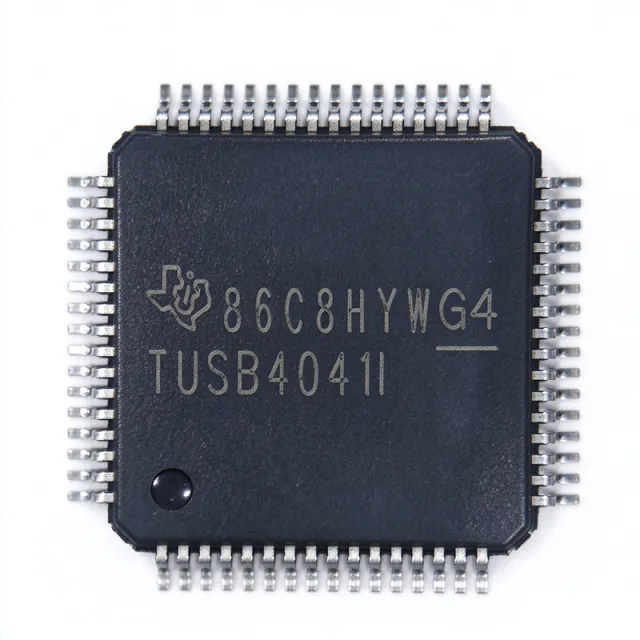
The Texas Instruments TUSB4041IPAP is a 4-port high-speed 480-Mbps USB 2.0 hub controller in a 64-pin HTQFP (PAP) 10x10 mm package. It provides USB high-speed (480 Mbps) or full-speed (12 Mbps) connections on the upstream port and supports four downstream ports that operate at high-speed, full-speed, or low-speed. The industrial-grade version operates across -40C to +85C, making it suitable for embedded and industrial designs. A USB 2.0 hub controller is a serial-interface bridge that aggregates one upstream USB port into multiple downstream ports while managing the protocol handshakes, transaction translation, and per-port power control dictated by the USB 2.0 specification. It sits within the broader hierarchy of USB controllers -> interface ICs -> power management and connectivity silicon -> mixed-signal semiconductors. The TUSB4041I family supports both self-powered and bus-powered configurations, with integrated USB transceivers and optional battery-charging detection on downstream ports. Key features include 480-Mbps high-speed upstream operation, per-port over-current protection flags, integrated 1.5-kV ESD on USB signal lines, support for compound devices, and I2C/EEPROM configurability for vendor ID (VID), product ID (PID), and port-remap policy. Per-port power-switch control outputs enable ganged or individual port-power switching without external glue logic. The device integrates a UTMI+ low-pin-interface (ULPI) or integrated transceiver variant, a serial-interface engine, and a protocol layer that handles split transactions for full-/low-speed peripherals attached to high-speed upstream links. The HTQFP-64 footprint provides ample ground and power pins for signal-integrity routing on 2-layer consumer-grade boards. Typical applications include USB port expansion on industrial PCs, docking stations, monitors with built-in USB hubs, embedded HMI panels, and POS terminals. The industrial temperature range and integrated charge-detection features also make it a strong fit for automotive-infotainment accessories and medical USB peripherals. When designing with this part, place 27 ohm series termination resistors close to the USB DP/DM pins and provide adequate bulk capacitance on each downstream VBUS rail managed by the controller's power-switch enables.

USD $3,28 В наличии
TUSB4041IPAPQ1 - 4-Port USB 2.0 Hub AEC-Q100 | Texas Instruments
TUSB4041IPAPQ1

TUSB4041IPAPQ1 - 4-Port USB 2.0 Hub AEC-Q100 | Texas Instruments

The Texas Instruments TUSB4041IPAPQ1 is an automotive-qualified 4-port high-speed 480-Mbps USB 2.0 hub controller in a 64-pin HTQFP (PAP) package with exposed pad. It provides four downstream USB 2.0 ports from a single upstream port, full-speed (12 Mbps), high-speed (480 Mbps), and low-speed (1.5 Mbps) signaling, and operates over -40C to +85C with an automotive-grade qualification. A USB 2.0 hub is a critical interface IC that expands a single USB root port into multiple downstream ports, providing downstream device connect/disconnect detection, overcurrent protection coordination, transaction translation between split USB transactions, and configurable port-power switching. The TUSB4041IPAPQ1 sits in the USB hub controller product hierarchy (USB 2.0 hub -> USB hub -> USB interface IC -> interface IC -> semiconductor) and is widely deployed in automotive infotainment, body electronics, and rear-seat entertainment systems. Key features include integrated USB 2.0 high-speed PHY on every port, pin-strap configuration for battery-charging support, customization via OTP ROM, I2C EEPROM, or I2C/SMBus target interface for VID/PID/port/phy settings, optional upstream port indicator, and individual port power control with overcurrent sensing. The device uses a single 3.3 V supply plus an internal 1.1 V core regulator generated by the on-chip LDO. Internal termination, pull-up/pull-down resistors, and a built-in 5 V VBUS load switch controller (external n-MOSFET required) simplify PCB design. Suspend and remote wakeup signaling are managed in hardware, reducing firmware complexity. Typical applications include automotive head-unit USB ports, rear-seat entertainment hubs, body-control module USB service ports, industrial PC USB expansion, and embedded telematics USB interfaces. AEC-Q100 qualification makes the -Q1 device preferred for road-vehicle applications, while the non-Q1 TUSB4041IPAP serves commercial/industrial environments. When designing with this part, place the external 24.576 MHz crystal (or oscillator) within 5 mm of the XI/XO pins and provide a continuous ground reference under the exposed thermal pad for thermal and EMI performance. Per-port 5 V VBUS switches must use a logic-level n-MOSFET driven by the integrated DP1PWR output to share load-current and fault indications with the host. This page synthesizes distributor pricing for automotive-grade USB hubs, pin-compatible drop-in alternatives, and design considerations from the manufacturer datasheet not always highlighted on distributor listings.

Запрос цены Контакты
TUSB4041IPAPR - 4-Port USB 2.0 480-Mbps Hub | Texas Instruments
TUSB4041IPAPR

TUSB4041IPAPR - 4-Port USB 2.0 480-Mbps Hub | Texas Instruments

The Texas Instruments TUSB4041IPAPR is a 4-port high-speed 480-Mbps USB 2.0 hub controller in a 64-pin HTQFP (PAP) 10x10 mm package. It provides USB high-speed (480 Mbps) or full-speed (12 Mbps) connections on the upstream port and supports four downstream ports that operate at high-speed, full-speed, or low-speed. The industrial-grade version operates across -40C to +85C, making it suitable for embedded and industrial designs. A USB 2.0 hub controller is a serial-interface bridge that aggregates one upstream USB port into multiple downstream ports while managing the protocol handshakes, transaction translation, and per-port power control dictated by the USB 2.0 specification. It sits within the broader hierarchy of USB controllers -> interface ICs -> power management and connectivity silicon -> mixed-signal semiconductors. The TUSB4041I family supports both self-powered and bus-powered configurations, with integrated USB transceivers and optional battery-charging detection on downstream ports. Key features include 480-Mbps high-speed upstream operation, per-port over-current protection flags, integrated 1.5-kV ESD on USB signal lines, support for compound devices, and I2C/EEPROM configurability for vendor ID (VID), product ID (PID), and port-remap policy. Per-port power-switch control outputs enable ganged or individual port-power switching without external glue logic. The device integrates a UTMI+ low-pin-interface (ULPI) or integrated transceiver variant, a serial-interface engine, and a protocol layer that handles split transactions for full-/low-speed peripherals attached to high-speed upstream links. The HTQFP-64 footprint provides ample ground and power pins for signal-integrity routing on 2-layer consumer-grade boards. Typical applications include USB port expansion on industrial PCs, docking stations, monitors with built-in USB hubs, embedded HMI panels, and POS terminals. The industrial temperature range and integrated charge-detection features also make it a strong fit for automotive-infotainment accessories and medical USB peripherals. When designing with this part, place 27 ohm series termination resistors close to the USB DP/DM pins and provide adequate bulk capacitance on each downstream VBUS rail managed by the controller's power-switch enables.

USD $3,28 В наличии
TUSB4041IPAPRQ1 - 4-Port USB 2.0 Hub, AEC-Q100 | Texas Instruments
TUSB4041IPAPRQ1

TUSB4041IPAPRQ1 - 4-Port USB 2.0 Hub, AEC-Q100 | Texas Instruments

The Texas Instruments TUSB4041IPAPRQ1 is an automotive-grade 4-port high-speed USB 2.0 hub controller supporting 480-Mbps upstream and downstream signaling in a 64-pin HTQFP (PAP) 10x10 mm package with an exposed thermal pad. The -Q1 suffix denotes AEC-Q100 qualification, making it suitable for in-vehicle USB expansion where reliability across -40C to +85C is mandatory. It integrates USB 2.0 transceivers, a serial-interface engine, hub repeater, and per-port power control with battery-charge support, allowing direct attachment to automotive head units, IVI systems, and telematics modules. A USB 2.0 hub is a compliant USB device class that expands one upstream port into multiple downstream ports while managing enumeration, power distribution, and transaction translation across a tiered-star topology. The hub sits between a host controller (xHCI/eHCI) and downstream peripherals; the hub repeater manages connectivity, while the hub controller handles split transactions and descriptor management. The TUSB4041I-Q1 family is positioned as an automotive TUSB2.0 hub silicon in TI's broader portfolio of USB interface ICs, falling under the Interface ICs > Audio/Video and broader serializer-deserializer hierarchy of signal-conditioning and protocol-bridging devices. Key features include support for downstream battery charging (DCP, CDP, SDP per BC1.2-like behavior), pin-strap configuration, OTP ROM customization, I2C/SMBus configuration interface, integrated 5V-to-3.3V LDO, and per-port overcurrent protection plus power-switch control outputs. Per-port event indicators are available via an interrupt output, and the part provides both full-speed (12 Mbps) and high-speed (480 Mbps) signaling upstream while supporting low-/full-/high-speed downstream traffic. Architecture-wise, the device combines an ULPI-style internal PHY layer with a hardwired hub controller core. Pin-strap pins allow boot-time selection of VID/PID, removable/non-removable port mapping, and battery-charging mode without external EEPROM, while an optional I2C EEPROM, OTP ROM, or SMBus target interface enables field-customizable configuration. The PAP package's exposed pad offers a low-junction-to-board thermal path, important under hood or behind-dash operating conditions. Typical automotive applications include infotainment USB expansion (rear-seat entertainment, smartphone projection), telematics control units, body and cluster controllers that expose diagnostic or media ports, and in-cabin USB charging outlets requiring BC1.2-class behavior. Industrial variants of the same die (TUSB4041I, no -Q1) target factory USB aggregation and USB-isolated medical-cart hubs. When designing with this part, allocate a generous copper pour under the exposed pad, keep the 24 MHz crystal traces short, and use a 5V-tolerant current-limited power switch per downstream port. The -Q1 qualification grade means PPAP and IMDS data are available from TI on request.

Запрос цены Контакты
TUSB422IYFPR - USB Type-C Port Controller DSBGA-9 | Texas Instruments
TUSB422IYFPR

TUSB422IYFPR - USB Type-C Port Controller DSBGA-9 | Texas Instruments

The Texas Instruments TUSB422IYFPR is a USB Type-C port controller with integrated USB Power Delivery (USB PD) physical layer, housed in a 9-ball DSBGA (YFP) package measuring approximately 1.6 mm x 1.6 mm. It supports USB Type-C Cable and Connector Specification and USB Power Delivery 2.0, enabling up to 100 W of negotiated power and alternate-mode signaling through a single USB Type-C connection. The device operates from a single 3.3 V supply and communicates with an external Type-C Port Manager (TCPM) over standard I2C interface up to 400 kHz. A USB Type-C port controller is a specialized interface IC that sits between a USB Type-C receptacle and the application processor in devices such as laptops, tablets, monitors, docks, and power adapters. It performs attach/detach detection on the two Configuration Channel (CC) pins, decodes BMC-encoded USB PD messages, and reports cable orientation, role detection, and current-mode advertisement to the host. Compared with discrete USB-C implementations, a dedicated port controller reduces BOM count, simplifies firmware, and accelerates USB-IF compliance. Key features of the TUSB422 include configurable DFP (Downstream Facing Port), UFP (Upstream Facing Port), or DRP (Dual Role Port) operation, integrated Rp/Rd termination for CC1 and CC2, automatic cable-orientation detection, and a low-power standby mode. The internal BMC PHY uses 9-ohm termination (per USB PD spec) so it can be paired with common external load switches and VBUS power-path controllers without external components. The device is qualified to industrial temperature range (-40C to +85C) and is supplied Pb-free and RoHS-compliant. Architecturally, the TUSB422 separates the protocol layer from the physical layer. The PHY handles BMC encoding, preamble, and collision detection on CC1/CC2; the TCPM firmware running on the host MCU handles policy engine, protocol layer, and device policy manager functions. This partitioning lets OEMs keep policy and security logic in trusted firmware and reuse a single TUSB422 across product families. Typical applications include USB-C power adapters and chargers, notebook/dock side-band controller, USB-C monitors and hubs, smartphones and tablets, and Thunderbolt 3 / USB4 accessory adapters. Designers choose the TUSB422 when they need a small-footprint, TI-trusted USB PD PHY with proven USB Type-C compliance. Design note: TI recommends placing the TUSB422 as close as possible to the USB Type-C connector CC pins. Keep CC1/CC2 traces matched within 1 mm to within the receptacle pads to ensure USB-IF compliance testing passes. Decouple VDD 3V3 with at least 0.1 uF plus 1 uF ceramic capacitors. This page synthesizes distributor pricing, drop-in alternatives, and design notes not always consolidated on the manufacturer datasheet, enabling faster component selection and drop-in replacement decisions.

Запрос цены Контакты
TUSB422IYFPT - USB PD TCPCi Port Controller | Texas Instruments
TUSB422IYFPT

TUSB422IYFPT - USB PD TCPCi Port Controller | Texas Instruments

The Texas Instruments TUSB422IYFPT is a USB Type-C port controller and USB Power Delivery physical-layer interface with Configuration Channel logic, supplied in a 9-DSBGA package. It supports USB Type-C 1.2 and USB Power Delivery specifications, provides 5 V to 24 V sourcing and sinking capability, and includes a 2.5 W VCONN switch for alternate-mode negotiations. The device is designed around the TCPCi architecture, where an external USB Type-C Port Manager communicates with the TUSB422 through an I2C interface. The TUSB422 handles the USB BMC physical layer and the low-level CC signaling while the external controller manages policy, negotiation, and system behavior. The TUSB422IYFPT is optimized for portable applications and can be configured by software as a dedicated host, dedicated device, or dual-role port with dual-role port support. Attach and detach detection, alternate-mode negotiation, power sourcing, power sinking, and USB data-role behavior are supported for compact USB Type-C designs. The 9-DSBGA package supports surface-mount assembly in space-constrained portable equipment. Designers should use the manufacturer datasheet pin-description table and reference application information when assigning PCB tracks, because the exposed-ball package and its power, ground, and signal assignments require exact footprint-level review. The TUSB422 is a physical-layer companion rather than a complete USB Type-C port manager, so firmware and an external TCPM remain necessary for full protocol policy control.

Запрос цены Контакты
TUSB501DRFR - 5Gbps USB 3.0 Redriver | Texas Instruments
TUSB501DRFR

TUSB501DRFR - 5Gbps USB 3.0 Redriver | Texas Instruments

The Texas Instruments TUSB501DRFR is a 3.3 V, single-channel USB 3.0 SuperSpeed redriver with a maximum data rate of 5 Gbps, packaged in an 8-pin WSON package measuring 2 mm by 2 mm. It combines input equalization with high-differential-voltage output drive to recover degraded 5 Gbps signals and extend the practical reach of USB SuperSpeed links across printed-circuit boards, cables, and interconnects. A USB redriver is a signal-conditioning semiconductor placed within a high-speed data path to combat insertion loss, reflections, and intersymbol interference. In the hierarchy of electronic components, the TUSB501 is a USB interface IC, a redriver and repeater, and ultimately a high-speed signal-integrity device. Unlike a protocol controller or hub, it does not interpret USB traffic or create a new bus segment; it conditions an existing differential pair and passes the recovered 5 Gbps signal onward. The TUSB501DRFR supports one USB 3.0 SuperSpeed channel at 5 Gbps and provides equalization for lossy channels. Its 3.3 V supply operation and 2 mm by 2 mm WSON (DRF) package support compact equipment designs. The specified operating-temperature range is -40°C to +85°C, making the device suitable for industrial and temperature-range-controlled consumer, communications, storage, and test-system implementations. Technically, the redriver compensates attenuation encountered by the differential pair and regenerates the output signal at a high differential voltage. This helps the receiving endpoint detect transitions reliably when PCB traces, connectors, and cable segments introduce loss. The manufacturer describes TUSB501 as a third-generation 3.3 V single-channel redriver designed to extend possible channel length while recovering USB 3.0 SuperSpeed data. Typical applications include host-to-device links, peripheral connections, storage controllers, docking systems, external test equipment, and active cable assemblies. The device is particularly useful when loss and intersymbol interference threaten link margin. In an active cable or extended PCB interconnect, placing the redriver near the degradation boundary can restore signal amplitude before the next connector or receiver. Designers should preserve the differential impedance of the USB SuperSpeed pair, use symmetrical routing, minimize stubs and unnecessary vias, and place decoupling close to the supply pin. The device has limited built-in ESD protection, so system-level protection and connector placement remain important. Differential probing and eye-diagram measurements are recommended when validating a new channel. This page combines the exact TUSB501DRFR ordering information with package, application, replacement, and design guidance. It distinguishes confirmed manufacturer characteristics from parameters that still require datasheet verification, helping engineers plan a 5 Gbps USB redriver design without relying on generic interface-IC assumptions.

Запрос цены Контакты
TUSB5052PZ - 5-Port USB 2.0 Hub Controller with Serial Bridge | Texas Instruments
TUSB5052PZ

TUSB5052PZ - 5-Port USB 2.0 Hub Controller with Serial Bridge | Texas Instruments

The Texas Instruments TUSB5052PZ is a USB 2.0 hub controller with an integrated bridge to two serial ports, a maximum hub clock frequency of 6 MHz, and a 1.5 MBps data-transfer rate. The device is supplied in a 100-terminal LQFP package measuring 14 mm by 14 mm. Its commercial temperature grade, gull-wing terminal form, and square package outline support use in conventional embedded USB expansion designs. A USB hub controller is a semiconductor that manages traffic between one upstream USB connection and multiple downstream USB ports. The TUSB5052PZ belongs to the broader USB interface controller hierarchy, where USB interface ICs connect host controllers, peripherals, hubs, bridges, and external serial devices. Its configurable optional hub capability allows designers to combine hub and serial-interface functions in one device instead of allocating separate ICs for those functions. The verified listing identifies the TUSB5052PZ as a five-port USB 2.0 hub controller with a bridge to two serial ports. Its maximum clock frequency is 6 MHz, while its stated data-transfer rate is 1.5 MBps. The nominal operating voltage is 3.3 V, matching the power level commonly used by USB 2.0 interface circuitry. These characteristics make the controller relevant to embedded USB systems requiring multiple USB connections alongside serial-port expansion. The 100-LQFP (14 x 14 mm) package provides 100 external terminals and a square, gull-wing surface-mount form. Compared with a smaller connector-oriented USB interface package, this device exposes a substantially larger pin count to support hub-port and serial-bridge functions. Its specified commercial temperature grade is suitable for ordinary commercial equipment, although manufacturer ordering information and the full datasheet should be checked for detailed electrical limits and qualification requirements. Typical application areas include industrial control panels, multifunction printers, point-of-sale terminals, external storage enclosures, test equipment, and legacy-port expansion systems. In each case, the controller can sit between a USB host and downstream peripherals while presenting serial connectivity to embedded subsystems. System-level performance remains dependent on upstream USB bandwidth, device scheduling, cable quality, enumeration behavior, and the electrical implementation of the connected ports. Designers should verify every signal, supply, and termination connection against the manufacturer datasheet before layout release. The large 100-terminal package demands careful escape routing between fine-pitch leads, while USB differential pairs require controlled impedance and minimized stub length. Decoupling and high-speed return paths should also be planned so that the 3.3 V interface supply and USB data paths are not compromised by adjacent digital or switching circuitry. This product record combines the verified distributor specifications, commercial availability references, package information, and cross-reference findings for the TUSB5052PZ. It also documents where additional engineering data remain necessary, including detailed pin assignments, electrical limits, lifecycle declarations, pricing, and validated drop-in replacements. Those gaps are intentionally marked rather than replaced with unverified datasheet or substitution claims.

Запрос цены Контакты
TUSB5152PZ - 5-Port USB Hub Controller | Texas Instruments
TUSB5152PZ

TUSB5152PZ - 5-Port USB Hub Controller | Texas Instruments

The Texas Instruments TUSB5152PZ is a USB interface controller that integrates a configurable 5-port hub, two serial ports, and a bridge to the IEEE 1284 parallel port. The device is supplied in a 100-LQFP surface-mount package measuring 14 x 14 mm, as identified by DigiKey and the manufacturer datasheet search results. Its package designation uses the PZ suffix, while the verified distributor information identifies the device as an interface controller in the USB interface IC category. A USB hub controller is a semiconductor that manages traffic between a host USB interface and one or more downstream ports. A configurable USB 2.0 hub can allocate upstream bandwidth according to the activity presented by connected devices. The TUSB5152PZ extends this conventional hub role with two serial interfaces and an IEEE 1284 parallel-port bridge, allowing legacy printer and peripheral connectivity to coexist within a system designed around USB. This integration reduces the need for separate interface components when both USB expansion and legacy peripheral support are required. The verified product descriptions identify an optional five-port hub configuration, two serial ports, and one parallel-port bridge. The parallel interface is specified as IEEE 1284, the legacy printer-port standard supported by the integrated bridge. The two serial ports provide additional data paths for system integration, although individual electrical rates and protocol details are not included in the supplied verified snippets and therefore cannot be stated here as confirmed specifications. The TUSB5152PZ is packaged in a 100-LQFP with 14 x 14 mm body dimensions. This high-pin-count surface-mount package exposes the hub, serial, and parallel functions to a controller-oriented PCB design. A complete design must route the relevant USB, serial, parallel, clock, power, and control signals according to the manufacturer datasheet. Because no verified public pin table was included in the supplied results, no pin-level assignments are asserted on this page. Typical applications include compact USB-to-IEEE-1284 printer adapters, multifunction office peripherals, industrial interface equipment, and legacy computer expansion systems. The device is particularly relevant where one controller must provide USB hub expansion while also maintaining compatibility with serial accessories and an IEEE 1284 printer connection. Product selection should account for the exact USB speed grade, supported serial interface standards, clock requirements, and system power needs found in the complete manufacturer documentation. Supply information identifies TUSB5152PZ as a product replaced by TUSB5052. Verified distributor listings also describe the component as available and provide pricing from $7.2600 at quantity one. This page combines the verified package and lifecycle information, pricing tiers, application guidance, and explicitly documents unresolved technical details rather than inferring unavailable specifications.

Запрос цены Контакты
TUSB522PRGER - 5Gbps Dual USB Redriver | Texas Instruments
TUSB522PRGER

TUSB522PRGER - 5Gbps Dual USB Redriver | Texas Instruments

The Texas Instruments TUSB522PRGER is a fourth-generation, dual-channel USB 3.1 Gen 1 redriver and signal conditioner supporting 5 Gbps per channel in a 24-pin VQFN RGE package measuring 4 mm by 4 mm. It operates from a 3.3 V supply and combines two independently processed SuperSpeed data paths on one compact IC. A USB redriver is an interface IC that regenerates a degraded high-speed differential signal, compensates for channel loss, and restores signal amplitude and timing before it reaches the next USB device. It occupies the physical layer between a transmitter and receiver. Within the interface-IC hierarchy, TUSB522PRGER is a dual-lane USB signal conditioner designed for USB 3.1 Gen 1 links operating at 5 Gbps. The principal features include two redriver channels, 5 Gbps data-rate support, a 3.3 V power supply, an ultra-low-power architecture, and support for USB 3.1 low-power modes. The dual-channel arrangement allows one device to condition both Tx and Rx SuperSpeed lanes in systems with separate unidirectional signal paths. The operating-temperature range shown for the RGE ordering option is 0 °C to 70 °C. The TUSB522PRGER is intended to improve margin across PCB traces, connectors, cables, and other interconnect elements whose insertion loss would otherwise prevent reliable USB 3.1 Gen 1 operation. Because each channel processes a single-lane SuperSpeed differential pair, board designers can preserve the standard USB topology while adding programmable signal-conditioning capability between controller and peripheral devices. Its 24-pin VQFN package also supports compact implementation in desktop, peripheral, docking, and embedded computing equipment. Typical applications include USB 3.1 Gen 1 host-to-hub links, docking-station connections, external storage, monitors, capture equipment, and other systems that place substantial channel loss between a USB controller and connector. The device can also be evaluated for other low-power 5 Gbps differential links when its USB-specific operating characteristics and configuration requirements are acceptable. PCB implementation requires careful treatment of the differential pairs. Place the device near the transition between the lossier interconnect segment and the receiver, maintain continuous impedance-controlled routing, and follow the manufacturer’s recommended bypass and layout practices. Verify receive eye margin and compliance after adding the redriver because an over-equalized channel can reduce signal integrity instead of improving it. This product page combines the manufacturer’s device description and ordering information with practical guidance covering application selection, package constraints, signal-path placement, and the distinction between the TUSB522PRGER and the identified drop-in family alternative TUSB522PIRGER. It is intended to help engineers determine whether the device’s 5 Gbps, dual-channel, 3.3 V architecture fits the intended USB signal path before layout begins.

Запрос цены Контакты
TUSB522PRGET - 5Gbps Dual-Channel USB Redriver | Texas Instruments
TUSB522PRGET

TUSB522PRGET - 5Gbps Dual-Channel USB Redriver | Texas Instruments

Texas Instruments TUSB522PRGET is a 3.3 V dual-channel USB 3.1 Gen 1 redriver and signal conditioner supporting 5 Gbps per channel in a 24-pin VQFN package with an exposed pad. The device provides two independent signal-conditioning paths for restoring USB SuperSpeed data integrity across PCB traces, cables, and connector transitions. A USB redriver is an interface IC that receives a degraded high-speed differential signal, applies gain and equalization, and retransmits a cleaner version to the next device. In the electronic hierarchy, the TUSB522PRGET is a USB interface IC, redriver, repeater, equalizer, signal conditioner, and semiconductor. It is intended for systems where USB 3.1 Gen 1 routing requires equalization without changing the host, peripheral, or hub protocol behavior. Key features include dual-channel SuperSpeed operation, a maximum supported data rate of 5 Gbps, and operation from a 3.3 V supply. The 24-VQFN package measures 4 mm by 4 mm and includes an exposed thermal pad for improved heat transfer from the device. Tape-and-reel packaging supports automated manufacturing, while the identified operating-temperature range is 0°C to 70°C. The redriver compensates for channel loss encountered on PCB traces and through connectors by regenerating the differential signal rather than functioning as a protocol controller. Independent transmit and receive paths allow the device to condition signals traveling in either direction on a USB link. Its low-power 3.3 V architecture is intended to support USB 3.1 Gen 1 low-power modes and reduce consumption when the link is idle. Typical applications include USB Type-C and USB-A docking systems, personal-computer peripherals, external storage, monitors, hubs, test equipment, and industrial USB connections. It is especially useful where connector or PCB routing creates attenuation before a USB SuperSpeed receiver. The device can also restore signal quality across longer interconnects when the original channel does not provide adequate eye margin. PCB implementation requires careful return-path continuity, symmetrical differential routing, and placement of the device near the impaired channel. The exposed pad should be connected to the appropriate ground plane and thermal copper, while high-speed traces should avoid stubs and abrupt impedance discontinuities. USB SuperSpeed differential pairs require the trace geometry and reference-plane treatment specified by the manufacturer datasheet. This page combines the manufacturer product information, verified ordering details, package characteristics, replacement guidance, and practical USB signal-integrity considerations to support component selection and board-level implementation.

Запрос цены Контакты