Двигатели и драйверы
Товары (4)

AC - Residential Air Conditioner System Family | Cooling & HVAC
The "AC" designation refers to the residential and light-commercial air conditioner product category, a broad family of cooling systems manufactured by major HVAC brands such as Carrier, Trane, Lennox, Goodman, Rheem, Daikin, LG, and AUX. AC units deliver cooling capacities typically ranging from 5,000 BTU/h (0.4-ton) for window units to 120,000 BTU/h (10-ton) for central ducted systems, operating on R-32 or R-410A refrigerants with SEER2 efficiency ratings from 14.0 to 25.0+. The category encompasses window units, portable ACs, mini-split (ductless) systems, multi-zone mini-splits, and central split systems. An air conditioner (AC) is a mechanical system that removes heat from an enclosed space and transfers it to the outdoors using a vapor-compression refrigeration cycle. The four core components are the evaporator (indoor coil that absorbs heat), the compressor (raises refrigerant pressure/temperature), the condenser (outdoor coil that rejects heat), and the expansion valve (drops refrigerant pressure to restart the cycle). The category hierarchy is: air conditioner -> HVAC equipment -> building mechanical systems -> thermal management. In the broader market taxonomy, AC products sit beside heat pumps (which add a reversing valve for heating) and furnaces (combustion-based heat). Key differentiating specifications across the AC category include cooling capacity (BTU/h or tons), SEER2 seasonal efficiency (14.3 minimum in US regions), HSPF2 heating efficiency (heat-pump variants), sound level (dB indoor/outdoor), refrigerant type, inverter compressor presence, smart Wi-Fi controls, and installation type. Premium brands offer variable-speed inverter compressors modulating from 25% to 110% capacity, while budget units use single- or two-stage fixed-speed compressors. Heat-pump variants add low-ambient heating down to -15 C (5 F). Modern AC architectures use inverter-driven rotary or scroll compressors (vs older reciprocating designs) to achieve part-load efficiency gains of 20-40%. Smart inverter control adapts compressor speed to real-time cooling demand, reducing start-stop cycling losses. Materials science choices - all-aluminum microchannel coils, copper tube-and-fin coils, blue fin corrosion protection - differentiate premium units from entry-level hardware. Quality brands rate coils with 10-year corrosion warranties. Typical applications include residential whole-home cooling (3-5 ton central units), apartment and condo retrofits (mini-splits), supplemental cooling (portable/window units), server-room precision cooling (dedicated split systems), light-commercial office cooling, and electric-vehicle cabin thermal management. Heat-pump variants extend the AC family into heating-dominated climates where winter electricity costs favor heat pumps over gas furnaces. The 2026 US refrigerant transition from R-410A to lower-GWP R-32 and R-454B reshapes the AC SKU landscape, with most 2026+ production now using A2L-rated refrigerants. When designing with AC systems, sizing is the single most critical decision: oversized ACs short-cycle and waste energy, undersized ACs run continuously and fail to dehumidify. The rule of thumb is 1 ton (12,000 BTU/h) per 400-500 square feet of conditioned floor area, adjusted for climate zone, insulation, window area, and ceiling height. Mini-split zoning further complicates sizing by allowing per-room oversizing. This page synthesizes distributor pricing ranges, brand-tier alternatives, and practical selection guidance not consolidated in any single manufacturer datasheet.
MRHQ25C-180S-M9PVSDPC-M9PS - 25mm Rotary Gripper, 180° | SMC
The SMC MRHQ25C-180S-M9PVSDPC-M9PS is a 25 mm-bore rotary gripper from the MRHQ Series that integrates a parallel 2-finger gripper with a 180° rotary actuator in a single compact body, eliminating the separate rotary table + adapter + air gripper stack used in older transfer-line designs. The unit ships with two M9PVSDPC solid-state auto-switches on the gripper fingers and one M9PS switch on the rotary axis, all pre-wired and configured for in-line PLC monitoring. Its 20% shorter axial length compared with the previous SMC generation reduces machine footprint on reversing stations. What is a rotary gripper? A rotary gripper is a pneumatically actuated end-effector that combines finger clamping and wrist rotation in one mechanism. In the broader automation taxonomy it sits below pneumatic gripper (a category of motion-control actuator) and above simple parallel air grippers; by merging rotation into the same housing, it removes external hoses, fittings, and timing-skew between the two motions, simplifying PLC ladder logic. Key differentiating features of the MRHQ25C-180S include a 25 mm bore giving a gripping force suitable for small- to medium-sized workpieces, a 180° rotation angle that reverses part orientation without a separate flip station, integrated M9P-series solid-state auto-switches with PNP / NPN options pre-selected at order code, and a hardened jaw guide for repeatable positioning under high-cycle transfer-line duty. Repeatability is specified at the sub-millimeter level because the rotary axis is mechanically locked after actuation. Technically the MRHQ25C-180S uses a dual-piston rack-and-pinion drive: one piston drives the parallel jaws through a mechanical linkage, and a second concentric piston rotates the output flange through 180°. The compact integration eliminates peripheral piping of the previous rotary table + adapter + air gripper combination, while the M9PVSDPC (gripper-finger) and M9PS (rotary-axis) switches give PLC feedback without extra wiring harnesses. Typical applications include part-reversing on transfer lines, machine tending of small turned or stamped components, robotic pick-and-place cells feeding CNC or assembly stations, and end-of-arm tooling on collaborative robots where one EOAT must both grip and reorient the part before placement. The 180° rotation also suits indexing fixtures in electronics assembly and inspection cells. When designing with the MRHQ25C-180S, confirm operating pressure (typically 0.2 to 0.7 MPa for SMC MRHQ), select air-preparation (FRL) upstream to protect seals, and route the three switch cables away from moving harnesses. Always verify jaw stroke and gripping-force margin against the heaviest workpiece in the mix, and use a soft-start valve if cycle rates are above 60 cpm to avoid water-hammer damage. This page synthesizes distributor pricing, drop-in same-series alternatives, and pneumatic-system design notes not found in the standalone SMC catalog PDF, enabling faster component selection for transfer-line engineers.
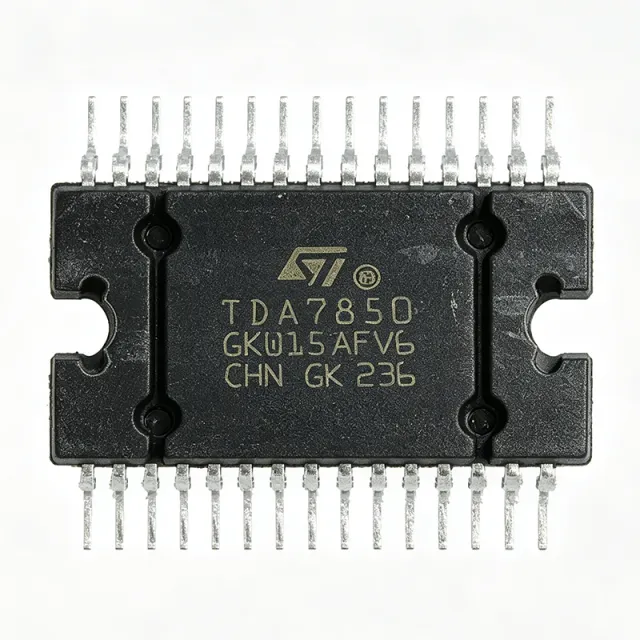
TDA7850 - 4x50W Quad Bridge Car Audio Amplifier | STMicroelectronics
The TDA7850 is a class AB quad bridge car radio amplifier from STMicroelectronics, delivering up to 4x50W into 4Ω loads with a 14.4V supply. It is housed in a Flexiwatt-25 package and designed for high-quality automotive audio systems. Data verified as of 2026-08-05. A class AB amplifier is a type of audio power amplifier that combines the efficiency of class B with the low distortion of class A, making it ideal for automotive head units where both power output and audio fidelity are critical. In the system hierarchy, the TDA7850 sits as the final power amplification stage, following the pre-amplifier and tone control stages, and drives the speakers directly. Key features include a high output power of 4x50W at 4Ω, a wide supply voltage range of 8V to 18V, and a low quiescent current of 120mA. The device also features standby and mute functions for power management, a full set of protections including short-circuit, over-temperature, and load-dump protection, and a very low output noise of 50µV. The Flexiwatt-25 package provides excellent thermal performance with a thermal resistance of 1°C/W, enabling reliable operation in confined automotive environments. The TDA7850 uses a complementary NPN/PNP output stage with a proprietary BiCMOS process, achieving a signal-to-noise ratio of 90dB and a total harmonic distortion of 0.006% at 1kHz. The high PSRR of 80dB minimizes alternator noise, ensuring clean audio output even with engine running. The device also includes a diagnostic pin for fault detection, simplifying system-level testing. Typical applications include car radio head units, aftermarket car audio amplifiers, and marine audio systems. The high output power and low distortion make it suitable for driving 4Ω or 2Ω speakers in multi-channel configurations. The standby and mute pins allow for easy integration with microcontroller-based control systems. When designing with this device, ensure adequate heatsinking to manage the thermal dissipation at high output power. The Flexiwatt-25 package requires a proper thermal interface to the chassis. Also, place the supply and output capacitors close to the IC to minimize EMI and ensure stable operation. This page synthesizes distributor pricing, drop-in alternatives, and practical design notes not found in the ST datasheet, providing a comprehensive resource for engineers selecting a quad bridge amplifier.
ZZCATCH-20260819 - Oil Catch Can | ZZPerformance | Engine Protection
The ZZCATCH-20260819 is an oil catch can manufactured by ZZPerformance, designed to intercept blow-by gases and oil vapor from the PCV (Positive Crankcase Ventilation) system before they enter the intake manifold. This device helps reduce carbon buildup on intake valves, improving engine performance and longevity. It is a mechanical component, not an electronic semiconductor, and is typically installed in the PCV line between the crankcase and the intake manifold. An oil catch can is a simple yet effective device used in internal combustion engines to separate oil mist and vapors from the crankcase ventilation gases. It works by allowing the blow-by gases to pass through a baffle or filter medium, where the oil droplets condense and collect in a reservoir, while the cleaned gases continue to the intake. This prevents oil from coating the intake valves, which is especially important in direct-injection engines where fuel is not sprayed on the valves to clean them. Key features of the ZZCATCH-20260819 include a durable aluminum or steel construction, a large capacity reservoir, and a simple installation process that requires no special tools. The device is designed to be maintenance-friendly, with a drain valve or removable bottom for easy emptying of collected oil. It is compatible with a wide range of vehicles, particularly those with turbocharged or supercharged engines that produce higher crankcase pressures. Technically, the catch can operates passively, relying on the pressure differential between the crankcase and the intake manifold to drive the blow-by gases through the device. The internal baffle design maximizes oil separation efficiency while minimizing flow restriction, ensuring that the PCV system continues to function correctly. The device does not require any electrical connections or electronic control, making it a purely mechanical addition to the engine. Typical applications include high-performance street cars, track vehicles, and daily drivers with modified engines. It is particularly beneficial for direct-injection engines, where carbon buildup on intake valves is a known issue. The ZZCATCH-20260819 is also suitable for use in both gasoline and diesel engines, provided the PCV system is compatible. When installing this catch can, it is important to ensure proper routing of the PCV hoses and to check the device periodically for accumulated oil. The reservoir should be emptied regularly to prevent overflow, which could lead to oil being drawn into the intake. The device is designed to be a low-maintenance addition to the engine, but regular inspection is recommended.