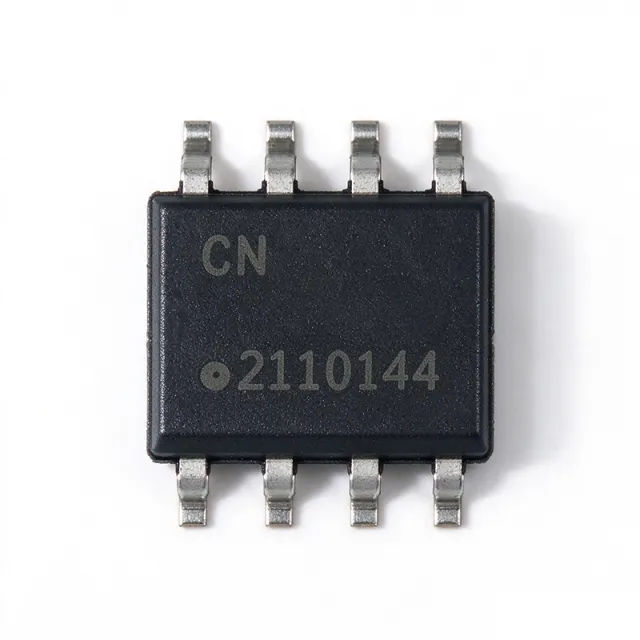
ATECC608B-SSHDA-T - CryptoAuthentication IC, SOIC-8 | Microchip
Артикул: ATECC608B-SSHDA-T ✗ Снят с производства| Кол-во | Цена за ед. | Итого |
|---|---|---|
| 1 | $0.9844 | $0,98 |
| 10 | $0.7109 | $7,11 |
| 100 | $0.6289 | $62,89 |
| 500 | $0.6016 | $300,80 |
| 1.000 | $0.5742 | $574,20 |
ATECC608B-SSHDA-T Обзор
What is a CryptoAuthentication IC? A CryptoAuthentication IC is a specialized secure element that offloads cryptographic operations from the main microcontroller and protects private keys in hardware-isolated storage. These devices sit at the foundation of the security hierarchy: CryptoAuthentication IC → secure element → hardware root-of-trust → embedded security subsystem. Unlike software-based cryptography, hardware secure elements ensure private keys never leave the silicon, dramatically reducing attack surface for IoT devices, network accessories, and edge nodes where MCU resources are limited but trust is non-negotiable.
The ATECC608B features a full ECDH/ECDSA engine operating in approximately 13 ms for sign operations and SHA-256/HMAC hardware acceleration, dramatically reducing cryptographic workload on host MCUs. It supports standard I²C up to 1 Mbps with configurable I²C addresses, an optional single-wire interface (SWI) variant, and operates from 2.0V to 5.5V supply with deep-sleep current as low as <150 nA. Internal EEPROM is locked through one-way fuses, preventing post-deployment firmware or key extraction by physical or remote attacks.
Typical applications include Matter/Thread device authentication, secure boot for Linux/Windows IoT edge nodes, AWS IoT multi-account registration, IP protection and firmware anti-cloning, accessory and consumable authentication (medical, industrial, printer cartridges), and TLS 1.2/1.3 mutual authentication offload for resource-constrained MCUs. The device ships with Microchip's CryptoAuthLib, which provides a unified API across the entire CryptoAuthentication family.
When designing with the ATECC608B, ensure I²C pull-ups are present (the SOIC version uses standard I²C, not SWI), allocate a dedicated 7-bit I²C address, and provision keys via the Microchip CryptoEvaluation kit during development. The GPIO pin can be used as a power-on reset indicator or wake source. Migration from ATECC608A is software-compatible via CryptoAuthLib.
This page synthesizes distributor pricing, drop-in same-package alternatives, and practical design notes not consolidated in the manufacturer datasheet alone.
Аналоги без доработки для ATECC608B-SSHDA-T — тот же корпус, pin-to-pin совместимость. Компоненты в других корпусах, требующие переработки PCB, исключены.
Варианты в этой серии
Модели той же серии, совместимые без доработки с ATECC608B-SSHDA-T (тот же форм-фактор и посадочное место) — отличается по Operating Temperature, Package, Tamper Detection.
Инструмент быстрого сравнения — выберите альтернативные компоненты для сравнения бок о бок:
ATECC608B-SSHDA-B
✓ В наличии
$0.69 / шт.
Открыть даташит →ATECC608A-SSHDA-T
📋 Справочный аналог (нет в каталоге)
ATECC108A-SSHDA-T
📋 Справочный аналог (нет в каталоге)
ATECC508A-SSHDA-T
📋 Справочный аналог (нет в каталоге)
ATECC608B-TCSMS
📋 Справочный аналог (нет в каталоге)
ATECC608B-MAHDA-T
📋 Справочный аналог (нет в каталоге)
ATECC608B-SSHDA-T Характеристики
| Product Type | CryptoAuthentication IC / Hardware Security Module |
| Family | CryptoAuthentication (ATECC608B) |
| Cryptographic Algorithms | ECC-P256 (ECDH, ECDSA), SHA-256, HMAC, AES-128-GCM |
| Key Storage | 10Kb secure EEPROM (hardware-isolated) |
| Hardware RNG | NIST SP 800-22 compliant |
| Интерфейс | I²C, up to 1 Mbps |
| I²C Address | Configurable (default 0x60) |
| Напряжение питания | 2.0V to 5.5V |
| Active Current | 3 mA typical during ECDSA operation |
| Deep Sleep Current | <150 nA |
| Корпус | 8-pin SOIC (SSHDA), Tape & Reel |
| Рабочая температура | -40°C to +85°C (industrial) |
| ECDH/ECDSA Sign Time | ~13 ms typical |
| Tamper Detection | Voltage glitch and temperature tamper |
| GPIO | 1 (general-purpose / interrupt) |
| Статус RoHS | Compliant |
| Статус жизненного цикла | Not Recommended for new designs (per Microchip product page) |
Конфигурация выводов ATECC608B-SSHDA-T
| Контакт 1 | NC — Not connected (per datasheet); leave floating or to GND |
| Контакт 2 | NC — Not connected (per datasheet); leave floating or to GND |
| Контакт 3 | NC — Not connected (per datasheet); leave floating or to GND |
| Контакт 4 | GND — Ground reference |
| Контакт 5 | SDA — I²C data; requires external pull-up to VCC |
| Контакт 6 | SCL — I²C clock; requires external pull-up to VCC |
| Контакт 7 | GPIO — General-purpose I/O / interrupt output (optional use) |
| Контакт 8 | VCC — Supply voltage, 2.0V to 5.5V |
Типичное применение
ATECC608B-SSHDA-T подходит для 6 применениеs: Matter / Thread Device Authentication, Secure Boot for Linux IoT Edge Gateways, Accessory and Consumable Authentication, Network Equipment Secure Authentication, Firmware Anti-Cloning and IP Protection, TLS 1.3 Mutual Authentication Offload.
Matter / Thread Device Authentication
The ATECC608B-SSHDA-T is one of the most widely deployed secure elements for Matter-compliant IoT commissioning. Its ECC-P256 engine handles the Device Attestation Certificate (DAC) signing in approximately 13 ms per operation, while the 10Kb secure EEPROM stores the Node Operational Certificate (NOC), DAC private key, and Matter fabric credentials. The hardware RNG (NIST SP 800-22) generates the per-device ephemeral keys required by the Matter attestation flow. Operating from 2.0V to 5.5V, the ATECC608B directly interfaces with both 3.3V Thread RCP MCUs and 5V legacy hubs without level shifters. CryptoAuthLib provides a unified API across Thread, Wi-Fi, and Ethernet Matter nodes, simplifying multi-platform Matter SDK integration while preserving the hardware root-of-trust.
Рекомендуется
Secure Boot for Linux IoT Edge Gateways
In Linux-based edge gateways (Raspberry Pi-class, industrial gateways running Yocto or Buildroot), the ATECC608B-SSHDA-T enforces hardware root-of-trust at boot. The host CPU reads the TPM-style PCR measurements from the ATECC608B and verifies signed kernel images against public keys stored in the device's secure EEPROM. Because the ATECC608B's private keys never leave the silicon, even a root-level OS compromise cannot extract the signing keys. The I²C interface runs at up to 1 Mbps, enabling sub-second boot-time attestation. With voltage-glitch and temperature tamper detection, the ATECC608B resists physical attacks during field deployment of industrial IoT gateways.
Рекомендуется
Accessory and Consumable Authentication
Printers, medical devices, and industrial fluid cartridges use the ATECC608B-SSHDA-T to verify that consumables are OEM-genuine. The host authenticates the cartridge's ATECC608B via ECDH key exchange, after which the secure element signs a random nonce using ECDSA. A successful signature verify proves the consumable is authentic and prevents counterfeit refills. The ATECC608B's deep-sleep current below 150 nA ensures consumable batteries last the full shelf life, while the wide 2.0V-5.5V supply tolerates the voltage droop of nearly-drained primary cells. The 10Kb EEPROM stores OEM certificate chains, batch counters, and expiry dates inside tamper-resistant hardware.
Рекомендуется
Network Equipment Secure Authentication
Routers, switches, and 5G small cells use the ATECC608B-SSHDA-T to authenticate peripheral modules like SFP transceivers, line cards, and antennas. Each module contains an ATECC608B provisioned with a unique X.509 certificate; the chassis validates the certificate chain before allowing the module to join the backplane. This prevents counterfeit SFPs that could compromise data plane integrity. The ATECC608B's 13 ms ECDSA sign time keeps the chassis bring-up time minimal, and its wide supply range (2.0V-5.5V) operates directly from typical 3.3V and 5V SFP cages. The hardware RNG ensures every module has a unique key pair, even in high-volume manufacturing.
Рекомендуется
Firmware Anti-Cloning and IP Protection
Industrial control systems, PLCs, and motor drives embed the ATECC608B-SSHDA-T to protect proprietary firmware from cloning. At first boot, the MCU reads a per-device secret from the ATECC608B and uses it to decrypt firmware stored in external flash. Without the correct ATECC608B, the firmware returns garbage data and refuses to run, even if the flash contents are dumped and copied to a clone. The 10Kb EEPROM stores per-customer license keys, entitlement counters, and expiry timestamps that the MCU queries on each boot. The ATECC608B's voltage-glitch detection resists simple fault-injection attacks that bypass microcontroller fuses.
Рекомендуется
TLS 1.3 Mutual Authentication Offload
Resource-constrained MCUs running mbedTLS or wolfSSL can offload TLS 1.3 mutual authentication to the ATECC608B-SSHDA-T. The private key never leaves the ATECC608B; instead, the host sends a TLS ServerHello hash to the secure element, which signs it with ECDSA and returns the signature. This protects the long-term device identity key even if the host MCU firmware is compromised. The ATECC608B's 13 ms ECDSA sign time is competitive with software mbedTLS on Cortex-M0+ cores while reducing flash/RAM footprint by 50-80 KB. Its low 3 mA active current is negligible compared to typical Wi-Fi radios, and the <150 nA sleep current enables years of battery life in standby.
Рекомендуется
Сводка рекомендуемых товаров
Справочные инженерные данные для ATECC608B-SSHDA-T — сравнение, рекомендации по проектированию и информация о соответствии.
Руководство по выбору
Сравнение с аналогами
| Параметр | Этот товар | ATECC608B-SSHDA-B | ATECC608A-SSHDA-T | ATECC108A-SSHDA-T | ATECC508A-SSHDA-T | ATECC608B-TCSMS |
|---|---|---|---|---|---|---|
| Package | SOIC-8 (SSHDA) | SOIC-8 - same | SOIC-8 - same | SOIC-8 - same | SOIC-8 - same | SOIC-8 - same |
| Brand | Microchip Technology | Microchip Technology | Microchip Technology | Microchip Technology | Microchip Technology | Microchip Technology |
| ECC Engine | ECC-P256 (ECDH + ECDSA) | ECC-P256 (same) | ECC-P256 (same) | No ECC (SHA-256 only) | ECC-P256 (same) | ECC-P256 (same) |
| AES-128 Acceleration | AES-128-GCM | AES-128-GCM | AES-128 (no GCM) | No AES | AES-128 (no GCM) | AES-128-GCM |
| Tamper Detection | Voltage glitch + temperature | Voltage glitch + temperature | Voltage glitch only | Basic | Voltage glitch only | Voltage glitch + temperature |
| Secure EEPROM | 10 Kb | 10 Kb | 10 Kb | 10 Kb | 10 Kb | 10 Kb |
| Supply Voltage | 2.0V to 5.5V | 2.0V to 5.5V | 2.0V to 5.5V | 2.0V to 5.5V | 2.0V to 5.5V | 2.0V to 5.5V |
| Pre-Provisioned Service | No (blank, customer provisions) | No (blank) | No (blank) | No (blank) | No (blank) | Yes - TrustCUSTOM |
| Unit Price (1 pc, USD, as of 2026-10-07) | 0.71 | 0.71 | 0.55 | 0.48 | 0.45 | 0.95 |
Ключевые отличия
- Enhanced tamper detection vs ATECC608A (против ATECC608A-SSHDA-T)
- AES-128-GCM hardware acceleration (против ATECC508A-SSHDA-T)
- Backward compatible with ATECC608A pinout (против ATECC108A-SSHDA-T)
Заметки по проектированию
Estimated: the ATECC608B-SSHDA-T draws approximately 3 mA during active ECDSA operations and less than 150 nA in deep sleep. Place a 100 nF X7R ceramic decoupling capacitor within 3 mm of the VCC pin (pin 8) and add a 1 µF bulk capacitor for noisy rails. For battery-powered applications, hold the SDA/SCL lines low during sleep to minimize wake-up glitches; the ATECC608B wakes within 1 ms after detecting I²C activity.
Route I²C SDA (pin 5) and SCL (pin 6) as short, parallel traces with a ground reference plane below. Keep trace length below 50 mm at 400 kbps and below 25 mm at 1 Mbps. Connect external pull-up resistors of 1 kΩ to 10 kΩ to VCC; choose 2.2 kΩ for 3.3V rails with multiple devices on the bus, or 4.7 kΩ for 5V rails. Place the ATECC608B away from high-frequency switching nodes (DC-DC converters, RF traces) to prevent EMI-induced crypto failures.
Do not leave the NC pins (1, 2, 3) floating on long-running production boards; tie them to GND via 100 kΩ resistors to prevent ESD-induced latch-up. Do not connect the GPIO pin (pin 7) to any signal that sources or sinks more than 5 mA. After provisioning, the ATECC608B's configuration zone is locked one-way; verify all slots and key assignments in pre-production units before locking, because once locked they cannot be modified.
Place the ATECC608B on the same PCB layer as the host MCU's I²C pins, avoiding vias on SDA/SCL. If a layer change is unavoidable, use paired ground-return vias adjacent to each signal via. Keep the exposed pad of the SOIC-8 connected to a quiet ground plane; do not run noisy signals beneath the IC. For CE/EMI compliance, consider a small ferrite bead on VCC to suppress high-frequency noise injection into the internal regulator.
Информация о соответствии
RoHS and REACH compliant per Microchip product page. Not AEC-Q100 qualified; the ATECC608B-MAHCZ-T variant is the automotive-grade counterpart. Lifecycle status 'NRND' (Not Recommended for new designs) per Microchip ATECC608B product page as of 2026-10-07.


