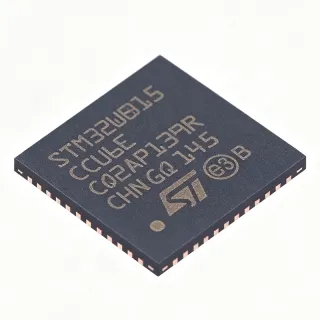
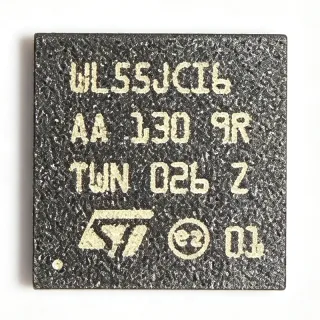
DW1000-I-TR13 - IEEE 802.15.4 UWB Transceiver IC | Qorvo
Артикул: DW1000-I-TR13 ✓ Активен| Кол-во | Цена за ед. | Итого |
|---|---|---|
| 1 | $5.53 | $5,53 |
| 10 | $5.2 | $52,00 |
| 100 | $4.9 | $490,00 |
| 500 | $4.62 | $2.310,00 |
| 1.000 | $4.35 | $4.350,00 |
DW1000-I-TR13 Обзор
A UWB transceiver is a radio IC that communicates using extremely short nanosecond-scale pulses spread over very wide bandwidth (typically 500 MHz or more per channel), rather than a narrowband modulated carrier. In the power-management and connectivity hierarchy of an embedded system, the DW1000 sits in the RF & Wireless > RF Transceivers layer, feeding ranging and data results to a host MCU over SPI. Because UWB pulses have sharp time-domain edges, time-of-flight between two radios can be measured with sub-nanosecond resolution, which is what enables centimeter-level positioning that Bluetooth and Wi-Fi cannot achieve.
Key features of the DW1000 include two-way ranging (TWR) and TDoA location capability with 10 cm position accuracy, six programmable channels across the 3.5-6.5 GHz UWB spectrum, four programmable preamble lengths and data rates up to 6.8 Mbps, and operation compliant with IEEE 802.15.4-2011 (originally 802.15.4a). The device integrates the analog front end, receiver and transmitter, needing only an external 38.4 MHz crystal and a few passive components to form a complete UWB radio.
On the receive side the DW1000 uses a direct-conversion analog receiver with programmable gain control, while the transmit side is a digitally generated pulse-based transmitter; both are synchronized to the 38.4 MHz crystal reference. The IC is controlled through an SPI slave interface, and the Decawave (now Qorvo) driver stack supports TDoA tag/anchor frameworks, SS-TWR and DS-TWR ranging modes. Its low-power architecture supports tag duty-cycling for battery-powered asset tags.
Typical applications include indoor real-time location systems (RTLS) with 10 cm accuracy, warehouse and factory asset tracking, robotics navigation and drone swarm relative positioning, and secure keyless entry.
Design consideration: UWB antenna placement and crystal tolerance directly affect ranging bias; follow the Qorvo reference design (DWM1000 module and related EVB1000 board) layouts and calibration guidance to meet the 10 cm accuracy figure.
This page synthesizes distributor pricing, drop-in packaging alternatives, and practical design notes not found in the manufacturer datasheet.
Аналоги без доработки для DW1000-I-TR13 — тот же корпус, pin-to-pin совместимость. Компоненты в других корпусах, требующие переработки PCB, исключены.
Инструмент быстрого сравнения — выберите альтернативные компоненты для сравнения бок о бок:
DW1000-I-TR7
✅ Прямая замена📋 Справочный аналог (нет в каталоге)
DW1000-I-TR13-R
✅ Прямая замена📋 Справочный аналог (нет в каталоге)
DW1000-I-TR13 Характеристики
| Product Type | IR-UWB Transceiver IC |
| Protocol Standard | IEEE 802.15.4-2011 (UWB IR) |
| Frequency Range | 3.5 GHz to 6.5 GHz |
| Number of UWB Channels | 6 (programmable) |
| Max Data Rate | 6.8 Mbps |
| Receive Sensitivity | -107 dBm |
| Ranging Accuracy | 10 cm (two-way ranging / TDoA) |
| Host Interface | SPI (slave) |
| Reference Crystal | 38.4 MHz external crystal |
| Корпус | 48-VFQFN with Exposed Pad |
| Тип монтажа | Surface Mount |
| Рабочая температура | -40C to +85C (industrial, -I grade) |
| Ranging Modes | Two-way ranging (TWR), TDoA |
Руководство по цоколевке DW1000-I-TR13 в корпусе 48-vfqfn with exposed pad
Цоколевка для DW1000-I-TR13 (корпус 48-vfqfn with exposed pad). Нумерация выводов, функции и схемы подключения определены в техническом описании производителя. Обратитесь к нему для точного посадочного места и рекомендаций по пайке.

Нет подробных данных о распиновке для DW1000-I-TR13.
Обратитесь к даташиту для полной конфигурации выводов.
Типичное применение
DW1000-I-TR13 подходит для 6 применениеs: Indoor Real-Time Location Systems (RTLS), Warehouse and Industrial Asset Tracking, Robotics and AGV Navigation, Drone Swarm Relative Positioning, Secure Keyless Entry and Smart Access, Sports Performance and Athlete Tracking.
Indoor Real-Time Location Systems (RTLS)
The DW1000-I-TR13 is the defining silicon of high-accuracy indoor RTLS, delivering 10 cm position precision via two-way ranging or TDoA - roughly 20x better than BLE RSSI systems. In a typical deployment, DW1000-based anchors are mounted at known ceiling or wall coordinates and synchronize over wired Ethernet or wireless backhaul; tags carrying the DW1000 and a low-power MCU emit UWB blink packets that the anchors time-stamp using the 38.4 MHz crystal-referenced clock. The -107 dBm receive sensitivity extends per-anchor coverage indoors, and six channels between 3.5 GHz and 6.5 GHz let large installations split cells across channels to avoid packet collisions. The 6.8 Mbps data rate also allows tags to return sensor telemetry on the same link, removing a second radio.
Рекомендуется
Warehouse and Industrial Asset Tracking
In factories and warehouses, the DW1000-I-TR13 tracks pallets, tools, and returnable containers with 10 cm accuracy, enough to detect which shelf an item sits on rather than merely which zone. Its industrial -40C to +85C temperature grade suits cold storage and unconditioned plants. Battery tags benefit from the transceiver's duty-cycled operation: a tag can beacon and complete a DS-TWR exchange in a few milliseconds, then sleep for seconds, stretching coin-cell life to years. Because UWB pulses coexist with Wi-Fi, Bluetooth, and 2.4 GHz ISM traffic without interference, the DW1000 can be deployed in RF-dense facilities where a BLE-based tracker would suffer contention. The SPI interface connects directly to MCUs such as the STM32 family used in most commercial tracking tags.
Рекомендуется
Robotics and AGV Navigation
Autonomous mobile robots and AGVs use the DW1000-I-TR13 for localization where lidar or vision struggles - dusty, dark, or geometrically repetitive environments. A fleet of fixed DW1000 anchors provides a TDoA grid, and each robot computes its position from UWB time-of-flight to 10 cm precision, sufficient for lane-keeping and docking without floor tape or reflectors. Alternatively, robot-to-robot relative ranging enables swarm coordination without infrastructure. The 6.8 Mbps link margin lets the same UWB exchange carry safety telemetry between robots and the fleet controller. The industrial temperature grade covers unconditioned warehouse aisles, and the deterministic nanosecond timing of the DW1000 avoids the latency jitter that plagues Wi-Fi-based localization in moving platforms.
Рекомендуется
Drone Swarm Relative Positioning
GPS-denied flight - indoors, under bridges, in mines - is where the DW1000-I-TR13 excels for drones. Each UAV carries a DW1000 radio; by exchanging two-way ranging packets with nearby drones and ground anchors, the flight controller maintains 10 cm-class relative position at update rates compatible with indoor flight control loops. The wide 3.5-6.5 GHz frequency range and six channels let multiple swarms operate concurrently in the same airspace. Compared to optical motion-capture, UWB ranging needs no cameras and works in fog and dust; compared to SLAM, it adds no compute burden on the autopilot. The low profile of the 48-VFQFN package and its exposed pad simplify mounting on constrained airframe PCB real estate.
Рекомендуется
Secure Keyless Entry and Smart Access
UWB secure ranging is the technology behind modern car keys and smart locks, and the DW1000-I-TR13 implements it through precise time-of-flight measurement: a relay attack extends the RF path, and because TWR measures actual flight time to sub-nanosecond accuracy, the DW1000 rejects relayed signals by detecting the physically impossible distance. Smart locks verify the key fob or phone is within tens of centimeters before actuating. The 10 cm ranging precision provides a natural geofence boundary, and data rates up to 6.8 Mbps exchange authentication payloads in the same burst. The industrial temperature grade covers vehicle door environments, and the SPI interface connects to the security MCU that runs the key-exchange protocol.
Рекомендуется
Sports Performance and Athlete Tracking
Professional sports increasingly adopt the DW1000-I-TR13 for player tracking: UWB anchors around a pitch or court localize lightweight athlete-worn tags to 10 cm at high update rates, yielding speed, acceleration, and positioning analytics that GPS cannot resolve indoors or at that granularity. Tag battery life benefits from the DW1000's low-power burst transmissions, critical for match-long wearables under weight limits. Six UWB channels allow concurrent multi-team training sessions without cross-talk, and the -107 dBm sensitivity sustains link margin across full stadium dimensions. Because UWB does not rely on satellite reception, the same system works in indoor arenas, hockey rinks, and velodromes. Data at 6.8 Mbps streams biometric sensor values alongside position per tag.
Рекомендуется
Сводка рекомендуемых товаров
Справочные инженерные данные для DW1000-I-TR13 — сравнение, рекомендации по проектированию и информация о соответствии.
Руководство по выбору
Сравнение с аналогами
| Параметр | Этот товар | DW1000-I-TR7 | DW3000 series |
|---|---|---|---|
| Brand | Qorvo | Qorvo | Qorvo |
Ключевые отличия
- Highest-accuracy ranging silicon in its class (против BLE/UWB-adjacent positioning ICs)
- Mature ecosystem with module and EVK support (против DW3000 series)
- Trade-off: no integrated MAC (против DW3000 series)
Заметки по проектированию
Follow the Qorvo reference design (DWM1000 module / EVB1000 board) layout for the 48-VFQFN exposed pad: the exposed pad must connect to a solid ground plane through an array of vias, since it is the primary RF ground return. Use the 38.4 MHz crystal specified in the Qorvo BOM with correct load capacitors - crystal tolerance directly adds ranging bias. Keep the differential RF_N/RF_P traces length-matched and 50-ohm controlled to the antenna network; re-tune the matching network for your specific antenna.
Antenna delays must be calibrated per unit to achieve the 10 cm ranging accuracy: the raw DW1000 timestamp includes fixed antenna and PCB propagation delay that shifts distance readings by 10-30 cm if left uncalibrated. Qorvo's application notes describe a one-point calibration procedure using a known measured distance. Also budget SPI timing carefully - running the host SPI beyond the specified maximum causes register corruption; verify with the datasheet electricals before finalizing firmware.
For battery tags, exploit the DW1000's fast wakeup and duty-cycled blink/TWR scheduling rather than leaving the receiver polling - the difference between years and weeks of coin-cell life. Place one decoupling capacitor per supply pin group close to the pins per the reference design; RF transmit bursts impose sharp current transients that a distant bulk capacitor cannot supply. Estimated: a 10 Hz ranging cadence at millisecond-scale airtime keeps average current in the sub-milliamp range versus continuous RX, but verify against the datasheet per-mode current figures.
Информация о соответствии
Compliance data not present in retrieved web data; request material declarations from Qorvo or distributor compliance portal.