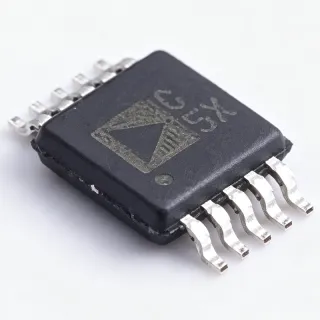
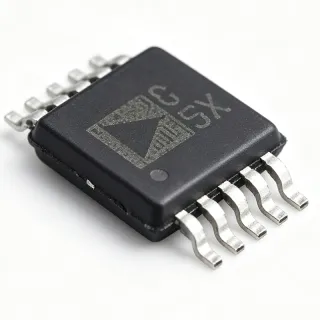
MCP3427T-E/UN - 16-Bit Dual-Channel Sigma-Delta ADC
Артикул: MCP3427T-E/UN ✓ АктивенMCP3427T-E/UN Обзор
An analog-to-digital converter is an integrated circuit that samples an analog voltage and produces a corresponding digital value. The MCP3427 belongs to the sigma-delta ADC class, within the broader ADC/DAC and data-converter semiconductor hierarchy. Its differential architecture accepts paired input voltages, while the internal 2.048 V reference establishes a differential measurement range of plus or minus 2.048 V. The low-rate conversion and fine resolution favor accurate sensing of slowly changing or near-static quantities.
Key features include 16-bit resolution, two differential input channels, and a conversion rate of up to 15 samples per second. The on-board 2.048 V reference reduces the need for an external voltage reference in many designs, and the I2C-compatible interface supports connection to embedded controllers and digital acquisition systems. The 2.7 V to 5.5 V supply range supports common embedded, industrial, and instrumentation rails, although the normal operating temperature range and detailed absolute maximum ratings must be confirmed in the manufacturer datasheet.
The device uses a sigma-delta conversion architecture to obtain high nominal resolution at relatively low sample rates. This is appropriate for pressure, temperature, position, load-cell, and slow process-control signals rather than audio sampling or high-speed vibration analysis. Differential inputs can also reject common-mode noise when the source and return paths are routed carefully. The internal reference and conversion speed should be considered together during calibration because reference accuracy contributes directly to measurement accuracy.
Typical uses include industrial process monitoring, precision temperature acquisition, load-cell signal measurement, laboratory instrumentation, and low-rate sensor conditioning. Differential input wiring is important in these systems because keeping the measurement pair together reduces susceptibility to externally induced noise. An I2C host controller can configure the conversion process and retrieve each result without requiring a high-speed parallel data bus.
For a new design, begin with the manufacturer pin-description table and application guidance, then verify the exposed-pad connection and decoupling requirements before layout. Keep analog input traces short, isolate them from switching nodes, and place the input and reference components where their parasitics will not materially degrade the selected conversion mode. Confirm the intended sample rate and gain configuration against the complete timing and noise specifications.
This page combines the manufacturer product information, distributor listings, package details, technical fit guidance, and a concise engineering comparison. It is designed to help developers identify whether the MCP3427T-E/UN matches a precision, low-speed measurement requirement and what must be confirmed before committing the footprint to a PCB.
Аналоги без доработки для MCP3427T-E/UN — тот же корпус, pin-to-pin совместимость. Компоненты в других корпусах, требующие переработки PCB, исключены.
Варианты в этой серии
Модели той же серии, совместимые без доработки с MCP3427T-E/UN (тот же форм-фактор и посадочное место) — отличается по Input Architecture.
MCP3427-E/UN
✅ Прямая заменаУточнить цену
Открыть даташит →MCP3427T-E/UN Максимальные параметры и электрические характеристики
| Разрешение | 16 bit |
| Input Channels | 2 channels |
| Input Architecture | Differential |
| Converter Architecture | Sigma-delta |
| Maximum Sampling Rate | 15 samples/s |
| Internal Reference Voltage | 2.048 V |
| Differential Input Range | -2.048 V to +2.048 V |
| Supply Voltage Range | 2.7 V to 5.5 V |
| Serial Interface | I2C-compatible two-wire interface |
| Корпус | 10-MSOP |
| Число выводов | 10 pins |
| Тип монтажа | Surface mount |
| Analog Input Type | Differential analog inputs |
| Power-Supply Architecture | Single power supply |
Руководство по цоколевке MCP3427T-E/UN в корпусе 10-msop
Цоколевка для MCP3427T-E/UN (корпус 10-msop). Этот аналоговый компонент имеет выводы входа, выхода и питания. Обратитесь к техническому описанию производителя для конфигураций выводов балансировки нуля, коррекции и разрешения. Идеально подходит для схем обработки сигналов и усилителей.

Нет подробных данных о распиновке для MCP3427T-E/UN.
Обратитесь к даташиту для полной конфигурации выводов.
Типичное применение
MCP3427T-E/UN подходит для 6 применениеs: Precision Temperature Measurement, Load-Cell Signal Acquisition, Industrial Process Monitoring, Low-Rate Sensor Conditioning, Laboratory Instrumentation, Battery-Powered Remote Sensing.
Precision Temperature Measurement
The MCP3427T-E/UN suits low-rate temperature acquisition because it provides 16-bit nominal resolution, two differential channels, and a 15 samples-per-second conversion rate. Differential input wiring can connect directly to a resistive sensor when its excitation and signal levels remain within the -2.048 V to +2.048 V differential range. The integrated 2.048 V reference simplifies system partitioning by removing the need for a separate reference in many designs. Route the sensor pair together, keep the converter away from switching regulators, and apply offset and gain calibration when absolute accuracy is required.
Load-Cell Signal Acquisition
The MCP3427T-E/UN is appropriate for slow load-cell and force-transducer measurements that prioritize resolution rather than sampling speed. Two differential channels support measurement of a bridge-derived signal and, where useful, a reference or temperature channel. The 16-bit conversion resolution and integrated 2.048 V reference reduce the number of precision components needed around the analog front end. Because conversion is limited to 15 samples per second, this device targets static force, slow-load, or event-based measurements rather than dynamic vibration analysis. Differential routing and shielding remain essential in mechanically noisy systems.
Industrial Process Monitoring
The MCP3427T-E/UN can digitize slowly varying industrial process signals through its two differential input channels and I2C-compatible interface. A 2.7 V to 5.5 V single supply allows integration near embedded controllers operating on common low-voltage rails. The converter is better suited to pressure, position, and chemical-sensor interfaces than to fast process waveforms because its maximum rate is 15 samples per second. Place the analog traces away from motors, relays, and switching power stages, and verify the selected conversion mode and digital filtering against the required response time.
Low-Rate Sensor Conditioning
The MCP3427T-E/UN provides a compact endpoint for resistive and bridge-based sensors that change over seconds or minutes. Its two differential channels, 16-bit nominal resolution, and integrated 2.048 V reference can simplify conditioning for pressure, position, and level sensors when their signal levels fit the differential input range. The I2C-compatible interface reduces wiring between the analog device and a digital controller. Keep conditioning passive components close to the input pins, maintain matched differential paths, and confirm that the sensor output does not exceed the converter's input limits.
Laboratory Instrumentation
The MCP3427T-E/UN is suitable for laboratory instruments that measure small, slowly varying voltages with two differential channels. Its 16-bit sigma-delta architecture, 2.048 V onboard reference, and 15 samples-per-second rate suit precision front ends for bench instrumentation and calibration systems. The I2C interface allows results to be transferred to a controller without a wide parallel bus. For best performance, use shielded or guarded input routing, calibrate offset and gain, and avoid placing the analog section next to high-energy switching nodes that could couple into the differential measurement.
Battery-Powered Remote Sensing
The MCP3427T-E/UN can serve as the measurement front end in a compact battery-powered sensing node because it operates from a 2.7 V to 5.5 V single supply and communicates over the two-wire I2C-compatible interface. Its low conversion rate is appropriate for reporting environmental or equipment parameters that do not require continuous high-speed sampling. The 10-MSOP package supports space-constrained board layouts, although the exposed-pad implementation and analog layout must follow the manufacturer guidance. Select the operating mode that delivers the required response without unnecessary conversion activity or power consumption.
Справочные инженерные данные для MCP3427T-E/UN — сравнение, рекомендации по проектированию и информация о соответствии.
Руководство по выбору
Сравнение с аналогами
| Параметр | Этот товар | MCP3427-E/UN |
|---|---|---|
| Brand | Microchip Technology | Microchip Technology |
| Package | 10-MSOP | 10-MSOP |
| Resolution | 16 bit | 16 bit |
| Input Channels | 2 differential channels | 2 differential channels |
| Conversion Architecture | Sigma-delta | Sigma-delta |
| Maximum Sampling Rate | 15 samples/s | 15 samples/s |
| Internal Reference | 2.048 V | 2.048 V |
| Differential Input Range | -2.048 V to +2.048 V | -2.048 V to +2.048 V |
| Supply Voltage | 2.7 V to 5.5 V | 2.7 V to 5.5 V |
| Serial Interface | I2C-compatible two-wire interface | I2C-compatible two-wire interface |
Ключевые отличия
- Two differential channels with integrated reference (против MCP3427-E/UN)
- Purpose-built for slow precision acquisition (против MCP3427-E/UN)
- Compact two-wire digital integration (против MCP3427-E/UN)
Заметки по проектированию
Route each differential input as a tightly coupled pair from the sensor or signal source to the converter. Keep the pair away from switching-regulator outputs, relay contacts, inductors, and high-current return paths. Place input filtering and protection components near the MCP3427T-E/UN pins, and follow the manufacturer layout and exposed-pad guidance to preserve low-noise differential acquisition.
Decouple the 2.7 V to 5.5 V supply close to the device and keep analog and digital return currents separated as far as the board architecture permits. The converter's 2.048 V internal reference supports a defined differential measurement range, but the complete error budget must include reference accuracy, input offset, gain error, and noise. Use the manufacturer test circuit when establishing the expected measurement uncertainty.
Do not treat the 16-bit resolution label as guaranteed 16-bit absolute accuracy. Offset, gain, reference, and noise specifications determine effective precision. Also verify that the signal source can be connected differentially without exceeding the input limits, and that the selected conversion rate satisfies the application's response-time requirement. A higher nominal resolution does not make the device suitable for high-speed sampling.
Информация о соответствии
The cited manufacturer product information and distributor records do not state explicit compliance declarations for the MCP3427T-E/UN ordering code. Review current Microchip material declarations before production release.