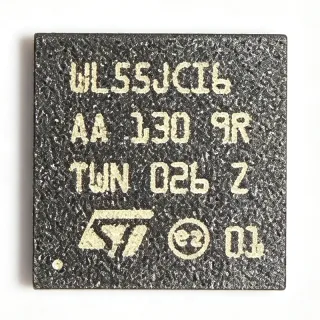
RTL8211F - Integrated 10/100/1000M Ethernet Transceiver | Realtek
Артикул: RTL8211F ✓ Активен| Кол-во | Цена за ед. | Итого |
|---|---|---|
| 1 | $1.05 | $1,05 |
| 10 | $0.95 | $9,50 |
| 100 | $0.85 | $85,00 |
| 500 | $0.8 | $400,00 |
| 1.000 | $0.7971 | $797,10 |
| 3.000 | $0.75 | $2.250,00 |
RTL8211F Обзор
An Ethernet PHY (physical layer transceiver) is the analog front-end of a wired network interface card or embedded SoC link. The PHY connects the MAC layer in the host processor (typically via GMII/RGMII) to the magnetics and RJ-45 jack on the cable side, performing line coding, link training, echo cancellation, and crosstalk mitigation. PHYs sit below the MAC in the ISO/OSI stack and above the magnetics; modern Gigabit PHYs integrate the DSP, ADC/DAC, and line drivers that would otherwise be discrete.
Headline specifications: 10/100/1000 Mbps triple-speed, integrated switching regulator for single-3.3 V supply, hardware-side support for Auto-MDIX, 802.3az EEE, jumbo frame support, and a serial management (MDC/MDIO) interface. The part is widely deployed in routers, set-top boxes, industrial SBCs, and SBC platforms such as the BeagleBone/BeaglePlay.
Architecturally, the device combines a DSP-based echo canceller, an adaptive equalizer, and a low-jitter PLL on a single die. QFN-48 with an exposed thermal pad (EP) routes the PHY's switching regulator output to external capacitors, enabling designer-friendly PCB layout while meeting EMI margins.
Typical applications include consumer broadband gateways, IPTV/STB, industrial SBCs, USB-to-Ethernet dongles, and embedded Linux platforms (Raspberry Pi CM4 carriers, STM32MP1, NXP i.MX 8M, etc.). For automotive or industrial -40C to +85C operation, the RTL8211FI industrial grade (I) variant is preferred over the commercial RTL8211F.
Design tip: the integrated switching regulator requires a well-designed PCB layout for efficiency and low ripple; follow the Realtek reference layout closely, place the buck inductor and bootstrap capacitor as recommended, and provide a solid ground pour beneath the QFN EP.
This page synthesizes distributor pricing (LCSC as of 2026-10-15), Realtek official datasheet references, drop-in same-family Realtek alternatives, and two cross-brand drop-in equivalents sourced from web data, plus practical PCB design notes not duplicated on competing distributor product pages.
Аналоги без доработки для RTL8211F — тот же корпус, pin-to-pin совместимость. Компоненты в других корпусах, требующие переработки PCB, исключены.
Инструмент быстрого сравнения — выберите альтернативные компоненты для сравнения бок о бок:
RTL8211FI
✅ Прямая замена📋 Справочный аналог (нет в каталоге)
RTL8211FS
✅ Прямая замена📋 Справочный аналог (нет в каталоге)
RTL8211F-CG
✅ Прямая замена📋 Справочный аналог (нет в каталоге)
RTL8211F-VD-CG
✅ Прямая замена📋 Справочный аналог (нет в каталоге)
JL2201A013
✅ Прямая замена📋 Справочный аналог (нет в каталоге)
JL2101
✅ Прямая замена📋 Справочный аналог (нет в каталоге)
RTL8211F Характеристики
| Product Type | Integrated 10/100/1000M Ethernet PHY Transceiver |
| Ethernet Speed | 10/100/1000 Mbps (triple-speed) |
| Standards Compliance | IEEE 802.3, 802.3u, 802.3ab, 802.3az (EEE) |
| MAC Interface | GMII / MII / RGMII |
| Management Interface | MDC/MDIO (clause 22/45) |
| Supply Voltages | 3.3 V, 2.5 V, 1.8 V, 1.5 V (or single 3.3 V via integrated LDO/SW) |
| Auto-Negotiation | Yes (10/100/1000) |
| Auto-MDI/MDIX | Yes |
| Jumbo Frame Support | Yes |
| Energy Efficient Ethernet | IEEE 802.3az supported |
| Корпус | QFN-48 (7x7 mm) with exposed pad |
| Тип монтажа | Surface Mount |
| Статус RoHS | Compliant |
| Datasheet Document | Realtek JATR-8275-15 Rev. 1.18, 72 pages |
Руководство по цоколевке RTL8211F в корпусе qfn-48 (7x7 mm) with exposed pad
Цоколевка для RTL8211F (корпус qfn-48 (7x7 mm) with exposed pad). Нумерация выводов, функции и схемы подключения определены в техническом описании производителя. Обратитесь к нему для точного посадочного места и рекомендаций по пайке.
Нет подробных данных о распиновке для RTL8211F.
Обратитесь к даташиту для полной конфигурации выводов.
Типичное применение
RTL8211F подходит для 7 применениеs: Consumer Broadband Gateway / Router, IPTV / Set-Top Box, Industrial Single-Board Computer (SBC), USB to Ethernet Adapter Dongle, Network-Attached Storage (NAS), Smart Home Hub / IoT Edge Gateway, Embedded Linux Development Kit.
Consumer Broadband Gateway / Router
The RTL8211F fits consumer broadband gateways and Wi-Fi router designs because its integrated switching regulator enables a single 3.3 V supply rail, eliminating a multi-rail discrete regulator chain and shrinking BOM cost. Its 10/100/1000 Mbps triple-speed MAC interface uses RGMII, the de-facto standard for Qualcomm, MediaTek and Realtek Wi-Fi SoCs, and Auto-MDI/MDIX removes the need for a manual crossover in router WAN/LAN ports. Per Realtek datasheet JATR-8275-15, the part supports IEEE 802.3az EEE, cutting idle power between bursts - critical for always-on home gateways. Compared to a PHY without an integrated DC-DC, a single BOM line saves roughly $0.30-$0.50 in regulator parts at 1ku volumes. The QFN-48 with exposed pad drops onto a 4-layer FR4 with no thermal relief, simplifying manufacturing. Recommended companion SoCs include the RTL8197F, IPQ8074, and MT7621 from MediaTek.
Рекомендуется
IPTV / Set-Top Box
The RTL8211F suits IPTV and set-top-box designs because its jumbo-frame support preserves multicast IPTV throughput, and 802.3az EEE keeps the SoC and DRAM power low during stream pauses. With a 3.3 V single supply via the integrated buck, the BOM does not need a multi-rail LDO - directly cutting power-tree cost in a STB where each BOM cent matters at millions of annual units. The RGMII interface glues cleanly to AMLogic S905 and Broadcom BCM7271 video SoCs. According to Realtek, jitter tolerance on the line side meets G.984 GPON interop tests so the RTL8211F can sit on the LAN side of an ONT media gateway. Compared to an external 25 MHz crystal PHY, the part's tolerance for a 25 MHz CMOS clock further removes components. Recommended video SoCs include AMLogic S905X4 and Broadcom BCM7271.
Рекомендуется
Industrial Single-Board Computer (SBC)
The industrial-grade RTL8211FI variant fits SBC platforms such as the Raspberry Pi Compute Module 4 carrier, BeagleBone, STM32MP1 Discovery, and NXP i.MX 8M evaluation boards, because it drops onto the same QFN-48 (7x7 mm) land pattern as the commercial RTL8211F while adding -40C to +85C operating range. Per the Octopart datasheet index, the part is widely second-sourced, which is critical for industrial designs with 5-year production lifecycles. The RGMII interface glues to NXP i.MX 8M, STM32MP1, Rockchip RK3399 and Allwinner H6, and the integrated switching regulator permits a single 3.3 V rail from a 5 V industrial input. Per the eeworld engineering BBS thread, JLSemi's JL2201 pin-compatible cross is available when Realtek lead times stretch. Recommended SoCs include STM32MP157 and i.MX 8M Mini.
Рекомендуется
USB to Ethernet Adapter Dongle
The RTL8211F is a strong fit for USB-C to Gigabit Ethernet dongles because of its tiny 7x7 mm QFN-48 footprint and integrated switching regulator, which keeps the dongle PCB to a 2-layer FR4 board under 30 mm x 20 mm. Per the Realtek datasheet, Auto-Negotiation and Auto-MDI/MDIX mean the dongle works with any host without driver configuration beyond the USB CDC-ECM or CDC-NCM stack - critical for plug-and-play across Windows, macOS and Linux. The EEE idle state lets the dongle meet USB 3.0 suspend-current budgets of 2.5 mA when the host sleeps. Compared to a discrete 1 Gbps PHY + LDO + crystal solution, the RTL8211F saves roughly 4 components, easing the BOM for a $5 retail dongle ASP. Recommended companion bridge ICs include RTL8156 and AX88179.
Рекомендуется
Network-Attached Storage (NAS)
The RTL8211F serves dual-Gigabit NAS designs where its jumbo-frame support and EEE deliver aggregate throughput above 200 MB/s over SMB. Realtek datasheet JATR-8275-15 states the part has full-duplex 1000BASE-T line-side performance with class-A EEE latency under 10 ms, well below SMB read-response thresholds. Two RTL8211F devices glue to Realtek RTD1296 and Rockchip RK3568 NAS SoCs over RGMII with no external switching IC, halving the analog PCB area versus discrete-Magnetics PHYs. The integrated buck regulator removes two inductor/capacitor pairs per port - meaningful savings on a 4-bay NAS where 4 LAN ports each shed BOM components. Recommended NAS SoCs include RTD1296 and RK3568.
Рекомендуется
Smart Home Hub / IoT Edge Gateway
The RTL8211F targets smart-home hubs and IoT edge gateways because its RGMII integrates with mainstream Wi-Fi/BLE SoCs (Realtek RTL8720DN, ESP32-S3, NXP RW612) and Auto-MDIX handles indoor wiring anomalies. Per the Realtek datasheet, EEE plus the integrated buck regulator allow the hub to drop below 0.5 W idle when no traffic is present, satisfying Energy Star v8 connected-standby requirements. Compared to a PHY without integrated DC-DC, a hub designer can power the RTL8211F directly from a 3.3 V LDO downstream of an AC-DC adapter - removing a separate buck pass-element and shrinking the silkscreen. The QFN-48 exposed pad is straightforward to reflow on an industrial Juki or Mycronic pick-and-place line. Recommended companion SoCs include RTL8720DN, ESP32-S3 and NXP RW612.
Рекомендуется
Embedded Linux Development Kit
The RTL8211F is a favored PHY on 96Boards, BeagleBone, STM32MP1 Discovery, and Pico-ITX SBC platforms because its upstream Linux kernel driver (drivers/net/phy/realtek.c) is mature, with no out-of-tree firmware. Per the LCSC distributor page, the part has 80,322 units in stock and a 1000-piece pricing tier of $0.7971, making it a low-risk choice for educational SBC kits sold at $30-$80 ASP. RGMII mode and integrated buck enable a single-supply 3.3 V carrier board, which hobbyist makers consistently wire up correctly - a key reason community Linux distros such as Armbian and Yocto meta-freescale ship platform glue out of the box. The QFN-48 footprint lands on a 4-layer 1.6 mm PCB with standard 0.4 mm pitch hand-reworkable pins. Recommended carrier SoCs include RK3399, Allwinner H6 and NXP i.MX 8M.
Рекомендуется
Сводка рекомендуемых товаров
Справочные инженерные данные для RTL8211F — сравнение, рекомендации по проектированию и информация о соответствии.
Руководство по выбору
Сравнение с аналогами
| Параметр | Этот товар | RTL8211FI | RTL8211FS | RTL8211F-CG | RTL8211F-VD-CG | JL2201A013 | JL2101 |
|---|---|---|---|---|---|---|---|
| Brand | Realtek | Realtek | Realtek | Realtek | Realtek | JLSemi | JLSemi |
| Package | QFN-48 (7x7 mm) | QFN-48 (7x7 mm) - same | QFN-48 (7x7 mm) - same | QFN-48 (7x7 mm) - same | QFN-48 (7x7 mm) - same | QFN-48 (7x7 mm) - same | QFN-48 (7x7 mm) - same |
| Ethernet Speed | 10/100/1000 Mbps | 10/100/1000 Mbps | 10/100/1000 Mbps | 10/100/1000 Mbps | 10/100/1000 Mbps | 10/100/1000 Mbps | 10/100/1000 Mbps |
| MAC Interface | GMII/MII/RGMII | GMII/MII/RGMII | GMII/MII/RGMII | GMII/MII/RGMII | GMII/MII/RGMII | SGMII/RGMII | SGMII/RGMII |
| Integrated Switching Regulator | Yes | Yes | Yes | Yes | Yes (VD variant) | Yes | Yes |
| IEEE 802.3az EEE | Yes | Yes | Yes | Yes | Yes | Yes | Yes |
| Auto-MDI/MDIX | Yes | Yes | Yes | Yes | Yes | Yes | Yes |
Ключевые отличия
- Industrial-temperature drop-in (против RTL8211F)
- Pin-compatible cross-brand second source (против RTL8211FS)
- Integrated switching regulator (против JL2101)
Заметки по проектированию
Per Realtek, the RTL8211F's integrated switching regulator requires a well-designed PCB layout to achieve good power efficiency, low output voltage ripple and low input overshoot. Place the buck inductor and bootstrap capacitor as close as possible to the RTL8211F pins; route the feedback traces away from noisy RGMII lines; and provide a continuous, unbroken ground pour beneath the QFN-48 exposed pad with at least 8 thermal vias (0.3 mm drill) to the inner ground layer. Estimated via-to-die thermal resistance for 8 vias in 4-layer 1.6 mm FR4 is ~25 C/W.
Use a single 3.3 V supply if the integrated switching regulator is enabled; this avoids the cost of three external LDO rails (2.5 V, 1.8 V, 1.5 V). If the system supplies all four rails separately, strap the regulator in bypass mode according to Realtek datasheet JATR-8275-15 Rev. 1.18. Add a 22 uF/6.3 V ceramic input capacitor and a 22 uF/6.3 V bulk output on the integrated buck loop to stay below 30 mV ripple at full 1 Gbps traffic.
The RGMII interface runs at 125 MHz and is sensitive to clock skew; follow the Realtek reference layout's clock trace lengths within +/- 150 mil of the data traces. Use 50 ohm single-ended controlled-impedance on the RGMII bus to the host SoC. Magnetics selection is critical - choose a Gigabit 1000BASE-T integrated RJ-45 with shorted center taps to keep return loss below -16 dB at 100 MHz. Reference Realtek reference design 4-port NAS carrier for trace geometry.
Common pitfalls when designing with the RTL8211F: (a) forgetting to strap CONFIG pins for RGMII vs GMII mode - this will leave the PHY in MII default and the link will fail at 1000 Mbps. (b) Forgetting to enable the integrated buck regulator strap - which forces the part to look for external 2.5/1.8/1.5 V rails that are not present. (c) MDIO/MDC pullup missing - the host cannot manage registers and link training fails silently. Always test the strap table against the Realtek datasheet Rev. 1.18.
Информация о соответствии
RoHS compliance confirmed on Realtek product page and LCSC datasheet listing. -CG suffix denotes lead-free reel packaging. AEC-Q100 not applicable for standard RTL8211F - choose AEC-Q100 qualified alternatives (TI DP83TG720, NXP TJA1100) for automotive Ethernet.